Form library · Facilities and maintenance

Leak detection report template

For plumbers, leak detection engineers and building managers investigating a reported leak. Log each point with a moisture reading against a dry reference, measure the stain from a photo, run a meter test with everything off and pin the stop tap, or a leak outside, by GPS. Try the form below, see every question or open a completed example.

Ready to use from the form library, and every question is yours to edit. Try it for a small trial fee, cancel any time.

Try it on your phone

Try it on this phone

Fill in the water leak investigation on your phone now

See how the water leak investigation looks on your phone

Scan the code with your phone camera. It opens the real form, no sign-up needed.

Open the live example and fill it in, just as your team would on site. No sign-up needed.

See it on this phone

Every question is editable. Add this form to your account, then change the wording, add or remove questions and options, and make it fit your own jobs.

Or start your trial with this form ready →

One email, and we won't add you to a mailing list.

How should leak investigation limits be recorded?

HSE risk and electrical maintenance guidance support assessing hazards and safe access before investigation. Record observed evidence and uncertainty; water near electrical equipment may require competent isolation and specialist support.

Last updated . Facts checked by the SiteSurvey team on 6 October 2026 against HSE managing risks and risk assessment and HSE electrical maintenance safety.

Built for tracking down a leak on site

Log each point you check on a phone as you go: a moisture reading against a dry reference, the stain measured from a photo, a meter test with everything off, and the stop tap pinned by GPS. The form counts the wet points and the affected area. It records the evidence and your reasoning; it is not a guaranteed diagnosis.

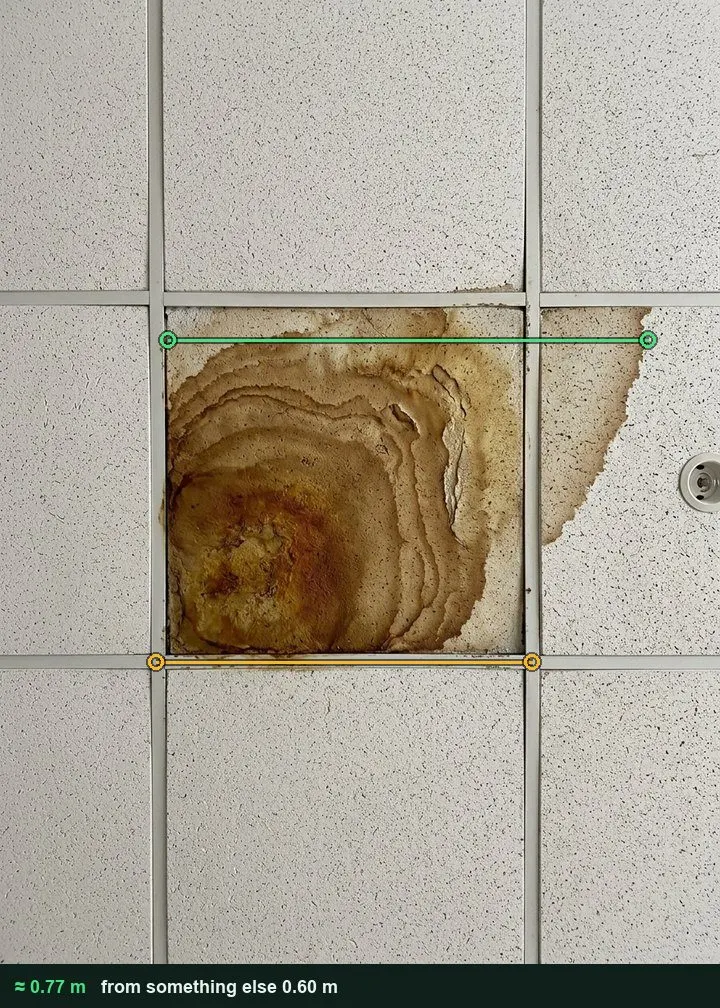
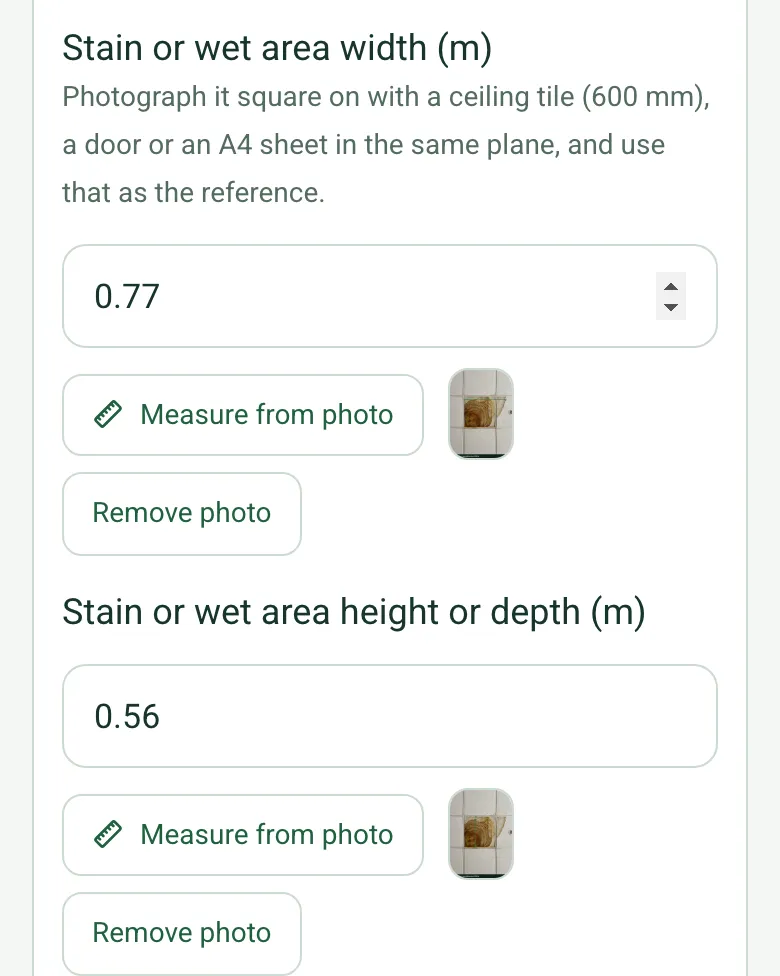
Stain width 0.77 m and depth 0.56 m, each with a measuring photo thumbnail, under guidance to photograph it square on with a ceiling tile, door or A4 sheet

The stain measured from a photo

Photograph the stain square on with a 600 mm ceiling tile, a door or an A4 sheet in the same plane, tap the reference, then the edges of the stain. The form works out the area, so the next visit can tell if it is spreading. It works on web forms in any phone browser today, and the app version is on its way.

How measuring from a photo works →
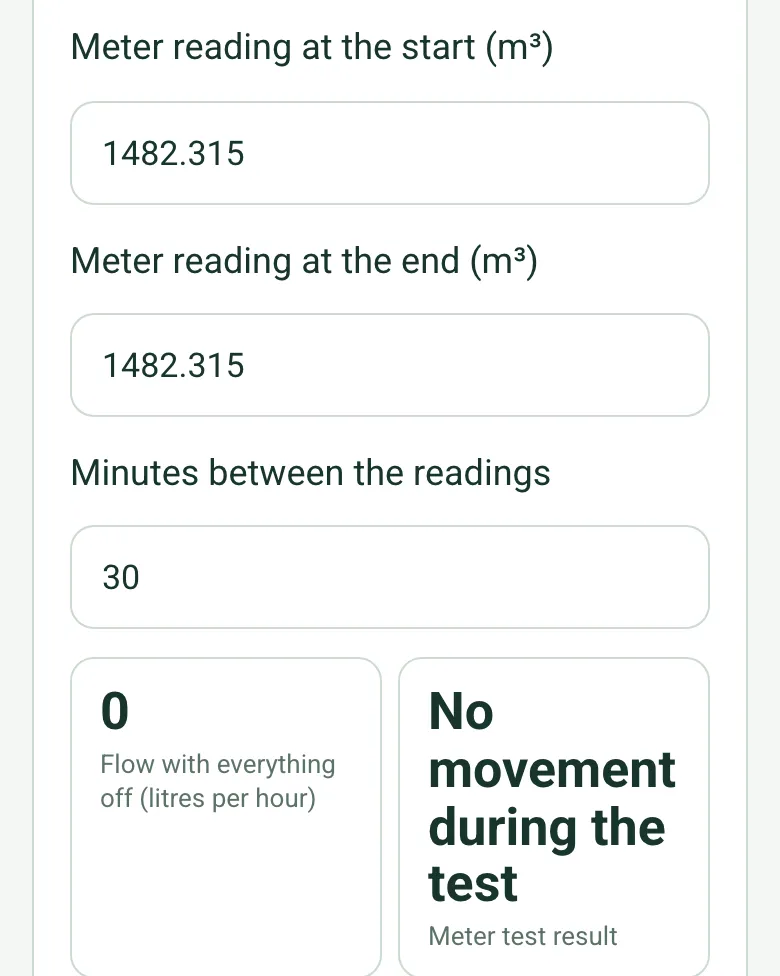
Meter readings 1482.315 at the start and end, 30 minutes apart, worked out as 0 litres per hour and No movement during the test

A meter test worked out

Read the meter with every tap, cistern and appliance off, wait, and read it again. The form works out the flow in litres per hour and says whether water is being used or lost after the meter.

How calculated fields work →
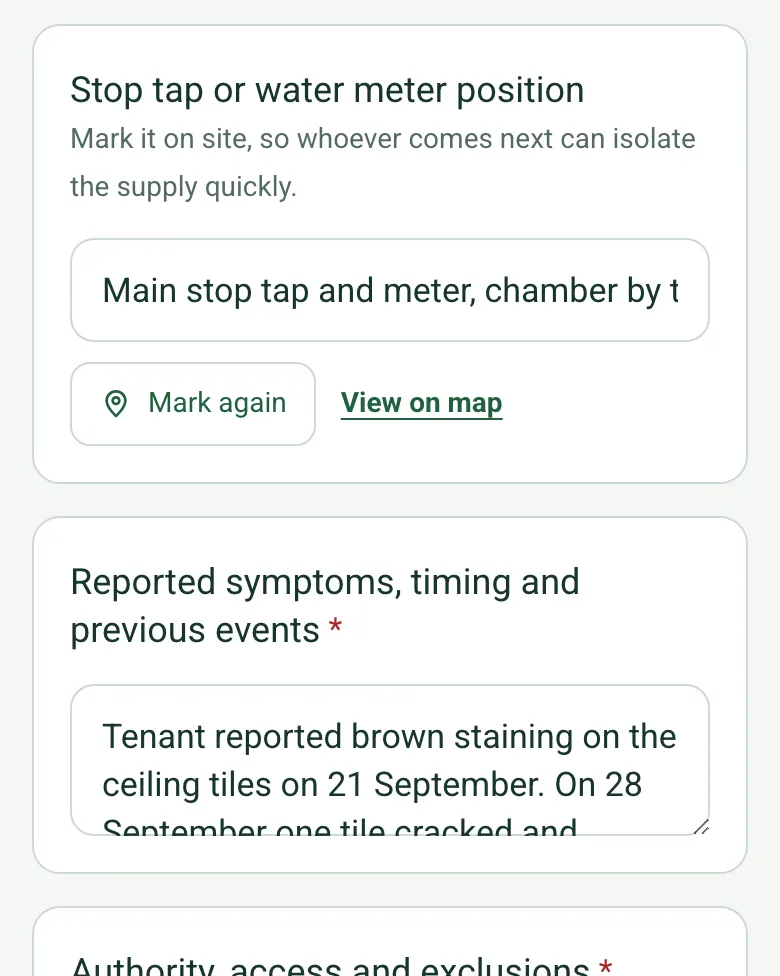
Stop tap or water meter position filled in as Main stop tap and meter, chamber by the car park, with Mark again and View on map

Pin the stop tap

Mark the stop tap or meter, and for a buried supply pipe the point where the leak was found, so the next person can isolate quickly and the dig starts in the right place. Mark current location works on web forms in any phone browser today, and the app version is on its way.

How GPS location works →
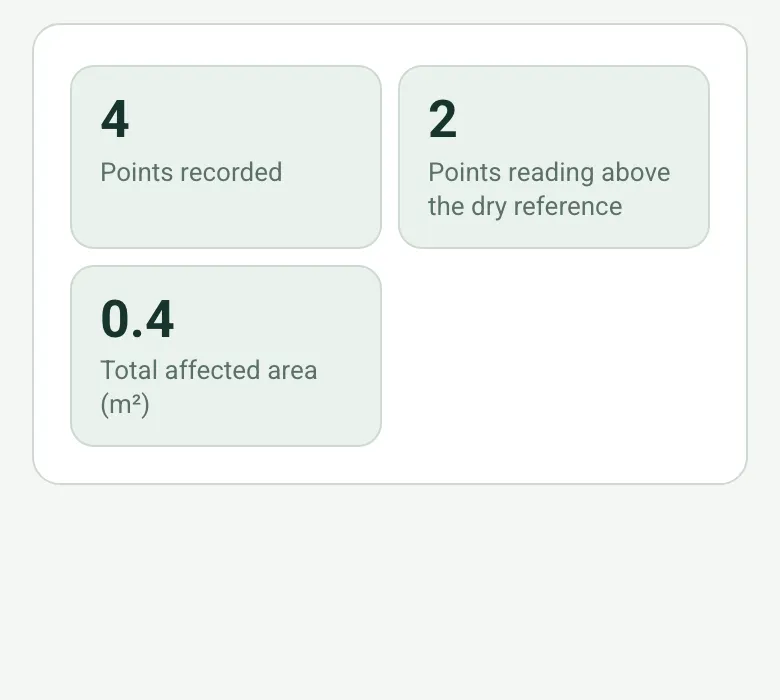
Counts worked out as 4 points recorded, 2 reading above the dry reference and 0.4 m² total affected area

Wet points and area counted

Each point takes a moisture reading and a reading at a dry reference with the same meter. The form counts the points above the reference and totals the affected area across the investigation.

How calculated fields work →

A completed leak investigation

Stained ceiling tiles in a fictional office: the stain measured at about 0.77 by 0.56 m, a soaked cupboard under the tea point above, the roof ruled out and a meter test showing no loss from the supply. Open it as a filled-in form, or switch to a blank copy and try it yourself.

A brown water stain across a ceiling tile and part of the next, measured from a photo at about 0.77 m wide against a 600 mm tile
Office 1.04 ceiling · about 0.77 x 0.56 m · reading 38 against 12 dry
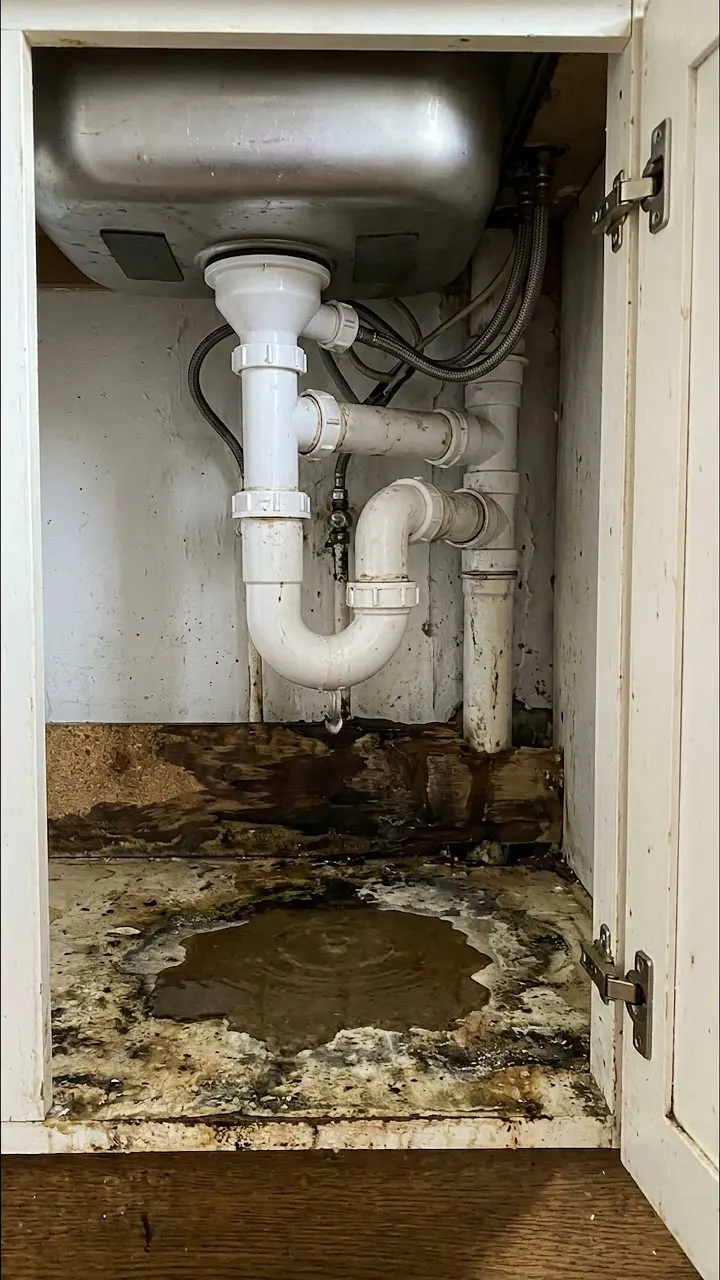
The cupboard under a tea point sink with water pooled on a stained, swollen base below the waste trap
Tea point sink trap above · the likely source
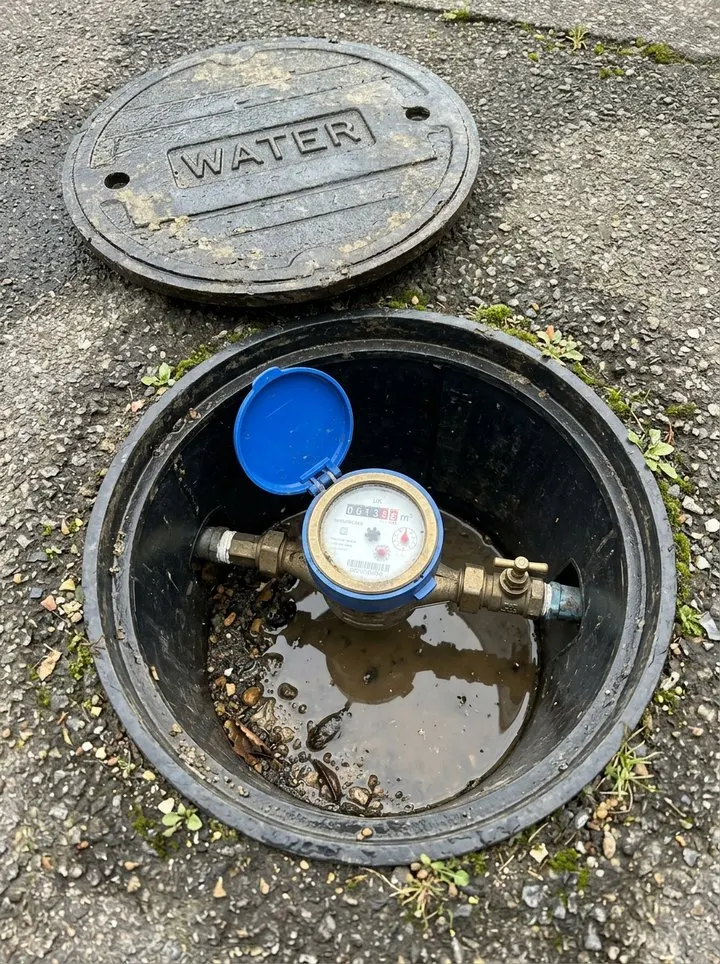
A water meter in a small chamber under a lifted cover marked WATER, with the dial and digits visible
Main meter · no movement in 30 minutes
Water dripping from a stained tile into a bucket

Try the water leak investigation form live

Answer a few questions and watch it adapt. Your answers are not saved, and any photos you add are deleted within the hour.

Live form: Water Leak InvestigationOpen full screen ↗
Fill it in right here

This is the real form as your team would use it: questions appear as you answer, scores work themselves out and you can add photos and signatures. No sign-up needed. Or open a completed example to see every answer, photo and score filled in.

Want to see one filled in? See a completed water leak investigation report (PDF), made by SiteSurvey from a fictional site visit.

Fill it in on a phone or tablet

Your team completes the water leak investigation on site in the SiteSurvey app on iPhone, iPad and Android phones and tablets. The project name and address fill in for them, it works without signal, and it syncs when the device is back online with photos kept against the question they answer.

Customers and subcontractors do not need the app: send them a link and they can fill it in from any browser.

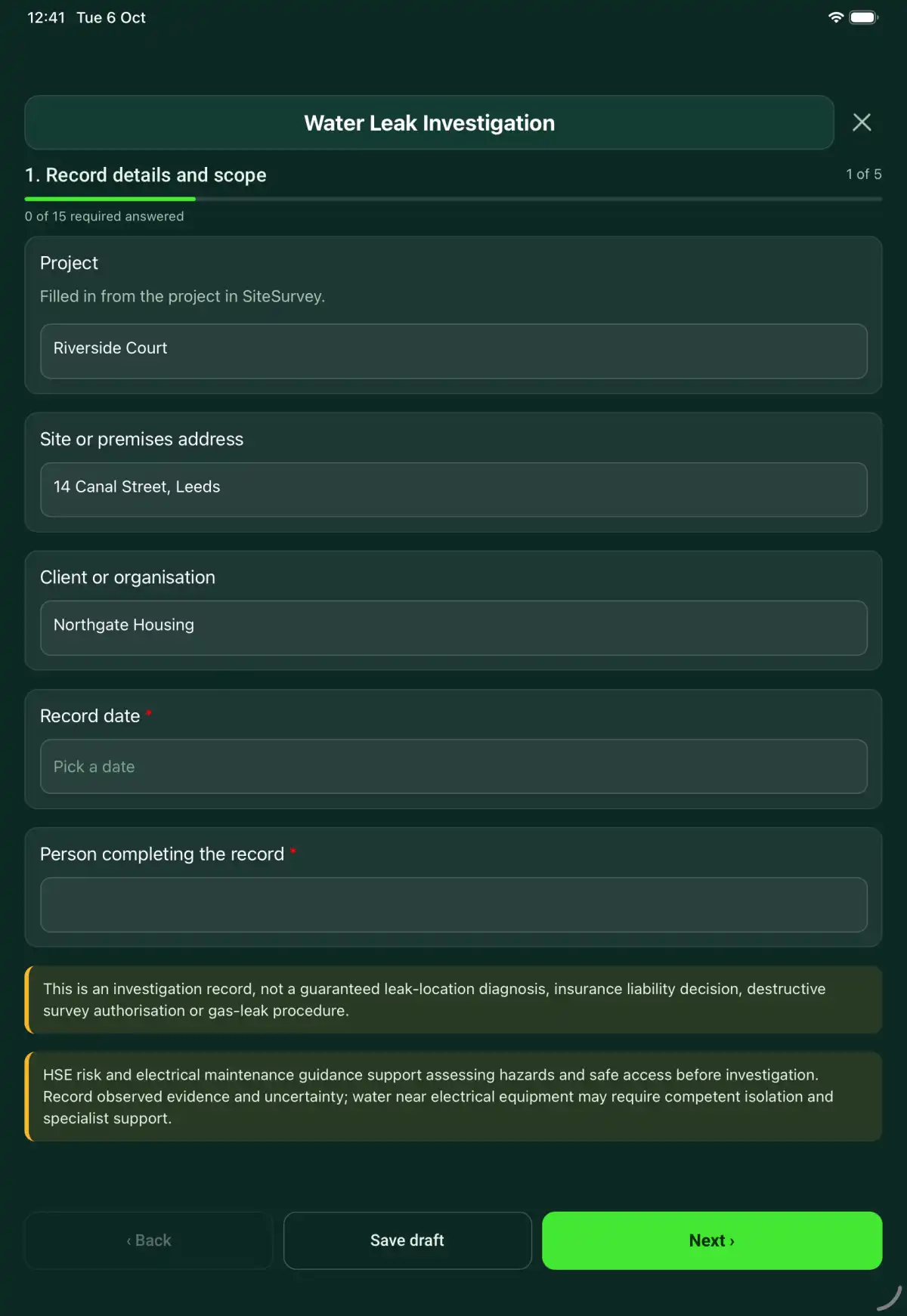
The Water Leak Investigation form in the SiteSurvey app on a tablet
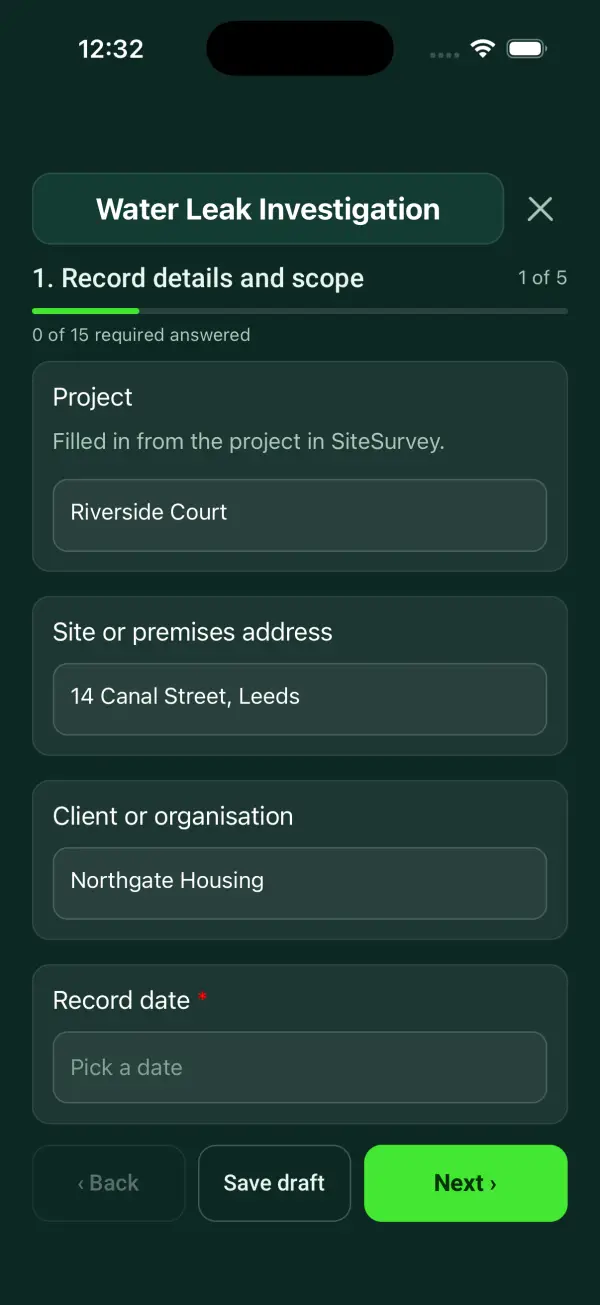
The Water Leak Investigation form in the SiteSurvey app on a phone

Every question in the water leak investigation template

A water leak investigation record linking reported symptoms, accessible observations, authorised test evidence, probable sources, uncertainty and next actions. 5 sections and 49 questions. Follow-up questions and guidance appear only when an answer calls for them, so the person on site never sees the ones that do not apply.

Make it your own: every question is editable

This is a starting point, not a fixed form. Once it is in your SiteSurvey account you can reword any question, add or remove questions, sections and answer options, and add your own logo, so it fits the way your team works and the jobs you do.

Details you only enter once

Add this form to a project in SiteSurvey and it fills in what the project already knows, so nobody on site retypes it and every form on the job uses the same names. Anything filled in can still be changed.

  • Project: the project name
  • Site or premises address: the site address, from the space or the project
  • Client or organisation: the project's customer

Record details and scope

  • ProjectShort answer

    Filled in from the project in SiteSurvey.

    Fills in from the project name
  • Site or premises addressShort answer
    Fills in from the site address, from the space or the project
  • Client or organisationShort answer
    Fills in from the project's customer
  • Record date*Date
  • Person completing the record*Short answer
  • Weather on siteAnswer

    Recent heavy rain points to roof or wall ingress rather than a pipe leak. Note it here.

  • CheckThis is an investigation record, not a guaranteed leak-location diagnosis, insurance liability decision, destructive survey authorisation or gas-leak procedure.
  • CheckHSE risk and electrical maintenance guidance support assessing hazards and safe access before investigation. Record observed evidence and uncertainty; water near electrical equipment may require competent isolation and specialist support.
  • GuidanceThe Water Supply (Water Fittings) Regulations 1999 (England and Wales) require water fittings to be installed and kept so they do not cause waste, misuse or contamination, so a leaking fitting must be repaired. As a rule, the water company owns the communication pipe up to the property boundary or the outside stop tap, and the property owner is responsible for the supply pipe from there into the building. Check the water company's own policy before telling the client who must repair an underground leak.

Reported problem

  • Property, room and affected area*Short answer
  • Stop tap or water meter positionShort answer

    Mark it on site, so whoever comes next can isolate the supply quickly.

  • Reported symptoms, timing and previous events*Notes
  • Authority, access and exclusions*Short answer
  • Electrical, access and contamination concerns*Notes

Evidence log

  • Meter reading at the start (m³)Number
  • Meter reading at the end (m³)Number
  • Minutes between the readingsNumber
  • Flow with everything off (litres per hour)Worked out by the form
    Shown only when the answers above make it relevant
  • Meter test resultWorked out by the form
    Shown only when the answers above make it relevant
  • Observation or test
    Repeat for each observation or test. Each one asks:
    • Location (room or area)*Short answer
    • Observation or authorised method*Short answer
    • Actual result and evidence reference*Notes
    • Occupancy or system conditions (for example heating on, taps running)Short answer
    • Moisture meter reading at this pointNumber
    • Reading at a dry reference area (same meter and mode)Number
    • Above the dry reference byWorked out by the form

      Moisture meters give comparative readings on most materials, so compare like with like.

      Shown when “Moisture meter reading at this point” is answered and “Reading at a dry reference area (same meter and mode)” is answered
    • Stain or wet area width (m)Number

      Photograph it square on with a ceiling tile (600 mm), a door or an A4 sheet in the same plane, and use that as the reference.

    • Stain or wet area height or depth (m)Number
    • Affected area (m²)Worked out by the form
      Shown only when the answers above make it relevant
    • Observation photographsPhotos
    • Walk Cam: this locationWalk Cam video with voice-to-text

      Optional. Film a guided walk-through on the SiteSurvey app.

  • Points recordedWorked out by the form
  • Points reading above the dry referenceWorked out by the form
  • Total affected area (m²)Worked out by the form

Interpretation

  • Possible source and reasoning*Notes
  • Suspected leak position (outside or buried pipes)Short answer

    For a buried supply pipe or a leak outside, mark the point found, so the excavation starts in the right place.

  • Alternative explanations and investigation limits*Notes

    Separate what was observed from possible causes. State what additional evidence would confirm or rule out each explanation.

  • Isolation or temporary protection referenceShort answer
  • Further specialist tests or repair recommendation*Notes

Actions and review

  • Are further actions required?*Choose one
    • Yes
    • No
  • Further action
    Repeat for each further action. Each one asks:
    Shown when “Are further actions required?” is “Yes”
    • Action and evidence reference*Notes
    • PriorityChoose one
      • Urgent
      • High
      • Medium
      • Low
    • Person responsible*Short answer
    • Target dateDate
    • Action status*Choose one
      • Open
      • In progress
      • Completed
    • Completion evidence*Notes
      Shown when “Action status” is “Completed”
  • Open actionsWorked out by the form

    Worked out from the actions above: open or in progress.

    Shown when “Are further actions required?” is “Yes”
  • Outstanding limitations and information to pass onNotes
  • Record status*Choose one
    • Ready for review
    • Further work needed
    • Work or use stopped
  • Reviewed byShort answer
  • Review dateDate
  • Author signature*Signature
  • CheckSigning records the information entered. It does not itself certify legal compliance, remove a limitation or authorise unsafe work.

Scope and responsibility

This is an investigation record, not a guaranteed leak-location diagnosis, insurance liability decision, destructive survey authorisation or gas-leak procedure.

What a useful entry looks like

Alternative explanations and investigation limits

Separate what was observed from possible causes. State what additional evidence would confirm or rule out each explanation.

Staining observed below the pipe route, but the source was not confirmed during the visit. Further access and testing are proposed for review.

Fictional example of record wording. Use the actual evidence and approved arrangements for your job; this is not a completed report or an instruction to carry out the work.

See it filled in

A completed water leak investigation report, made by SiteSurvey from a fictional site visit: every answer, the photos, the guidance that applied and the sign-off, ready to send as a PDF.

See completed form (PDF) ↗

Water Leak Investigation FAQs

How should I record “Alternative explanations and investigation limits”?

Separate what was observed from possible causes. State what additional evidence would confirm or rule out each explanation.

Can a damp patch prove the leak source?

No. Record the evidence, alternative explanations and further work needed.

Does this permit opening walls or roofs?

No. Record separate authority and safe arrangements before intrusive work.

Can it determine an insurance claim?

No. It records investigation evidence without deciding coverage or liability.

What are the limits of this template?

This is an investigation record, not a guaranteed leak-location diagnosis, insurance liability decision, destructive survey authorisation or gas-leak procedure.

Can I complete this form on site and share the record?

In the SiteSurvey app the form works offline, with photos and signatures recorded against the questions. Share the completed record as a PDF or a link. Dates and action owners are recorded fields; this form does not send reminders or update other systems.

Related

Use this water leak investigation form with your team

Add it from the form library in one click, change any question, and every completed form becomes a branded PDF report.

Start your trial →