Form library · Facilities and maintenance

Water tank inspection checklist

For people recording cold water storage tank inspections within a water-management plan. Pin the plant room with GPS, measure the tank (by tape, or from a photo with a measuring rod beside it) and the form works out the water stored and how many hours of use that is, flagging more than a day's storage. Enter the stored and incoming mains temperatures and it shows the rise and flags stored water at or above 20 °C. The visible checks needing action are counted, and the record ends with remedial work and review. Try the form below, see every question or open a completed example.

Ready to use from the form library, and every question is yours to edit. Try it for a small trial fee, cancel any time.

Try it on your phone

Try it on this phone

Fill in the cold water storage tank inspection on your phone now

See how the cold water storage tank inspection looks on your phone

Scan the code with your phone camera. It opens the real form, no sign-up needed.

Open the live example and fill it in, just as your team would on site. No sign-up needed.

See it on this phone

Every question is editable. Add this form to your account, then change the wording, add or remove questions and options, and make it fit your own jobs.

Or start your trial with this form ready →

One email, and we won't add you to a mailing list.

How does tank inspection fit water hygiene management?

HSE hot and cold water guidance includes inspection of cold-water storage tanks and remedial work where necessary. Inspection records support the site water-management arrangements; a visual check cannot demonstrate absence of legionella.

Last updated . Facts checked by the SiteSurvey team on 6 October 2026 against HSE hot and cold water systems and HSE hot and cold water technical guidance.

Built for inspecting cold water storage tanks

Inspect the tank from the hatch with the form on a phone. Pin the plant room, measure the tank and the water depth, and the form works out the litres stored and how many hours of use that is. Enter the stored and mains temperatures and it shows the rise and flags 20 °C or more. It records a visual inspection from safe access; it is not a cleaning certificate, a sampling result or a confined space entry authority.

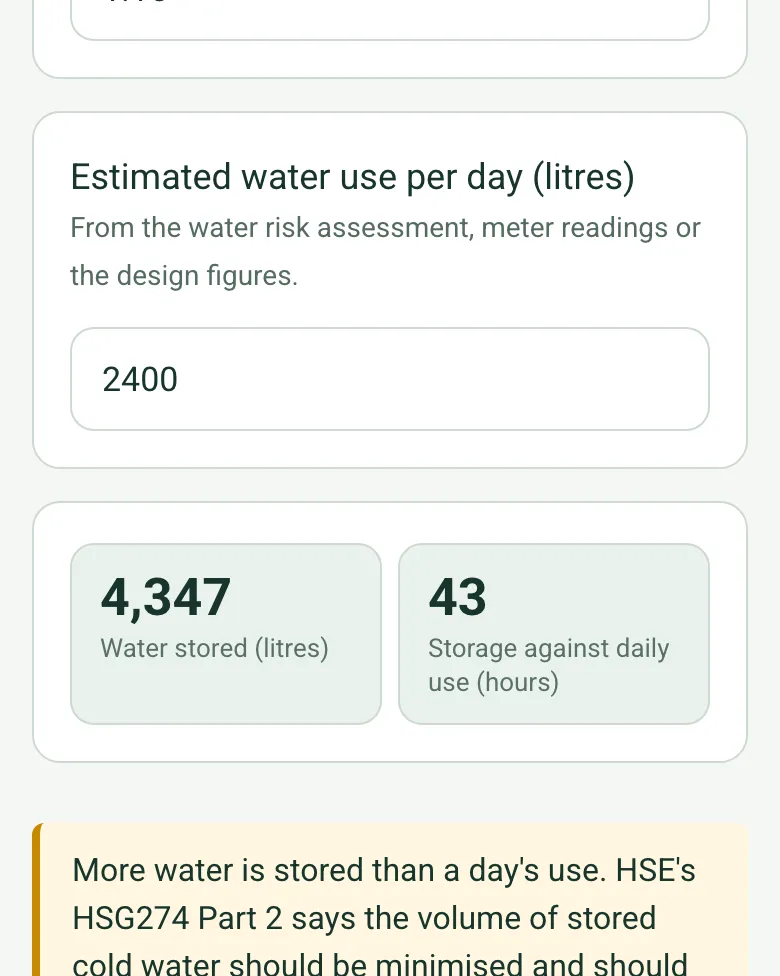
Estimated water use 2400 litres a day, water stored 4,347 litres, storage against daily use 43 hours, and an amber note that more water is stored than a day's use

Stored volume against a day's use

Enter the inside length, width and water depth, and the daily use from the water risk assessment. The form works out the litres stored and the hours of storage, and flags more than 24 hours: HSG274 Part 2 says stored cold water should not normally exceed one day's use.

How calculated fields work →
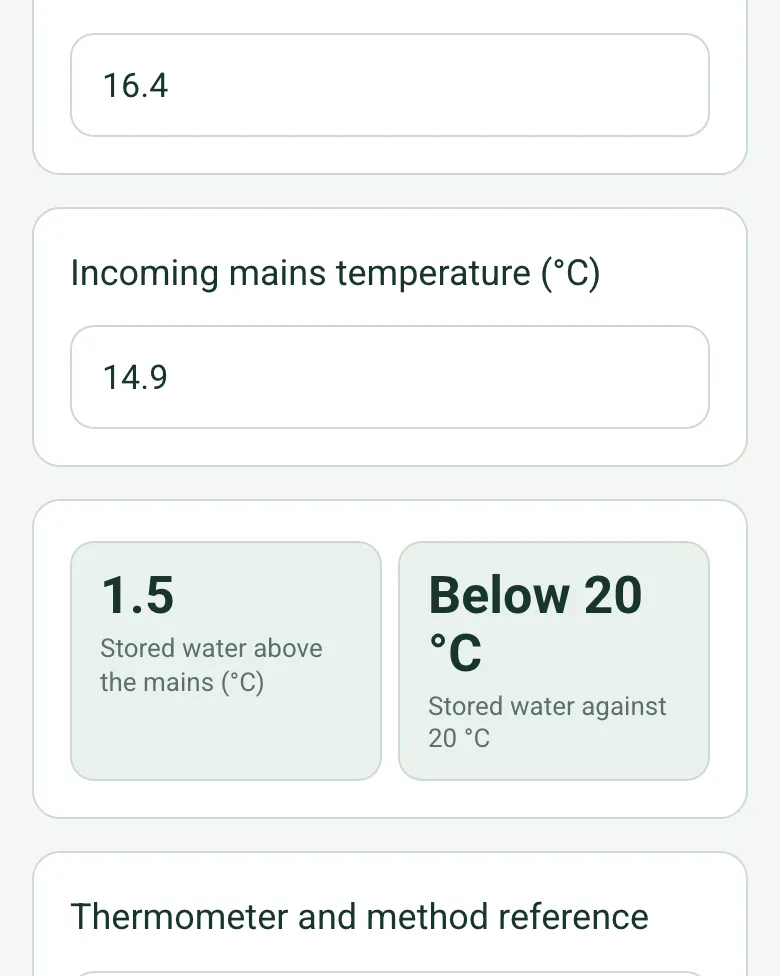
Stored water 16.4 °C, incoming mains 14.9 °C, stored water 1.5 °C above the mains and Below 20 °C

Temperatures against 20 °C

Record the stored water temperature away from the ball valve and the incoming mains temperature. The form shows the rise over the mains and flags stored water at or above 20 °C for the water risk assessment.

How calculated fields work →
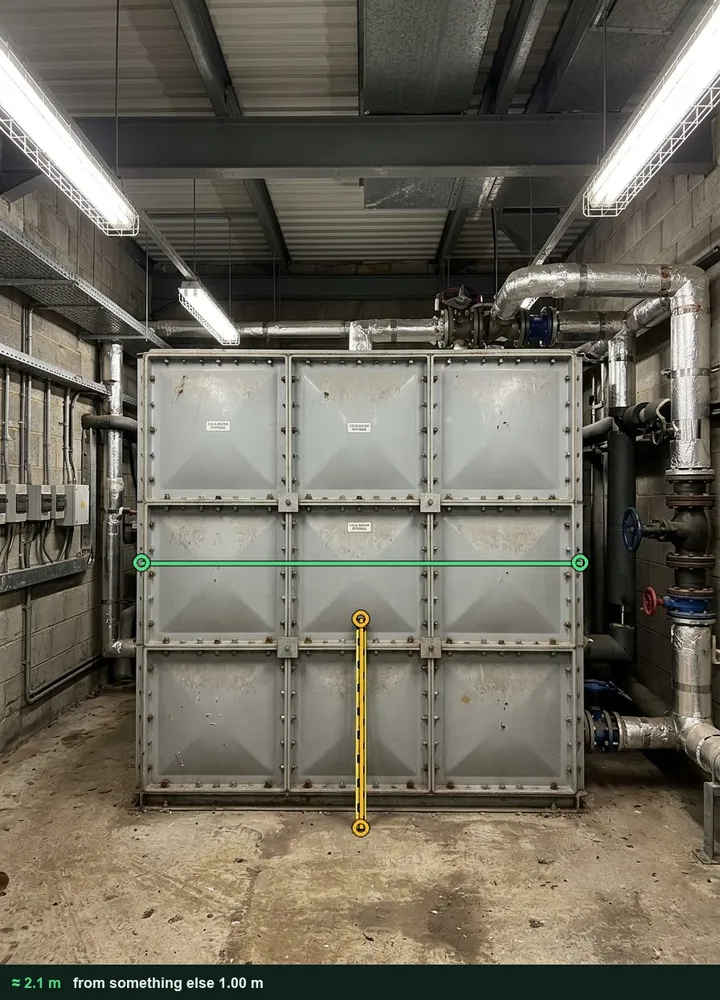
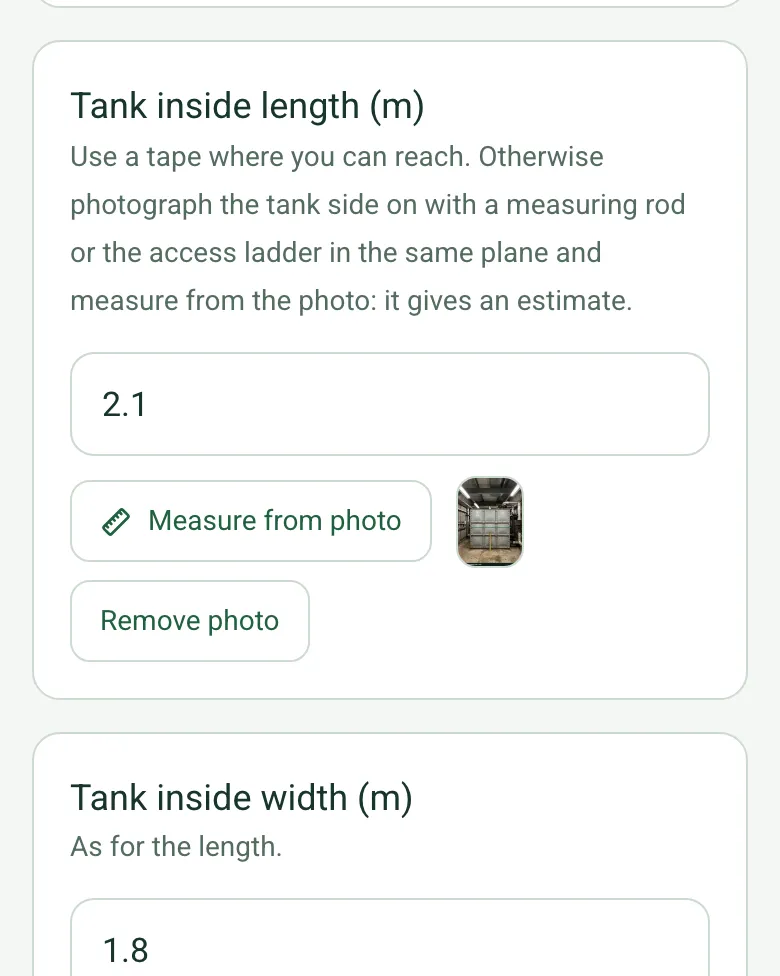
Tank inside length 2.1 m filled in by Measure from photo, with the marked-up photo kept under the answer

Tank size from a photo

Where the tank side cannot be reached with a tape, photograph it with a measuring rod in the same plane, tap the rod's ends, then the tank's. The value goes into the answer with the marked-up photo. It is an estimate. It works on web forms in any phone browser today, and the app version is on its way.

How measuring from a photo works →
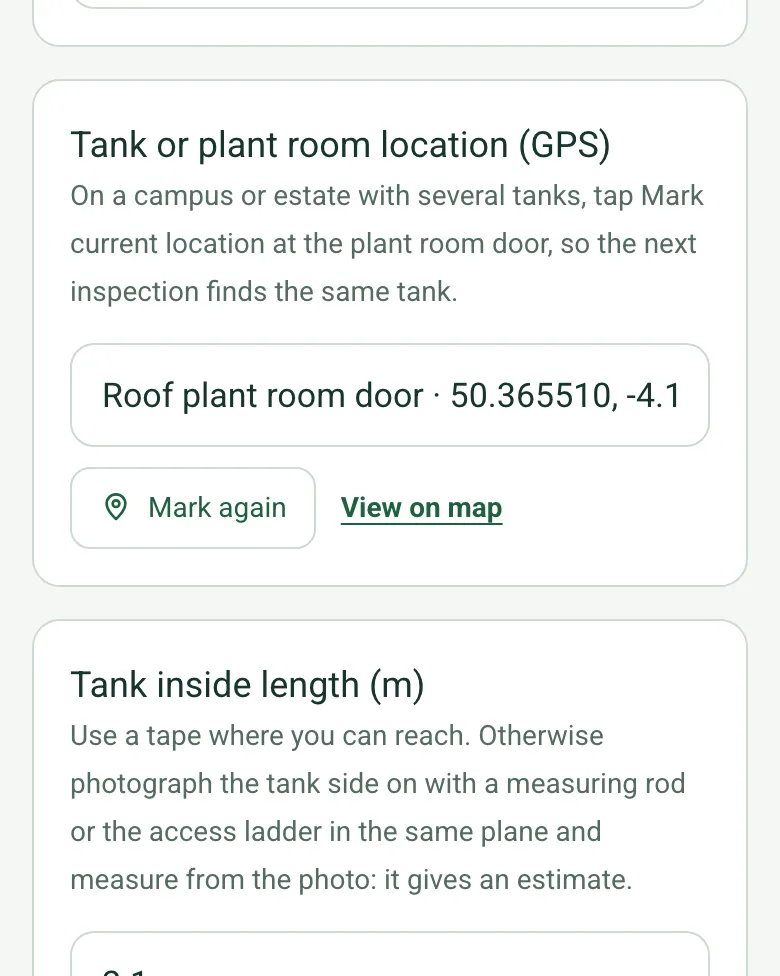
Tank or plant room location (GPS) filled in as Roof plant room door with coordinates, a grid reference and a View on map link

Pin the plant room

On a campus or estate with several tanks, mark the plant room door so the next inspection finds the same tank. Mark current location works on web forms in any phone browser today, and the app version is on its way.

How GPS location works →

A completed tank inspection

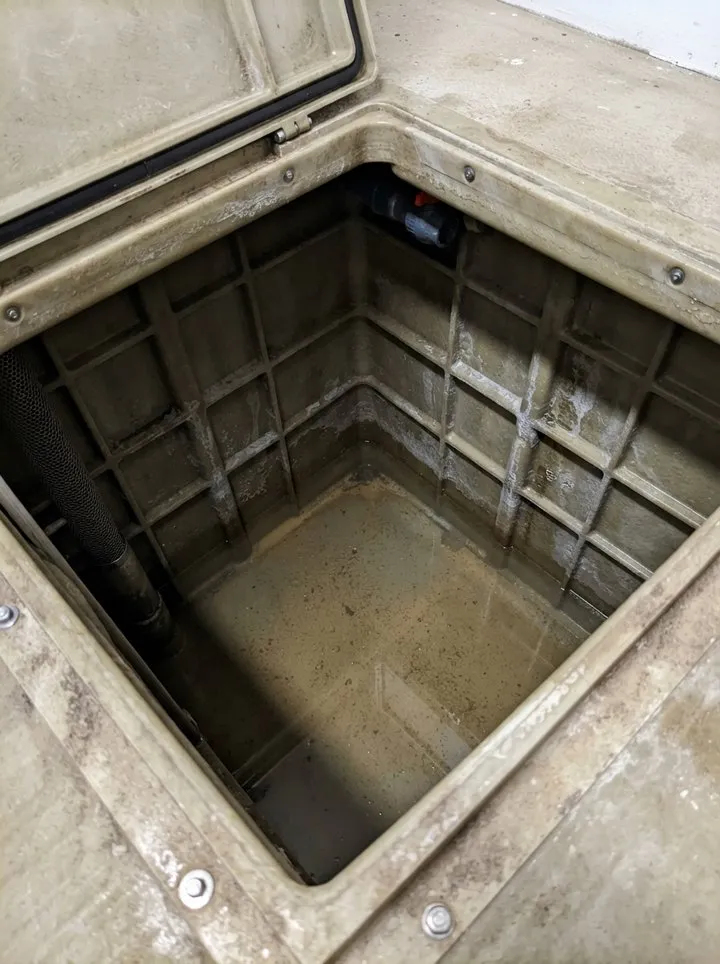
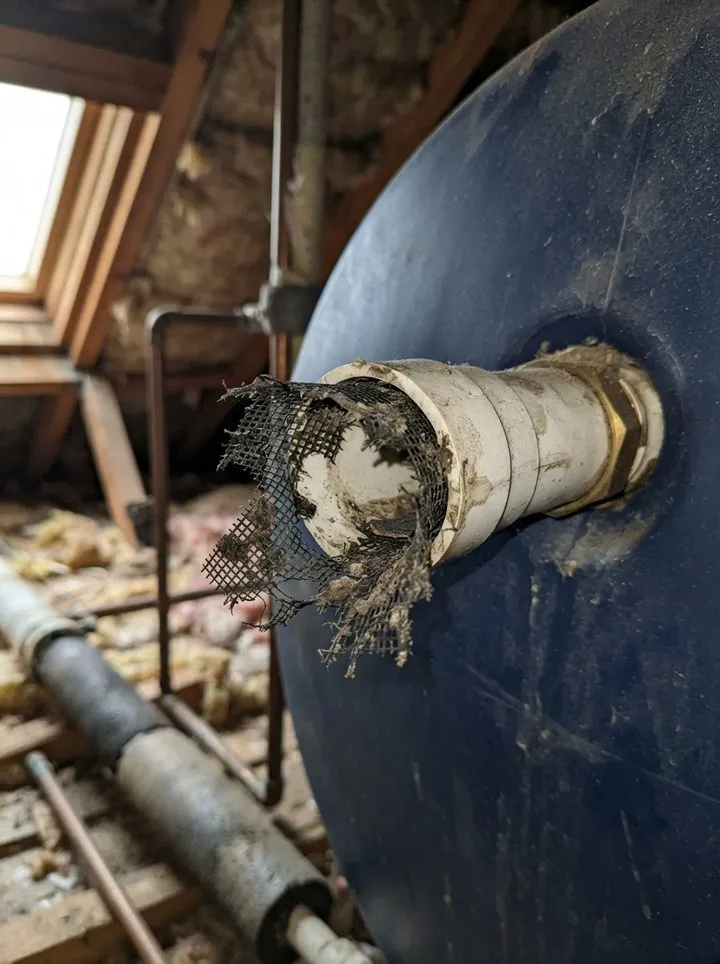
An annual inspection of a fictional office building's roof tank: torn overflow screen and sediment on the base referred for repair and cleaning, water at 16.4 °C, and about 43 hours of storage against current use, passed to the water risk assessment review. Open it as a filled-in form, or switch to a blank copy and try it yourself.

A grey sectional GRP tank in a plant room with a 1 m rod against it, marked up with a green line across the tank and an amber line on the rod
Tank length about 2.1 m from the 1 m rod
Light brown sediment on the base of a cold water tank seen through the access hatch
Sediment on the base · referred for clean and disinfection
A torn insect screen on a tank overflow pipe
Overflow screen torn · replaced
Along the tanks in a plant room

Try the cold water storage tank inspection form live

Answer a few questions and watch it adapt. Your answers are not saved, and any photos you add are deleted within the hour.

Live form: Cold Water Storage Tank InspectionOpen full screen ↗
Fill it in right here

This is the real form as your team would use it: questions appear as you answer, scores work themselves out and you can add photos and signatures. No sign-up needed. Or open a completed example to see every answer, photo and score filled in.

Want to see one filled in? See a completed cold water storage tank inspection report (PDF), made by SiteSurvey from a fictional site visit.

Fill it in on a phone or tablet

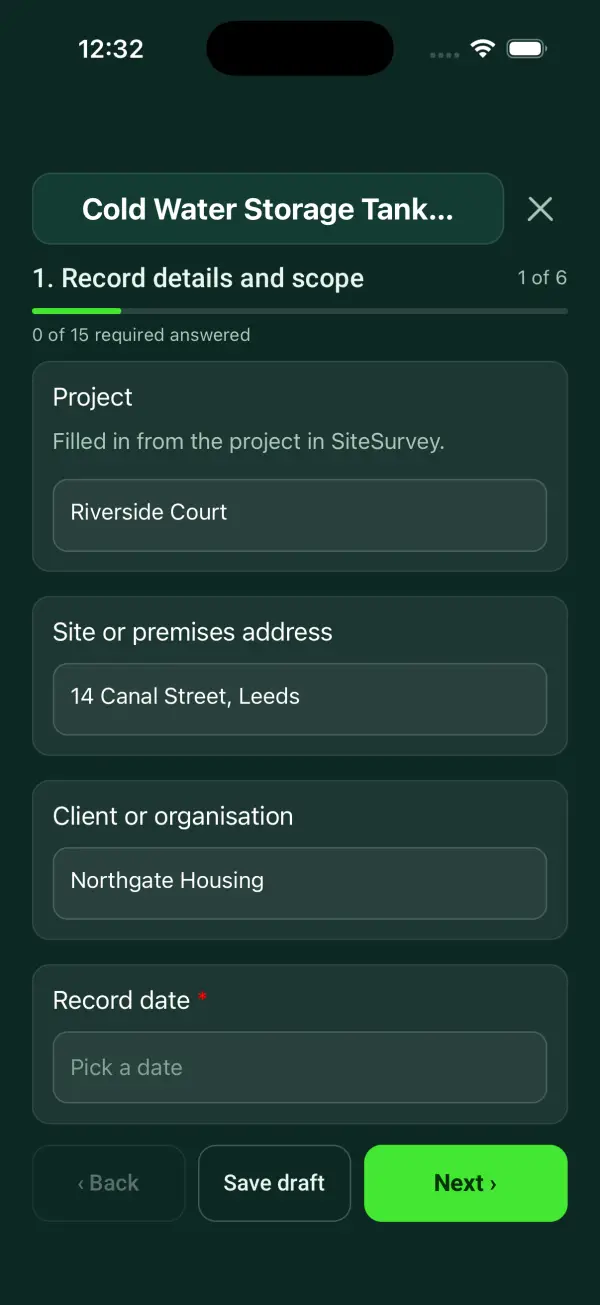
Your team completes the cold water storage tank inspection on site in the SiteSurvey app on iPhone, iPad and Android phones and tablets. The project name and address fill in for them, it works without signal, and it syncs when the device is back online with photos kept against the question they answer.

Customers and subcontractors do not need the app: send them a link and they can fill it in from any browser.

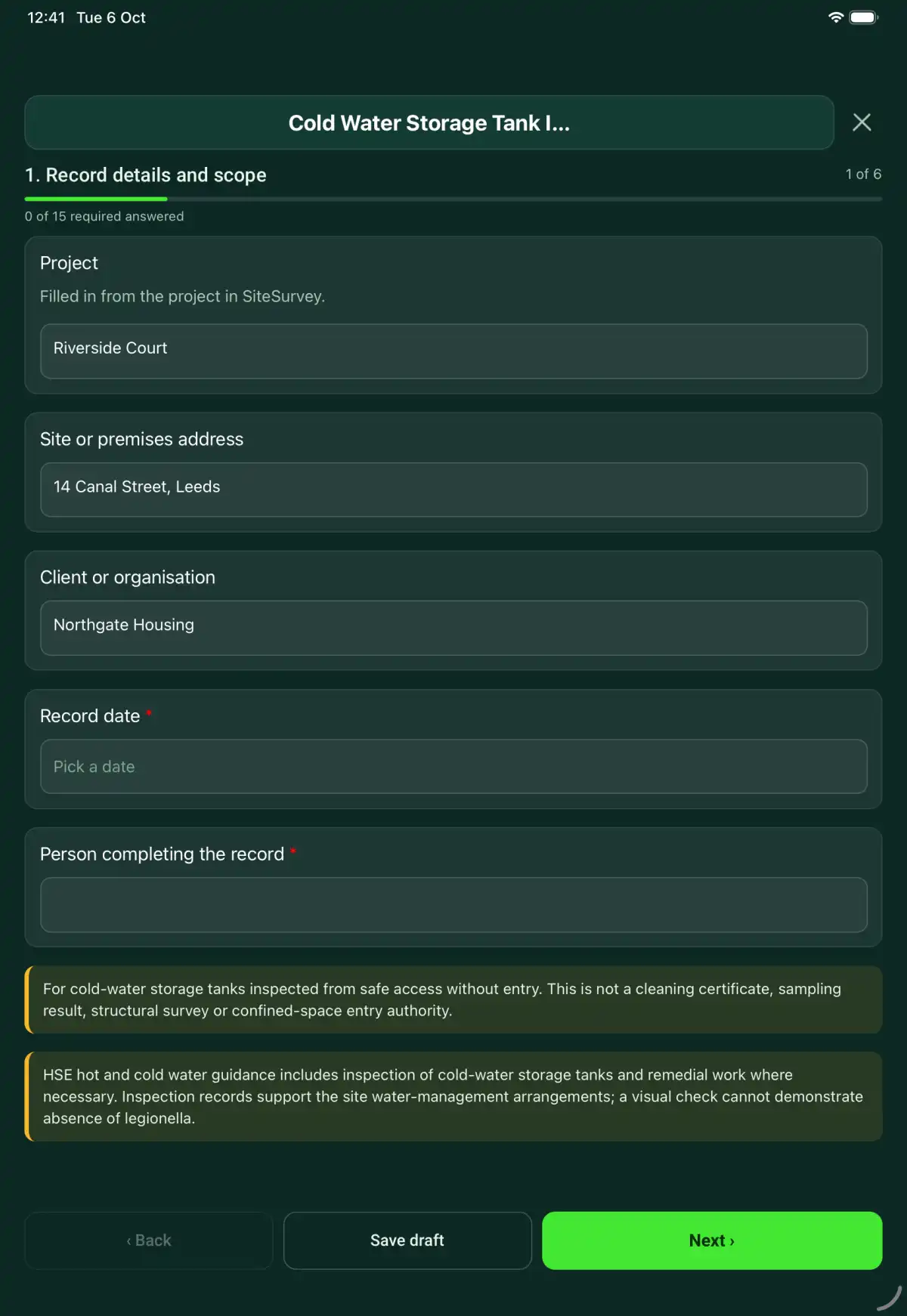
The Cold Water Storage Tank Inspection form in the SiteSurvey app on a tablet
The Cold Water Storage Tank Inspection form in the SiteSurvey app on a phone

Every question in the cold water storage tank inspection template

A cold water storage tank record covering tank identity, safe access, visible hygiene condition, monitoring references, defects and remedial follow-up. 6 sections and 53 questions. Follow-up questions and guidance appear only when an answer calls for them, so the person on site never sees the ones that do not apply.

Make it your own: every question is editable

This is a starting point, not a fixed form. Once it is in your SiteSurvey account you can reword any question, add or remove questions, sections and answer options, and add your own logo, so it fits the way your team works and the jobs you do.

Details you only enter once

Add this form to a project in SiteSurvey and it fills in what the project already knows, so nobody on site retypes it and every form on the job uses the same names. Anything filled in can still be changed.

  • Project: the project name
  • Site or premises address: the site address, from the space or the project
  • Client or organisation: the project's customer

Record details and scope

  • ProjectShort answer

    Filled in from the project in SiteSurvey.

    Fills in from the project name
  • Site or premises addressShort answer
    Fills in from the site address, from the space or the project
  • Client or organisationShort answer
    Fills in from the project's customer
  • Record date*Date
  • Person completing the record*Short answer
  • CheckFor cold-water storage tanks inspected from safe access without entry. This is not a cleaning certificate, sampling result, structural survey or confined-space entry authority.
  • CheckThe HSE Approved Code of Practice L8 (Legionnaires disease: the control of legionella bacteria in water systems, 4th edition) requires the duty holder to assess the legionella risk, put a written control scheme in place and keep records. HSG274 Part 2 (the control of legionella bacteria in hot and cold water systems) gives the technical guidance, including inspecting cold water storage tanks at least annually and carrying out remedial work where necessary. Inspection records support the site water management arrangements; a visual check cannot show that legionella is absent.

Tank and access

  • Tank ID, service and location*Short answer
  • Water risk assessment and schematic reference*Short answer
  • Safe access method and limits*Short answer
  • Nominal capacity and served areasShort answer
  • Tank or plant room location (GPS)Short answer

    On a campus or estate with several tanks, tap Mark current location at the plant room door, so the next inspection finds the same tank.

  • Tank inside length (m)Number

    Use a tape where you can reach. Otherwise photograph the tank side on with a measuring rod or the access ladder in the same plane and measure from the photo: it gives an estimate.

  • Tank inside width (m)Number

    As for the length.

  • Water depth at the working level (m)Number

    From the hatch with a dip tape or rule, without entering the tank.

  • Estimated water use per day (litres)Number

    From the water risk assessment, meter readings or the design figures.

  • Water stored (litres)Worked out by the form
  • Storage against daily use (hours)Worked out by the form
  • CheckMore water is stored than a day's use. HSE's HSG274 Part 2 says the volume of stored cold water should be minimised and should not normally exceed what is needed for one day's water use (in healthcare premises, a nominal 12 hours). Refer it to the person responsible for the water risk assessment.
    Shown only when the answers above make it relevant

Visible checks

  • Lid, vent and overflow protection checked*Choose one
    • Acceptable
    • Action needed
    • Not checked
    • Not applicable
  • Action, limitation or reason not applicable*Notes
    Shown only when the answers above make it relevant
  • Visible internal condition and deposits recorded without entry*Choose one
    • Acceptable
    • Action needed
    • Not checked
    • Not applicable
  • Action, limitation or reason not applicable*Notes
    Shown only when the answers above make it relevant
  • Insulation and external condition checked*Choose one
    • Acceptable
    • Action needed
    • Not checked
    • Not applicable
  • Action, limitation or reason not applicable*Notes
    Shown only when the answers above make it relevant
  • Inlets, outlets and stagnation concerns recorded*Choose one
    • Acceptable
    • Action needed
    • Not checked
    • Not applicable
  • Action, limitation or reason not applicable*Notes
    Shown only when the answers above make it relevant
  • Leaks and nearby contamination sources checked*Choose one
    • Acceptable
    • Action needed
    • Not checked
    • Not applicable
  • Action, limitation or reason not applicable*Notes
    Shown only when the answers above make it relevant
  • Checks needing actionWorked out by the form
  • Checks not doneWorked out by the form

Evidence and remedial work

  • Stored water temperature (°C)Number

    Taken remote from the ball valve, as HSG274 Part 2 describes. Use the maximum from a fixed max/min thermometer where one is fitted.

  • Incoming mains temperature (°C)Number
  • Stored water above the mains (°C)Worked out by the form
    Shown when “Stored water temperature (°C)” is answered and “Incoming mains temperature (°C)” is answered
  • Stored water against 20 °CWorked out by the form
    Shown when “Stored water temperature (°C)” is answered
  • CheckStored water at or above 20 °C. HSG274 Part 2 says cold water systems should be kept, where possible, below 20 °C. Record the likely cause, such as heat gain in the plant room or low turnover, and refer it to the person responsible for the water risk assessment.
    Shown only when the answers above make it relevant
  • Thermometer and method referenceShort answer
  • Separate sampling or cleaning report referenceShort answer
  • Condition photographsPhotos
  • Areas not visible and further investigation*Notes

    Record the viewing and access limits and any evidence not obtained. A visual check alone cannot establish water quality.

Handover

  • Use decision*Choose one
    • Available within recorded limits
    • Restricted use
    • Out of service
  • Restrictions, isolation and person informed*Notes
    Shown only when the answers above make it relevant
  • Repair or follow-up job referenceShort answer

Actions and review

  • Are further actions required?*Choose one
    • Yes
    • No
  • Further action
    Repeat for each further action. Each one asks:
    Shown when “Are further actions required?” is “Yes”
    • Action and evidence reference*Notes
    • PriorityChoose one
      • Urgent
      • High
      • Medium
      • Low
    • Person responsible*Short answer
    • Target dateDate
    • Action status*Choose one
      • Open
      • In progress
      • Completed
    • Completion evidence*Notes
      Shown when “Action status” is “Completed”
  • Outstanding limitations and information to pass onNotes
  • Record status*Choose one
    • Ready for review
    • Further work needed
    • Work or use stopped
  • Reviewed byShort answer
  • Review dateDate
  • Next tank inspection dueDate

    HSG274 Part 2 says cold water storage tanks should be inspected at least annually. The water risk assessment may set a shorter interval.

  • Days to next inspectionWorked out by the form
    Shown when “Record date” is answered and “Next tank inspection due” is answered
  • CheckThe next due date is before the date of this record. Check the date entered.
    Shown only when the answers above make it relevant
  • Author signature*Signature
  • CheckSigning records the information entered. It does not itself certify legal compliance, remove a limitation or authorise unsafe work.

Scope and responsibility

For cold-water storage tanks inspected from safe access without entry. This is not a cleaning certificate, sampling result, structural survey or confined-space entry authority.

What a useful entry looks like

Areas not visible and further investigation

Record the viewing and access limits and any evidence not obtained. A visual check alone cannot establish water quality.

Inspection completed from the authorised viewing position. Internal concealed areas were not observed and no sample result is claimed in this record.

Fictional example of record wording. Use the actual evidence and approved arrangements for your job; this is not a completed report or an instruction to carry out the work.

See it filled in

A completed cold water storage tank inspection report, made by SiteSurvey from a fictional site visit: every answer, the photos, the guidance that applied and the sign-off, ready to send as a PDF.

See completed form (PDF) ↗

Cold Water Storage Tank Inspection FAQs

How should I record “Areas not visible and further investigation”?

Record the viewing and access limits and any evidence not obtained. A visual check alone cannot establish water quality.

Can I enter the tank to inspect it?

This form provides no entry authority or rescue arrangements. Record the access limitation and refer the work.

What temperature should a cold water tank be?

HSG274 Part 2 says cold water systems should be kept, where possible, below 20 °C, and asks for the stored water temperature remote from the ball valve and the incoming mains temperature. The form shows the rise over the mains and flags 20 °C or more. Clear, cool water still does not prove the water is free of legionella.

Does the form work out how much water is stored?

Yes. Enter the inside length and width and the water depth, and it calculates the litres stored and, against your estimated daily use, the hours of storage. HSG274 Part 2 says stored cold water should not normally exceed one day's use, so the form flags more than 24 hours.

What are the limits of this template?

For cold-water storage tanks inspected from safe access without entry. This is not a cleaning certificate, sampling result, structural survey or confined-space entry authority.

Can I complete this form on site and share the record?

In the SiteSurvey app the form works offline, with photos and signatures recorded against the questions. Share the completed record as a PDF or a link. Dates and action owners are recorded fields; this form does not send reminders or update other systems.

Related

Use this cold water storage tank inspection form with your team

Add it from the form library in one click, change any question, and every completed form becomes a branded PDF report.

Start your trial →