Solar panel installation certificate and commissioning record
A commissioning record for a solar PV system. Record the panels and inverter, and the form works out the array size in kWp. Add each string with its open-circuit voltage against the expected value, short-circuit current, insulation resistance and polarity: the form checks Voc against the tolerance you work to, insulation against your minimum and the panels in the strings against the panel count. Pin the array by GPS, check the isolators and labels, and record the G98 or G99 route, the DNO date, the MCS certificate number and what was handed over. The form is the installer's record; the MCS certificate itself comes from MCS. Try the form below, see every question or open a completed example.
✎Every question is editable. Add this form to your account, then change the wording, add or remove questions and options, and make it fit your own jobs.
What certificate do you get when solar panels are installed?
A home solar PV installation by an MCS certified installer comes with an MCS certificate, alongside the electrical installation certificate, the manuals and warranties and a generation estimate. MCS says an installation must be MCS certified to be eligible for the Smart Export Guarantee. Behind the certificate, the installer records the string tests, isolation and labelling, and notifies the DNO under G98 or applies under G99.
Fill the record in as you test each string. Enter the measured Voc and the expected value, and the form checks it against the tolerance you work to, compares the insulation resistance with your minimum and checks that the panels in the strings match the panel count. It records the commissioning and the MCS certificate number; it is not the MCS certificate or an electrical installation certificate.
Voc against the expected value
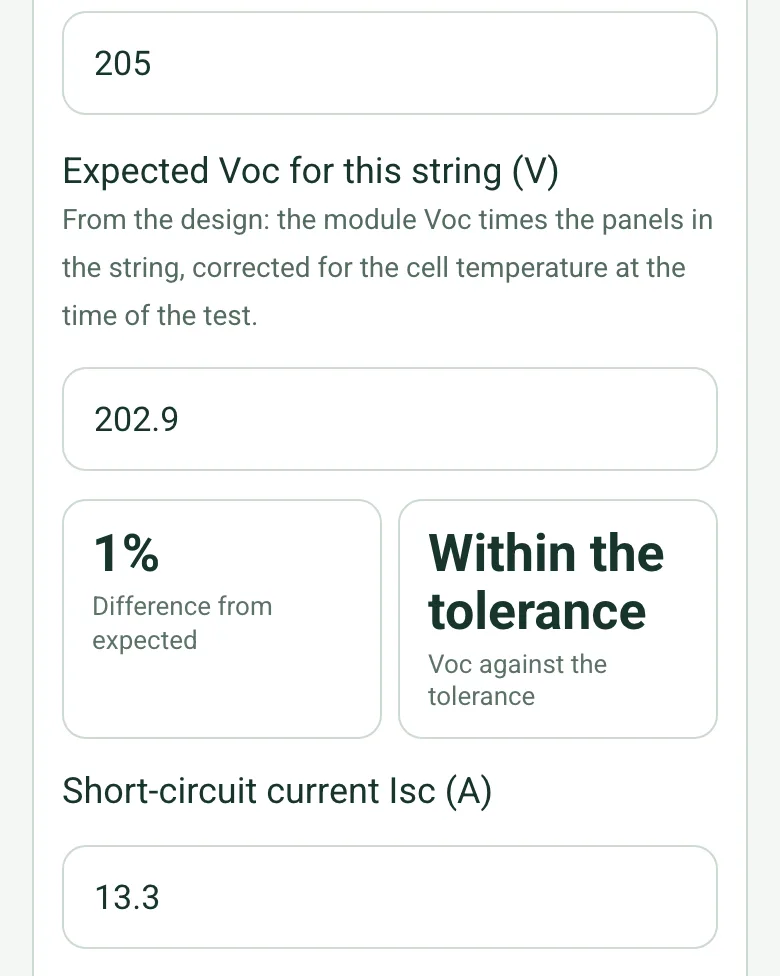
Enter the expected Voc from the design, corrected for the cell temperature, and the measured value. The form works out the difference in percent and checks it against the tolerance you set at the top, and checks the insulation resistance against your stated minimum.
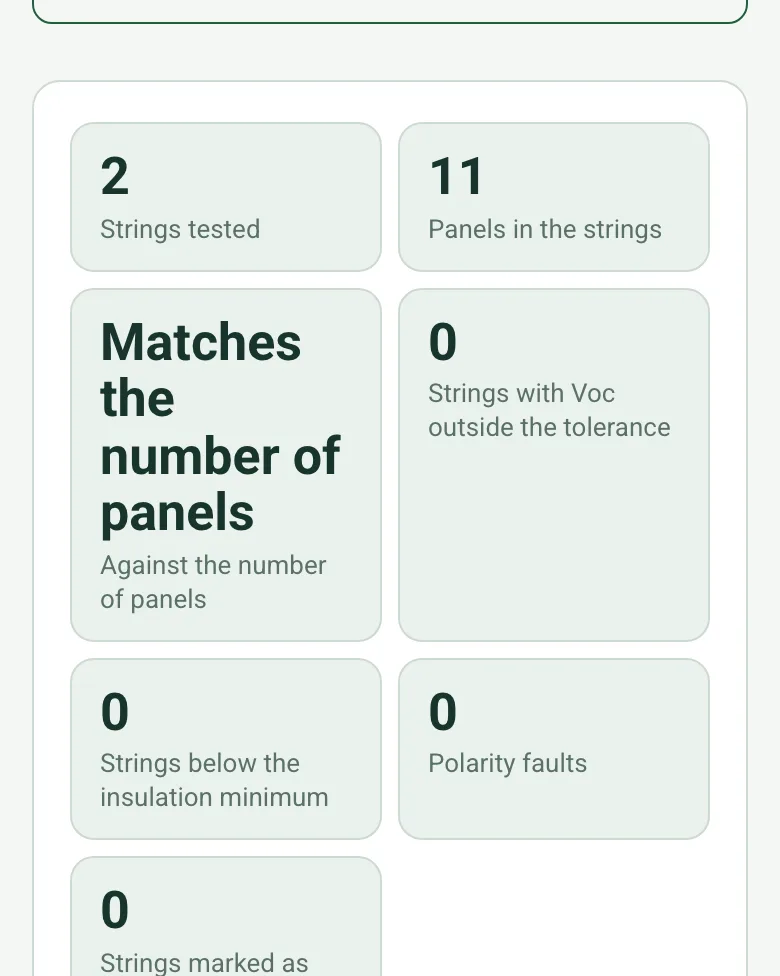
The form counts the strings, adds up the panels in them against the panel count on page 1, and counts any outside the Voc tolerance, below the insulation minimum or with a polarity fault. Any of them shows a red note to retest before handover.
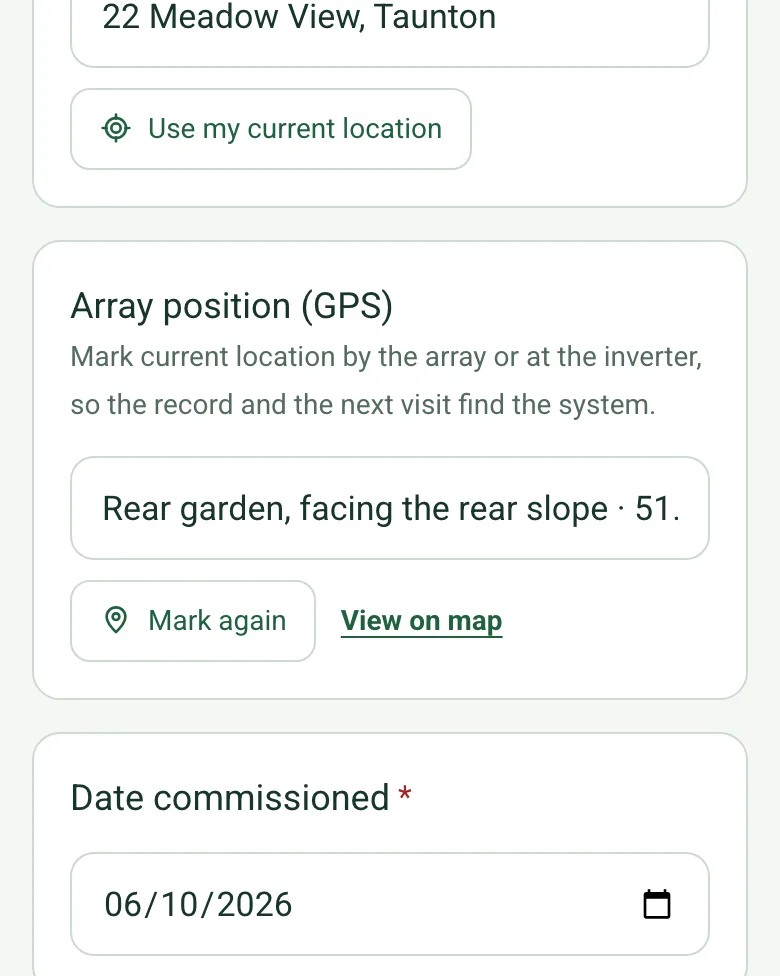
Mark current location by the array or the inverter, so the record and the next service visit find the system. Mark current location works on web forms in any phone browser today, and the app version is on its way.
A fictional 4.8 kWp system on a house: two strings on the rear slope, both within 5% of the expected Voc and at 50 MΩ, notified under G98 three days after commissioning. Open it as a filled-in form, or switch to a blank copy and try it yourself.
This is the real form as your team would use it: questions appear as you answer, scores work themselves out and you can add photos and signatures. No sign-up needed. Or open a completed example to see every answer, photo and score filled in.
Every question in the solar PV commissioning template
A solar PV commissioning record: panels, inverter, string tests (Voc, Isc, insulation resistance, polarity), isolators and labels, the G98 or G99 route, MCS certificate, generation meter and handover. 4 sections and 66 questions. Follow-up questions and guidance appear only when an answer calls for them, so the person on site never sees the ones that do not apply.
✎
Make it your own: every question is editable
This is a starting point, not a fixed form. Once it is in your SiteSurvey account you can reword any question, add or remove questions, sections and answer options, and add your own logo, so it fits the way your team works and the jobs you do.
Details you only enter once
Add this form to a project in SiteSurvey and it fills in what the project already knows, so nobody on site retypes it and every form on the job uses the same names. Anything filled in can still be changed.
Project: the project name
Client: the project's customer
Site: the site, when the form is opened for a space or a product
Site address: the site address, from the space or the project
1
System
ProjectShort answer
Fills in from the project name
ClientShort answer
Fills in from the project's customer
Site*Short answer
Fills in from the site, when the form is opened for a space or a product
Site addressShort answer
Fills in from the site address, from the space or the project
Array position (GPS)Short answer
Mark current location by the array or at the inverter, so the record and the next visit find the system.
Date commissioned*Date
Time commissionedTime
Installer and MCS certification number*Short answer
Electrical competence (for example competent person scheme)Short answer
Weather on siteAnswer
Cloud and low sun lower Isc and output readings. Note it here.
Panel make and model*Short answer
Number of panelsNumber
Panel rating (Wp)Number
Array size (kWp)Worked out by the form
Shown only when the answers above make it relevant
Inverter make and model*Short answer
Scan the inverter labelScan a label: serial number, model number
Optional. Scan the label or tag to capture its numbers.
Inverter AC rating (kW)Number
SupplyChoose one
Single-phase
Three-phase
Is a battery installed with it?Yes or No
2
String tests
Voc tolerance you are working to (±%)Number
From your commissioning procedure. The form compares each string's Voc with the expected value within this tolerance.
Minimum insulation resistance you are working to (MΩ)Number
From your test procedure, for the system voltage and test voltage used.
Strings tested
Repeat for each string. Each one asks:
String reference*Short answer
Panels in the stringNumber
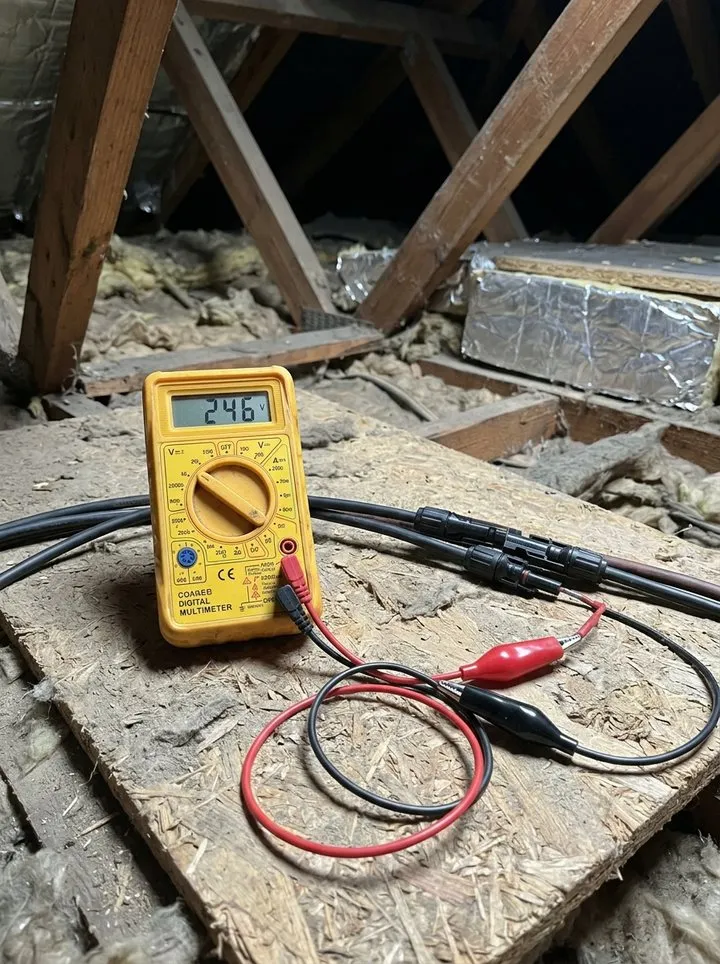
Open-circuit voltage Voc (V)Number
Expected Voc for this string (V)Number
From the design: the module Voc times the panels in the string, corrected for the cell temperature at the time of the test.
Difference from expected (%)Worked out by the form
Shown only when the answers above make it relevant
Voc against the toleranceWorked out by the form
Shown only when the answers above make it relevant
Short-circuit current Isc (A)Number
Insulation resistance (MΩ)Number
Insulation resistance against the minimumWorked out by the form
Shown only when the answers above make it relevant
PolarityChoose one
Correct
Fault
Result*Choose one
Pass
Fail
NotesNotes
Shown only when the answers above make it relevant
Strings testedWorked out by the form
Panels in the stringsWorked out by the form
Against the number of panelsWorked out by the form
Shown only when the answers above make it relevant
Strings with Voc outside the toleranceWorked out by the form
Strings below the insulation minimumWorked out by the form
Polarity faultsWorked out by the form
Strings marked as failedWorked out by the form
WarningA string is outside the Voc tolerance, below the insulation minimum or has a polarity fault. Find the cause and retest before the system is energised and handed over.
Shown only when the answers above make it relevant
GuidanceString tests follow BS EN 62446-1 (grid-connected PV: documentation, commissioning tests and inspection): continuity of protective conductors, polarity, open-circuit voltage (Voc), short-circuit current (Isc) and insulation resistance of each string. The installation itself must meet BS 7671 Section 712 (solar photovoltaic power supply systems). Compare each reading against the expected value from the design and the manufacturer data, not a general figure.
DC and AC isolators fitted and labelled?Yes or No
Warning labels fitted at the meter, consumer unit and inverter?Yes or No
Generation meter reading at commissioningShort answer
Monitoring app set up for the customer?Yes or No
3
DNO and MCS
Connection routeChoose one
G98: notify after commissioning
G99: approved before installation
GuidanceMCS guidance: where G98 applies and the system is under 16 A per phase, notify the DNO within 28 days of commissioning (G98 Form B). Where G99 applies, above 16 A per phase, permission to connect is needed before installation.
WarningOver 3.68 kW with a battery. MCS says the application (Form A1-1, or Form A1-2 for a fully type-tested integrated system) must go to the DNO before installation.
Shown only when the answers above make it relevant
Date the DNO was notified or approvedDate
Days from commissioning to notificationWorked out by the form
Shown only when the answers above make it relevant
WarningMore than 28 days after commissioning.
Shown only when the answers above make it relevant
WarningThe approval date is after the commissioning date. G99 approval is needed before installation.
Shown only when the answers above make it relevant
MCS certificate numberShort answer
Date the MCS certificate was createdDate
GuidanceMCS sets a deadline for creating the MCS certificate after the commissioning date, and the period has changed over time. Check the current MCS installer scheme documents (MCS 001 and MIS 3002) or the MCS Installation Database for the deadline that applies to this job.
WarningMore than 14 days after commissioning. Check this against the current MCS deadline.
Shown only when the answers above make it relevant
GuidanceMCS: to be paid under the Smart Export Guarantee, the installation must be MCS certified and have a smart meter that records exported electricity.
4
Handover
CheckThis is a site commissioning record. It supports the MCS certificate and the Electrical Installation Certificate, but it is not either certificate. Issue those separately.
Are there defects or actions to record?Yes or No
Defects and actions
Repeat for each entry. Each one asks:
Shown when “Are there defects or actions to record?” is Yes
Defect or action*Notes
PriorityChoose one
Urgent
High
Medium
Low
OwnerShort answer
DueDate
StatusChoose one
Open
In progress
Completed
PhotosPhotos
Actions still openWorked out by the form
Shown when “Are there defects or actions to record?” is Yes
Urgent actionsWorked out by the form
Shown when “Are there defects or actions to record?” is Yes
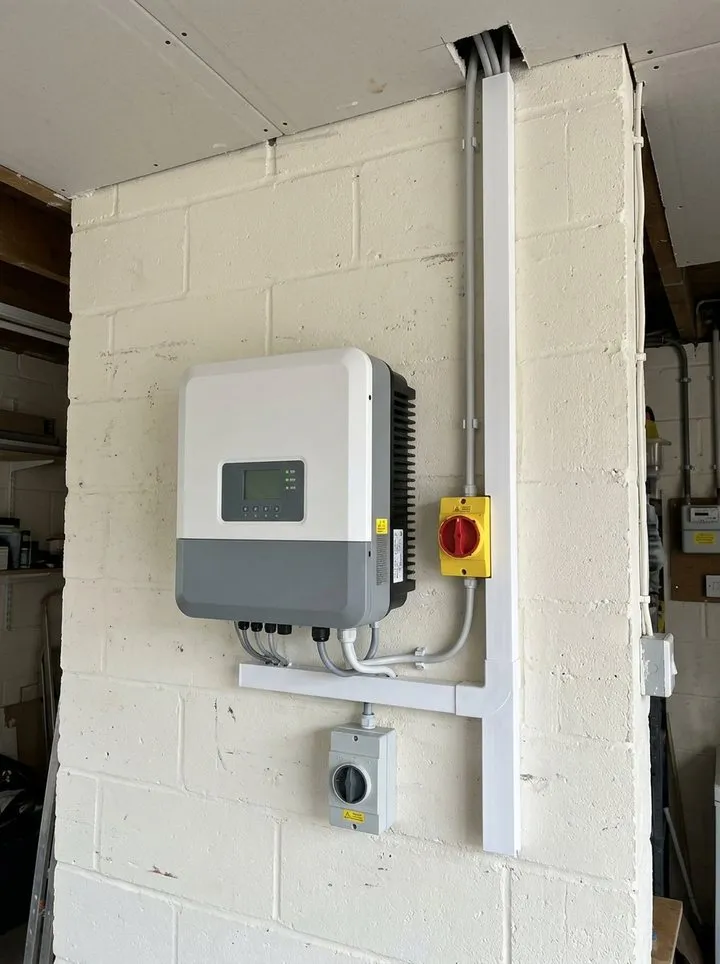
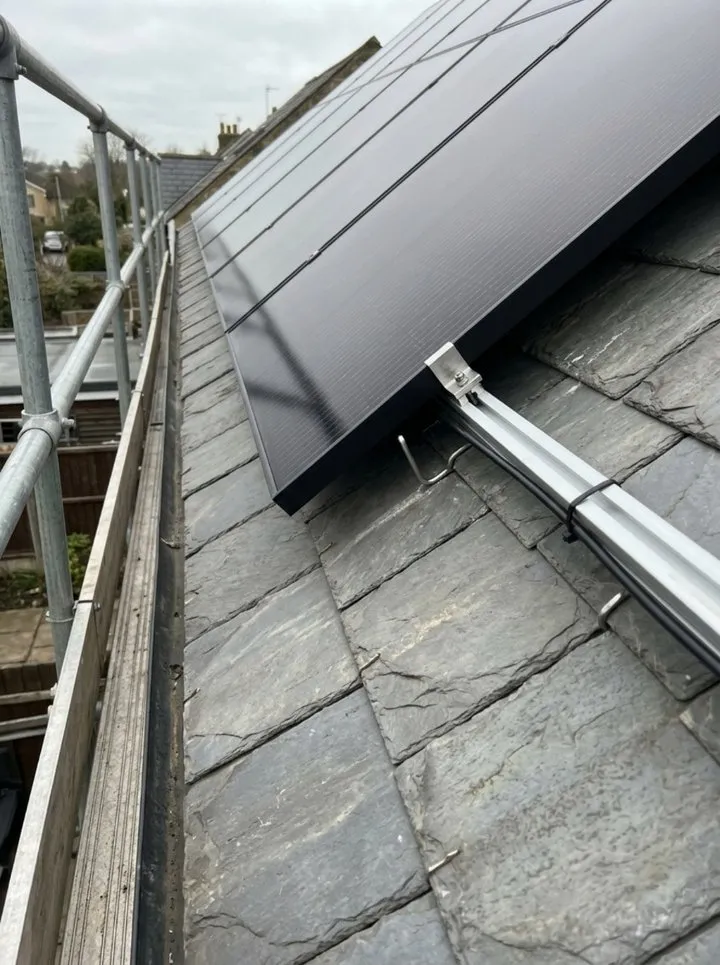
Photos of the array, inverter, isolators and labelsPhotos
Handed overTick all that apply
MCS certificate
Electrical installation certificate
Manuals and warranties
Generation estimate
How to isolate the system
Recommended next inspection dueDate
Set by the installer from the O&M manual and the electrical certificate.
Days to the next inspectionWorked out by the form
Shown when “Date commissioned” is answered and “Recommended next inspection due” is answered
CheckThe next due date is before the date of this visit. Check the date.
Shown only when the answers above make it relevant
Customer nameShort answer
Customer signatureSignature
Installer nameWorked out by the form
Installer signatureSignature
See it filled in
A completed solar PV commissioning report, made by SiteSurvey from a fictional site visit: every answer, the photos, the guidance that applied and the sign-off, ready to send as a PDF.
MCS guidance: where G98 applies and the system is under 16 A per phase, notify the DNO within 28 days of commissioning using G98 Form B. Where G99 applies, above 16 A per phase, permission to connect is needed before installation. The form warns when a G98 notification is late.
What string tests are recorded?
For each string: the number of panels, open-circuit voltage (Voc), short-circuit current (Isc), insulation resistance and polarity, with a pass or fail. The form counts the strings that failed and asks for notes on each failure.
What if there is a battery as well?
Answer that a battery is installed. If the inverter is over 3.68 kW and the route is G98, the form warns that MCS says the application (Form A1-1, or Form A1-2 for a fully type-tested integrated system) must go to the DNO before installation.
How soon is the MCS certificate due?
MCS requires the MCS certificate to be created no later than 14 days after the commissioning date. The form records the certificate number and date, and warns when it is more than 14 days.
Is this the MCS certificate?
No. The MCS certificate is created by the MCS certified installer through MCS. This form is the commissioning record behind it, with readings, photos and the customer's signature.
Who uses this?
MCS solar installers, electrical contractors and housing providers fitting PV to their homes.