An installation record for a home battery energy storage system. Scan the battery label, record the capacity and inverter, then where it is installed. The form shows the PAS 63100 location rules and warns on bedrooms, escape routes and lofts. On an outside wall, measure the distance to the nearest door, window or opening from a photo and the form checks it against the 1 m in PAS 63100. Record separation, detection, ventilation and isolation, then the tests: the form works out Zs as a share of the maximum and counts the results that need attention. Try the form below, see every question or open a completed example.
✎Every question is editable. Add this form to your account, then change the wording, add or remove questions and options, and make it fit your own jobs.
PAS 63100:2024, published by BSI, says home batteries should be installed outdoors where practicable, for example in an outbuilding. It says they shall not be installed in rooms where people sleep, in escape routes such as hallways, landings and stairs, in lofts, roof spaces or voids, or in cellars with no access to the outside. Indoors it asks for 30 minutes' fire separation from bedrooms and escape routes, fresh-air ventilation to outdoors and interlinked fire detection.
Record the installation at the battery on a phone. On an outside wall, measure the distance to the nearest door, window or opening from a photo and the form checks it against the 1 m in PAS 63100. Enter the tests and it works out Zs as a share of the maximum and counts the results that need attention. It is the installer's site record, not the electrical installation certificate.
Distance to the nearest opening
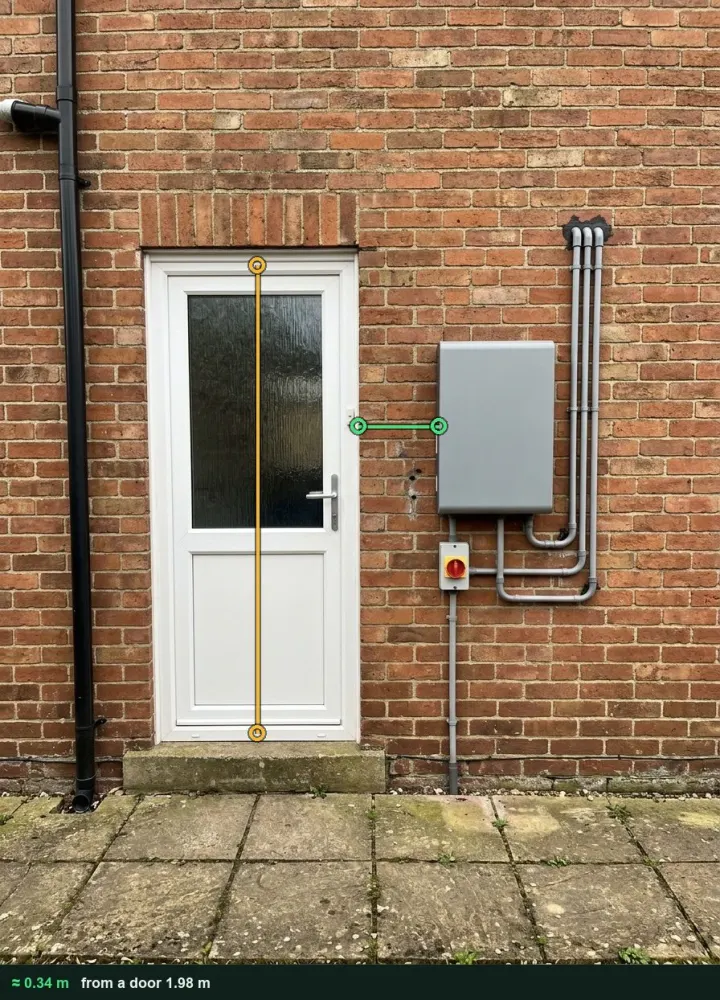
Photograph the wall square on and measure from the battery to the nearest opening, using the door as the reference. The form checks it against the 1 m in PAS 63100 and asks what was done about it. It works on web forms in any phone browser today, and the app version is on its way.
The form counts insulation resistance below 1 MΩ at 500 V, Zs above the maximum you enter, an RCD slower than 300 ms and a polarity fault, and shows Zs as a share of the maximum.
A fictional 13.5 kWh battery on the side wall of a house in Ely: the commissioning check measured it about 0.34 m from the side door, under the 1 m in PAS 63100, so it was left isolated and is being moved to the rear wall before it goes into service. The electrical tests needed no attention. Open it as a filled-in form, or switch to a blank copy and try it yourself.
This is the real form as your team would use it: questions appear as you answer, scores work themselves out and you can add photos and signatures. No sign-up needed. Or open a completed example to see every answer, photo and score filled in.
Every question in the battery storage installation template
A home battery storage installation record: battery and inverter, location and fire safety against PAS 63100, separation, detection, ventilation, isolation, tests, backup, DNO route and handover. 4 sections and 51 questions. Follow-up questions and guidance appear only when an answer calls for them, so the person on site never sees the ones that do not apply.
✎
Make it your own: every question is editable
This is a starting point, not a fixed form. Once it is in your SiteSurvey account you can reword any question, add or remove questions, sections and answer options, and add your own logo, so it fits the way your team works and the jobs you do.
Details you only enter once
Add this form to a project in SiteSurvey and it fills in what the project already knows, so nobody on site retypes it and every form on the job uses the same names. Anything filled in can still be changed.
Project: the project name
Client: the project's customer
Site: the site, when the form is opened for a space or a product
Site address: the site address, from the space or the project
1
Battery
ProjectShort answer
Fills in from the project name
ClientShort answer
Fills in from the project's customer
Site*Short answer
Fills in from the site, when the form is opened for a space or a product
Site addressShort answer
Fills in from the site address, from the space or the project
Date commissioned*Date
Time commissionedTime
Installer*Short answer
Battery make and model*Short answer
Usable capacity (kWh)Number
Scan the battery labelScan a label: serial number, model number
Optional. Scan the label or tag to capture its numbers.
InverterChoose one
Hybrid inverter with solar
AC-coupled battery inverter
Inverter AC rating (kW)Number
CheckThis is the installer's site record of the installation and tests. The formal electrical installation certificate is issued separately, from the installer's registration scheme or certification software.
2
Location and fire safety
Where it is installed*Choose one
Outbuilding
Outside wall
Garage
Utility room
Loft
Under the stairs
Hallway or landing
Bedroom
Other
GuidancePAS 63100:2024 (BSI) says batteries should be installed outdoors where practicable, for example in an outbuilding. It says they shall not be installed in rooms where people sleep, in escape routes such as hallways, landings and stairs, in lofts, roof spaces or voids, within 2 m of stored flammable materials or fuel tanks, or in cellars with no access to the outside. PAS 63100 is not law, but the IET Code of Practice for energy storage says it should be used for battery location.
WarningPAS 63100 says batteries shall not be installed in this location.
Shown only when the answers above make it relevant
CheckAn under-stairs cupboard is usually next to an escape route. PAS 63100 asks for at least 30 minutes' fire-resisting separation from escape routes, and an interlinked smoke or multi-sensor detector in a store cupboard.
Shown when “Where it is installed” is “Under the stairs”
Why this location, and the fire precautionsNotes
Shown only when the answers above make it relevant
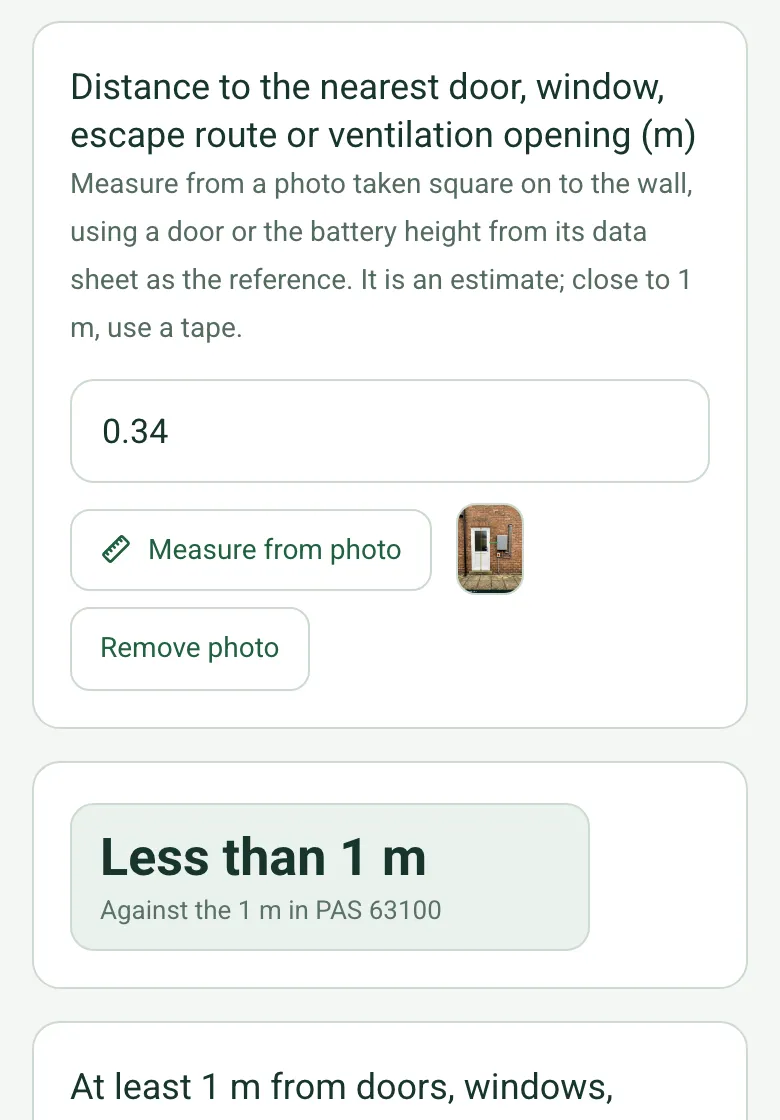
Distance to the nearest door, window, escape route or ventilation opening (m)Number
Measure from a photo taken square on to the wall, using a door or the battery height from its data sheet as the reference. It is an estimate; close to 1 m, use a tape.
Shown when “Where it is installed” is “Outside wall”
Against the 1 m in PAS 63100Worked out by the form
Shown when “Where it is installed” is “Outside wall” and “Distance to the nearest door, window, escape route or ventilation opening (m)” is answered
What was done about the distance, and who was toldNotes
Shown only when the answers above make it relevant
WarningPAS 63100 says outdoor batteries shall not be within 1 m of escape routes, doors, windows or ventilation openings.
Shown only when the answers above make it relevant
Fire-resisting separation of at least 30 minutes from bedrooms and escape routes?Yes or No
PAS 63100 asks for walls, ceilings and floors of at least REI 30 between an indoor battery location and those rooms and routes.
Shown only when the answers above make it relevant
Is there a smoke or multi-sensor detector covering the battery, interlinked with the home's fire alarms?Yes or No
Fresh-air ventilation to outdoors from the battery location?Yes or No
Shown only when the answers above make it relevant
Manufacturer's clearances and mounting met?Yes or No
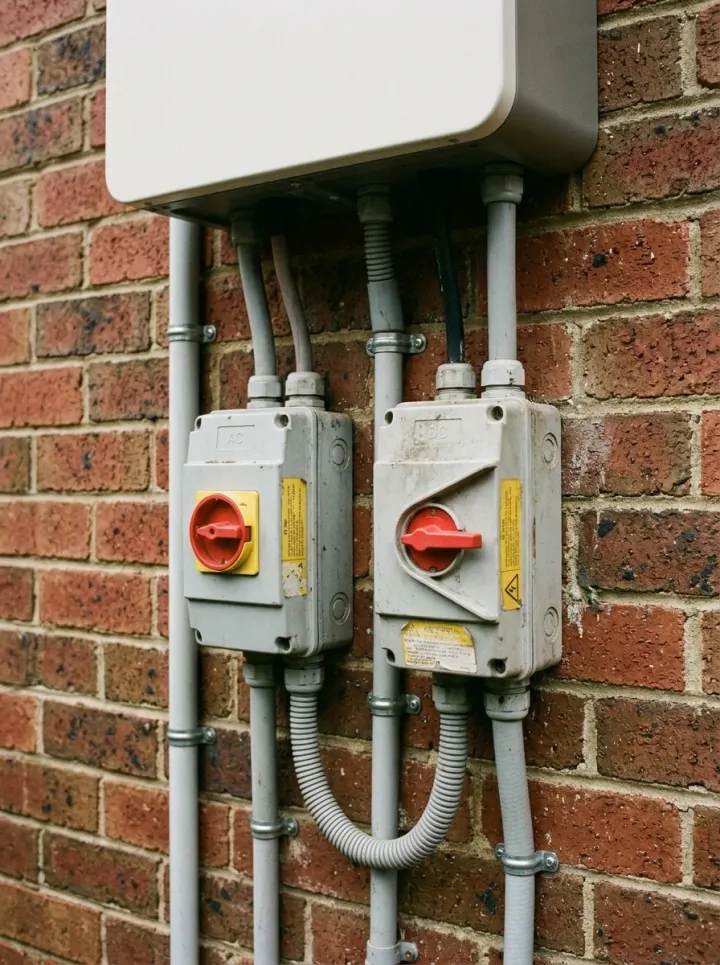
DC and AC isolation fitted and labelled?Yes or No
CheckOver 40 kWh. PAS 63100 limits the total stored energy in a home to 40 kWh, or 80 kWh where the batteries are outdoors, in a detached garage or outbuilding, or in an attached one with 60 minutes' fire separation.
Shown only when the answers above make it relevant
3
Tests and commissioning
Continuity R1 + R2 (Ω)Number
Insulation resistance test voltageChoose one
250 V
500 V
1000 V
Insulation resistance, live to live (MΩ)Number
Insulation resistance, live to earth (MΩ)Number
WarningBelow 1 MΩ. The IET gives 1 MΩ as the minimum insulation resistance, with a 500 V d.c. test for circuits up to 500 V. Investigate before the circuit is put into service.
Shown only when the answers above make it relevant
PolarityChoose one
Correct
Fault
Earth fault loop impedance Zs, measured (Ω)Number
Maximum permitted Zs for this device (Ω)Number
From the BS 7671 tables or the device manufacturer.
Measured Zs as a share of the maximum (%)Worked out by the form
Shown only when the answers above make it relevant
WarningMeasured Zs is above the maximum permitted for this protective device. The device may not disconnect in time.
Shown only when the answers above make it relevant
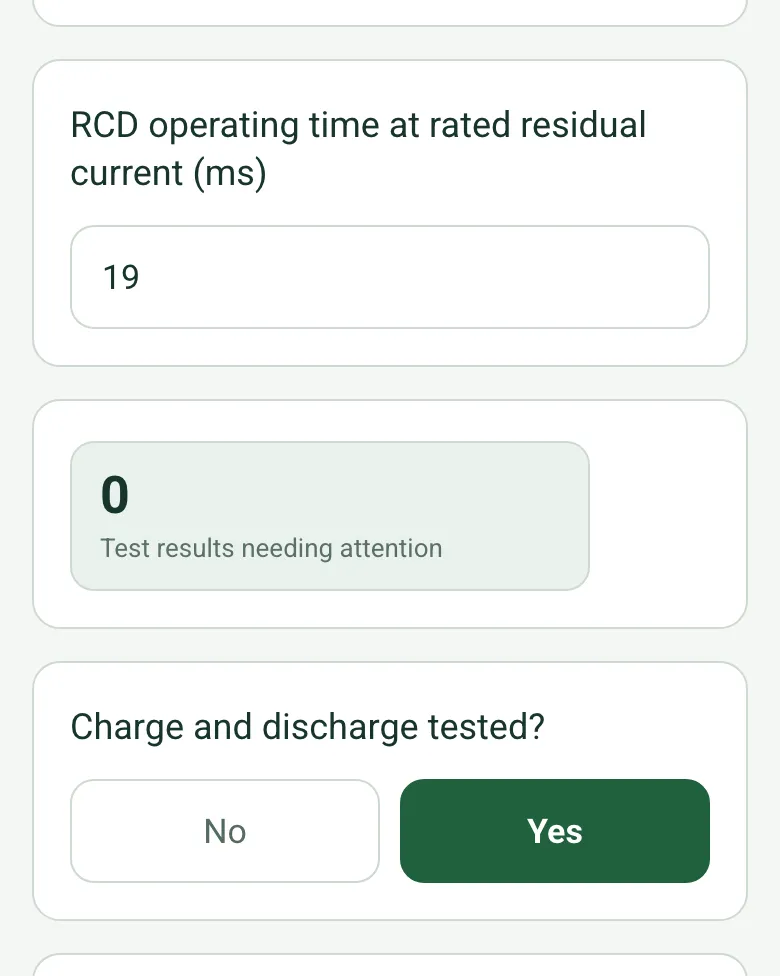
RCD operating time at rated residual current (ms)Number
Test results needing attentionWorked out by the form
Counts insulation resistance below 1 MΩ at 500 V, Zs above the maximum you entered, an RCD slower than 300 ms and a polarity fault, the same checks as the notes above.
CheckA test result needs attention. Record what was found and put right before the circuit is put into service, in the photos and the handover notes.
Shown only when the answers above make it relevant
WarningOver 300 ms at the rated residual current. IET guidance gives 300 ms as the maximum for a general non-delay RCD (an S type time-delayed RCD may take up to 500 ms). Check or replace the RCD.
Shown only when the answers above make it relevant
Charge and discharge tested?Yes or No
Backup or EPSChoose one
Tested and working
Fitted, not tested
Not fitted
Monitoring app set up for the customer?Yes or No
DNO routeChoose one
Applied before installation (Form A1-1)
Applied before installation (Form A1-2 fast track)
G98 notify after commissioning
Not known
CheckMCS guidance: where G98 applies, submit G98 Form B to the DNO within 28 days of installation. Where G99 applies, and for installations over 3.68 kW with energy storage, Form A1-1 must be submitted before installation. Integrated solar and storage that meets the fast-track conditions uses Form A1-2, also before installation.
WarningOver 3.68 kW. MCS says to apply to the DNO before installation.
Shown only when the answers above make it relevant
DNO referenceShort answer
4
Handover
Photos of the battery, isolators, labels and clearancesPhotos
Defects and actions
Repeat for each action. Each one asks:
Action needed*Notes
PriorityChoose one
Urgent
High
Medium
Low
OwnerShort answer
Due dateDate
StatusChoose one
Open
In progress
Completed
PhotosPhotos
Handed overTick all that apply
Electrical installation certificate
Manuals and warranty
How to isolate in an emergency
App login
First service or inspection dueDate
Set by the battery and inverter manufacturer instructions or warranty terms.
Days to first serviceWorked out by the form
Shown when “Date commissioned” is answered and “First service or inspection due” is answered
CheckThe next due date is before the date of this record. Check the date entered.
Shown only when the answers above make it relevant
Customer nameShort answer
Customer signatureSignature
Installer nameWorked out by the form
Installer signatureSignature
See it filled in
A completed battery storage installation report, made by SiteSurvey from a fictional site visit: every answer, the photos, the guidance that applied and the sign-off, ready to send as a PDF.
No. It is a BSI specification, sponsored by the government and published as a free download. MCS says it has no standing in UK regulations such as the Building Regulations, but the IET Code of Practice for energy storage says it should be used for battery location. The form records the location and, where PAS 63100 rules it out, why it was chosen and the precautions.
Does a battery need DNO approval?
MCS guidance: where G98 applies, submit G98 Form B within 28 days of installation. Where G99 applies, and for installations over 3.68 kW with energy storage, Form A1-1 must be submitted before installation, or Form A1-2 for integrated solar and storage on the fast track. The form records the route and the reference.
What is tested?
Continuity, insulation resistance, polarity, earth fault loop impedance and RCD time, then a charge and discharge test and, where fitted, the backup or EPS supply.
What does the customer need to know?
How to isolate the battery in an emergency, the app, the manuals and warranty and the electrical certificate. The form records each item handed over and the customer signs.
Can I use it with a solar installation?
Yes. Record a hybrid inverter or an AC-coupled battery inverter. Use the solar panel installation certificate form for the PV side.
Has BS 7671 changed for batteries?
Yes. The IET and BSI published Amendment 4 (2026) to BS 7671:2018 in April 2026, with a new chapter on stationary secondary batteries that covers battery location, ventilation and fire risk. The previous version was withdrawn six months later.