An installation and commissioning record for a home or workplace EV chargepoint. Scan the charger label, pin the charger by GPS and measure the height of the socket or holster from a photo against the range in the manufacturer's instructions. Record the circuit, protective device and cable, the RCD and DC fault protection and how the outdoor PME restriction is met, then the tests: the form works out Zs as a share of the maximum you enter and counts the results that need attention. Record the smart set-up, the maximum demand and the DNO notification, and get the customer's signature. It is the installer's record, not the electrical installation certificate. Try the form below, see every question or open a completed example.
✎Every question is editable. Add this form to your account, then change the wording, add or remove questions and options, and make it fit your own jobs.
What should an EV charger installation record include?
An EV charger installation record should include the charger make, model, serial number and power, the circuit and protective device, cable size and length, the RCD type and DC fault protection, the earthing arrangement and how the PME restriction is met, the test results, load management, the smart set-up, the maximum demand, the DNO notification and the handover to the customer. The formal electrical installation certificate is issued separately.
Record the installation at the charger on a phone. Pin it by GPS, measure the height of the socket or holster from a photo against the manufacturer's range, and enter the tests: the form works out Zs as a share of the maximum you enter and counts the results that need attention. It is the installer's site record; the electrical installation certificate is issued separately.
Height of the holster from a photo
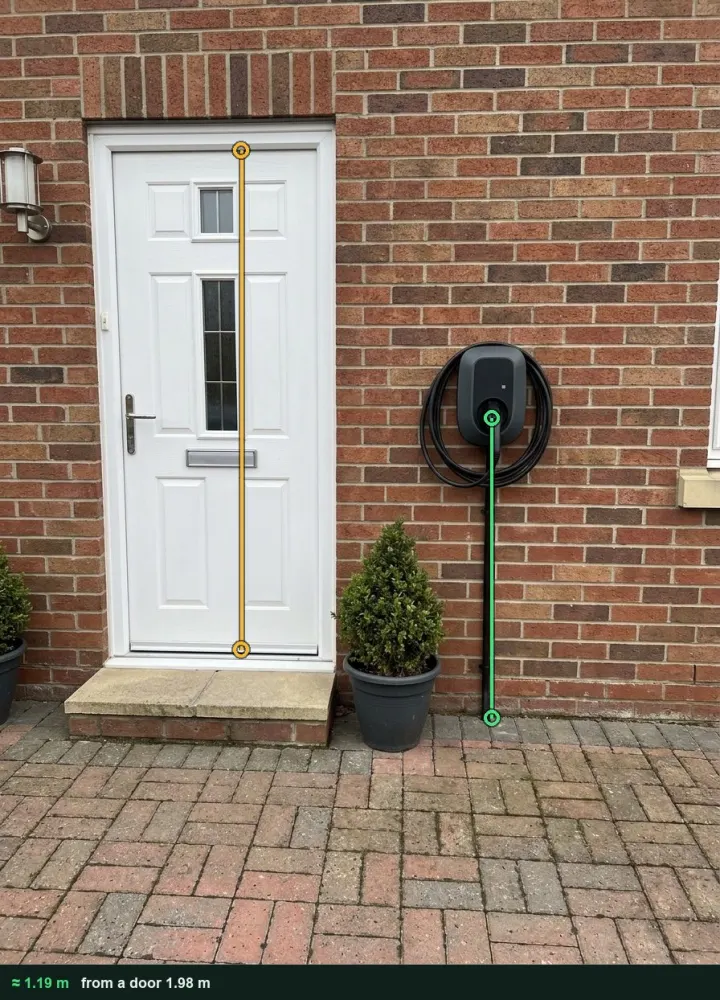
Photograph the wall square on and measure from the ground to the holster, using the front door as the reference. The form checks it against the range in the manufacturer's instructions. It works on web forms in any phone browser today, and the app version is on its way.
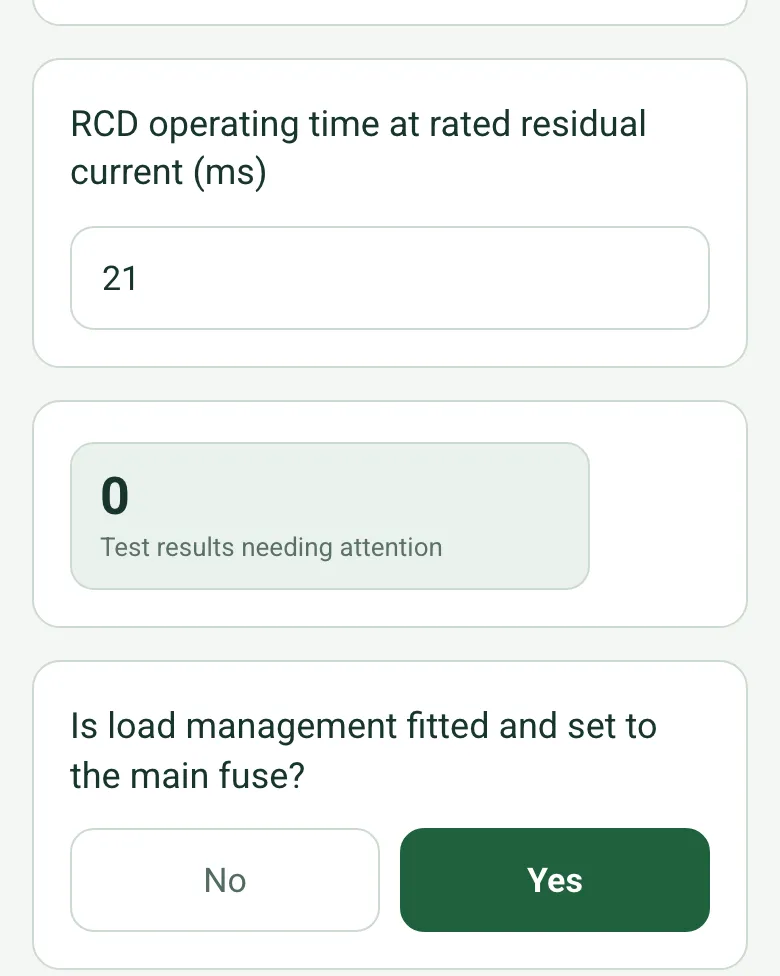
The form counts insulation resistance below 1 MΩ at 500 V, Zs above the maximum you enter, an RCD slower than 300 ms and a polarity fault, the same checks as its red notes, and shows Zs as a share of the maximum.
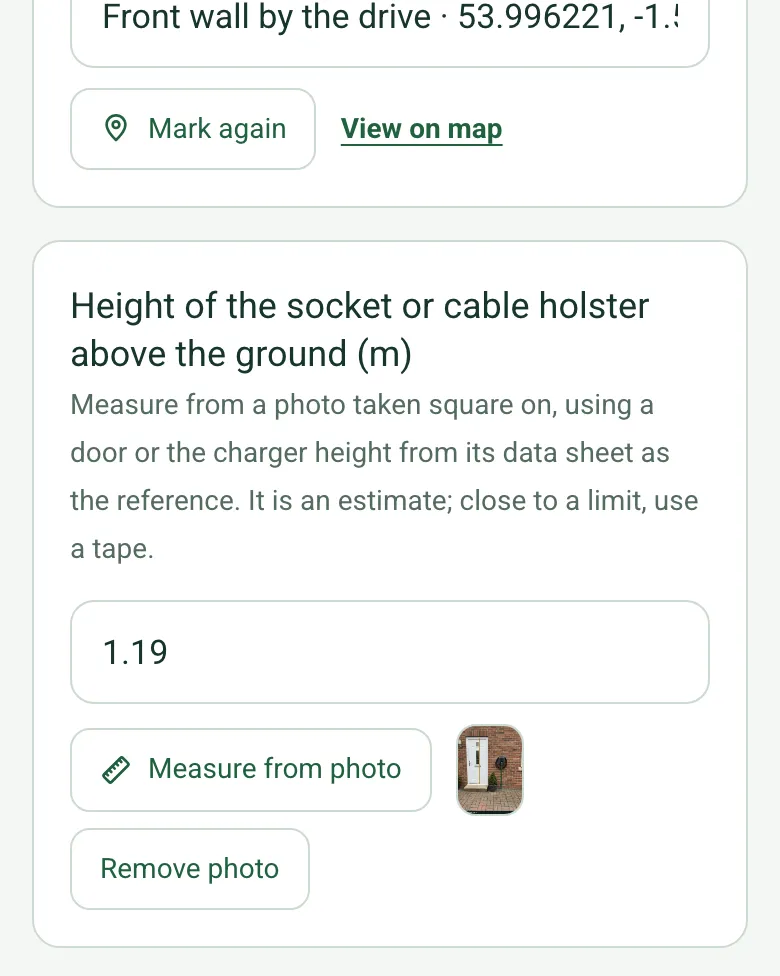
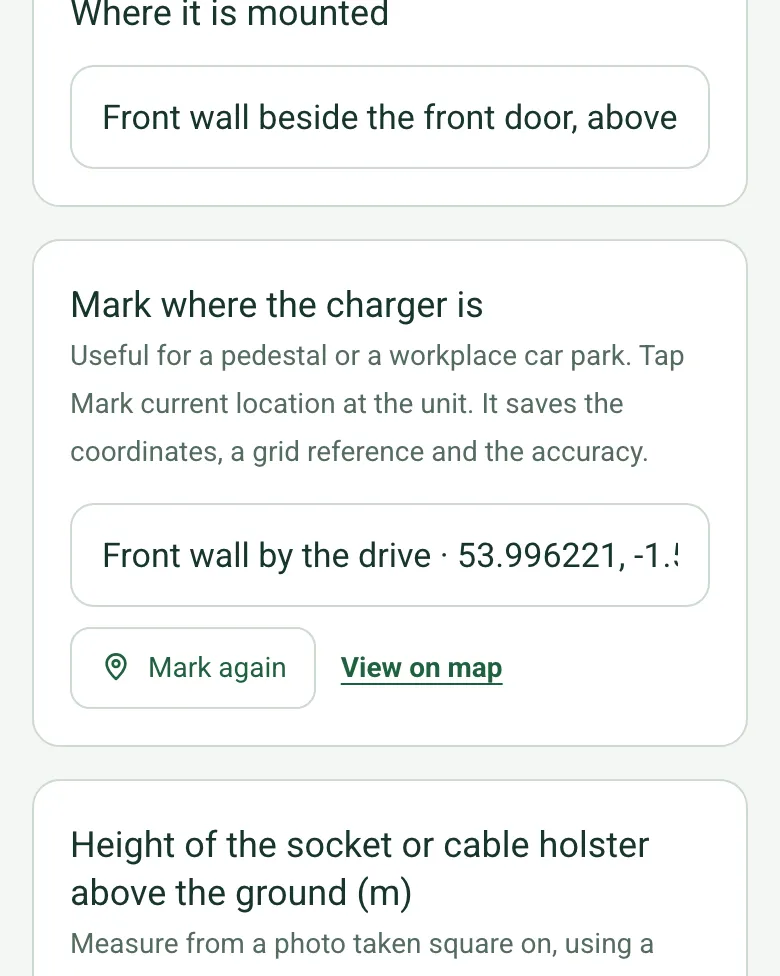
Tap Mark current location at the charger. It helps most with pedestals and workplace car parks. Mark current location works on web forms in any phone browser today, and the app version is on its way.
A fictional 7 kW tethered home charger in Harrogate: holster about 1.19 m above the drive against a 0.75 to 1.5 m range, Type A RCBO with DC detection in the charger, Zs 0.52 Ω (38% of the 1.37 Ω maximum), no results needing attention, and the DNO notified 3 days after commissioning. Open it as a filled-in form, or switch to a blank copy and try it yourself.
This is the real form as your team would use it: questions appear as you answer, scores work themselves out and you can add photos and signatures. No sign-up needed. Or open a completed example to see every answer, photo and score filled in.
Every question in the EV charger installation template
An EV charger installation and commissioning record: the charger, circuit, RCD and DC protection, PME method, tests, load management, smart set-up, DNO notification, handover and photos. 5 sections and 54 questions. Follow-up questions and guidance appear only when an answer calls for them, so the person on site never sees the ones that do not apply.
✎
Make it your own: every question is editable
This is a starting point, not a fixed form. Once it is in your SiteSurvey account you can reword any question, add or remove questions, sections and answer options, and add your own logo, so it fits the way your team works and the jobs you do.
Details you only enter once
Add this form to a project in SiteSurvey and it fills in what the project already knows, so nobody on site retypes it and every form on the job uses the same names. Anything filled in can still be changed.
Project: the project name
Client: the project's customer
Site: the site, when the form is opened for a space or a product
Site address: the site address, from the space or the project
1
Charger
ProjectShort answer
Fills in from the project name
ClientShort answer
Fills in from the project's customer
Site*Short answer
Fills in from the site, when the form is opened for a space or a product
Site addressShort answer
Fills in from the site address, from the space or the project
Date commissioned*Date
Time commissionedTime
Installer, and OZEV authorisation if a grant is claimed*Short answer
Charger make and model*Short answer
Serial numberShort answer
Scan the charger labelScan a label: serial number, model number
Optional. Scan the label or tag to capture its numbers.
PowerChoose one
7 kW
11 kW
22 kW
CableChoose one
Tethered
Untethered (socket)
Where it is mountedShort answer
Mark where the charger isShort answer
Useful for a pedestal or a workplace car park. Tap Mark current location at the unit. It saves the coordinates, a grid reference and the accuracy.
Height of the socket or cable holster above the ground (m)Number
Measure from a photo taken square on, using a door or the charger height from its data sheet as the reference. It is an estimate; close to a limit, use a tape.
Lowest height in the manufacturer's instructions (m)Number
Highest height in the manufacturer's instructions (m)Number
Height against the instructionsWorked out by the form
Shown when “Height of the socket or cable holster above the ground (m)” is answered and “Lowest height in the manufacturer's instructions (m)” is answered and “Highest height in the manufacturer's instructions (m)” is answered
Grant claim reference, if anyShort answer
CheckThis is the installer's site record of the installation and tests. The formal electrical installation certificate is issued separately, from the installer's registration scheme or certification software.
2
Circuit and protection
Consumer unit and circuit*Short answer
Protective deviceChoose one
MCB type B
MCB type C
MCB type D
RCBO type B
RCBO type C
BS 88 fuse
BS 1361 fuse
BS 3036 rewireable fuse
Other
Rating (A)Number
Cable size (mm²)Number
Cable length (m)Number
RCD and DC fault protection*Choose one
Type B RCD
Type A or Type F RCD, with DC fault detection (RDC-DD) in the charger
Other
GuidanceBS 7671 regulation 722.531.3.101, as the IET explains it: each charging point needs its own RCD of Type A, F or B, rated at no more than 30 mA. A charger can produce DC fault current, so where it has no DC fault protection of its own a Type B RCD is needed. Where it has DC detection (an RDC-DD), a Type A or Type F RCD can be used.
Describe the protectionShort answer
Shown when “RCD and DC fault protection” is “Other”
Earthing arrangementChoose one
TN-C-S (PME)
TN-S
TT
How the outdoor PME restriction is metShort answer
For example built-in open-PEN protection or an earth electrode.
Shown when “Earthing arrangement” is “TN-C-S (PME)”
GuidanceBS 7671 regulation 722.411.4.1, as the IET explains it: a PME earthing facility must not be used for charging outdoors unless one of the methods the regulation lists is used, such as an earth electrode or a device that disconnects the supply on an open-PEN fault.
Shown when “Earthing arrangement” is “TN-C-S (PME)”
Earth electrode resistance (Ω)Number
3
Tests
Continuity R1 + R2 (Ω)Number
Insulation resistance test voltageChoose one
250 V
500 V
1000 V
Insulation resistance, live to live (MΩ)Number
Insulation resistance, live to earth (MΩ)Number
WarningBelow 1 MΩ. The IET gives 1 MΩ as the minimum insulation resistance, with a 500 V d.c. test for circuits up to 500 V. Investigate before the circuit is put into service.
Shown only when the answers above make it relevant
PolarityChoose one
Correct
Fault
Earth fault loop impedance Zs, measured (Ω)Number
Maximum permitted Zs for this device (Ω)Number
From the BS 7671 tables or the device manufacturer.
Measured Zs as a share of the maximum (%)Worked out by the form
Shown only when the answers above make it relevant
WarningMeasured Zs is above the maximum permitted for this protective device. The device may not disconnect in time.
Shown only when the answers above make it relevant
RCD operating time at rated residual current (ms)Number
Test results needing attentionWorked out by the form
Counts insulation resistance below 1 MΩ at 500 V, Zs above the maximum you entered, an RCD slower than 300 ms and a polarity fault, the same checks as the notes above.
CheckA test result needs attention. Record what was found and put right before the circuit is put into service, in the photos and the handover notes.
Shown only when the answers above make it relevant
WarningOver 300 ms at the rated residual current. IET guidance gives 300 ms as the maximum for a general non-delay RCD (an S type time-delayed RCD may take up to 500 ms). Check or replace the RCD.
Shown only when the answers above make it relevant
Is load management fitted and set to the main fuse?Yes or No
Has a test charge been completed with the customer's car or a test unit?Yes or No
4
Smart set-up and DNO
Is the charger online, with the app set up for the customer?Yes or No
CheckCharge points sold for home or workplace use in Great Britain since 30 June 2022 must meet the smart charge point regulations. It keeps charging without a connection, but its smart functions send and receive information, so they need one.
Shown when “Is the charger online, with the app set up for the customer?” is No
Has the customer been shown the default off-peak charging hours, to accept or change?Yes or No
Maximum demand of the property after installation (A)Number
Including the new equipment and the effect of any load management.
Network operator (DNO) routeChoose one
Connect and notify after installation
Applied and approved before installation
Not known
CheckMCS points to one ENA process and form for EV chargers and heat pumps. Where the property's new maximum demand is 60 A or less, the equipment can be connected and the DNO notified within 28 days. Between 60 A and 100 A, apply to the DNO before installing.
WarningMaximum demand is over 60 A. MCS says to apply to the DNO before installing, not connect and notify.
Shown only when the answers above make it relevant
Date the DNO was notified or approvedDate
Shown only when the answers above make it relevant
Days from commissioning to notificationWorked out by the form
Shown only when the answers above make it relevant
WarningMore than 28 days after commissioning.
Shown only when the answers above make it relevant
WarningThe approval date is after the commissioning date. Approval is needed before installation.
Shown only when the answers above make it relevant
DNO referenceShort answer
Shown only when the answers above make it relevant
5
Handover
Photos of the installed charger, labels and consumer unitPhotos
Handed overTick all that apply
Electrical installation certificate
Charger manual and warranty
App login
How to use and lock the charger
Customer nameShort answer
Customer signatureSignature
Installer nameWorked out by the form
Installer signatureSignature
See it filled in
A completed EV charger installation report, made by SiteSurvey from a fictional site visit: every answer, the photos, the guidance that applied and the sign-off, ready to send as a PDF.
The IET explains that BS 7671 regulation 722.531.3.101 requires each charging point to have its own RCD of Type A, F or B, rated at no more than 30 mA. Where the charger has no DC fault protection, a Type B RCD is needed. Where it has DC detection (an RDC-DD), a Type A or Type F RCD can be used. The form records which was fitted.
Do I need to tell the DNO?
Yes. MCS points to one ENA process for EV chargers and heat pumps: where the property's new maximum demand is 60 A or less, connect and notify the DNO within 28 days, and between 60 A and 100 A apply before installing. The form records the maximum demand, route and dates, and warns when notification is late or demand is over 60 A.
Does the charger have to be smart?
Charge points sold for home or workplace use in Great Britain since 30 June 2022 must meet the Electric Vehicles (Smart Charge Points) Regulations 2021, including pre-set off-peak default charging hours that the owner can accept or change. The form records whether the charger is online with the app set up and the default hours shown to the customer.
What about PME earthing outdoors?
The IET explains that BS 7671 regulation 722.411.4.1 does not allow a PME earthing facility to be used for charging outdoors unless one of the listed methods is used, such as an earth electrode or a device that disconnects the supply on an open-PEN fault. The form asks how it is met and records the electrode resistance.
Is this the electrical certificate?
No. It is the installer's site record of the installation and tests, with photos and the customer's signature. The formal electrical installation certificate is issued separately, from the installer's registration scheme or certification software.
Who uses this?
EV charger installers, electrical contractors and fleet and facilities teams installing workplace chargers.