A site record for electrical minor works: an extra socket or light, or moving a switch, on an existing circuit. Record the work with photos, the board and circuit, earthing and the protective device, then continuity, insulation resistance, polarity, Zs, RCD time and test buttons. The form checks insulation resistance against the BS 7671 Table 64 minimum, Zs against the maximum you enter and the RCD time against 300 ms, and counts any result outside a limit. It is a site record, not the certificate. Try the form below, see every question or open a completed example.
✎Every question is editable. Add this form to your account, then change the wording, add or remove questions and options, and make it fit your own jobs.
A minor electrical installation works certificate is for additions or alterations to an existing installation that do not extend to a new circuit, such as adding a socket outlet or a lighting point, or moving a light switch. The IET model form says it is not for replacing a consumer unit or distribution board; more extensive work gets an Electrical Installation Certificate. Inspection and testing still apply whatever the size of the job.
Built for recording a small job on an existing circuit
Fill the record in before you leave the job. Add before and after photos, enter the test results and the form checks them against limits you can look up and counts anything outside a limit. It is a site record of the work and the readings; the certificate itself comes from your scheme's or your certification software.
Insulation resistance against Table 64
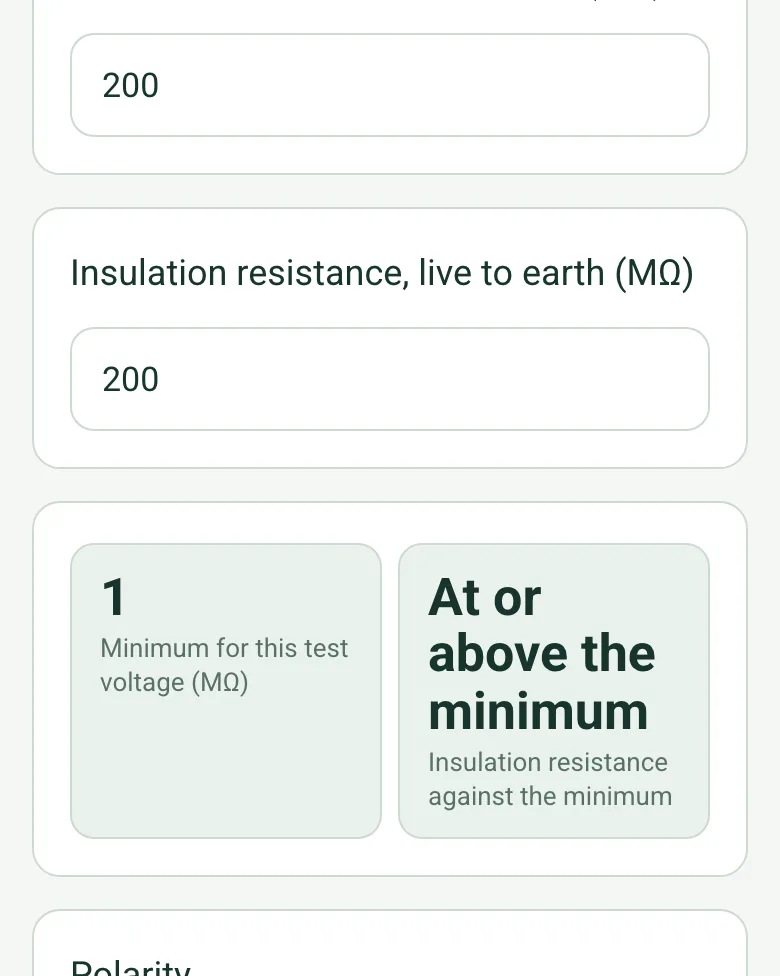
Pick the test voltage and enter the readings. The form shows the BS 7671 Table 64 minimum for that voltage and says whether the lower reading meets it, with a red note if it does not.
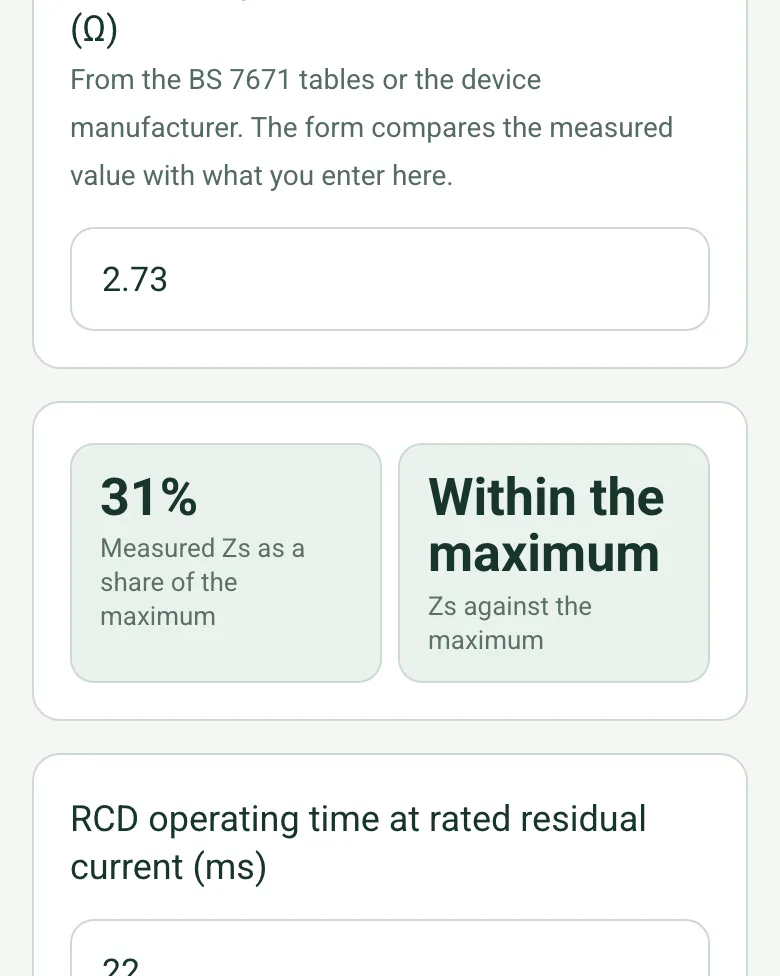
Enter the maximum Zs for the protective device from the BS 7671 tables or the manufacturer. The form shows the measured value as a share of it and flags a reading above it, where the device may not disconnect in time.
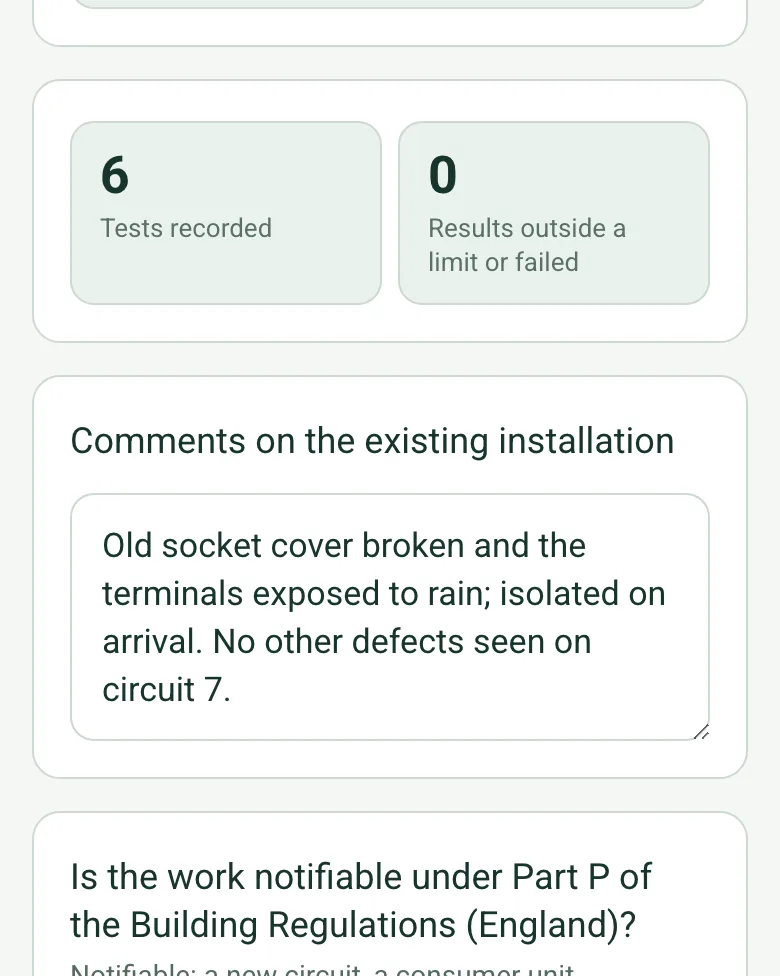
The form counts the tests recorded and any result outside a limit or failed, including an RCD over 300 ms or a test button that does not work, so a missing or failed test stands out before you sign.
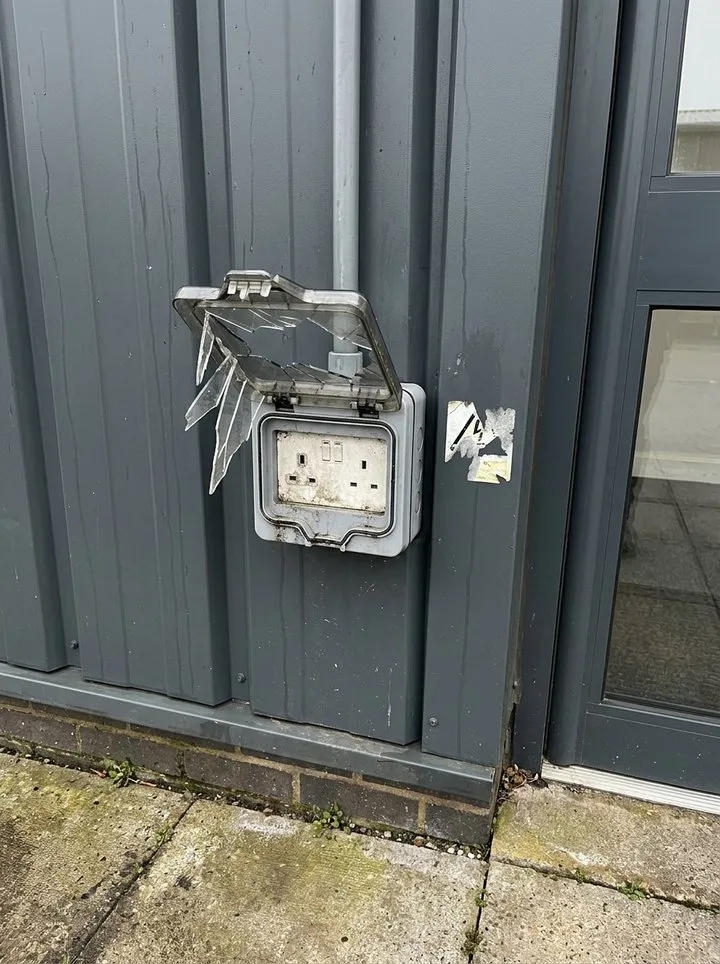
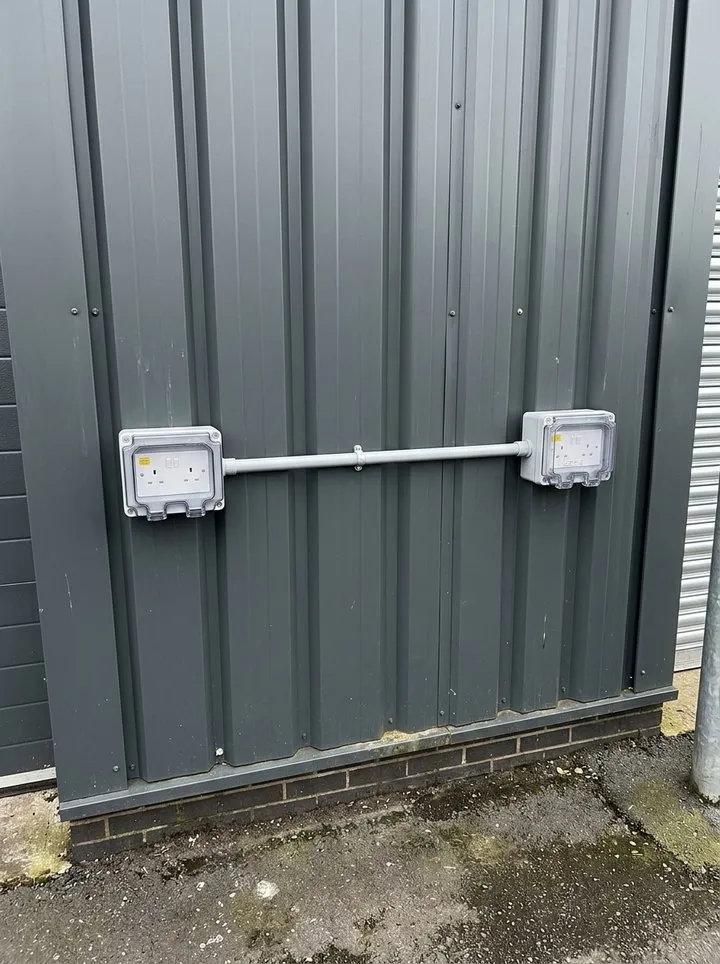
A fictional trade park unit: a damaged outdoor socket replaced and a second outdoor socket added on the same RCBO-protected circuit, with before and after photos and every test inside its limit. Open it as a filled-in form, or switch to a blank copy and try it yourself.
This is the real form as your team would use it: questions appear as you answer, scores work themselves out and you can add photos and signatures. No sign-up needed. Or open a completed example to see every answer, photo and score filled in.
Every question in the minor works certificate template
An electrical minor works site record: the work done, the circuit it was on, earthing and protection, continuity, insulation resistance, polarity, Zs and RCD tests, departures and Part P notification. 3 sections and 41 questions. Follow-up questions and guidance appear only when an answer calls for them, so the person on site never sees the ones that do not apply.
✎
Make it your own: every question is editable
This is a starting point, not a fixed form. Once it is in your SiteSurvey account you can reword any question, add or remove questions, sections and answer options, and add your own logo, so it fits the way your team works and the jobs you do.
Details you only enter once
Add this form to a project in SiteSurvey and it fills in what the project already knows, so nobody on site retypes it and every form on the job uses the same names. Anything filled in can still be changed.
Project: the project name
Client: the project's customer
Site: the site, when the form is opened for a space or a product
Site address: the site address, from the space or the project
1
Work done
ProjectShort answer
Fills in from the project name
ClientShort answer
Fills in from the project's customer
Site*Short answer
Fills in from the site, when the form is opened for a space or a product
Site addressShort answer
Fills in from the site address, from the space or the project
Date the work was completed*Date
Electrician*Short answer
Registration scheme and numberShort answer
Description of the minor works*Notes
Location of the workShort answer
Photos of the work and the boardPhotos
Before and after, and the circuit at the board.
CheckA minor works certificate is for additions or alterations to an existing circuit that do not add a new circuit, such as an extra socket or light, or moving a switch. A new circuit or a consumer unit replacement needs an Electrical Installation Certificate.
CheckThis is a site record of the readings and checks. It is not the BS 7671 certificate or schedule itself: issue that from your registration scheme's or your certification software.
2
Circuit and protection
Distribution board and circuit number*Short answer
Earthing arrangementChoose one
TN-C-S (PME)
TN-S
TT
Other
Earth fault loop impedance at the distribution board, Zdb (Ω)Number
Earthing conductor and main protective bonding present and adequate?Yes or No
Protective deviceChoose one
MCB type B
MCB type C
MCB type D
RCBO type B
RCBO type C
BS 88 fuse
BS 1361 fuse
BS 3036 rewireable fuse
Other
Rating (A)Number
RCD typeChoose one
Type AC
Type A
Type F
Type B
No RCD
RCD rated residual current (mA)Number
Arc fault detection device fitted?Yes or No
Departures from BS 7671, if anyNotes
3
Tests
Protective conductor continuity R1 + R2 or R2 (Ω)Number
Insulation resistance test voltageChoose one
250 V
500 V
1000 V
Insulation resistance, live to live (MΩ)Number
Insulation resistance, live to earth (MΩ)Number
Minimum for this test voltage (MΩ)Worked out by the form
BS 7671 Table 64: 0.5 MΩ for SELV and PELV circuits tested at 250 V, and 1 MΩ for circuits tested at 500 V (up to 500 V) or 1000 V (above 500 V).
Shown when “Insulation resistance test voltage” is answered
Insulation resistance against the minimumWorked out by the form
Shown only when the answers above make it relevant
WarningBelow the minimum insulation resistance in BS 7671 Table 64 (1 MΩ at a 500 V or 1000 V test, 0.5 MΩ for SELV and PELV at 250 V). Investigate before the circuit is put into service.
Shown when “Insulation resistance against the minimum” is “Below the minimum”
PolarityChoose one
Correct
Fault
Earth fault loop impedance Zs, measured (Ω)Number
Maximum permitted Zs for this device (Ω)Number
From the BS 7671 tables or the device manufacturer. The form compares the measured value with what you enter here.
Measured Zs as a share of the maximum (%)Worked out by the form
Shown only when the answers above make it relevant
Zs against the maximumWorked out by the form
Shown only when the answers above make it relevant
WarningMeasured Zs is above the maximum permitted for this protective device. The device may not disconnect in time.
Shown only when the answers above make it relevant
RCD operating time at rated residual current (ms)Number
RCD time against 300 msWorked out by the form
Shown only when the answers above make it relevant
WarningOver 300 ms at the rated residual current. IET guidance gives 300 ms as the maximum for a general non-delay RCD (an S type time-delayed RCD may take up to 500 ms). Check or replace the RCD.
Shown only when the answers above make it relevant
RCD test button operatesChoose one
Yes
No
No RCD
AFDD test button operatesChoose one
Yes
No
Not fitted
Tests recordedWorked out by the form
Results outside a limit or failedWorked out by the form
CheckOne or more results above are outside a limit or failed. Record what was found and done, and retest, before the circuit is put back into service.
Shown only when the answers above make it relevant
Comments on the existing installationNotes
Is the work notifiable under Part P of the Building Regulations (England)?Yes or No
Notifiable: a new circuit, a consumer unit replacement, or any addition or alteration to an existing circuit in a special location (the space around a bath or shower, or a room with a swimming pool or sauna heater).
CheckNotifiable work must be self-certified by a registered competent person, certified by a registered third-party certifier appointed before work starts, or notified to a building control body before work starts (Approved Document P).
Shown when “Is the work notifiable under Part P of the Building Regulations (England)?” is Yes
NameWorked out by the form
Electrician signatureSignature
See it filled in
A completed minor works certificate report, made by SiteSurvey from a fictional site visit: every answer, the photos, the guidance that applied and the sign-off, ready to send as a PDF.
Protective conductor continuity (R1 + R2 or R2), insulation resistance live to live and live to earth with the test voltage, polarity, earth fault loop impedance Zs, RCD disconnection time and the RCD and AFDD test buttons. The form warns on insulation resistance under 1 MΩ at 500 V, Zs over the maximum and an RCD slower than 300 ms, the IET maximum for a general non-delay RCD.
Is minor works notifiable under Part P?
In England, notifiable work is a new circuit, a consumer unit replacement, or any addition or alteration to an existing circuit in a special location, such as the space around a bath or shower. Other additions to existing circuits are not notifiable. Notifiable work is self-certified by a registered competent person, certified by a registered third-party certifier, or notified to building control before work starts. The form asks and shows a reminder.
Is this the BS 7671 certificate?
No. It is a site record of the work and test readings. Issue the formal certificate from your registration scheme's or your certification software, using the readings recorded here.
What else does it record?
The description and location of the work, the distribution board and circuit, the earthing arrangement, Zdb, whether earthing and main bonding are present and adequate, the protective device type and rating, the RCD type and rating, any departures from BS 7671 and comments on the existing installation.
Can the customer see it?
Yes. The record goes out as a PDF report or a share link from the SiteSurvey app, with the electrician's signature.
Who uses this?
Domestic and commercial electricians recording small jobs on site, and maintenance teams keeping a record of alterations to each circuit.