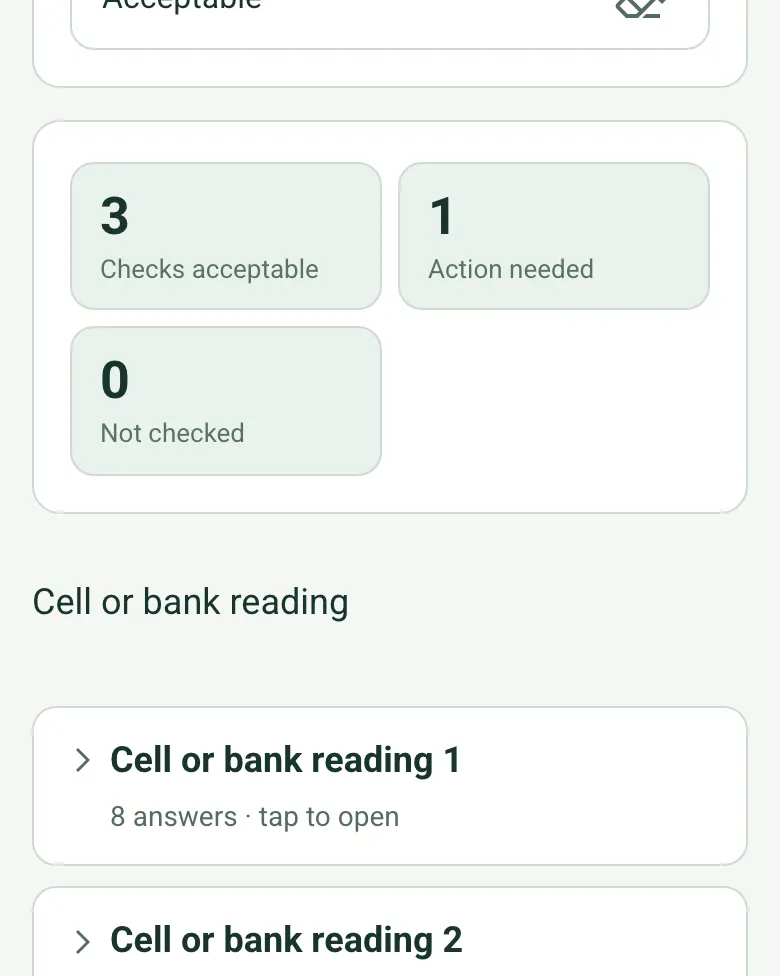
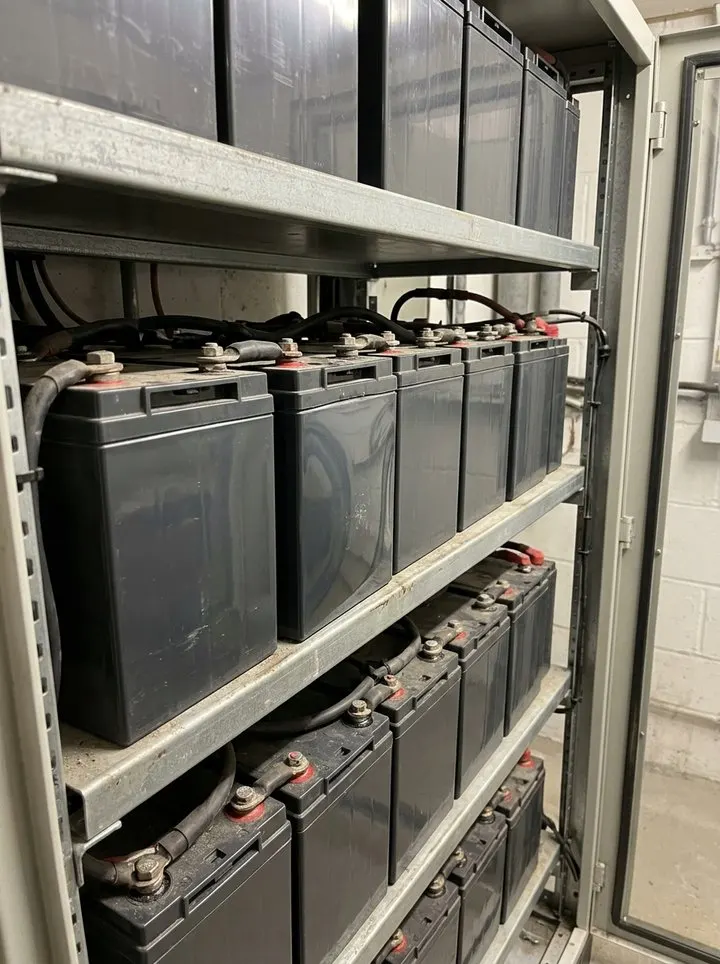
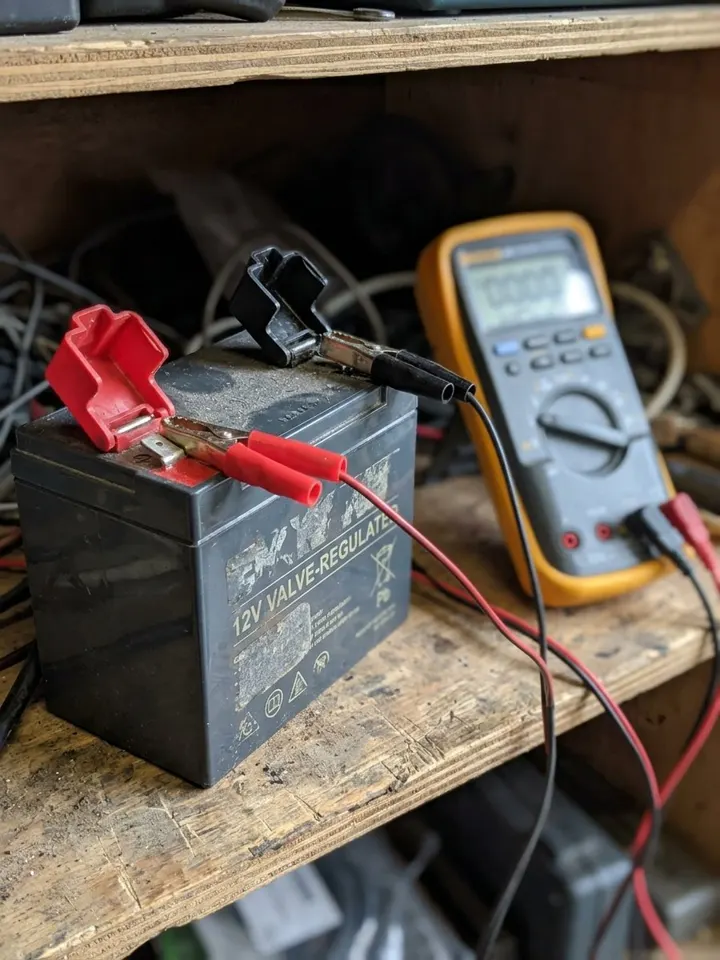
For people maintaining stationary lead-acid battery banks, such as UPS and standby batteries. Record the bank, the procedure and the isolation, then the condition checks: the form counts those acceptable, needing action and not checked. For each reading, enter the value and the acceptance range from the manufacturer or your procedure, and the form shows whether it is within, below or above it, counts readings outside their range and flags an assessment that does not match. It warns when the battery is handed back as available with a reading outside its range. Try the form below, see every question or open a completed example.
✎Every question is editable. Add this form to your account, then change the wording, add or remove questions and options, and make it fit your own jobs.
HSE’s storage-battery guidance identifies electrical, chemical and explosion hazards. Use suitable ventilation, precautions against ignition and short circuits, and the manufacturer’s safe maintenance procedure.
Record the bank and the procedure, then the checks and readings. For each reading, enter the value and the acceptance range from the manufacturer or your procedure: the form shows whether it is within, below or above, counts readings outside their range and warns before the battery is handed back as available.
Each reading against its range
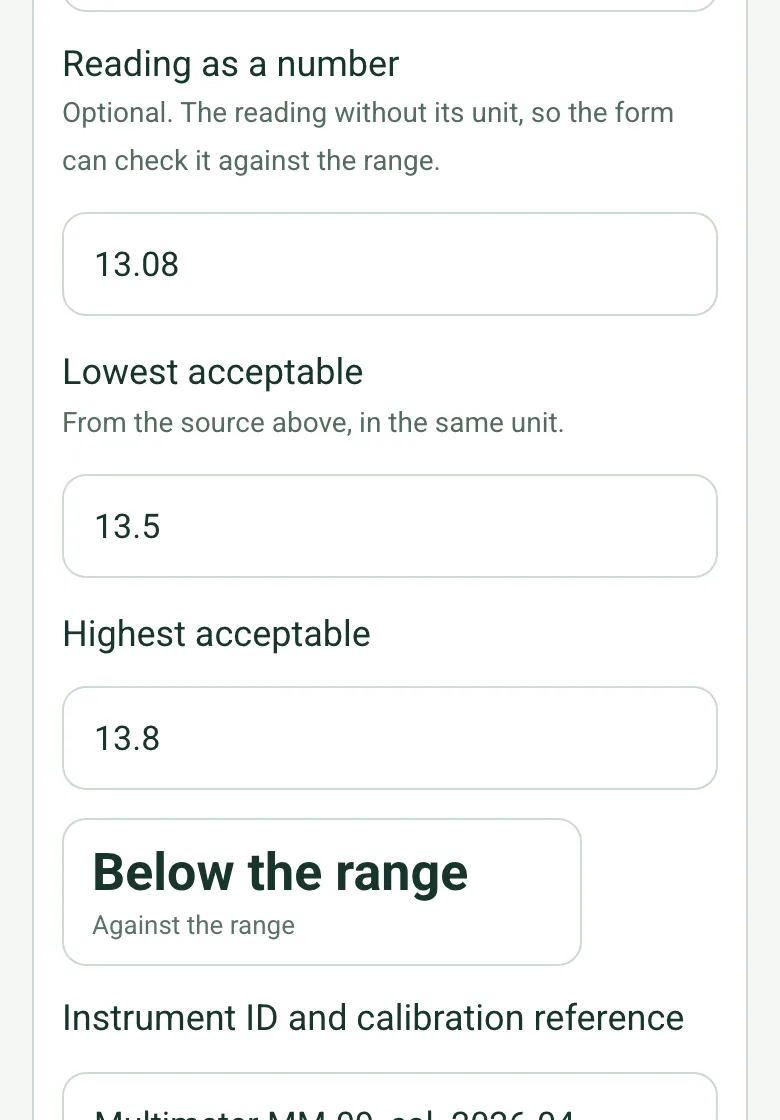
Enter the reading and the lowest and highest acceptable values from the source you work to. The form shows within, below or above the range, and an amber note if the assessment says within criterion when it is not.
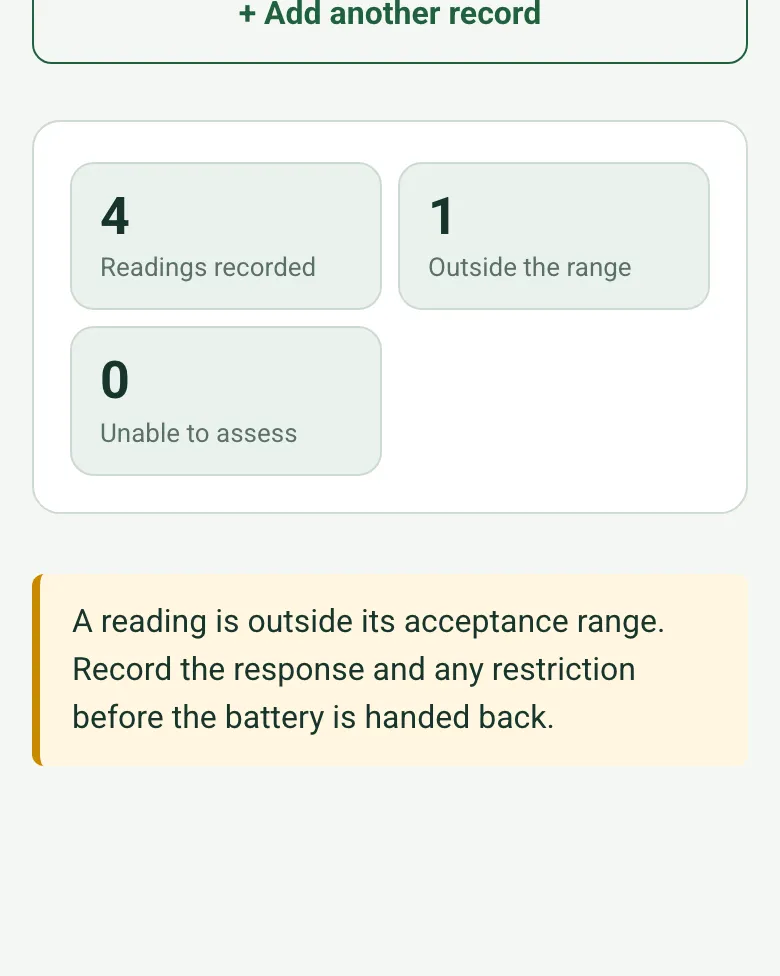
The form counts the readings recorded, outside their range and unable to assess, and warns if the battery is handed back as available within recorded limits with a reading outside its range.
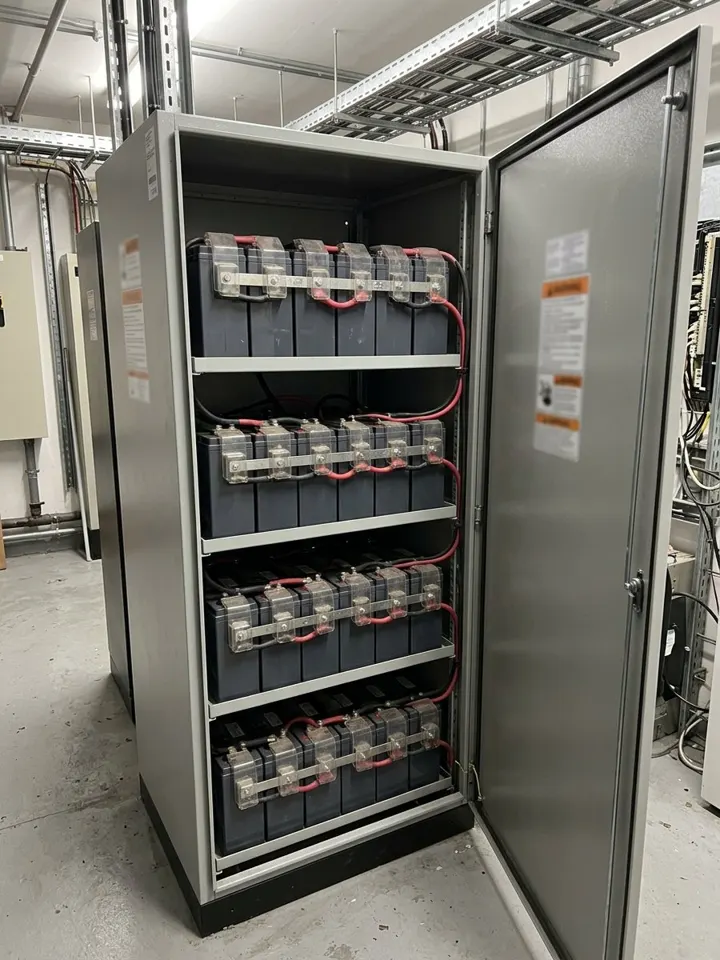
Add photos or a short video of the bank before and after the work.
A completed battery maintenance record
A fictional data suite UPS string of 40 blocks: string float 544 V within 540 to 552 V, block 27 swollen and low at 13.08 V against 13.50 to 13.80 V from the procedure, a replacement ordered and the battery handed back for restricted use until it is fitted.
This is the real form as your team would use it: questions appear as you answer, scores work themselves out and you can add photos and signatures. No sign-up needed. Or open a completed example to see every answer, photo and score filled in.
Your team completes the stationary battery maintenance on site in the SiteSurvey app on iPhone, iPad and Android phones and tablets. The project name and address fill in for them, it works without signal, and it syncs when the device is back online with photos kept against the question they answer.
Customers and subcontractors do not need the app: send them a link and they can fill it in from any browser.
Every question in the stationary battery maintenance template
A stationary lead-acid battery maintenance record covering bank identity, ventilation, visible condition, approved readings, defects and handback limits. 6 sections and 60 questions. Follow-up questions and guidance appear only when an answer calls for them, so the person on site never sees the ones that do not apply.
✎
Make it your own: every question is editable
This is a starting point, not a fixed form. Once it is in your SiteSurvey account you can reword any question, add or remove questions, sections and answer options, and add your own logo, so it fits the way your team works and the jobs you do.
Details you only enter once
Add this form to a project in SiteSurvey and it fills in what the project already knows, so nobody on site retypes it and every form on the job uses the same names. Anything filled in can still be changed.
Project: the project name
Site or premises address: the site address, from the space or the project
Client or organisation: the project's customer
Manufacturer, model and serial number: the product's model
1
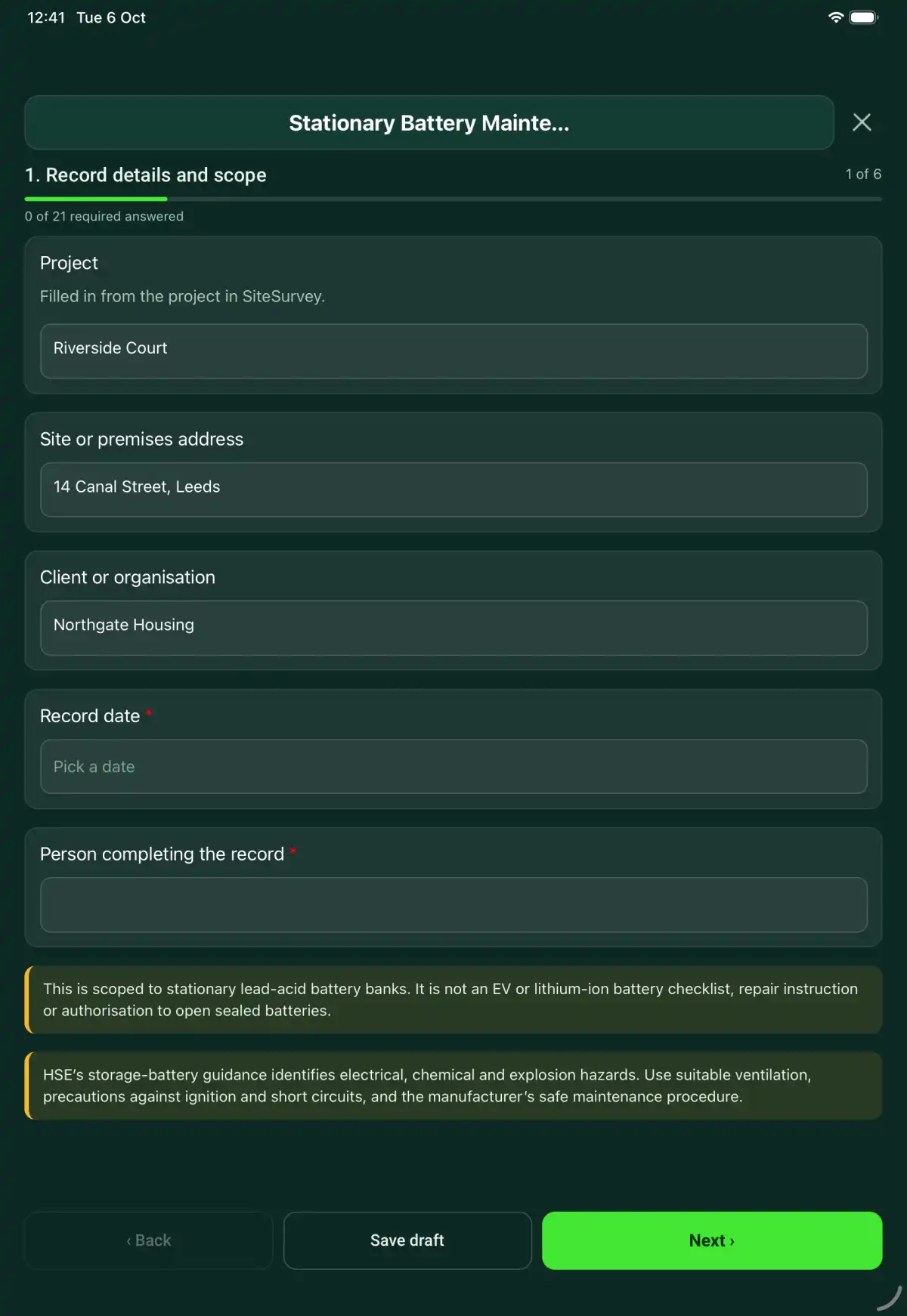
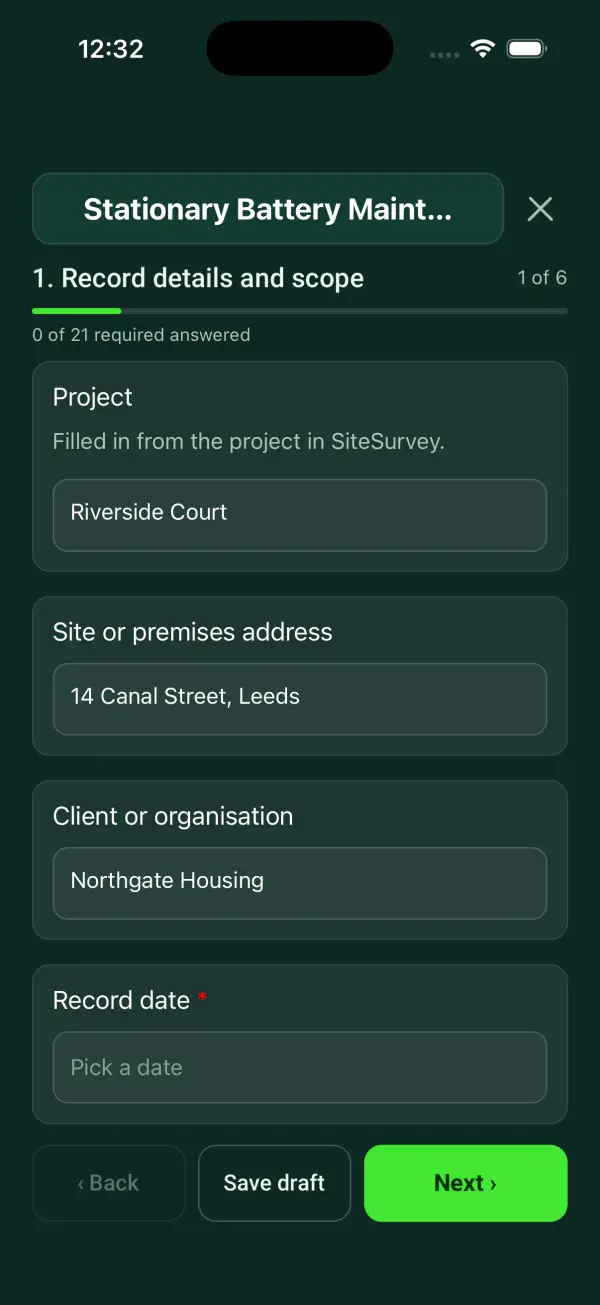
Record details and scope
ProjectShort answer
Filled in from the project in SiteSurvey.
Fills in from the project name
Site or premises addressShort answer
Fills in from the site address, from the space or the project
Client or organisationShort answer
Fills in from the project's customer
Record date*Date
Person completing the record*Short answer
CheckThis is scoped to stationary lead-acid battery banks. It is not an EV or lithium-ion battery checklist, repair instruction or authorisation to open sealed batteries.
CheckHSE INDG139 Using electric storage batteries safely sets out the electrical, chemical and explosion (hydrogen) hazards and the precautions: ventilation, no ignition sources, insulated tools, eye and skin protection and a means to wash off acid. The Electricity at Work Regulations 1989 require the system to be maintained to prevent danger (regulation 4) and the work to be done by competent people (regulation 16). BS EN IEC 62485-2 (safety requirements for secondary batteries and battery installations, stationary batteries) covers ventilation, protection and the battery room. Follow the manufacturer maintenance procedure for set-points and limits.
2
Equipment and work
Stationary battery bank asset ID and location*Short answer
Manufacturer, model and serial number*Short answer
Fills in from the product's model
Scan the data plateScan a label: serial number, model number, asset number
Optional. Scan the label or data plate to capture the serial and other numbers.
Maintenance procedure and revision*Short answer
Technician and competence reference*Short answer
Planned work and exclusions*Notes
Safe isolation or permit reference*Short answer
3
Battery scope
Battery chemistry*Choose one
Confirm the installed chemistry and instruction before choosing checks. Record uncertainty and refer it rather than assuming a familiar battery type.
Lead-acid
Other
Unknown
CheckIf the battery is not confirmed lead-acid, stop this checklist and use an appropriate specialist procedure.
Shown only when the answers above make it relevant
Bank configuration, cell or block count and nominal voltageShort answer
Charger ID and set-point referenceShort answer
4
Condition and readings
Ventilation and access arrangements checked*Choose one
Acceptable
Action needed
Not checked
Not applicable
Action, limitation or reason not applicable*Notes
Shown only when the answers above make it relevant
Cases, terminals and racks visually checked*Choose one
Acceptable
Action needed
Not checked
Not applicable
Action, limitation or reason not applicable*Notes
Shown only when the answers above make it relevant
Leakage, corrosion, swelling or abnormal heat recorded*Choose one
Acceptable
Action needed
Not checked
Not applicable
Action, limitation or reason not applicable*Notes
Shown only when the answers above make it relevant
Labels and protective covers checked*Choose one
Acceptable
Action needed
Not checked
Not applicable
Action, limitation or reason not applicable*Notes
Shown only when the answers above make it relevant
Checks acceptableWorked out by the form
Action neededWorked out by the form
Not checkedWorked out by the form
Cell or bank reading
Repeat for each cell or bank reading. Each one asks:
Measurement point and parameter*Short answer
Actual value and unit*Short answer
Acceptance range and source*Short answer
Reading as a numberNumber
Optional. The reading without its unit, so the form can check it against the range.
Lowest acceptableNumber
From the source above, in the same unit.
Highest acceptableNumber
Against the rangeWorked out by the form
Shown when “Reading as a number” is answered and “Lowest acceptable” is answered and “Highest acceptable” is answered
Instrument ID and calibration referenceShort answer
Assessment*Choose one
Within criterion
Outside criterion
Unable to assess
Response to exception*Notes
Shown only when the answers above make it relevant
CheckThe reading is outside the range entered, but the assessment says within criterion. Check the reading, the range and the assessment.
Shown only when the answers above make it relevant
f_outWorked out by the form
f_unableWorked out by the form
Readings recordedWorked out by the form
Outside the rangeWorked out by the form
Unable to assessWorked out by the form
CheckA reading is outside its acceptance range. Record the response and any restriction before the battery is handed back.
Shown only when the answers above make it relevant
5
Work and handback
Work performed and parts usedNotes
Post-work tests and evidenceNotes
Equipment handback*Choose one
Available within recorded limits
Restricted use
Out of service
Restrictions, isolation and person informed*Notes
Shown only when the answers above make it relevant
CheckA check needs action or a reading is outside its range, but the battery is handed back as available within recorded limits. Record the limits in the summary, or restrict its use.
Shown only when the answers above make it relevant
Condition and work evidence photosPhotos
Next maintenance dueDate
Set from the battery and charger manufacturer schedule.
Days to the next maintenanceWorked out by the form
Shown when “Record date” is answered and “Next maintenance due” is answered
CheckThe next due date is before the date of this visit. Check the date.
Shown only when the answers above make it relevant
6
Actions and review
Are further actions required?*Choose one
Yes
No
Further action
Repeat for each further action. Each one asks:
Shown when “Are further actions required?” is “Yes”
Action and evidence reference*Notes
PriorityChoose one
Urgent
High
Medium
Low
Person responsible*Short answer
Target dateDate
Action status*Choose one
Open
In progress
Completed
Completion evidence*Notes
Shown when “Action status” is “Completed”
Outstanding limitations and information to pass onNotes
Record status*Choose one
Ready for review
Further work needed
Work or use stopped
Reviewed byShort answer
Review dateDate
Author signature*Signature
CheckSigning records the information entered. It does not itself certify legal compliance, remove a limitation or authorise unsafe work.
Scope and responsibility
This is scoped to stationary lead-acid battery banks. It is not an EV or lithium-ion battery checklist, repair instruction or authorisation to open sealed batteries.
What a useful entry looks like
Battery chemistry
Confirm the installed chemistry and instruction before choosing checks. Record uncertainty and refer it rather than assuming a familiar battery type.
Installed battery label and system manual referenced as evidence of chemistry. Any conflicting identification is referred before maintenance proceeds.
Fictional example of record wording. Use the actual evidence and approved arrangements for your job; this is not a completed report or an instruction to carry out the work.
See it filled in
A completed stationary battery maintenance report, made by SiteSurvey from a fictional site visit: every answer, the photos, the guidance that applied and the sign-off, ready to send as a PDF.
Confirm the installed chemistry and instruction before choosing checks. Record uncertainty and refer it rather than assuming a familiar battery type.
Can it be used for lithium-ion storage?
No. The scope is stationary lead-acid banks. Other chemistries need their own hazard controls and procedures.
Does it tell me to top up batteries?
No. Only perform work specified for that battery type by its manufacturer; sealed batteries must not be treated as flooded cells.
Are voltage limits supplied?
No. Enter the bank-specific criterion and its source, the measured value and the instrument reference. Add the reading and the lowest and highest acceptable values as numbers, and the form checks the reading against them.
What are the limits of this template?
This is scoped to stationary lead-acid battery banks. It is not an EV or lithium-ion battery checklist, repair instruction or authorisation to open sealed batteries.
Can I complete this form on site and share the record?
In the SiteSurvey app the form works offline, with photos and signatures recorded against the questions. Share the completed record as a PDF or a link. Dates and action owners are recorded fields; this form does not send reminders or update other systems.