Form library · Health and safety

Playground inspection checklist

For parks teams, schools and play providers doing routine visual playground checks. Pin each item by GPS, measure the free height of fall from a photo and compare it with the critical fall height the surfacing is rated for, and check loose-fill depth against the minimum. The form counts items restricted, referred, above the surfacing rating or short of fill. Try the form below, see every question or open a completed example.

Ready to use from the form library, and every question is yours to edit. Try it for a small trial fee, cancel any time.

Try it on your phone

Try it on this phone

Fill in the playground visual inspection on your phone now

See how the playground visual inspection looks on your phone

Scan the code with your phone camera. It opens the real form, no sign-up needed.

Open the live example and fill it in, just as your team would on site. No sign-up needed.

See it on this phone

Every question is editable. Add this form to your account, then change the wording, add or remove questions and options, and make it fit your own jobs.

Or start your trial with this form ready →

One email, and we won't add you to a mailing list.

Does a routine check replace a specialist playground inspection?

RoSPA distinguishes routine visual checks from more detailed operational and specialist annual inspections. Checks should consider the whole play area, follow equipment information and connect defects to a repair process.

Last updated . Facts checked by the SiteSurvey team on 6 October 2026 against RoSPA playground inspection and maintenance and RoSPA routine play area inspections.

Built for routine playground checks

Walk the play area with the form on a phone. Pin each item by GPS, measure the free height of fall from a photo and compare it with the critical fall height the surfacing is rated for, and check loose-fill depth where children land. The form counts the items restricted, referred, above the surfacing rating or short of fill. It records a routine visual check; it is not an annual inspection or a surfacing test.

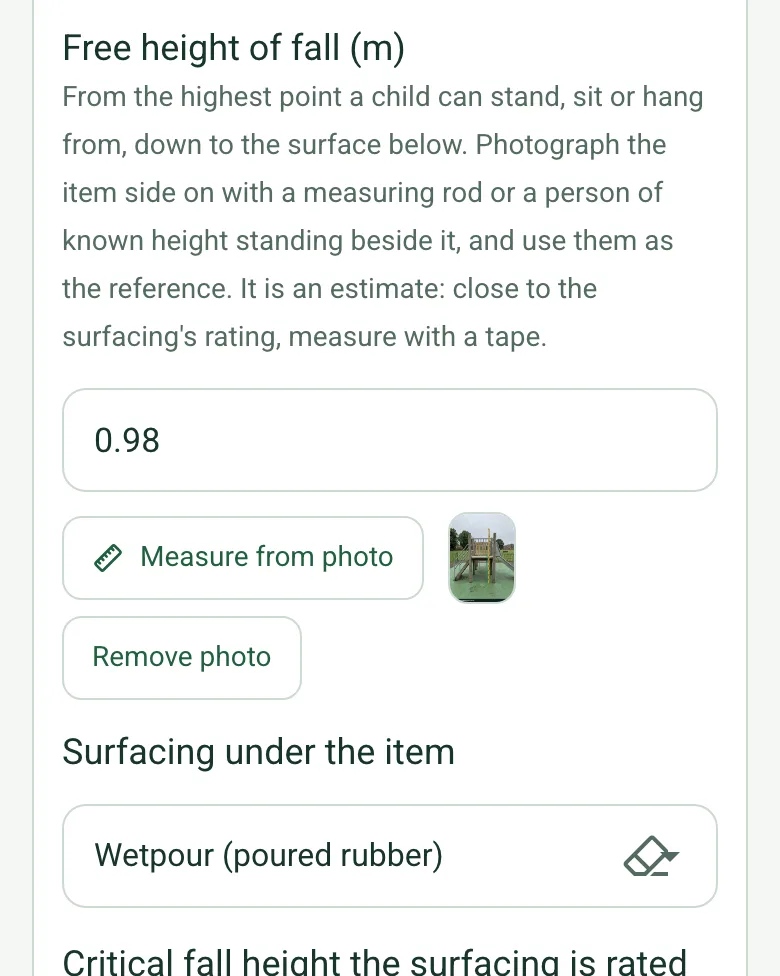
Free height of fall filled in from a measuring photo, with the photo thumbnail, wetpour surfacing rated 2.0 m and Within the surfacing rating

Fall height measured from a photo

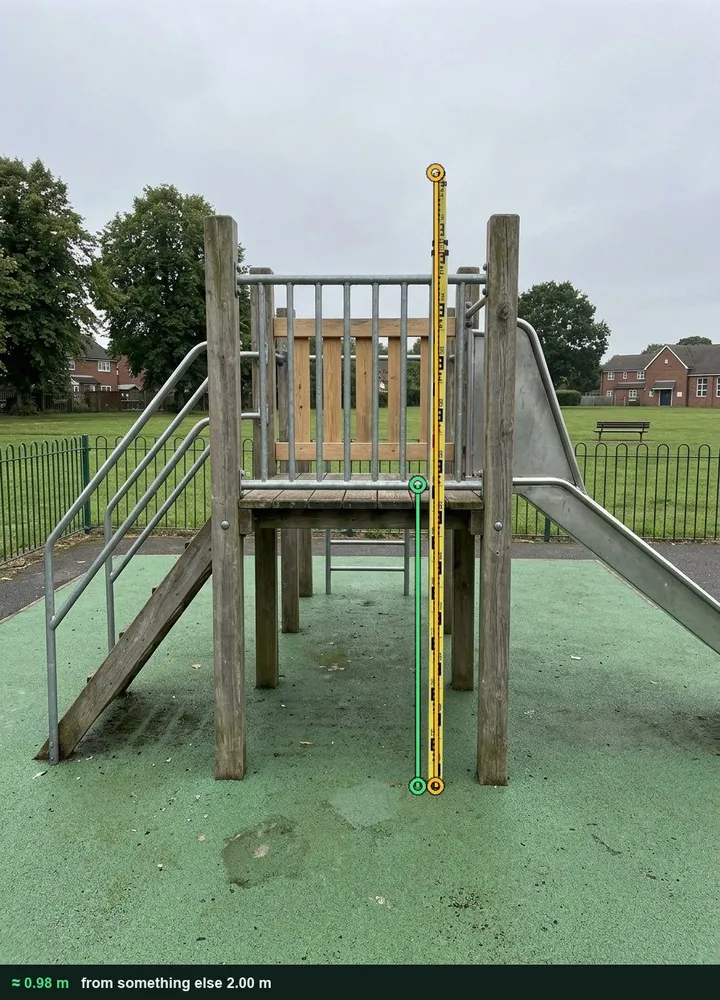
Photograph the item side on with a measuring rod or a person of known height beside it, tap the reference, then the platform and the surface. The form compares the height with the critical fall height on the surfacing's test certificate. It is an estimate: close to the rating, use a tape. It works on web forms in any phone browser today, and the app version is on its way.

How measuring from a photo works →
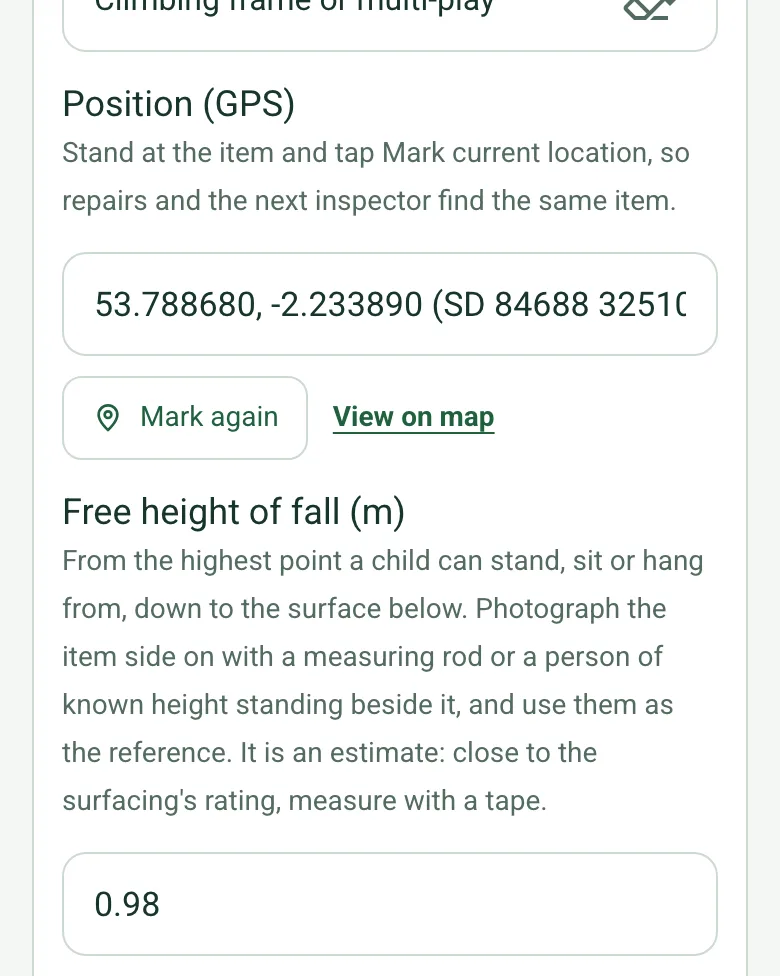
Position (GPS) for an item filled in with the coordinates, grid reference and accuracy, and a View on map link

Pin each item

Stand at the item and tap Mark current location, so the repair team and the next inspector find the right swing or springer. Mark current location works on web forms in any phone browser today, and the app version is on its way.

How GPS location works →
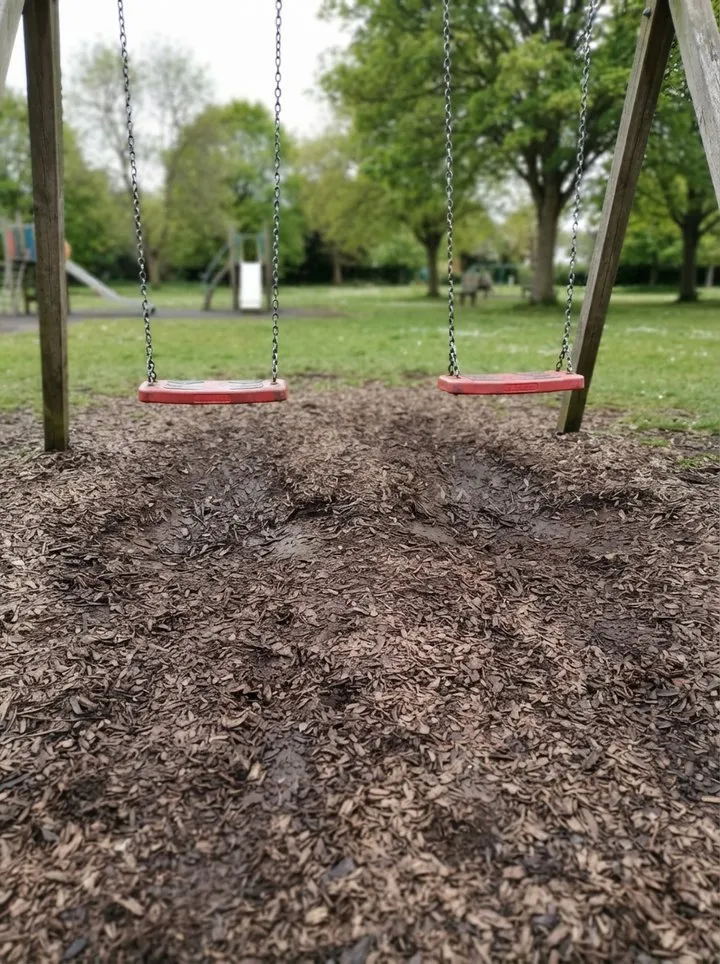
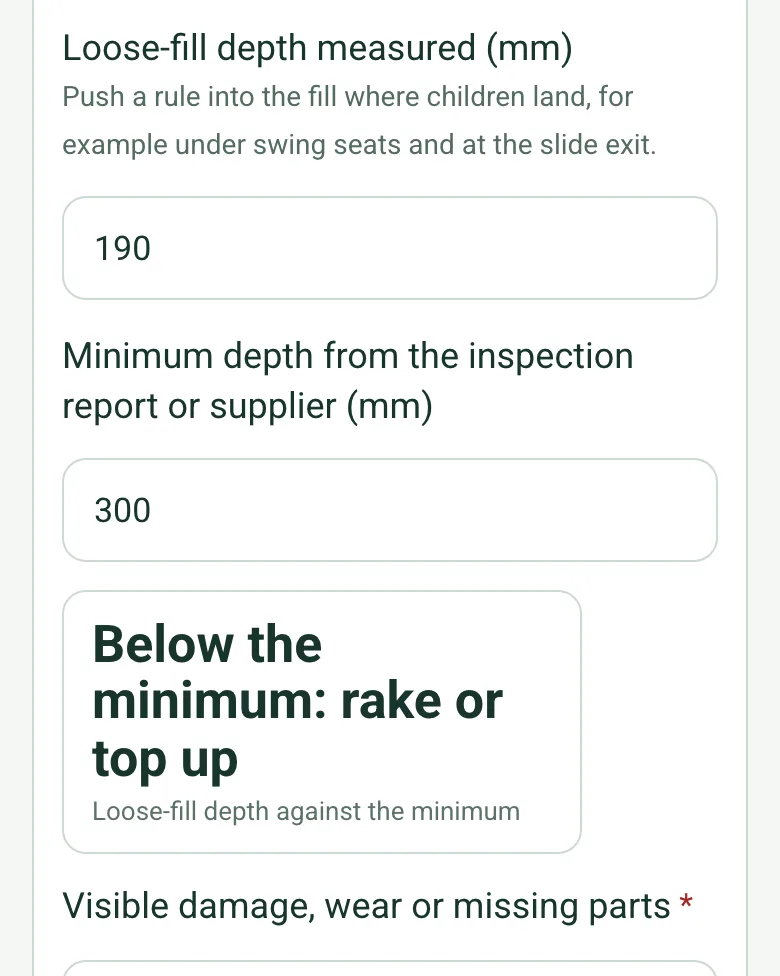
Bark under the swings measured at 190 mm against a 300 mm minimum, and Below the minimum: rake or top up

Loose-fill depth against the minimum

For bark and sand, push a rule into the fill where children land and enter the minimum from the inspection report. The form says when it has been scuffed too thin.

How calculated fields work →
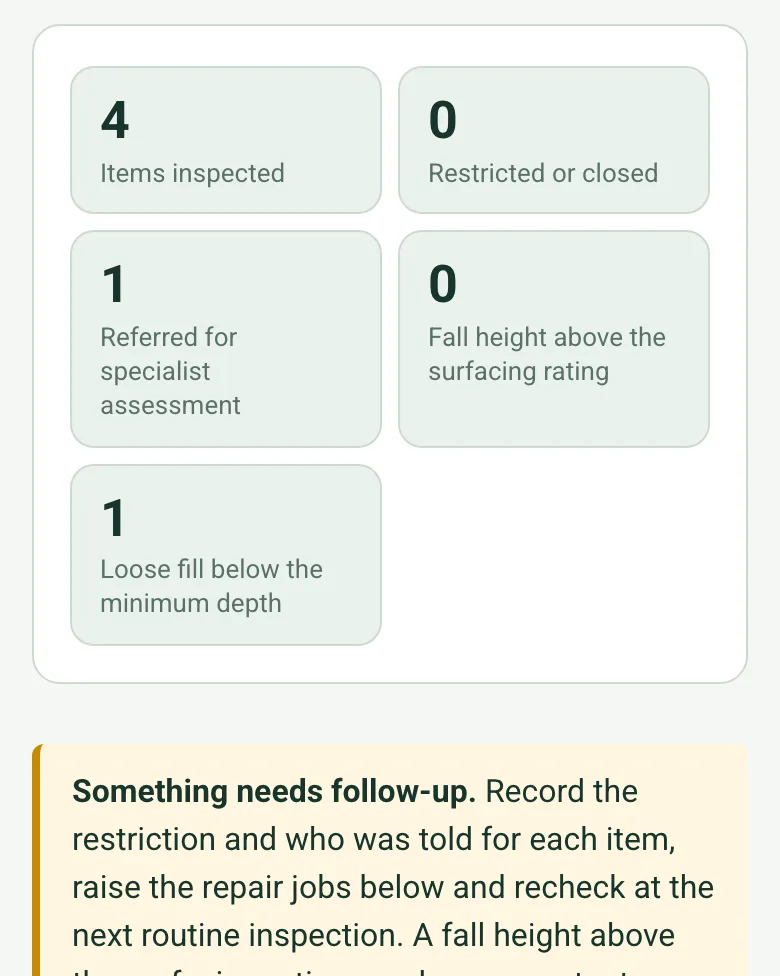
4 items inspected, 0 restricted or closed, 1 referred for specialist assessment, 0 above the surfacing rating and 1 short of loose fill, with an amber note

Follow-up counted

The form counts the items restricted or closed, referred for specialist assessment, above the surfacing rating or short of fill, and asks for the repair jobs before you sign.

How calculated fields work →

A completed playground inspection

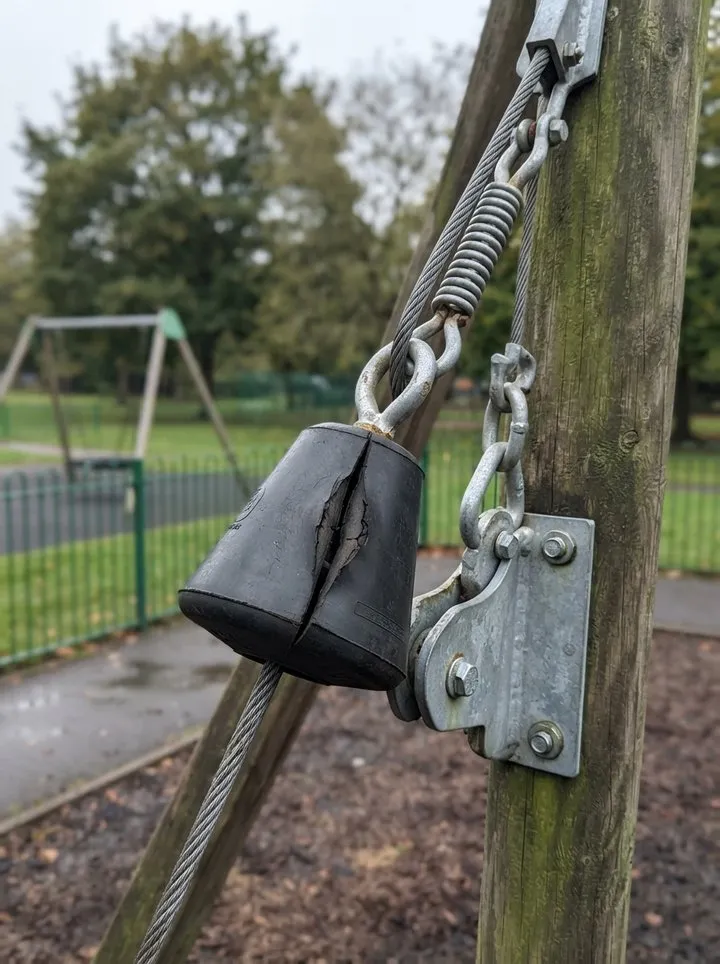
A weekly check of a fictional park play area: four items pinned, the multi-play platform measured from a photo at about 0.98 m, within its 2.0 m wetpour rating, bark under the swings at 190 mm against 300 mm, and a split cableway buffer referred to the supplier. Open it as a filled-in form, or switch to a blank copy and try it yourself.

A multi-play unit on wetpour with a measuring staff beside the platform, marked up to measure the platform height
PV-07-04 platform · about 0.98 m from the photo · wetpour rated 2.0 m
A two-bay swing over a bark pit with hollows worn under the seats
PV-07-03 swings · bark 190 mm against 300 mm
The end stop buffer of a cableway on a timber post, split along one side
PV-07-05 cableway · split buffer · referred
Swings and surfacing on a routine check

Try the playground visual inspection form live

Answer a few questions and watch it adapt. Your answers are not saved, and any photos you add are deleted within the hour.

Live form: Playground Visual InspectionOpen full screen ↗
Fill it in right here

This is the real form as your team would use it: questions appear as you answer, scores work themselves out and you can add photos and signatures. No sign-up needed. Or open a completed example to see every answer, photo and score filled in.

Want to see one filled in? See a completed playground visual inspection report (PDF), made by SiteSurvey from a fictional site visit.

Walk Cam route · four guided clips

Record the playground visual inspection on video

Show the whole play area before moving to equipment and surfacing. Keep a visual record of where each observation was made and what needs follow-up.

Identify the site, equipment and visit stage, then take a wide view before each closer clip. Record obvious visible condition and where the camera cannot see. Route any concern for prompt action under the operator’s inspection and maintenance process.

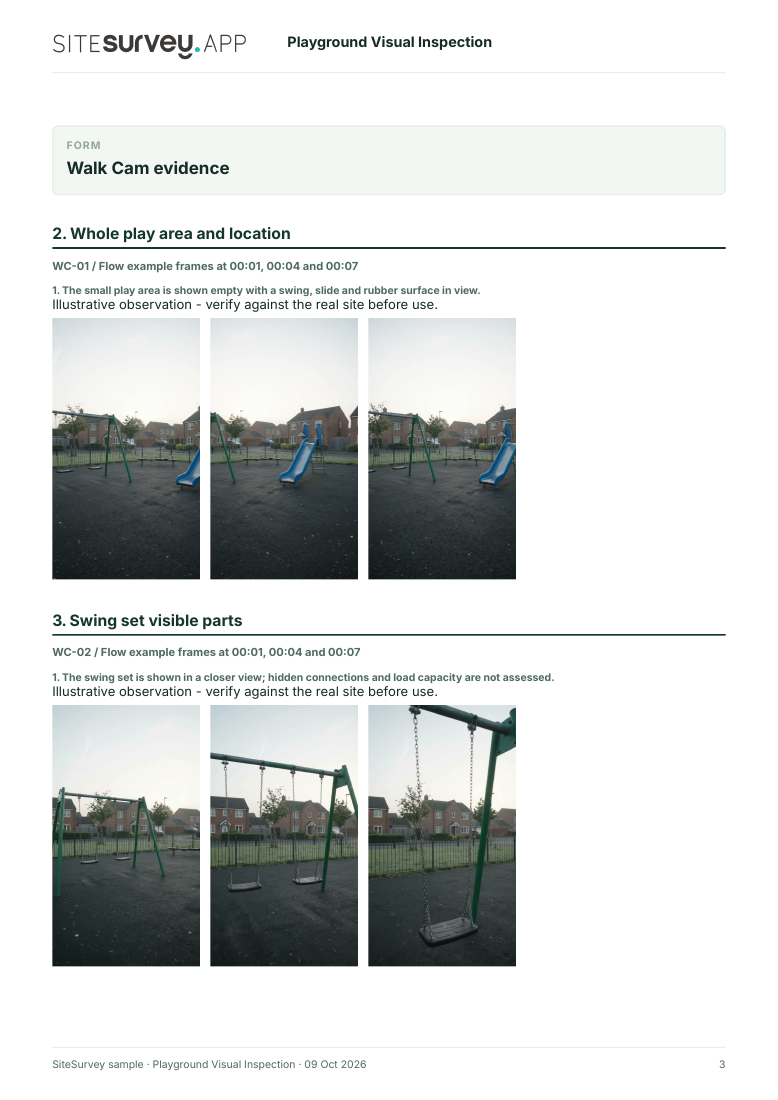
See the footage in a report

A fictional six-page example with the four points, twelve stills from the clips, observations, follow-up actions and the limits of a visual record.

View the visual evidence (PDF) ↗ · Download the full sample report

Visual evidence page from the playground visual inspection sample report, with footage stills and observations

Routine phone footage cannot test stability, impact protection or BS EN 1176 compliance. It does not replace operational or annual specialist inspection. Example footage was generated in Google Flow and the observations are scripted; no real site is shown. Walk Cam works inside any form in the app. How Walk Cam works · All visual inspections

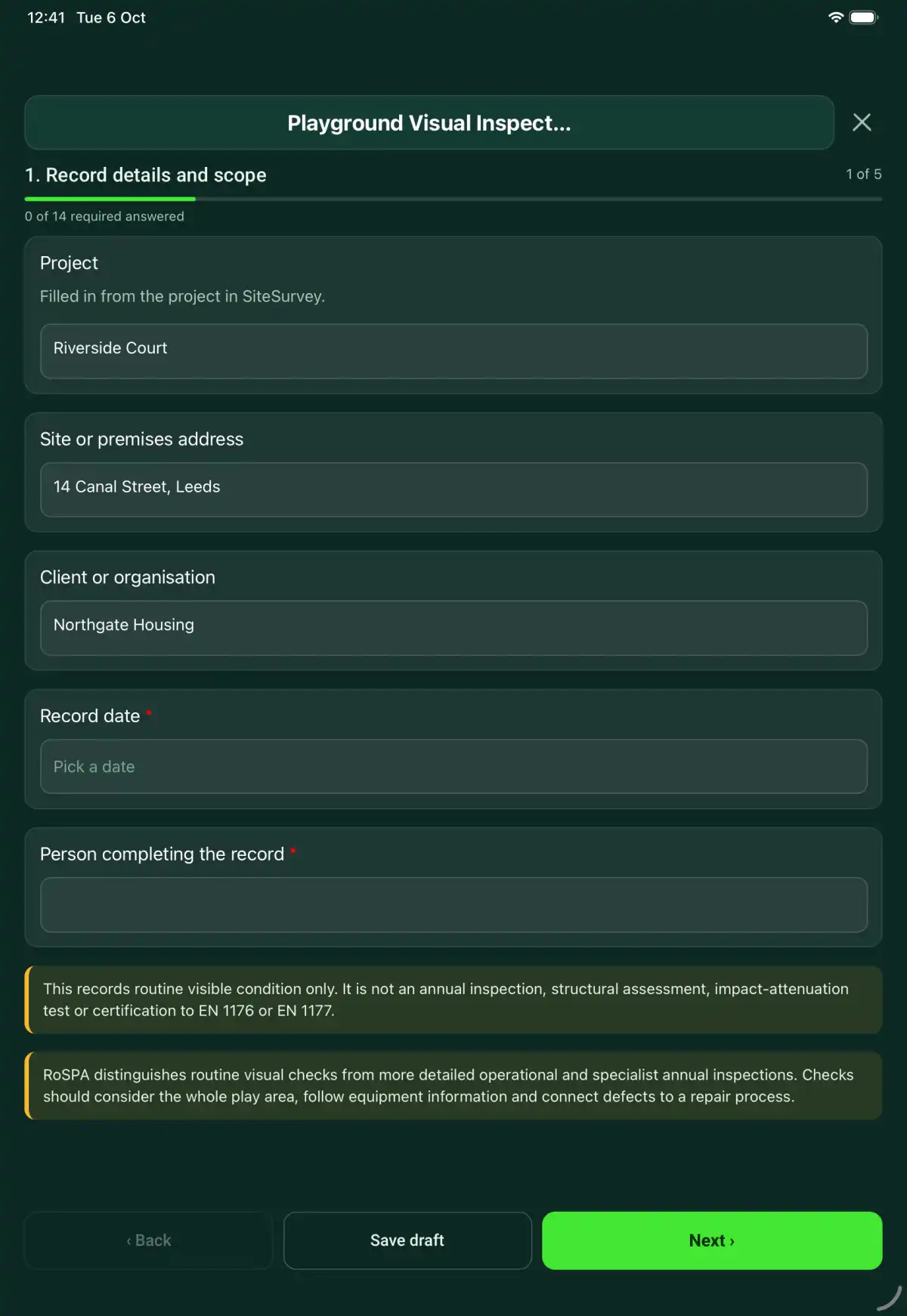
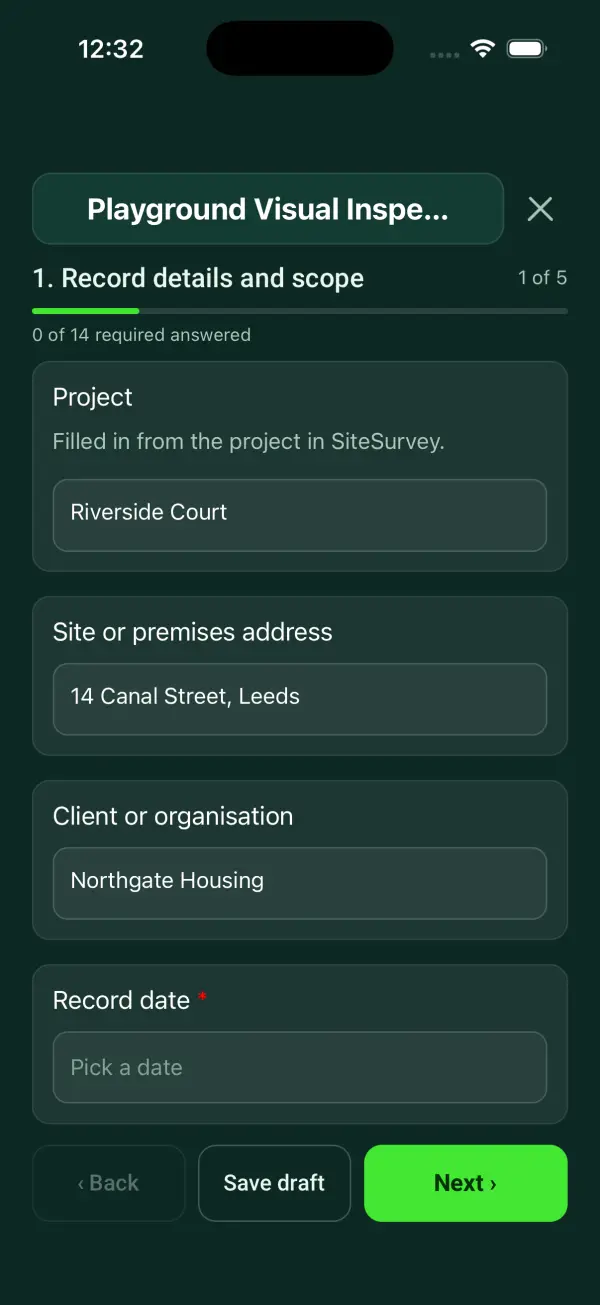
Fill it in on a phone or tablet

Your team completes the playground visual inspection on site in the SiteSurvey app on iPhone, iPad and Android phones and tablets. The project name and address fill in for them, it works without signal, and it syncs when the device is back online with photos kept against the question they answer.

Customers and subcontractors do not need the app: send them a link and they can fill it in from any browser.

The Playground Visual Inspection form in the SiteSurvey app on a tablet
The Playground Visual Inspection form in the SiteSurvey app on a phone

Every question in the playground visual inspection template

A routine playground visual inspection: area checks, then each item pinned by GPS with its fall height measured from a photo against the surfacing's rated critical fall height, loose-fill depth against the minimum, restrictions and repair follow-up, with counts. 5 sections and 55 questions. Follow-up questions and guidance appear only when an answer calls for them, so the person on site never sees the ones that do not apply.

Make it your own: every question is editable

This is a starting point, not a fixed form. Once it is in your SiteSurvey account you can reword any question, add or remove questions, sections and answer options, and add your own logo, so it fits the way your team works and the jobs you do.

Details you only enter once

Add this form to a project in SiteSurvey and it fills in what the project already knows, so nobody on site retypes it and every form on the job uses the same names. Anything filled in can still be changed.

  • Project: the project name
  • Site or premises address: the site address, from the space or the project
  • Client or organisation: the project's customer

Record details and scope

  • ProjectShort answer

    Filled in from the project in SiteSurvey.

    Fills in from the project name
  • Site or premises addressShort answer
    Fills in from the site address, from the space or the project
  • Client or organisationShort answer
    Fills in from the project's customer
  • Record date*Date
  • Person completing the record*Short answer
  • CheckThis records routine visible condition only. It is not an annual inspection, structural assessment, impact-attenuation test or certification to EN 1176 or EN 1177.
  • CheckSources. BS EN 1176-7:2020 (Playground equipment and surfacing, Part 7: Guidance on installation, inspection, maintenance and operation) sets out three levels of inspection: routine visual inspection, operational inspection and annual main inspection, at a frequency set by the operator taking account of the manufacturer's instructions and how the site is used. RoSPA guidance follows the same levels. Checks should consider the whole play area, follow equipment information and connect defects to a repair process. The general duty of care comes from the Health and Safety at Work etc. Act 1974 and the Occupiers' Liability Acts 1957 and 1984.

Play area and scope

  • Walk Cam: playground walk-roundWalk Cam video with voice-to-text

    Optional. Film a guided walk-through on the SiteSurvey app.

  • Play area and asset-plan reference*Short answer
  • Inspector and training reference*Short answer
  • Inspection schedule and supplier checklist referenceShort answer
  • Weather on siteAnswer
  • Access, light or other inspection limitationsNotes

    State inaccessible or closed equipment and poor light. A visual visit should not imply that hidden components or specialist tests were covered.

Area checks

  • Entrances, paths and boundary condition checked*Choose one
    • Acceptable
    • Action needed
    • Not checked
    • Not applicable
  • Action, limitation or reason not applicable*Notes
    Shown only when the answers above make it relevant
  • Litter, sharps or contamination addressed through safe arrangements*Choose one
    • Acceptable
    • Action needed
    • Not checked
    • Not applicable
  • Action, limitation or reason not applicable*Notes
    Shown only when the answers above make it relevant
  • Surfacing and fall spaces checked visually*Choose one
    • Acceptable
    • Action needed
    • Not checked
    • Not applicable
  • Action, limitation or reason not applicable*Notes
    Shown only when the answers above make it relevant
  • Signs, seating and other site features checked*Choose one
    • Acceptable
    • Action needed
    • Not checked
    • Not applicable
  • Action, limitation or reason not applicable*Notes
    Shown only when the answers above make it relevant
  • Area checks needing actionWorked out by the form

Equipment and defects

  • Equipment item
    Repeat for each equipment. Each one asks:
    • Equipment ID and location*Short answer
    • TypeChoose one
      • Swing
      • Slide
      • Climbing frame or multi-play
      • Cableway
      • Roundabout or spinner
      • Springer or rocker
      • Seesaw
      • Ground-level trampoline
      • Other
    • Position (GPS)Short answer

      Stand at the item and tap Mark current location, so repairs and the next inspector find the same item.

    • Free height of fall (m)Number

      From the highest point a child can stand, sit or hang from, down to the surface below. Photograph the item side on with a measuring rod or a person of known height standing beside it, and use them as the reference. It is an estimate: close to the surfacing's rating, measure with a tape.

    • Surfacing under the itemChoose one
      • Grass or topsoil
      • Bark or woodchip
      • Sand or pea gravel
      • Wetpour (poured rubber)
      • Rubber tiles or mats
      • Synthetic grass on a shock pad
      • Hard surface (tarmac or paving)
    • Critical fall height the surfacing is rated for (m)Number

      From the supplier's test certificate or the annual inspection report.

    • Fall height against the surfacingWorked out by the form
      Shown only when the answers above make it relevant
    • Loose-fill depth measured (mm)Number

      Push a rule into the fill where children land, for example under swing seats and at the slide exit.

      Shown only when the answers above make it relevant
    • Minimum depth from the inspection report or supplier (mm)Number
      Shown only when the answers above make it relevant
    • Loose-fill depth against the minimumWorked out by the form
      Shown only when the answers above make it relevant
    • Visible damage, wear or missing parts*Notes
    • Action*Choose one
      • No immediate restriction identified
      • Restrict access
      • Close equipment or area
      • Refer for specialist assessment
    • Restriction method and person notifiedNotes
    • Supporting photosPhotos
  • Items inspectedWorked out by the form
  • Restricted or closedWorked out by the form
  • Referred for specialist assessmentWorked out by the form
  • Fall height above the surfacing ratingWorked out by the form
  • Loose fill below the minimum depthWorked out by the form
  • CheckSomething needs follow-up. Record the restriction and who was told for each item, raise the repair jobs below and recheck at the next routine inspection. A fall height above the surfacing rating needs a competent inspector to assess it; this visual check does not test the surfacing.
    Shown only when the answers above make it relevant
  • Repair and reinspection referencesNotes

Actions and review

  • Are further actions required?*Choose one
    • Yes
    • No
  • Further action
    Repeat for each further action. Each one asks:
    Shown when “Are further actions required?” is “Yes”
    • Action and evidence reference*Notes
    • PriorityChoose one
      • Urgent
      • High
      • Medium
      • Low
    • Person responsible*Short answer
    • Target dateDate
    • Action status*Choose one
      • Open
      • In progress
      • Completed
    • Completion evidence*Notes
      Shown when “Action status” is “Completed”
  • Open actionsWorked out by the form
    Shown when “Are further actions required?” is “Yes”
  • Outstanding limitations and information to pass onNotes
  • Record status*Choose one
    • Ready for review
    • Further work needed
    • Work or use stopped
  • Reviewed byShort answer
  • Date reviewedDate
  • Next routine inspection dueDate

    Set by the operator from the manufacturer's instructions and how busy the site is (BS EN 1176-7).

  • Days to the next routine inspectionWorked out by the form
    Shown when “Record date” is answered and “Next routine inspection due” is answered
  • CheckThe next inspection date is before the date of this record. Check the date.
    Shown only when the answers above make it relevant
  • Author signature*Signature
  • CheckSigning records the information entered. It does not itself certify legal compliance, remove a limitation or authorise unsafe work.

Scope and responsibility

This records routine visible condition only. It is not an annual inspection, structural assessment, impact-attenuation test or certification to EN 1176 or EN 1177.

What a useful entry looks like

Access, light or other inspection limitations

State inaccessible or closed equipment and poor light. A visual visit should not imply that hidden components or specialist tests were covered.

Visual check completed from ground level. Internal fixings and areas behind the locked service enclosure were not inspected.

Fictional example of record wording. Use the actual evidence and approved arrangements for your job; this is not a completed report or an instruction to carry out the work.

See it filled in

A completed playground visual inspection report, made by SiteSurvey from a fictional site visit: every answer, the photos, the guidance that applied and the sign-off, ready to send as a PDF.

See completed form (PDF) ↗

Playground Visual Inspection FAQs

How should I record “Access, light or other inspection limitations”?

State inaccessible or closed equipment and poor light. A visual visit should not imply that hidden components or specialist tests were covered.

How often should checks happen?

Use a schedule based on the site, usage, risks and supplier guidance. The template does not impose a universal interval.

Does a visual check prove surfacing performance?

No. It records visible condition. You enter the critical fall height the surfacing is rated for, from the supplier's test certificate or the annual inspection report, and the form flags any item whose measured fall height is higher, for a competent inspector to assess. It does not test the surfacing.

How are dangerous defects handled?

Record how access was restricted, who was informed and the repair or specialist review needed.

What are the limits of this template?

This records routine visible condition only. It is not an annual inspection, structural assessment, impact-attenuation test or certification to EN 1176 or EN 1177.

Can I complete this form on site and share the record?

In the SiteSurvey app the form works offline, with photos and signatures recorded against the questions. Share the completed record as a PDF or a link. Dates and action owners are recorded fields; this form does not send reminders or update other systems.

Related

Use this playground visual inspection form with your team

Add it from the form library in one click, change any question, and every completed form becomes a branded PDF report.

Start your trial →