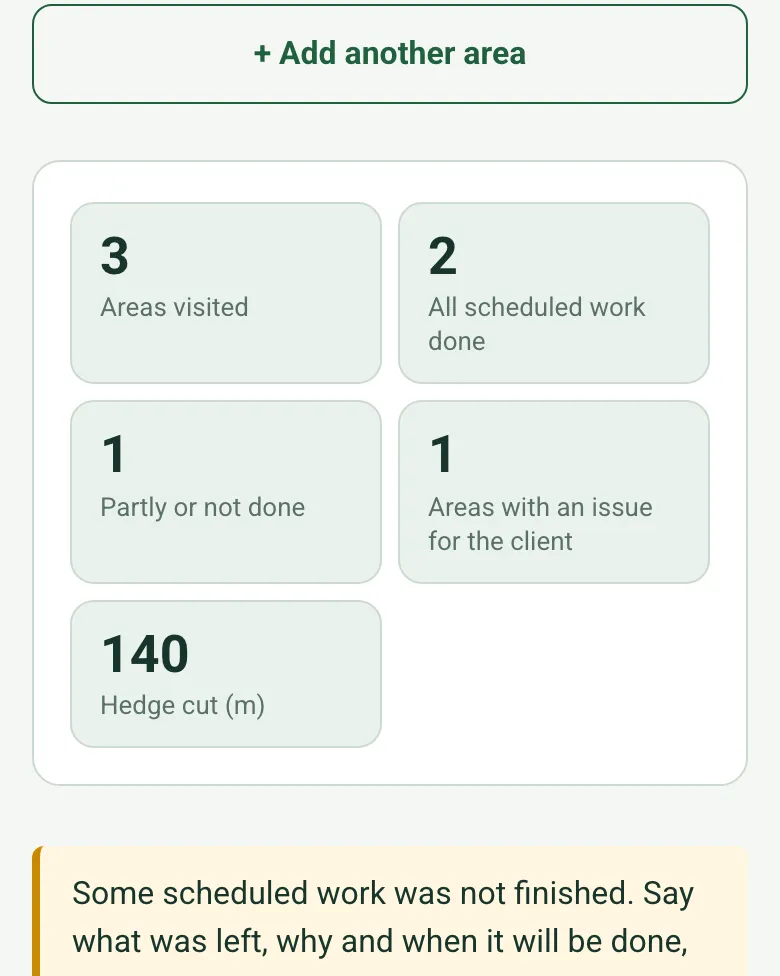
Areas done, and what was left
Say whether each area's scheduled work was all done, partly done or not done, and why. The form counts them and reminds the team to tell the client what was left.
How calculated fields work →Form library · Facilities and maintenance
A proof of visit for grounds maintenance contracts. Record the team, people and hours, and the form works out the person-hours on site. Then each area: pin it with GPS, tick the tasks done (grass, edges, hedges, beds, leaves, litter, hard surfaces, weed control), say whether the scheduled work was all done and why not, and add photos and any issue for the client. The form counts the areas done, partly done and with an issue, and totals the hedge cut. It checks for active bird nests before hedge or tree work and records the length left uncut, measured from a photo or by tape, then pesticide use, green waste and the client's signature. Try the form below, see every question or open a completed example.
Ready to use from the form library, and every question is yours to edit. Try it for a small trial fee, cancel any time.
Try it on your phone
Try it on this phone
Fill in the grounds maintenance on your phone now
See how the grounds maintenance looks on your phone
Scan the code with your phone camera. It opens the real form, no sign-up needed.
Open the live example and fill it in, just as your team would on site. No sign-up needed.
See it on this phoneEvery question is editable. Add this form to your account, then change the wording, add or remove questions and options, and make it fit your own jobs.
A grounds maintenance visit record should show the date, team and hours, each area visited with the tasks done and photos, any issues found such as damage or fly-tipping, any pesticide use, how green waste was dealt with, and the client's sign-off. Dated records with photos prove each visit in the contract was made.
Last updated . Facts checked by the SiteSurvey team on 17 October 2026 against section 1 of the Wildlife and Countryside Act 1981 (wild birds, their nests and eggs), GOV.UK: wild birds, protection and licences and article 67 of Regulation (EC) No 1107/2009 (pesticide record-keeping).
Record each area with its GPS point, the tasks done and whether the scheduled work was all done, and the form counts the areas done, partly done and with an issue for the client, works out the person-hours and totals the hedge cut. A nest found before hedge work is recorded with the length left uncut, by tape or from a photo.
Say whether each area's scheduled work was all done, partly done or not done, and why. The form counts them and reminds the team to tell the client what was left.
How calculated fields work →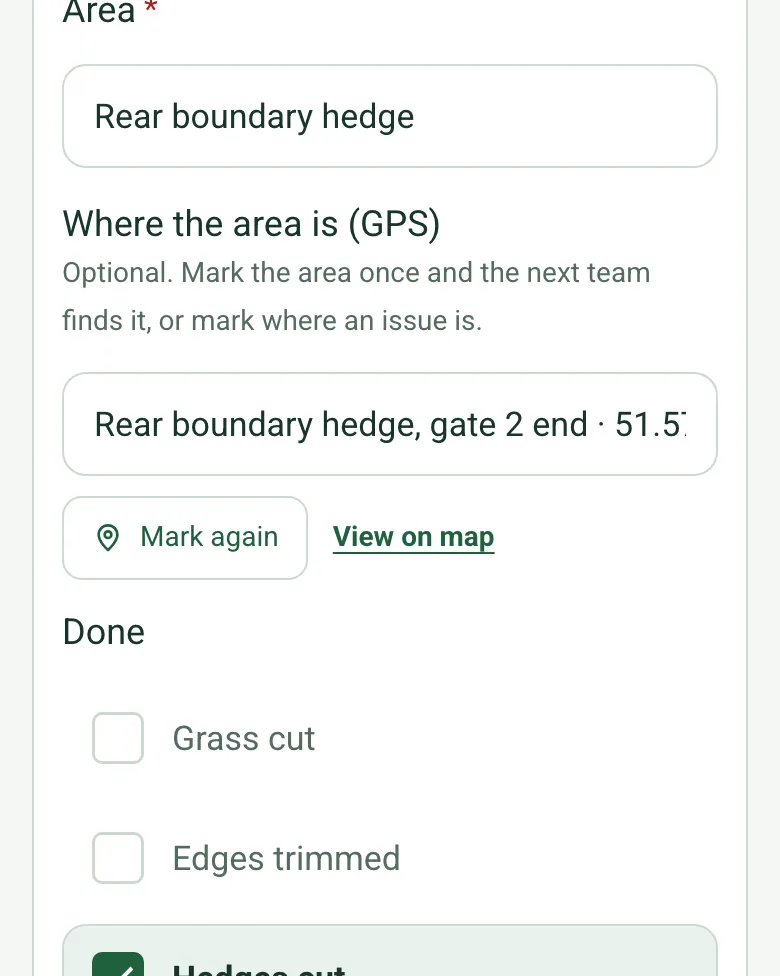
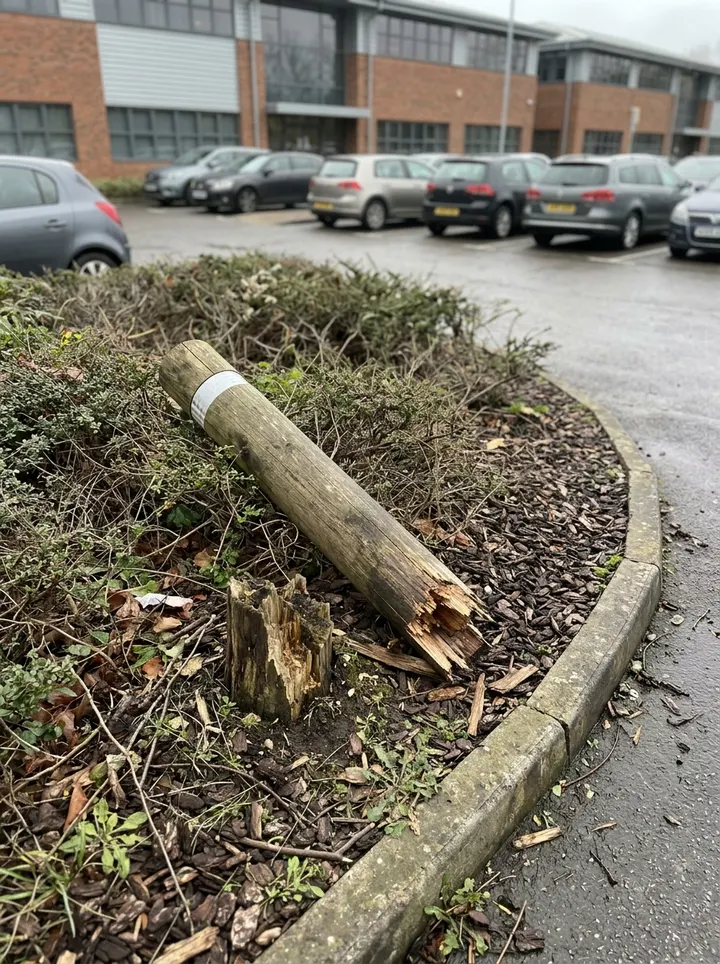
Mark each area once and the next team finds it, or mark exactly where an issue is, such as a broken bollard in a car park island.
How GPS location works →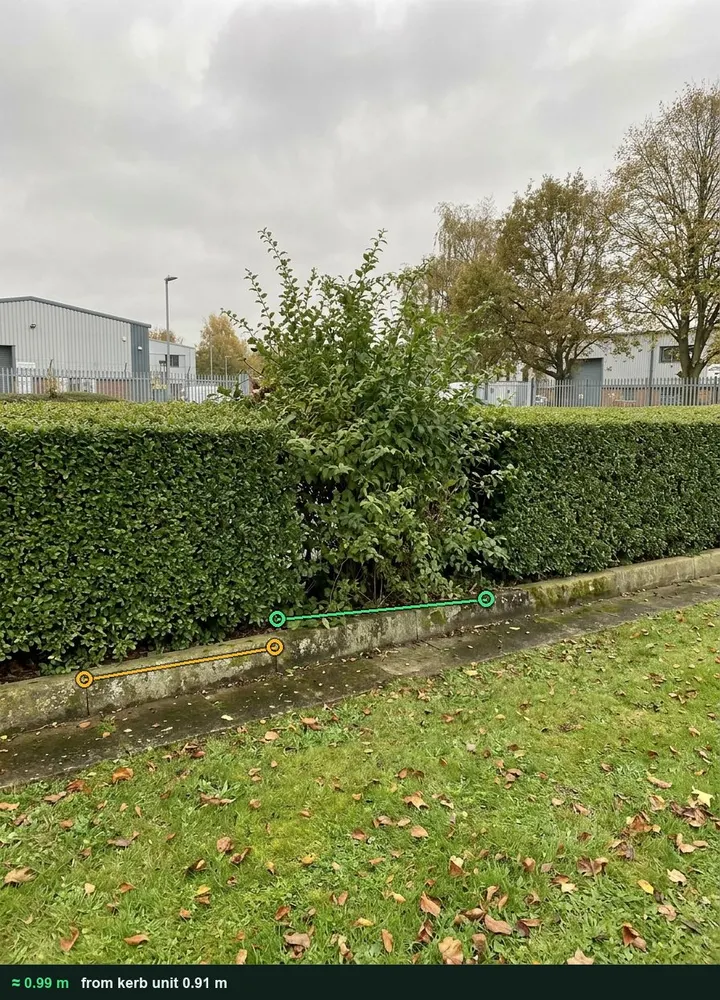
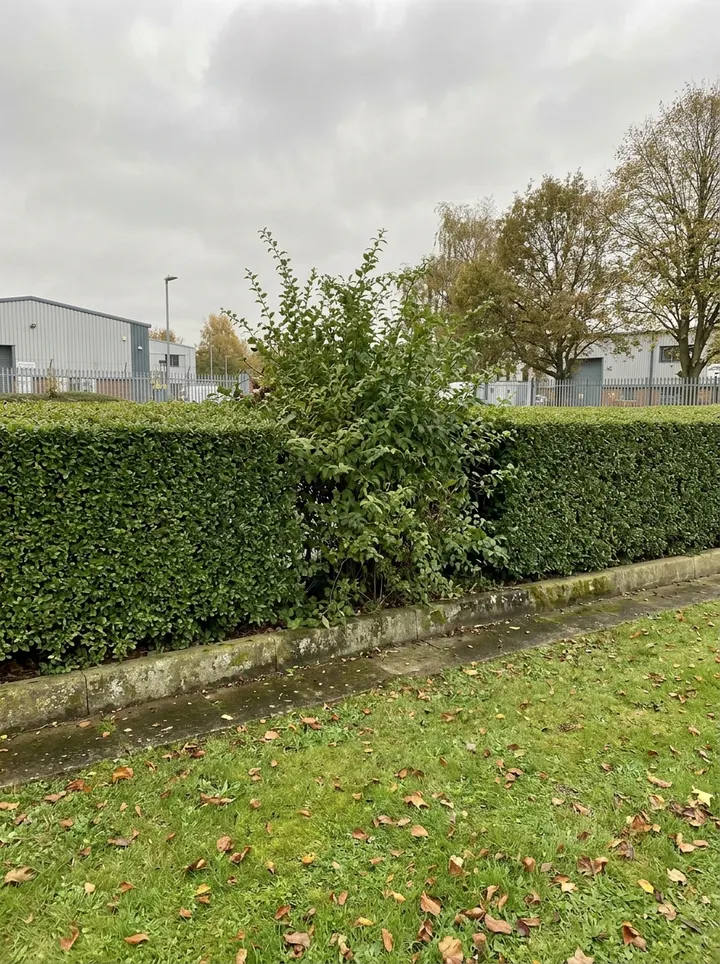
When an active nest is found, record where and measure the length left uncut, by tape or from a photo with a known size such as a kerb unit. It works on web forms in any phone browser today, and the app version is on its way.
How measuring from a photo works →The optional Walk Cam route films the overview, edges, borders and paths, so the client sees the finish as well as the ticks.
A fictional business park in Swindon: three people for six hours (18 person-hours), three areas pinned with GPS, car park island 5 left unweeded because cars were parked over it, a broken bollard reported, 140 m of hedge cut and about 1 m left uncut round an active blackbird nest.
Answer a few questions and watch it adapt. Your answers are not saved, and any photos you add are deleted within the hour.
This is the real form as your team would use it: questions appear as you answer, scores work themselves out and you can add photos and signatures. No sign-up needed. Or open a completed example to see every answer, photo and score filled in.
Want to see one filled in? See a completed grounds maintenance report (PDF), made by SiteSurvey from a fictional site visit.
Walk Cam route · four guided clips
Film the whole garden, lawn and edges, planted beds, and a final view before signing off visible maintenance work.
Record the site, scheduled work and visit date before filming. Walk a repeatable route from overview to lawn edge, beds and a final view. Describe visible outcomes and missed locations, then compare with the agreed specification.
Show the maintained area from a fixed starting position so later close-ups can be located.
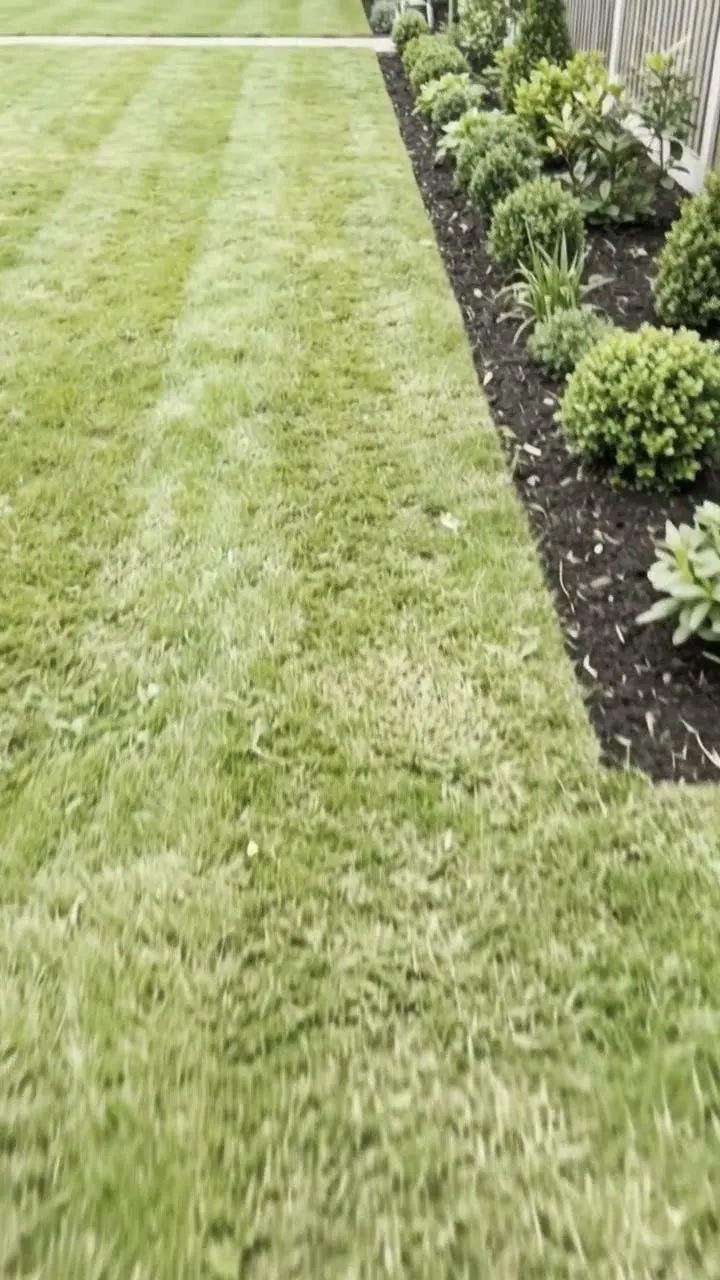
The staged garden overview shows lawn, border and paving from the patio.
Move along an accessible lawn edge under consistent light and show any missed growth or clippings.
A trimmed lawn edge is visible in the staged view; a full perimeter check is not established.
Record the bed surface, obvious weeds and retained plantings without disturbing them.
The planted border is shown in context; hidden roots and plant health are not assessed.
Show the remaining accessible planting and finish with wider garden context. Note paths or areas not shown.
The staged final clip shows planting bed detail; the path and wider property are not established.
A fictional six-page example with the four points, twelve stills from the clips, observations, follow-up actions and the limits of a visual record.
View the visual evidence (PDF) ↗ · Download the full sample report
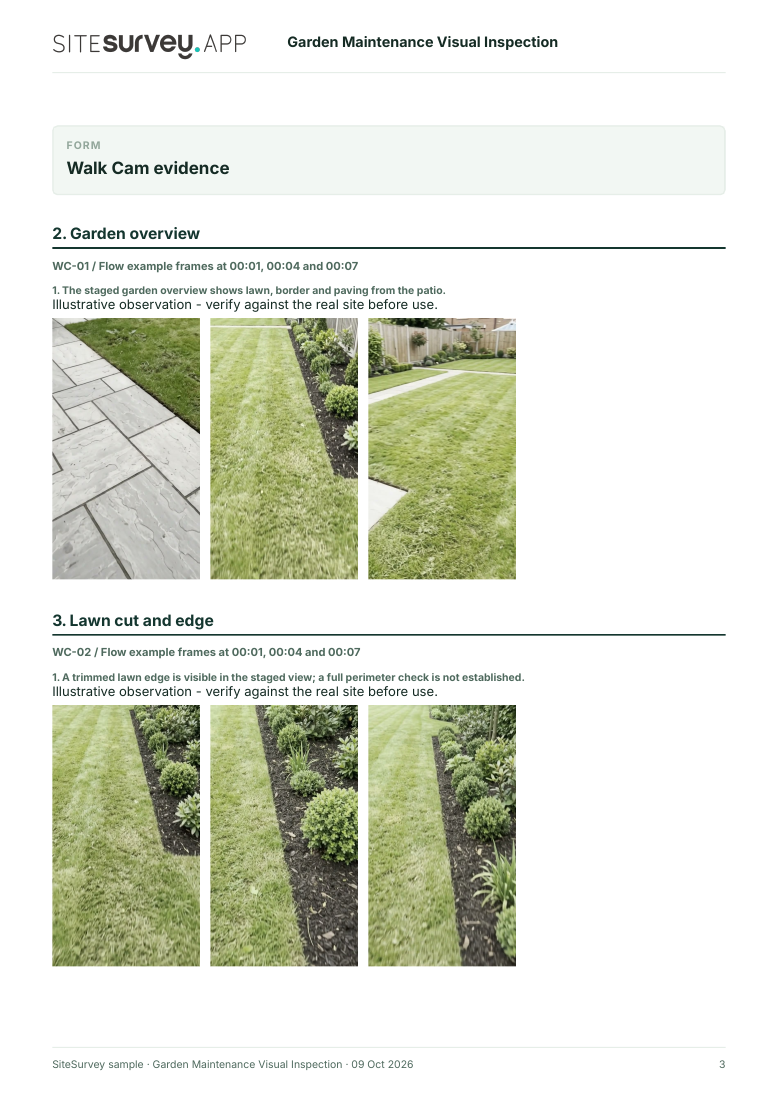
A phone recording shows visible condition at one visit. It does not prove plant health, treatment effectiveness, hidden ground condition or that all contracted work was completed. Check the agreed maintenance scope separately. Example footage was generated in Google Flow and the observations are scripted; no real site is shown. Walk Cam works inside any form in the app. How Walk Cam works · All visual inspections
A grounds maintenance visit record: each area with tasks done, photos and issues, weed control, nesting bird checks before hedge work, waste removed, and the client's sign-off as proof of visit. 3 sections and 39 questions. Follow-up questions and guidance appear only when an answer calls for them, so the person on site never sees the ones that do not apply.
This is a starting point, not a fixed form. Once it is in your SiteSurvey account you can reword any question, add or remove questions, sections and answer options, and add your own logo, so it fits the way your team works and the jobs you do.
Add this form to a project in SiteSurvey and it fills in what the project already knows, so nobody on site retypes it and every form on the job uses the same names. Anything filled in can still be changed.
Hours each person spent on site.
Optional. Mark the area once and the next team finds it, or mark where an issue is.
Optional. By tape or pacing, or from the site schedule.
Optional. Use a tape, or measure from a photo with something of known size in the same plane, such as a 1.83 m (6 ft) fence panel or a gate.
Optional. Film the four guided points on the SiteSurvey app; each clip keeps its spoken note.
A completed grounds maintenance report, made by SiteSurvey from a fictional site visit: every answer, the photos, the guidance that applied and the sign-off, ready to send as a PDF.
It is an offence to intentionally take, damage or destroy the nest of any wild bird while it is in use or being built. GOV.UK advises timing work such as hedge and tree cutting to avoid the breeding season. The form asks whether nests were checked, warns if not, and records any active nest left uncut.
Professional users must keep a record of each plant protection product they use, with the product name, the time and dose of application and the area treated, for at least 3 years. The form records the product, area and dose for the visit; use the pesticide application record for the full details.
Yes. Each area has its own photos and a GPS point, and you say whether the scheduled work was all done, partly done or not done, and why. The form counts the areas in each case, so the client sees the result area by area.
Yes. The client or site contact signs on your phone, and the record goes as a PDF or a link.
Yes. Record damage, fly-tipping or hazards in each area so the client can act on them.
Grounds maintenance and landscaping contractors, housing associations, councils, schools and business parks.
Related templates
A park and open space inspection: paths, benches, bins, signs, fencing and gates, trees, water features, lighting, litter and hazards, each issue with risk, photos and action.
A professional grounds pesticide application record: authorised product and label, each treated area pinned by GPS with its area and product used, the dose applied per hectare against the label maximum, weather, exposure controls and follow-up.
A tree condition survey: every tree with its tag, species, size, condition, defects, the people or property it could hit, risk, recommended work and urgency, plus TPO and conservation area checks.
A fly-tipping report for land and estate managers: location, waste types and size, hazards, evidence, photos, council or Environment Agency reports, and clearance by a registered waste carrier with the transfer note.
Add it from the form library in one click, change any question, and every completed form becomes a branded PDF report.
Start your trial →