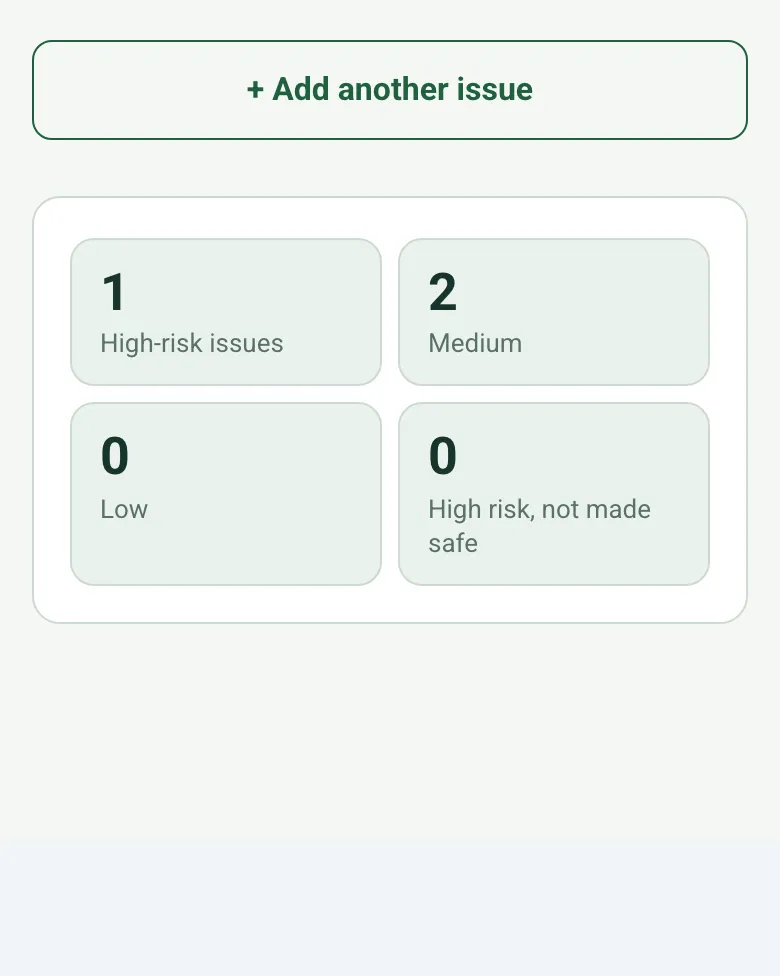
Issues counted by risk
Set each issue's risk and the form counts the high, medium and low risks. A high-risk issue not made safe on site is counted on its own and brings up a red note.
How calculated fields work →Form library · Facilities and maintenance
A routine safety and condition inspection of a park or open space. Record whether it is a routine visit or after a report or storm, then check the paths and steps, benches and bins, signs, fencing and gates, trees, ponds and water features, lighting and litter, and the form counts the checks OK and with defects. Pin each issue with GPS, measure the length affected by tape or from a photo, and set its risk. The form counts high, medium and low risk issues, flags any high-risk issue not made safe on site, and counts the actions still open. Try the form below, see every question or open a completed example.
Ready to use from the form library, and every question is yours to edit. Try it for a small trial fee, cancel any time.
Try it on your phone
Try it on this phone
Fill in the park inspection on your phone now
See how the park inspection looks on your phone
Scan the code with your phone camera. It opens the real form, no sign-up needed.
Open the live example and fill it in, just as your team would on site. No sign-up needed.
See it on this phoneEvery question is editable. Add this form to your account, then change the wording, add or remove questions and options, and make it fit your own jobs.
Under section 2 of the Occupiers' Liability Act 1957, an occupier owes visitors a duty to take such care as is reasonable in all the circumstances to see that they will be reasonably safe. The Occupiers' Liability Act 1984 adds a duty, in some circumstances, to people who are not visitors. Regular inspections of paths, furniture, boundaries, trees, water features, lighting and litter, with issues recorded and acted on, show what was checked and done.
Last updated . Facts checked by the SiteSurvey team on 17 October 2026 against section 2 of the Occupiers' Liability Act 1957 (common duty of care) and section 1 of the Occupiers' Liability Act 1984 (duty to people other than visitors).
Work through the paths, furniture, signs, fencing, trees, water, lighting and litter checks, and the form counts them. Each issue gets its GPS point, its risk and the length or size affected, by tape or from a photo, and the form counts issues by risk and flags any high-risk issue not made safe on site.
Set each issue's risk and the form counts the high, medium and low risks. A high-risk issue not made safe on site is counted on its own and brings up a red note.
How calculated fields work →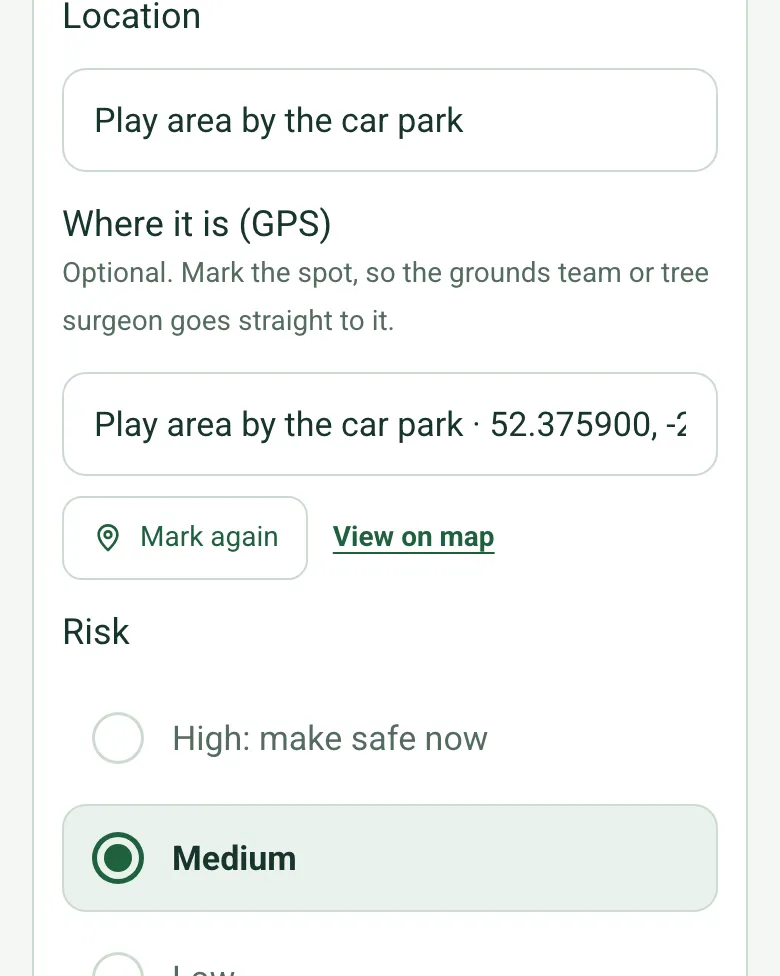
Mark each issue where you stand, so the grounds team or the tree surgeon goes straight to it, even in a large open space.
How GPS location works →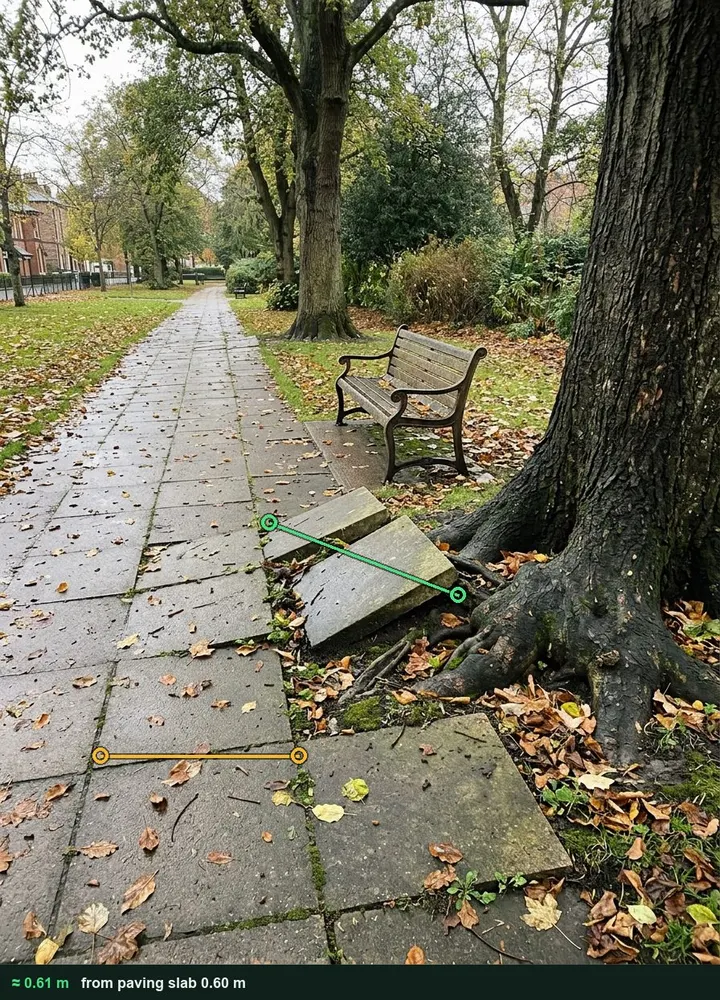
Use a paving slab or another known size in the same plane to measure the length or size affected, for the repair order. It works on web forms in any phone browser today, and the app version is on its way.
How measuring from a photo works →Add a short clip or photos to any issue, so the tree surgeon or the grounds team sees what you saw.
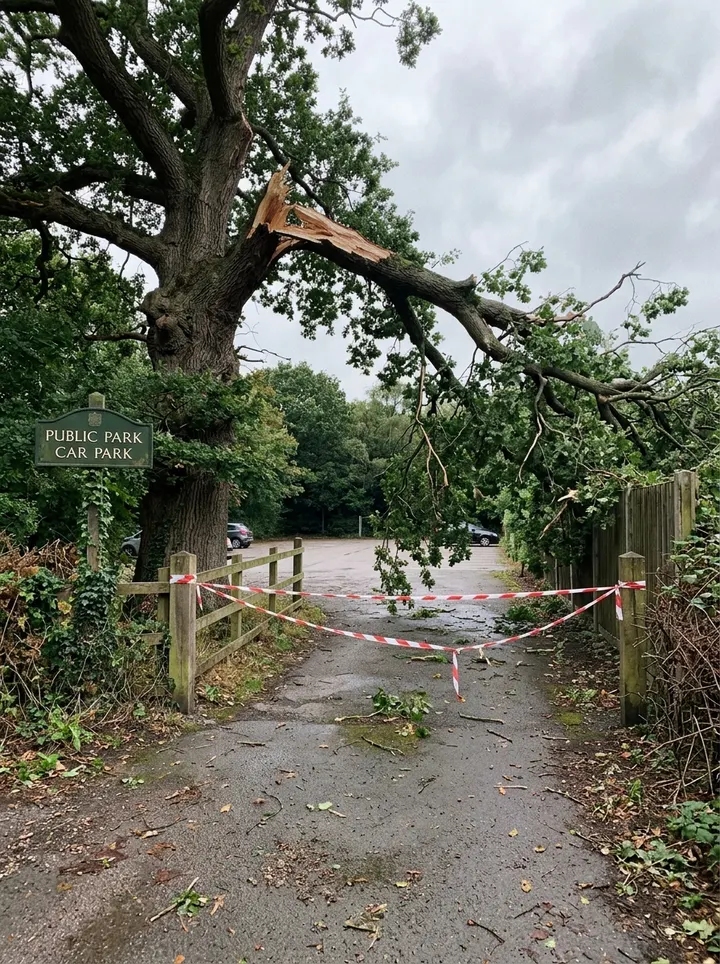
A fictional riverside park in Bewdley: a hanging branch over the car park entrance taped off on the day, two slabs lifted by tree roots by bench 4 (the lifted area about 0.61 m across, measured from a photo) and a split buffer on the cableway referred to the play inspector.
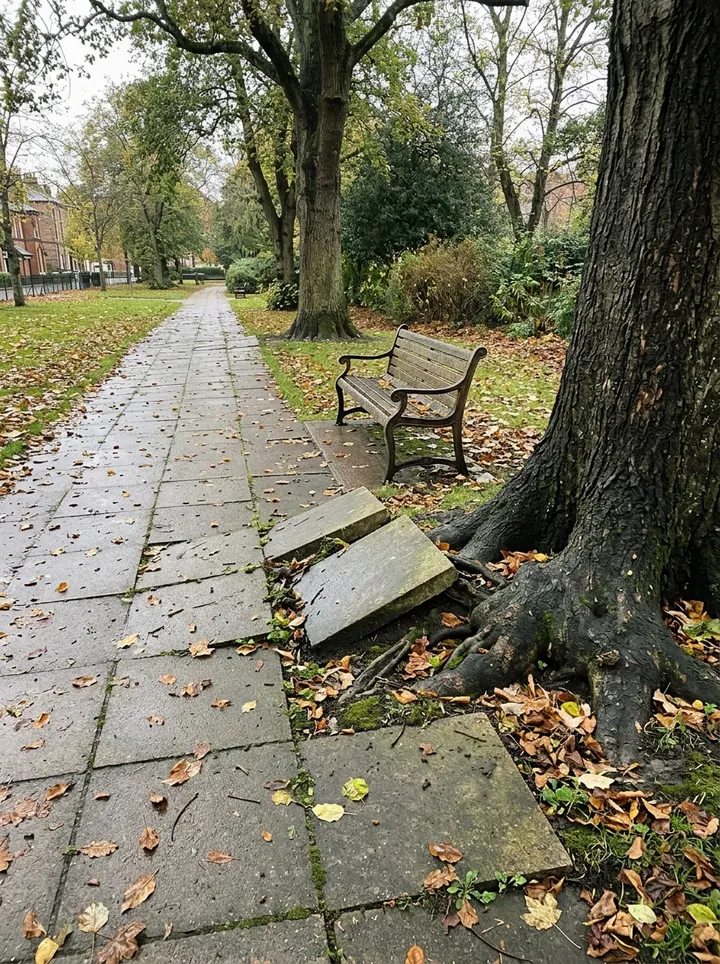
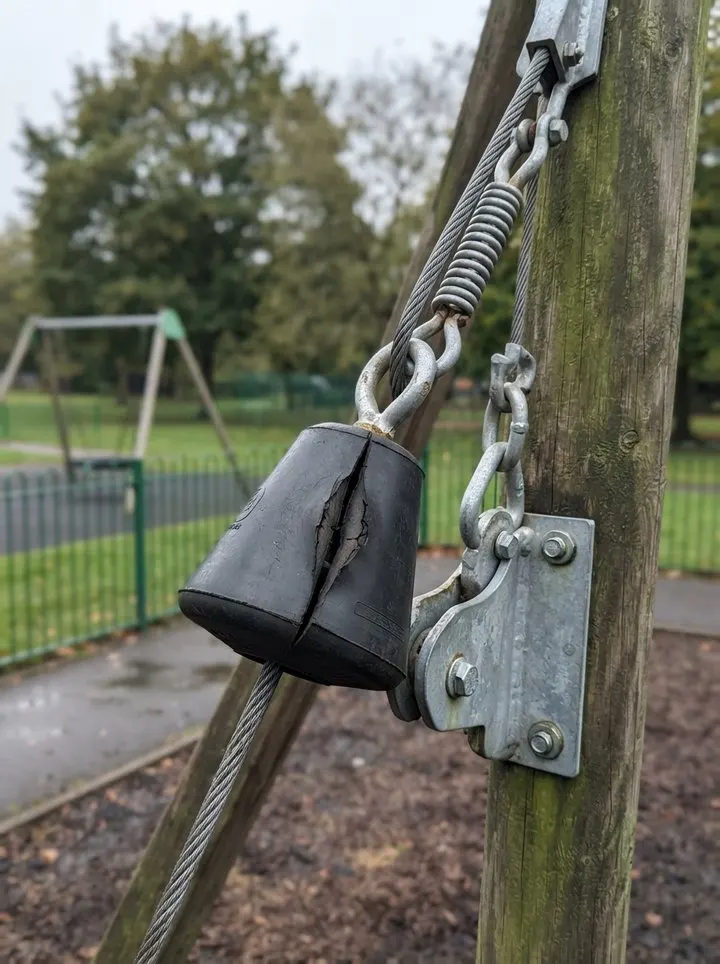
Answer a few questions and watch it adapt. Your answers are not saved, and any photos you add are deleted within the hour.
This is the real form as your team would use it: questions appear as you answer, scores work themselves out and you can add photos and signatures. No sign-up needed. Or open a completed example to see every answer, photo and score filled in.
Want to see one filled in? See a completed park inspection report (PDF), made by SiteSurvey from a fictional site visit.
A park and open space inspection: paths, benches, bins, signs, fencing and gates, trees, water features, lighting, litter and hazards, each issue with risk, photos and action. 3 sections and 52 questions. Follow-up questions and guidance appear only when an answer calls for them, so the person on site never sees the ones that do not apply.
This is a starting point, not a fixed form. Once it is in your SiteSurvey account you can reword any question, add or remove questions, sections and answer options, and add your own logo, so it fits the way your team works and the jobs you do.
Add this form to a project in SiteSurvey and it fills in what the project already knows, so nobody on site retypes it and every form on the job uses the same names. Anything filled in can still be changed.
Optional. Film a guided walk-through on the SiteSurvey app.
Optional. Mark the spot, so the grounds team or tree surgeon goes straight to it.
Optional. Such as the length of lifted path or broken fencing, or a branch across a path. Use a tape, or measure from a photo with something of known size in the same plane, such as a 600 mm paving slab.
Set by the site owner's inspection regime.
A completed park inspection report, made by SiteSurvey from a fictional site visit: every answer, the photos, the guidance that applied and the sign-off, ready to send as a PDF.
The law sets no fixed frequency. Decide it from how busy the space is and its risks, and add checks after storms or reports. The form records the type of inspection.
Under section 1 of the Occupiers' Liability Act 1984, an occupier owes a duty to people other than visitors where they know of a danger or have reasonable grounds to believe it exists, have reasonable grounds to believe someone may come near it, and the risk is one they may reasonably be expected to offer some protection against.
Use the playground inspection checklist for equipped play areas. You can still note an obvious play area defect here as an issue.
Record it as high risk and make it safe on site where you can, for example by taping off a hanging branch. The form counts high-risk issues and asks whether each was made safe.
Yes. Each issue has its own GPS point, photos and the length or size affected, by tape or measured from a photo with a paving slab or another known size in the same plane. The form counts issues by risk and flags any high-risk issue not made safe.
Council parks teams, town and parish councils, grounds maintenance contractors and estate managers.
Related templates
A routine playground visual inspection: area checks, then each item pinned by GPS with its fall height measured from a photo against the surfacing's rated critical fall height, loose-fill depth against the minimum, restrictions and repair follow-up, with counts.
A tree condition survey: every tree with its tag, species, size, condition, defects, the people or property it could hit, risk, recommended work and urgency, plus TPO and conservation area checks.
A grounds maintenance visit record: each area with tasks done, photos and issues, weed control, nesting bird checks before hedge work, waste removed, and the client's sign-off as proof of visit.
Add it from the form library in one click, change any question, and every completed form becomes a branded PDF report.
Start your trial →