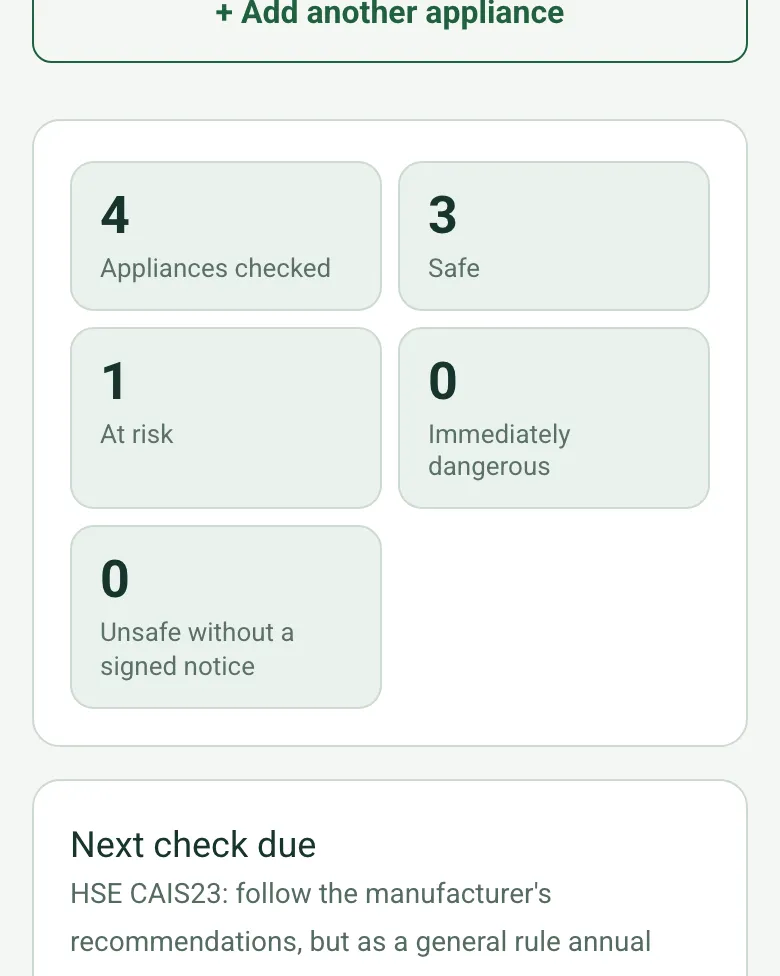
Appliances counted by result
The form counts the appliances by result and shows how many unsafe appliances have no signed warning notice, with a red note until one is recorded.
How calculated fields work →Form library · Food safety
A site record of the gas safety checks in a commercial kitchen. Record the engineer, their Gas Safe number and catering competence, then the tightness test, emergency isolation, ventilation and the gas interlock, and the CO2 level against the action level you work to. Add each appliance with its flame supervision, flue or canopy, burner pressure against the data plate, result, action and warning notice, with photos. The form counts appliances safe, at risk and immediately dangerous, flags an unsafe appliance with no signed notice, and works out the days to the next check. It is a record of checks, not a gas safety certificate. Try the form below, see every question or open a completed example.
Ready to use from the form library, and every question is yours to edit. Try it for a small trial fee, cancel any time.
Try it on your phone
Try it on this phone
Fill in the commercial kitchen gas check on your phone now
See how the commercial kitchen gas check looks on your phone
Scan the code with your phone camera. It opens the real form, no sign-up needed.
Open the live example and fill it in, just as your team would on site. No sign-up needed.
See it on this phoneEvery question is editable. Add this form to your account, then change the wording, add or remove questions and options, and make it fit your own jobs.
A commercial catering gas check covers gas tightness, the emergency isolation valve, the mechanical ventilation and the interlock that shuts off the gas if the ventilation fails, and each appliance's flame supervision devices, flue or extract canopy and combustion. Regulation 35 of the Gas Safety (Installation and Use) Regulations 1998 requires employers to keep gas appliances, pipework and flues at work in a safe condition, and HSE's CAIS23 explains how this applies to catering.
Last updated . Facts checked by the SiteSurvey team on 17 October 2026 against HSE CAIS23: gas safety in catering and hospitality, regulation 35 of the Gas Safety (Installation and Use) Regulations 1998 (duties of employers) and IGEM/G/11: gas industry unsafe situations procedure.
Record the checks in the kitchen on a phone. Add each appliance with its burner pressure against the data plate and its result; the form counts appliances safe, at risk and immediately dangerous, flags an unsafe appliance with no signed warning notice, compares CO2 with the action level you work to and works out the days to the next check. It is a record of the checks, not a gas safety certificate.
The form counts the appliances by result and shows how many unsafe appliances have no signed warning notice, with a red note until one is recorded.
How calculated fields work →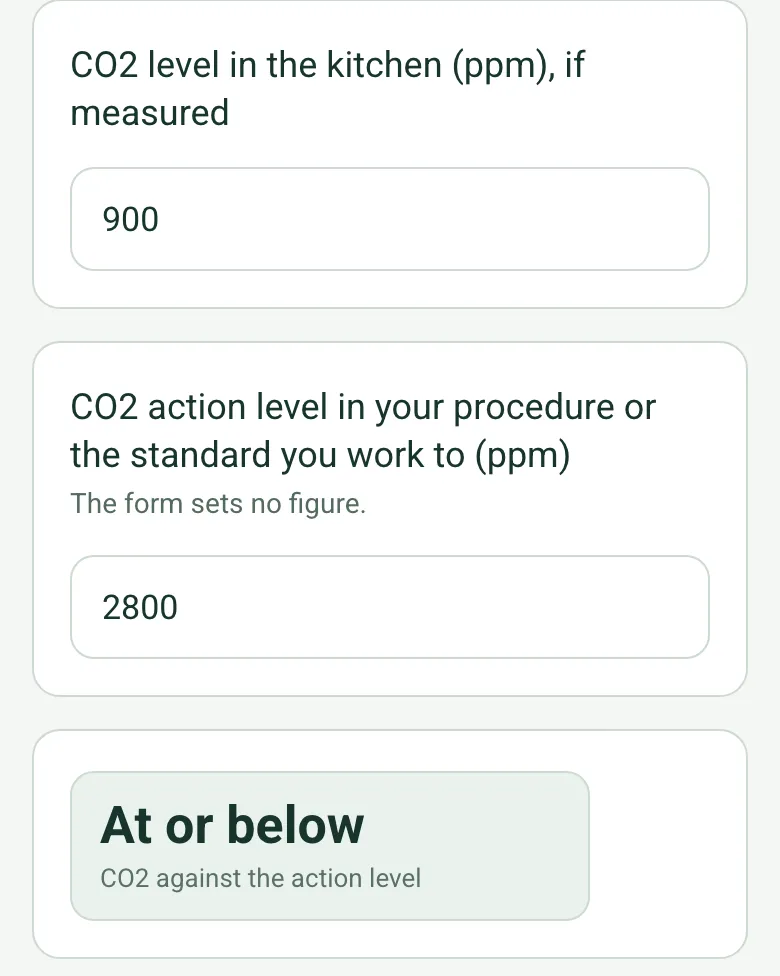
Enter the CO2 reading and the action level from your procedure or the standard you work to. The form sets no figure; it compares the two and adds a note when the reading is above.
How calculated fields work →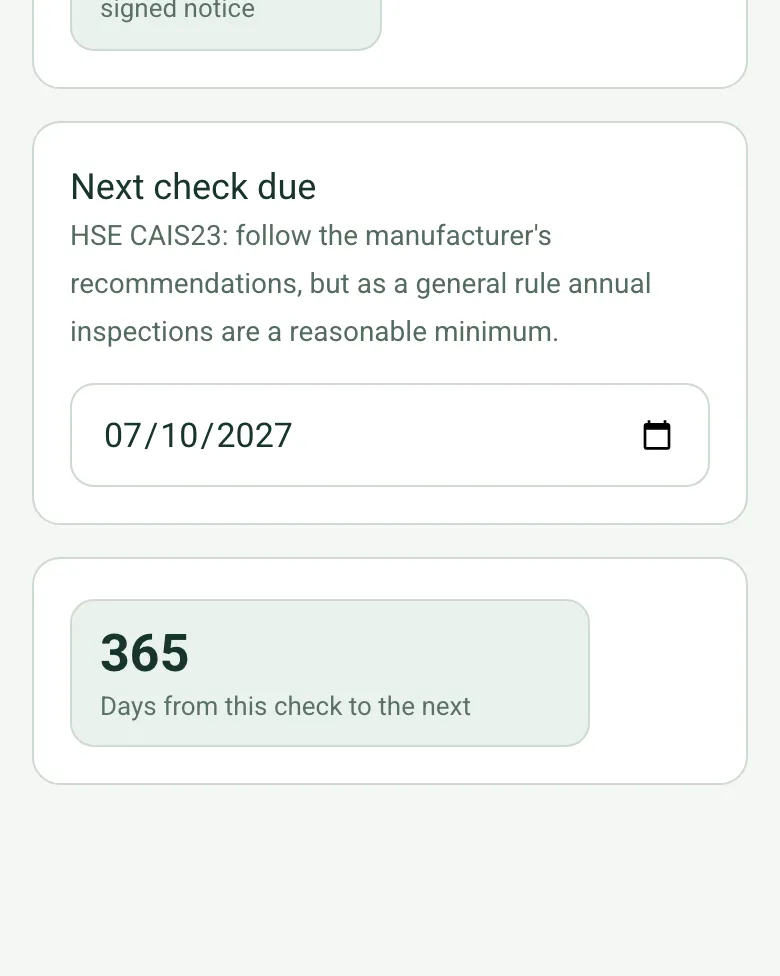
The form works out the days to the next check and adds a note over 12 months, quoting HSE's general rule that annual inspections are a reasonable minimum.
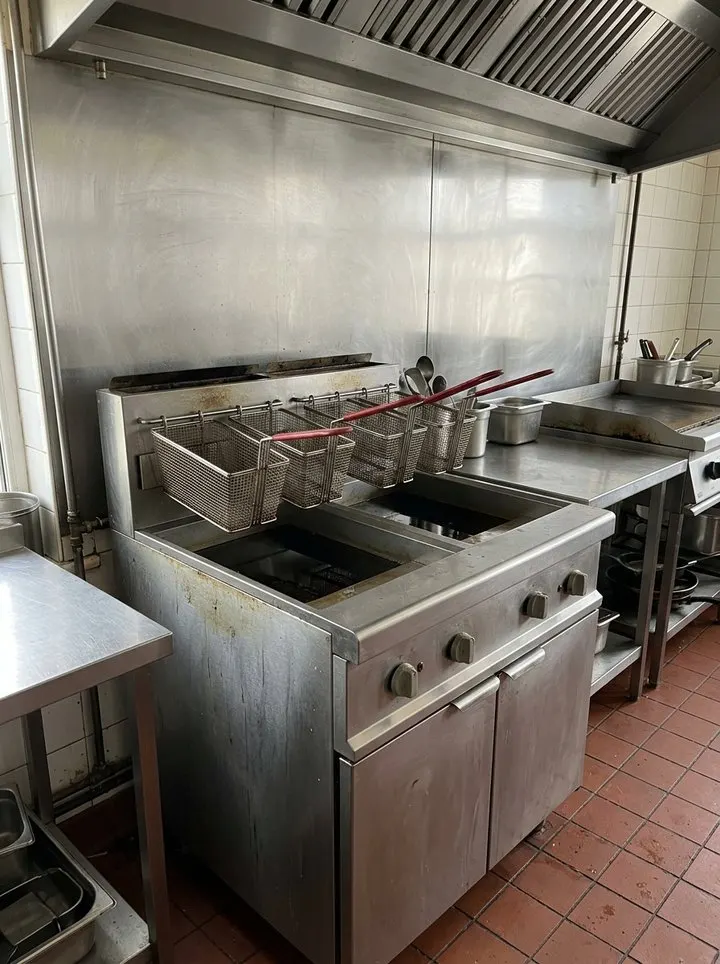
How calculated fields work →A fictional pub kitchen in Whitstable: tightness test passed, interlock working, CO2 900 ppm, four appliances checked with burner pressures against their data plates, and a twin tank fryer at risk with a slow thermocouple, turned off and labelled with the head chef's agreement and a signed warning notice. Open it as a filled-in form, or switch to a blank copy and try it yourself.
Answer a few questions and watch it adapt. Your answers are not saved, and any photos you add are deleted within the hour.
This is the real form as your team would use it: questions appear as you answer, scores work themselves out and you can add photos and signatures. No sign-up needed. Or open a completed example to see every answer, photo and score filled in.
Want to see one filled in? See a completed commercial kitchen gas check report (PDF), made by SiteSurvey from a fictional site visit.
A commercial kitchen gas safety site record: each appliance checked, gas tightness, ventilation and the gas interlock, flues and flame supervision, emergency isolation, unsafe situations and the engineer's sign-off. 4 sections and 44 questions. Follow-up questions and guidance appear only when an answer calls for them, so the person on site never sees the ones that do not apply.
This is a starting point, not a fixed form. Once it is in your SiteSurvey account you can reword any question, add or remove questions, sections and answer options, and add your own logo, so it fits the way your team works and the jobs you do.
Add this form to a project in SiteSurvey and it fills in what the project already knows, so nobody on site retypes it and every form on the job uses the same names. Anything filled in can still be changed.
The form sets no figure.
For example Main kitchen, Pastry section or Servery
Optional. Scan the label or tag to capture its numbers.
HSE CAIS23: follow the manufacturer's recommendations, but as a general rule annual inspections are a reasonable minimum.
A completed commercial kitchen gas check report, made by SiteSurvey from a fictional site visit: every answer, the photos, the guidance that applied and the sign-off, ready to send as a PDF.
A system that shuts off the gas supply to the appliances if the mechanical ventilation fails. HSE's CAIS23 says manual bypasses are not permitted. The form warns if the interlock is faulty or not fitted.
HSE's CAIS23 says the business must be Gas Safe registered and its engineers must hold valid certificates of competence for the types of gas equipment and work involved. Ask to see the engineer's Gas Safe ID card.
HSE's CAIS23 says to follow the manufacturers' recommendations but, as a general rule, annual inspections are a reasonable minimum, with repairs as needed.
The gas industry unsafe situations procedure (IGEM/G/11) applies. With the responsible person's permission, an at risk appliance is turned off and an immediately dangerous one is disconnected and sealed, a DANGER DO NOT USE label is attached, and a warning notice is completed. The form records the action and the notice.
No. It is the engineer's site record. Issue the formal certificate or report from your own software.
Commercial catering gas engineers, restaurant and pub operators, schools, care homes and contract caterers.
Related templates
A kitchen extract cleaning record to TR19 Grease: usage band and frequency, canopy, filters, ductwork and fan, deposit thickness tests before and after, access panels, photos and the post-clean report.
Record commercial kitchen appliance service tasks, manufacturer references, findings, parts and follow-up work across a maintenance visit.
A landlord gas safety site record: every appliance and flue room by room with its checks, analyser readings against the manufacturer's limit, defects and remedial action, counts of unsafe appliances, the installation checks, the engineer's Gas Safe number and the details regulation 36 requires.
Opening and closing checks for a commercial kitchen: fridges, handwashing, cleanliness, pests, allergens, date labels, waste and close-down, with problems and sign-off.
Add it from the form library in one click, change any question, and every completed form becomes a branded PDF report.
Start your trial →