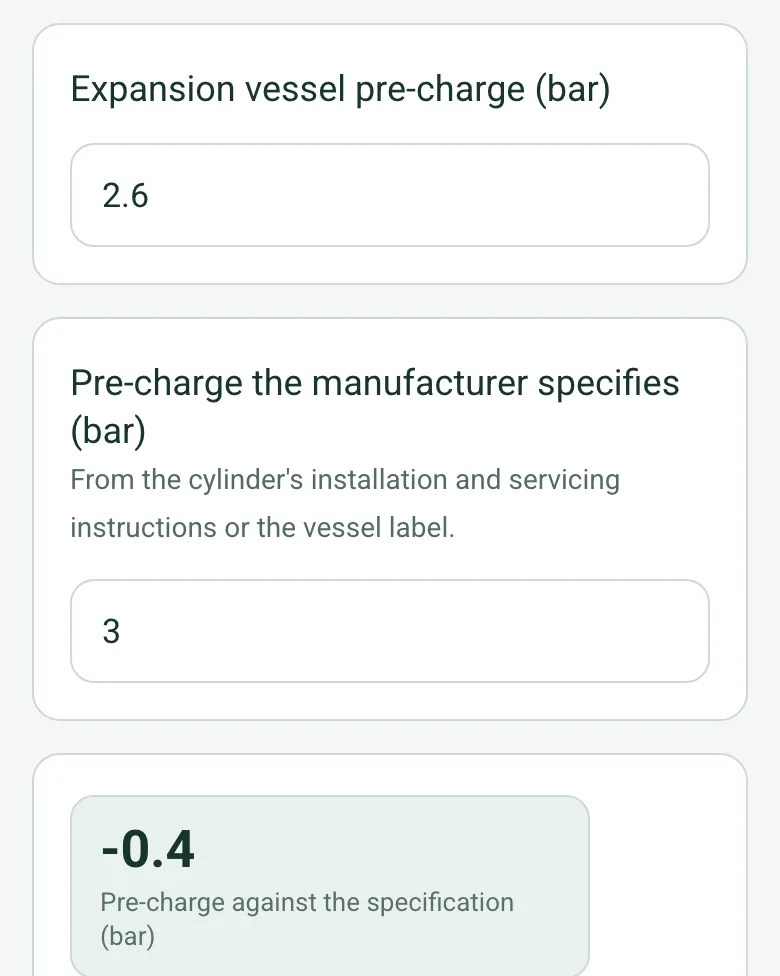
Pre-charge against the specification
Enter the pre-charge as found and the figure in the manufacturer's instructions, and the form shows the difference before you recharge the vessel.
How calculated fields work →Form library · Facilities and maintenance
An annual service record for an unvented hot water cylinder. Scan the data label, then record the incoming pressure, pressure reducing valve setting and the expansion vessel pre-charge against the manufacturer's figure, and the form shows the difference. Stored water under 60 °C is flagged, and the D1 and D2 discharge pipe lengths are checked against the 600 mm and 300 mm in Approved Document G. Check the relief valves, energy cut-out, tundish, strainer and leaks, and the form counts the defects and the safety device defects. Try the form below, see every question or open a completed example.
Ready to use from the form library, and every question is yours to edit. Try it for a small trial fee, cancel any time.
Try it on your phone
Try it on this phone
Fill in the unvented cylinder service on your phone now
See how the unvented cylinder service looks on your phone
Scan the code with your phone camera. It opens the real form, no sign-up needed.
Open the live example and fill it in, just as your team would on site. No sign-up needed.
See it on this phoneEvery question is editable. Add this form to your account, then change the wording, add or remove questions and options, and make it fit your own jobs.
An unvented cylinder service checks the incoming mains pressure and pressure reducing valve, the expansion vessel pre-charge, that the temperature and pressure relief valve and expansion relief valve open and reseat, that the energy cut-out works, that the tundish is visible and the discharge pipe safe, and cleans the line strainer. Approved Document G says unvented systems should have at least two independent safety devices as well as the thermostat, and the Building Regulations require precautions so that the stored water can never exceed 100°C.
Last updated . Facts checked by the SiteSurvey team on 17 October 2026 against requirement G3 in Schedule 1 to the Building Regulations 2010 (hot water supply and systems), Approved Document G (2015 edition with 2024 amendments): unvented hot water storage systems and Hot Water Association: unvented hot water storage cylinder servicing guide.
Work through the annual service on a phone. The form compares the expansion vessel pre-charge with the manufacturer's figure, flags stored water under 60 °C, checks the D1 and D2 discharge pipe lengths against Approved Document G and counts the defects and the safety device defects. It records the service; it does not replace the manufacturer's service record or the G3 qualification.
Enter the pre-charge as found and the figure in the manufacturer's instructions, and the form shows the difference before you recharge the vessel.
How calculated fields work →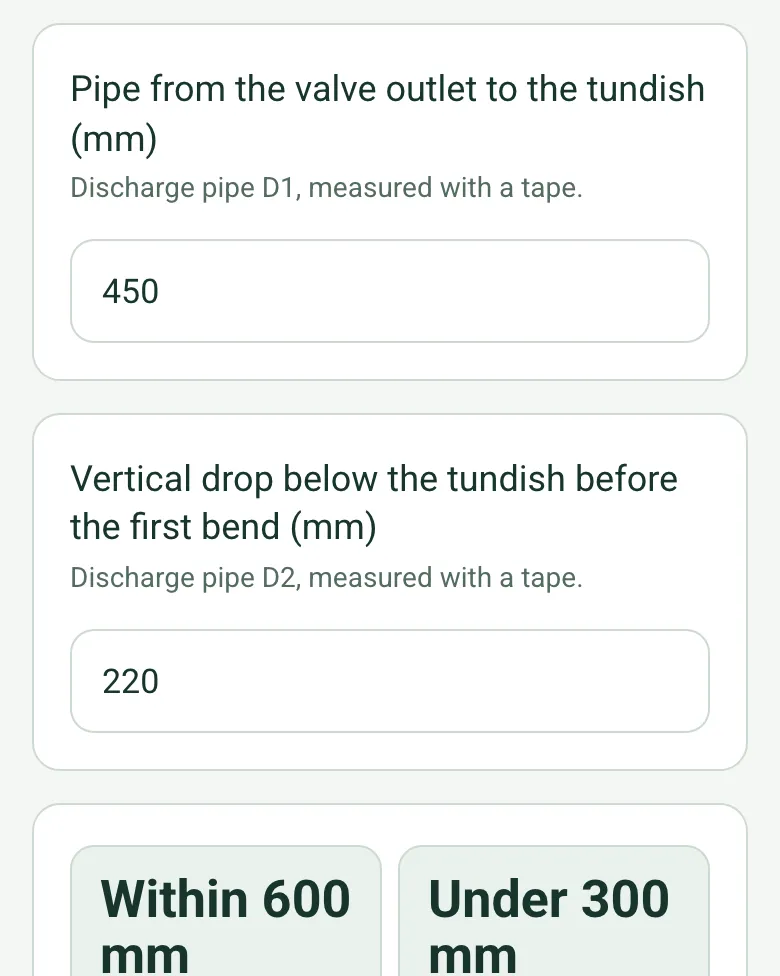
Approved Document G says no more than 600 mm of pipe between the valve outlet and the tundish, and at least 300 mm of vertical pipe below the tundish before any bend. Enter both and the form flags either one outside those figures.
How calculated fields work →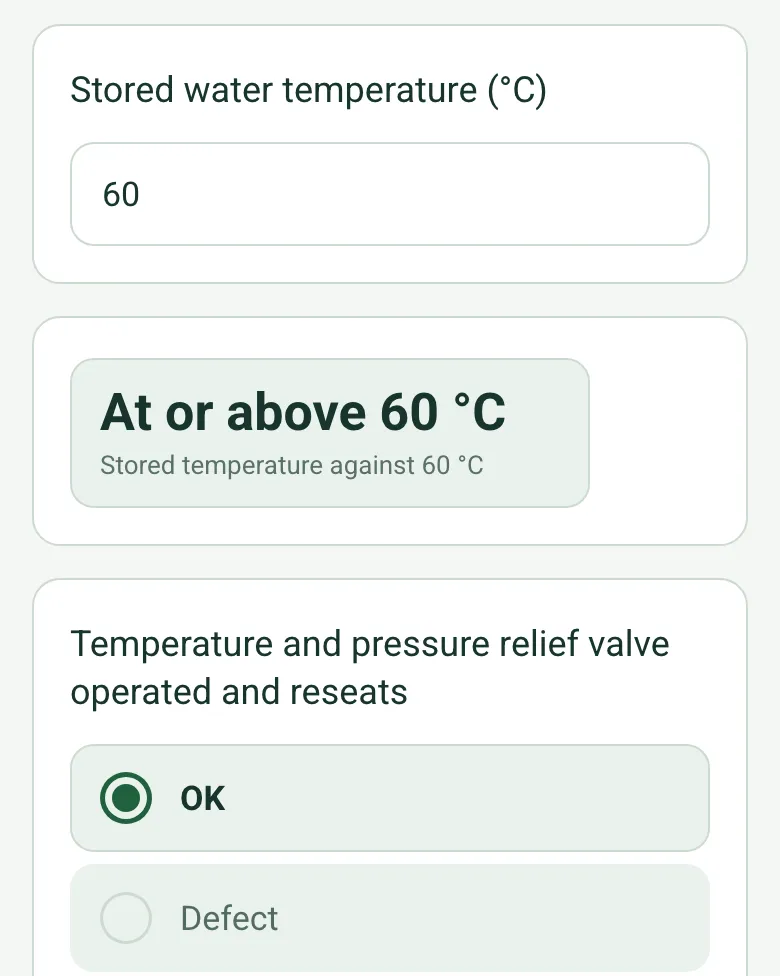
Stored water under 60 °C is flagged with HSE's guidance on legionella, and the form counts the checks with a defect and the defects on the relief valves and energy cut-out, with a red note never to bypass them.
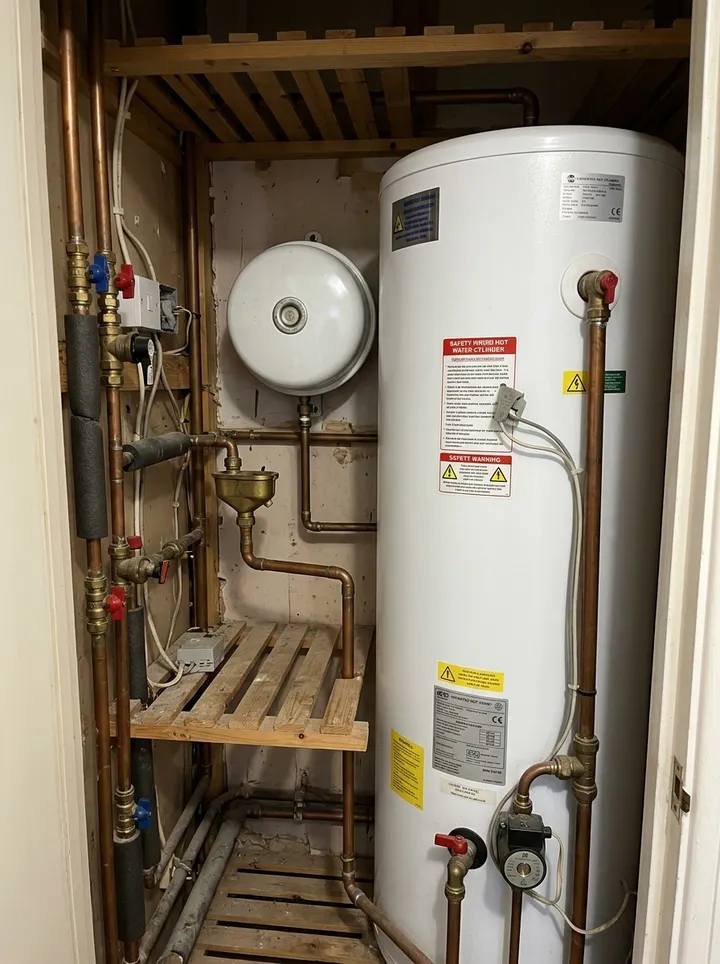
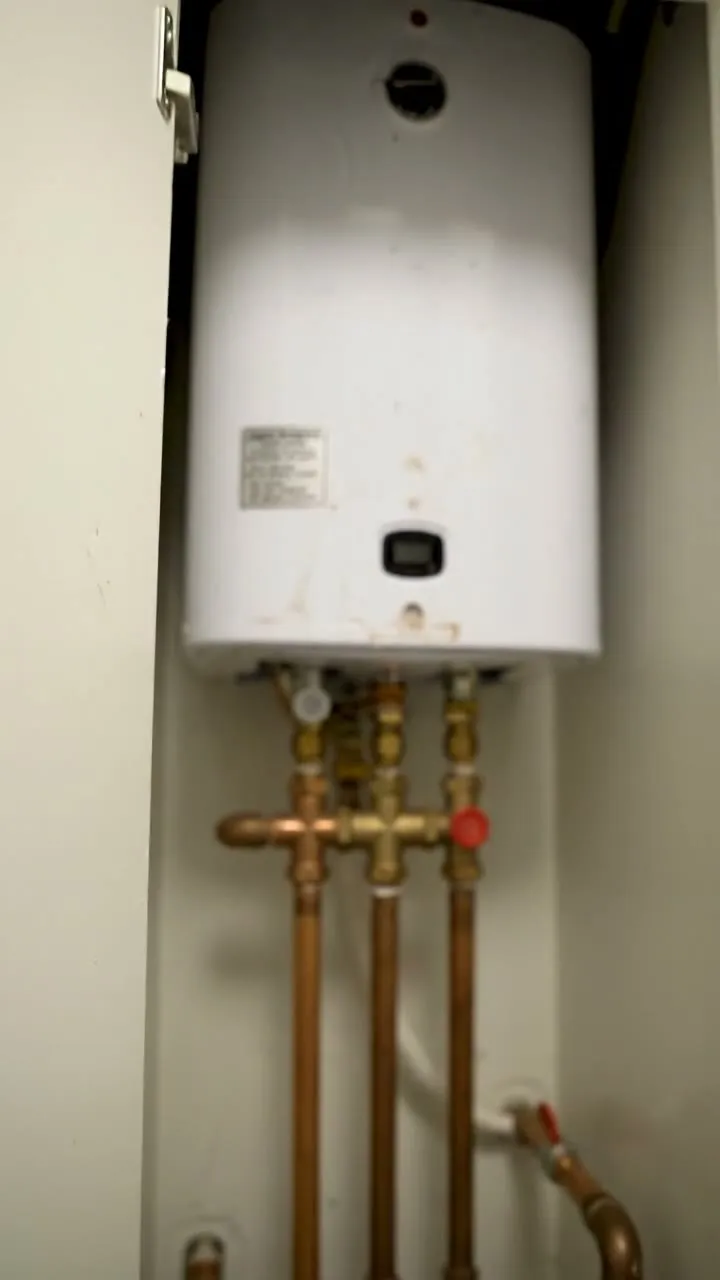
How calculated fields work →A fictional house in Reading: the expansion vessel found at 2.6 bar against 3.0 and recharged, water stored at 60 °C, and a tundish hidden behind a cupboard panel with only 220 mm of drop before the first bend. Serviced, with an access panel and a re-run discharge pipe quoted. Open it as a filled-in form, or switch to a blank copy and try it yourself.
Answer a few questions and watch it adapt. Your answers are not saved, and any photos you add are deleted within the hour.
This is the real form as your team would use it: questions appear as you answer, scores work themselves out and you can add photos and signatures. No sign-up needed. Or open a completed example to see every answer, photo and score filled in.
Want to see one filled in? See a completed unvented cylinder service report (PDF), made by SiteSurvey from a fictional site visit.
An unvented hot water cylinder (G3) annual service: cylinder and heat source, inlet pressure, expansion vessel charge, relief valves, energy cut-out, tundish and discharge, temperature setting and the next service. 3 sections and 45 questions. Follow-up questions and guidance appear only when an answer calls for them, so the person on site never sees the ones that do not apply.
This is a starting point, not a fixed form. Once it is in your SiteSurvey account you can reword any question, add or remove questions, sections and answer options, and add your own logo, so it fits the way your team works and the jobs you do.
Add this form to a project in SiteSurvey and it fills in what the project already knows, so nobody on site retypes it and every form on the job uses the same names. Anything filled in can still be changed.
Optional. Scan the label or tag to capture its numbers.
From the cylinder's installation and servicing instructions or the vessel label.
Discharge pipe D1, measured with a tape.
Discharge pipe D2, measured with a tape.
A completed unvented cylinder service report, made by SiteSurvey from a fictional site visit: every answer, the photos, the guidance that applied and the sign-off, ready to send as a PDF.
The Hot Water Association's servicing guide recommends a service every 12 months by a suitably qualified engineer, and in most cases regular servicing is a condition of the manufacturer's warranty. The form records whether the Benchmark or manufacturer's service record was completed, and the next service date.
Requirement G3(3) says a hot water system with a storage vessel must prevent the stored water exceeding 100°C, and convey any discharge from safety devices safely to where it is visible. Approved Document G says an unvented system should have at least two independent safety devices as well as the thermostat, such as a non self-resetting energy cut-out and a temperature relief valve.
The form warns never to bypass the energy cut-out or relief valves, and to replace a faulty device before the cylinder is used. Record the result as unsafe and left off if needed.
Approved Document G says any discharge should be visible at the tundish, with no more than 600 mm of pipe between the valve outlet and the tundish, and at least 300 mm of vertical pipe below it before any bend. Enter both lengths and the form flags either one outside those figures. If the tundish is hidden, a fault can go unnoticed, so record it as a defect with the fix.
Yes. Scan the data label on the SiteSurvey app to capture the serial and model numbers.
Plumbing and heating engineers with unvented (G3) qualifications, landlords and housing maintenance teams.
Related templates
A gas boiler service record with appliance identity, engineer scope, manufacturer checks, measured results, defects, remedial work and customer handover.
A legionella monthly temperature log: hot and cold sentinel outlet readings, cylinder flow and return temperatures and TMV inlets, with warnings when a reading misses the HSE target.
A thermostatic mixing valve (TMV) service record: each valve with its location, outlet and type, set and measured mixed temperatures, fail-safe test, strainers and result, with a warning above 44°C.
A water heater maintenance and inspection record for tank and tankless heaters, gas and electric: each heater by location with a label scan and age, relief valve and discharge, venting, gas and combustion air, anode rod, flushing, expansion tank against your figure, outlet temperature against your target, seismic straps, leaks and drain pan, descaling, a recommendation per heater, actions and sign-off.
Add it from the form library in one click, change any question, and every completed form becomes a branded PDF report.
Start your trial →