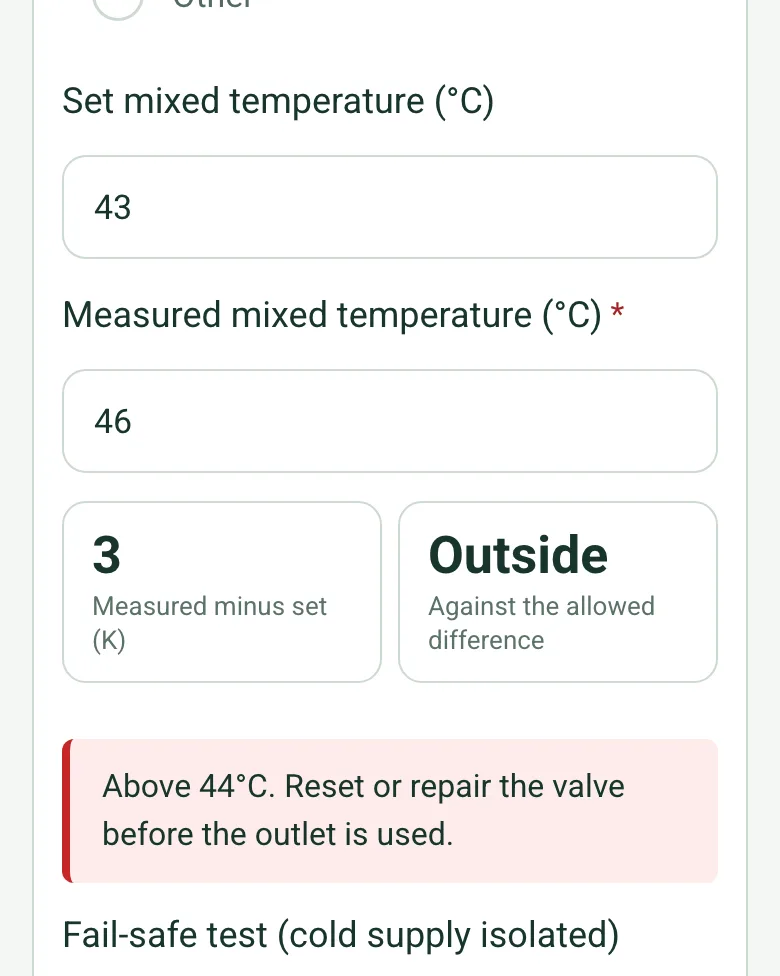
Each valve against its set point
Enter the set and measured mixed temperature. The form shows the difference and whether it is within the allowed difference from the maker's instructions, with a red note above 44°C.
How calculated fields work →Form library · Facilities and maintenance
A service and test record for thermostatic mixing valves (TMVs). Add each valve with its outlet, tag, set and measured mixed temperatures, fail-safe test, strainers and photos. Enter the allowed difference from the maker's instructions and the form shows each valve's difference from its set point, the temperature as left after any adjustment, and counts the valves above 44°C as found and as left, fail-safe failures and strainers not cleaned. Try the form below, see every question or open a completed example.
Ready to use from the form library, and every question is yours to edit. Try it for a small trial fee, cancel any time.
Try it on your phone
Try it on this phone
Fill in the TMV servicing on your phone now
See how the TMV servicing looks on your phone
Scan the code with your phone camera. It opens the real form, no sign-up needed.
Open the live example and fill it in, just as your team would on site. No sign-up needed.
See it on this phoneEvery question is editable. Add this form to your account, then change the wording, add or remove questions and options, and make it fit your own jobs.
A TMV service checks each valve's mixed water temperature against its set point with a thermometer, tests the fail-safe with the cold supply isolated, cleans the strainers and check valves, and records the result and any adjustment. HSE says TMVs need regular routine maintenance by competent people in line with the manufacturer's instructions, and that strainers or filters should be inspected, cleaned, descaled and disinfected annually or as the risk assessment says.
Last updated . Facts checked by the SiteSurvey team on 17 October 2026 against HSE: scalding and burning, HSE HSG274 Part 2: control of legionella in hot and cold water systems (TMVs) and HSE HSIS6: managing the risk from hot water and surfaces in health and social care.
Record each valve at the outlet on a phone. Enter the set and measured mixed temperature, the fail-safe test and the strainers, with photos: the form shows the difference from the set point against the allowed difference you enter from the maker's instructions, the temperature as left after any adjustment, and counts the outlets above 44°C as found and as left, fail-safe failures and strainers not cleaned.
Enter the set and measured mixed temperature. The form shows the difference and whether it is within the allowed difference from the maker's instructions, with a red note above 44°C.
How calculated fields work →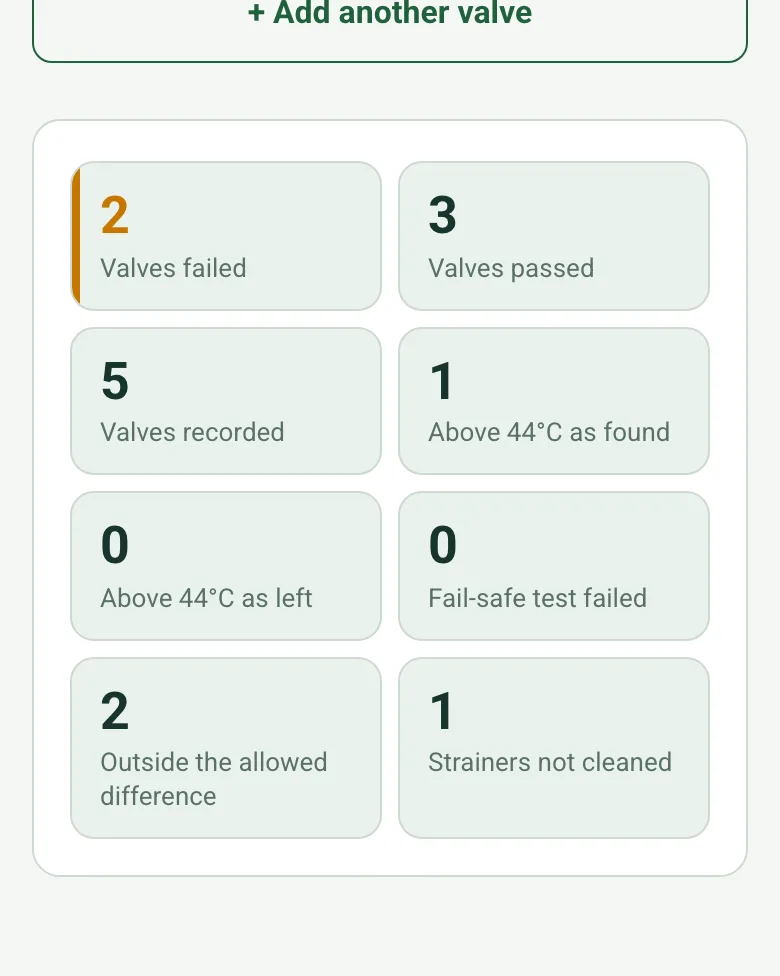
The form counts the valves above 44°C as found and as left, fail-safe failures, valves outside the allowed difference and strainers not cleaned. An outlet left above 44°C shows a red note to take it out of use.
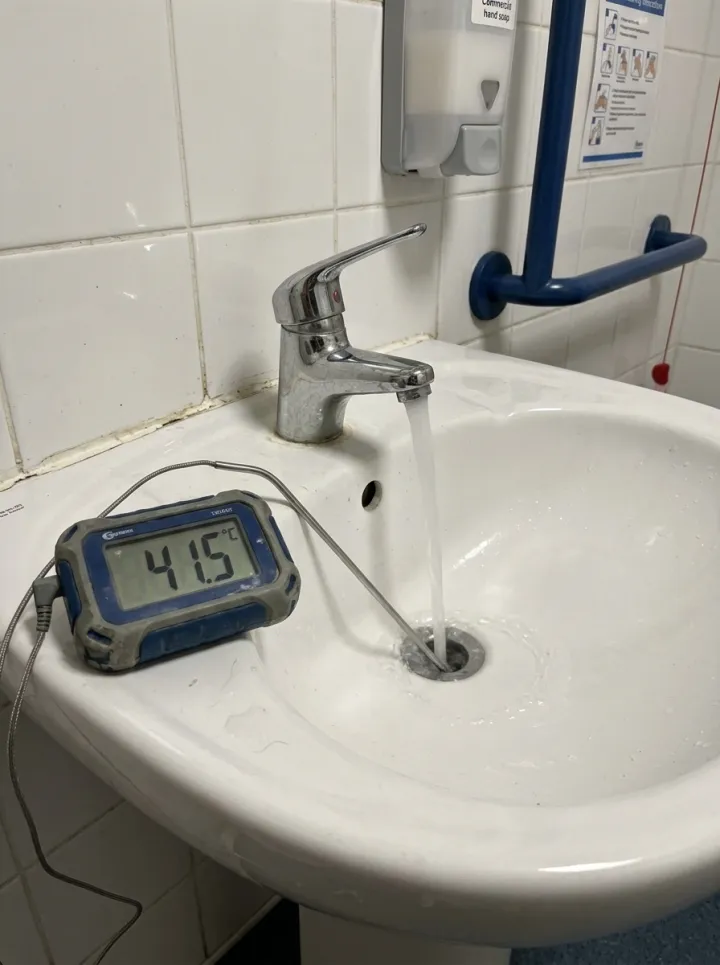
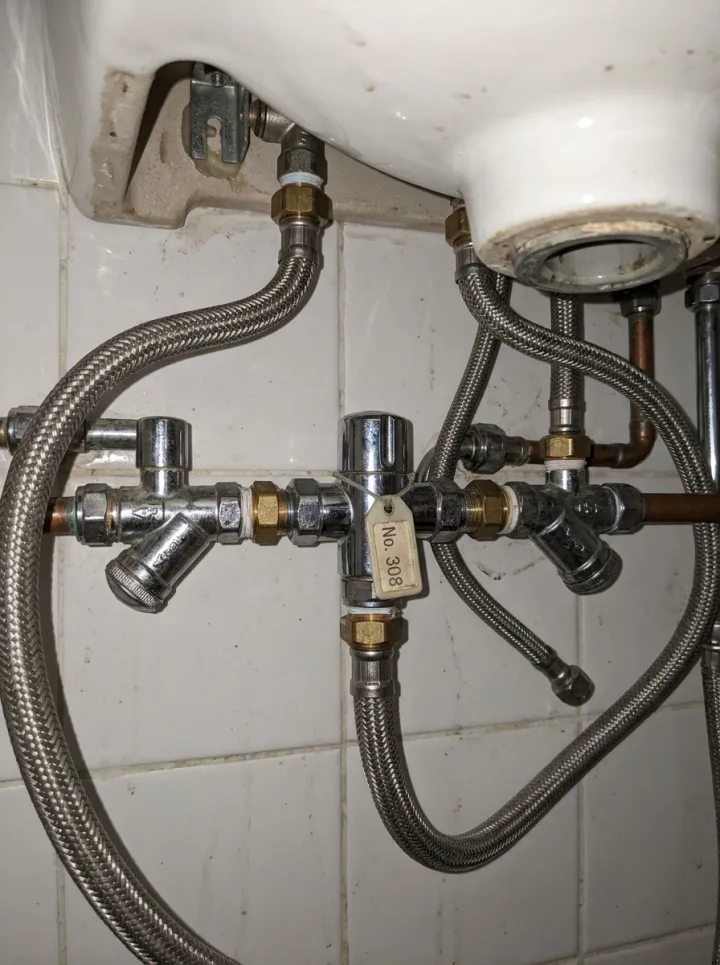
How calculated fields work →Add a photo of the thermometer reading and the valve to each record, so the temperature on the report has its evidence beside it.
An annual service of five valves at a fictional care home: the assisted bath found at 46°C against 43°C, taken out of use and reset to 43.2°C, a basin valve 2.4 K low and recalibrated, and one valve boxed in so its strainers could not be cleaned. Nothing was left above 44°C. Open it as a filled-in form, or switch to a blank copy and try it yourself.
Answer a few questions and watch it adapt. Your answers are not saved, and any photos you add are deleted within the hour.
This is the real form as your team would use it: questions appear as you answer, scores work themselves out and you can add photos and signatures. No sign-up needed. Or open a completed example to see every answer, photo and score filled in.
Want to see one filled in? See a completed TMV servicing report (PDF), made by SiteSurvey from a fictional site visit.
A thermostatic mixing valve (TMV) service record: each valve with its location, outlet and type, set and measured mixed temperatures, fail-safe test, strainers and result, with a warning above 44°C. 3 sections and 55 questions. Follow-up questions and guidance appear only when an answer calls for them, so the person on site never sees the ones that do not apply.
This is a starting point, not a fixed form. Once it is in your SiteSurvey account you can reword any question, add or remove questions, sections and answer options, and add your own logo, so it fits the way your team works and the jobs you do.
Add this form to a project in SiteSurvey and it fills in what the project already knows, so nobody on site retypes it and every form on the job uses the same names. Anything filled in can still be changed.
From the valve maker's instructions or your water safety plan. The form sets none; leave it blank to record the difference only.
For example Ward 4 assisted bathroom or Flat 12
Optional. Scan the label or tag to capture its numbers.
From D08 or the site water safety plan for this outlet type.
The temperature after adjustment if there is one, otherwise the measured temperature.
Set from D08 and the results of this service.
A completed TMV servicing report, made by SiteSurvey from a fictional site visit: every answer, the photos, the guidance that applied and the sign-off, ready to send as a PDF.
Where vulnerable people are at risk from scalding during whole-body immersion, HSE says water temperatures must not exceed 44°C. The form warns above 44°C and counts outlets above it as found and as left.
HSE says type 3 TMVs are pre-set and fail-safe, and should be checked regularly to make sure they fail safe if the cold water supply pressure is interrupted. The form records the test, with the cold supply isolated, for each valve.
HSE's HSG274 says type 2 TMVs, which users can override, are required by building regulations where the scalding risk is low. Pre-set type 3 TMVs should be fitted where the risk is significant and are required at healthcare premises. The form records the type of each valve.
Where hot water is stored above 60°C and distributed above 50°C to control legionella, HSE says baths and showers should be fitted with TMVs so water temperatures do not exceed 44°C. Keep this record with your legionella temperature checks.
Yes. Tag each valve and scan it on the SiteSurvey app, so readings stay with the right valve visit to visit.
Water hygiene engineers, plumbers, care homes, schools, hospitals and facilities teams.
Related templates
A shower head and hose descaling record for legionella control: each outlet with its location, condition, descale and disinfection, temperatures and result, against the HSG274 quarterly frequency.
A legionella monthly temperature log: hot and cold sentinel outlet readings, cylinder flow and return temperatures and TMV inlets, with warnings when a reading misses the HSE target.
A weekly flushing record for little-used outlets: each tap, shower and hose with how long it was flushed, whether it was done without spray, the temperature reached and showerhead cleaning dates.
Legionella risk assessment for a hot and cold water system: who is responsible, tanks and heaters, outlet temperatures, little-used outlets, findings and actions.
Add it from the form library in one click, change any question, and every completed form becomes a branded PDF report.
Start your trial →