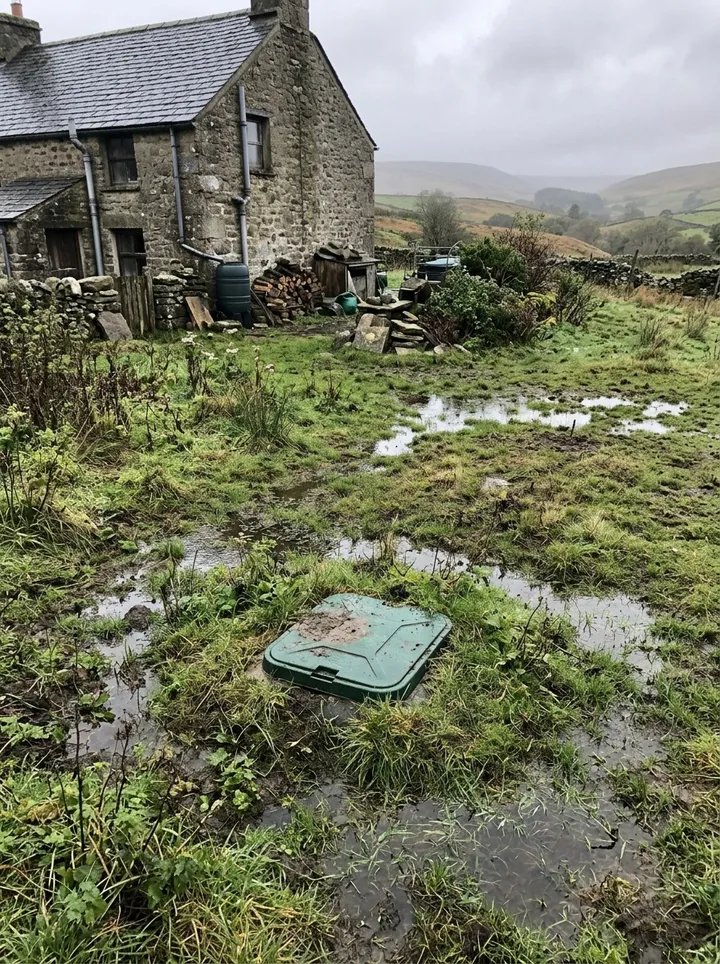
An inspection checklist for septic tanks and small sewage treatment plants in England. Pin the tank lids with GPS and mark the distribution chamber and the ends of the drainage field point by point, so the next visit and the emptying tanker find them under the lawn. Record where the system discharges, the lids, sludge level, when it was last desludged and by whom, tank defects, the motor, pump and alarm, and signs at the drainage field. The form counts the problems at the tank and the field, flags a septic tank discharging to a watercourse and desludging more than a year ago, and asks you to check a result of Working when problems are recorded. Try the form below, see every question or open a completed example.
✎Every question is editable. Add this form to your account, then change the wording, add or remove questions and options, and make it fit your own jobs.
A septic tank inspection should check what the system is and where it discharges, the condition of the lids, the sludge level and when it was last desludged by a registered waste carrier, cracks, leaks, baffles and blocked pipes, the motor, pump and alarm on a treatment plant, and the drainage field or outlet for pools of water, sewage smells and, at a watercourse, overflowing sludge or white scum. It should end with whether the system is working, needs maintenance or is failing.
Built for inspecting septic tanks and treatment plants
Find the tank, pin it, and work through the lids, sludge, tank and drainage field on a phone. The form marks the tank and each end of the drainage field with GPS, counts the problems at the tank and the field, flags desludging more than a year ago and checks a result of Working against what you recorded. It records an inspection against the general binding rules in England; it does not issue a permit.
Find the tank next time
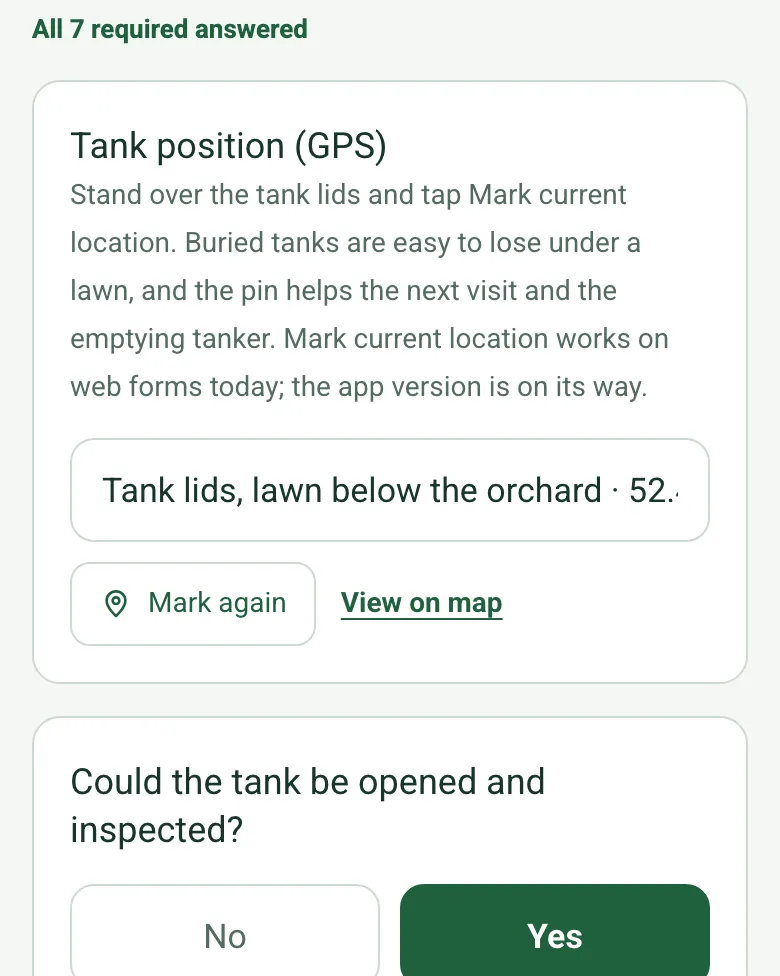
Buried tanks are easy to lose under a lawn. Stand over the lids and tap Mark current location, so the next visit and the emptying tanker go straight to them. Mark current location works on web forms in any phone browser today, and the app version is on its way.
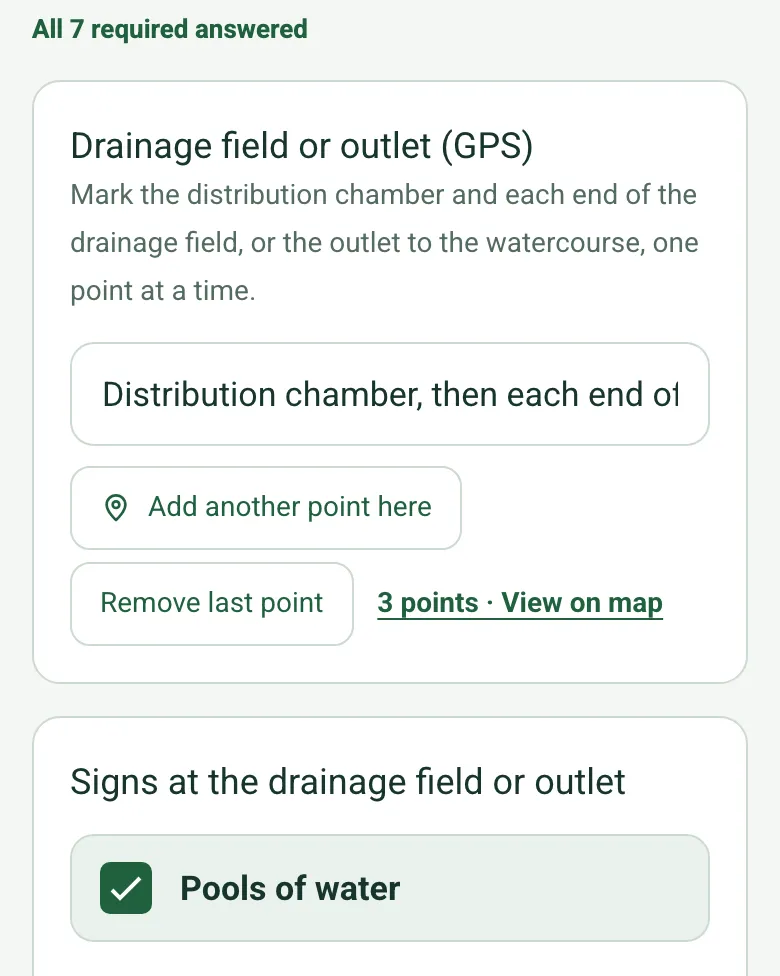
Add a point at the distribution chamber and at each end of the drainage field, or at the outlet to a watercourse. The points stay with the record for the next inspection or a buyer's survey.
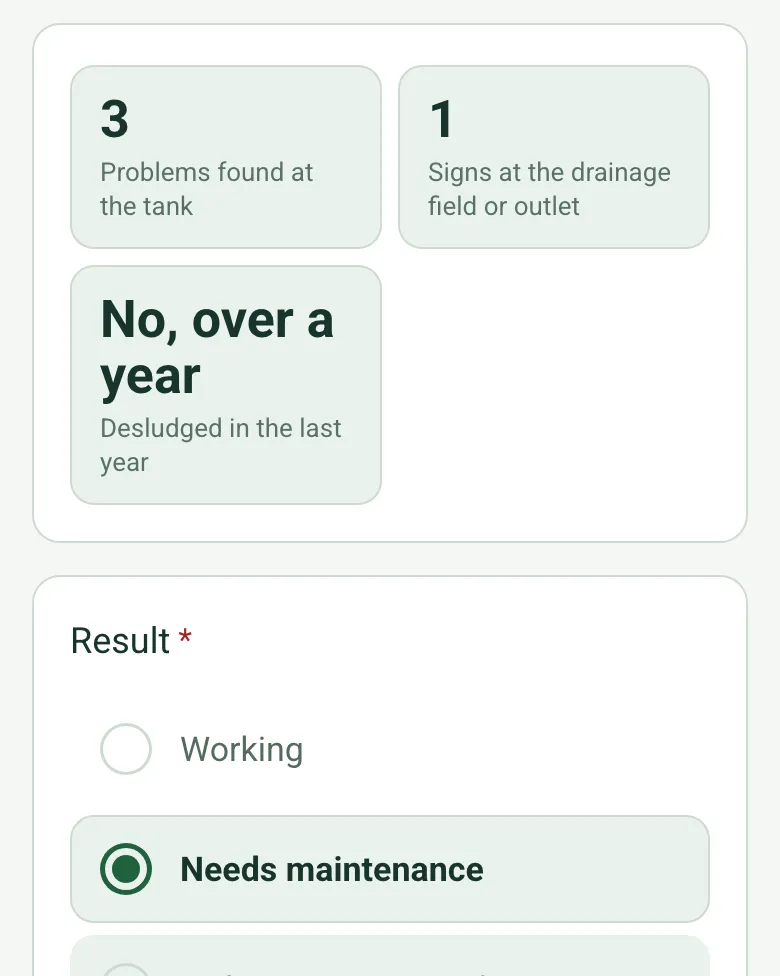
The form counts a damaged or missing lid, sludge near or over capacity, a pump fault and each tank defect, and the signs at the field. It flags desludging more than a year ago and asks you to check a result of Working when problems are recorded.
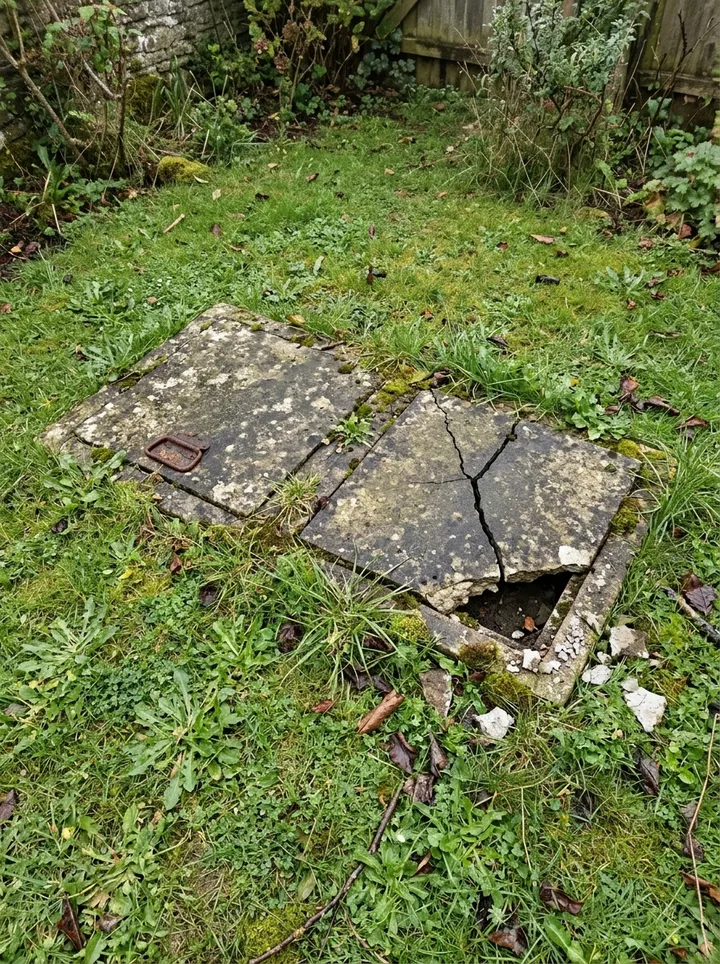
A fictional cottage in Shropshire: cracked lid, a damaged outlet baffle, sludge near capacity 16 months after the last empty, and pools of water over the drainage field after rain. Result: needs maintenance, with desludging and repairs booked. Open it as a filled-in form, or switch to a blank copy and try it yourself.
This is the real form as your team would use it: questions appear as you answer, scores work themselves out and you can add photos and signatures. No sign-up needed. Or open a completed example to see every answer, photo and score filled in.
Every question in the septic tank inspection template
A septic tank and sewage treatment plant inspection: system and discharge, tank and lid, sludge, desludging date and waste carrier, baffles, pumps and alarms, the drainage field and signs of pollution. 4 sections and 40 questions. Follow-up questions and guidance appear only when an answer calls for them, so the person on site never sees the ones that do not apply.
✎
Make it your own: every question is editable
This is a starting point, not a fixed form. Once it is in your SiteSurvey account you can reword any question, add or remove questions, sections and answer options, and add your own logo, so it fits the way your team works and the jobs you do.
Details you only enter once
Add this form to a project in SiteSurvey and it fills in what the project already knows, so nobody on site retypes it and every form on the job uses the same names. Anything filled in can still be changed.
Project: the project name
Client: the project's customer
Site: the site, when the form is opened for a space or a product
Site address: the site address, from the space or the project
1
System
ProjectShort answer
Fills in from the project name
ClientShort answer
Fills in from the project's customer
Site*Short answer
Fills in from the site, when the form is opened for a space or a product
Site addressShort answer
Fills in from the site address, from the space or the project
Inspection date*Date
Owner or operator responsible for the system*Short answer
Inspected by*Short answer
Weather on siteAnswer
Heavy rain can flood a drainage field and look like a failure. Note it here.
System*Choose one
Septic tank
Small sewage treatment plant
Cesspool (no discharge)
Discharges toChoose one
Ground through a drainage field
Surface water (a watercourse)
Nowhere (holding tank)
WarningA septic tank must not discharge to a watercourse. Under the general binding rules, as soon as possible connect to a public foul sewer, replace the tank with a small sewage treatment plant, or install a drainage field, with plans to do the work within a reasonable time, usually 12 months.
Shown when “System” is “Septic tank” and “Discharges to” is “Surface water (a watercourse)”
GuidanceGeneral binding rules (England). The sludge must be removed before it goes beyond the maximum capacity, and the guidance says to do this at least once a year or in line with the manufacturer's instructions, using a registered waste carrier. The system must be repaired or replaced if it is not in good working order. These rules apply in England only. Wales, Scotland and Northern Ireland have their own rules: check with Natural Resources Wales, SEPA or the Northern Ireland Environment Agency.
Shown only when the answers above make it relevant
Is the discharge point within 50 m of a private drinking water supply, or in a groundwater source protection zone 1?Yes or No
Shown when “Discharges to” is “Ground through a drainage field”
WarningA discharge to ground in a source protection zone 1 (other than SPZ1c) needs an environmental permit from the Environment Agency. An SPZ1 can also be any area within 50 m of a private water supply for human consumption.
Shown when “Is the discharge point within 50 m of a private drinking water supply, or in a groundwater source protection zone 1?” is Yes
2
Tank
Tank position (GPS)Short answer
Stand over the tank lids and tap Mark current location. Buried tanks are easy to lose under a lawn, and the pin helps the next visit and the emptying tanker. Mark current location works on web forms today; the app version is on its way.
Could the tank be opened and inspected?Yes or No
Lids and coversChoose one
Sound and secure
Damaged
Missing
Sludge levelChoose one
Low
Moderate
Near capacity
Over capacity
Date last desludgedDate
Days since desludgingWorked out by the form
Shown when “Date last desludged” is answered and “Inspection date” is answered
CheckMore than a year since the tank was desludged.
Shown only when the answers above make it relevant
CheckThe desludging date is after the inspection date. Check the dates.
Shown only when the answers above make it relevant
Was it emptied by a registered waste carrier?Yes or No
Next desludge dueDate
At least once a year under the general binding rules guidance, or as the manufacturer says.
Days to the next desludgeWorked out by the form
Shown when “Inspection date” is answered and “Next desludge due” is answered
CheckThe next desludge date is before the date of this record. Check the date.
Shown only when the answers above make it relevant
Tank defectsTick all that apply
Cracks in tank walls
Leaks
Damaged inlet or outlet baffles
Blocked pipes
Roots in the tank
None seen
Motor, pump and alarm (treatment plant)Choose one
Working
Fault
Not applicable
Photos of the tankPhotos
3
Drainage field and pollution
Drainage field or outlet (GPS)Short answer
Mark the distribution chamber and each end of the drainage field, or the outlet to the watercourse, one point at a time.
Shown only when the answers above make it relevant
Signs at the drainage field or outletTick all that apply
Pools of water
Sewage smells
Overflowing sludge
White scum or foam on the water
Slow-draining toilets or sinks in the property
None seen
Photos of the drainage field or outletPhotos
Problems found at the tankWorked out by the form
Signs at the drainage field or outletWorked out by the form
Desludged in the last yearWorked out by the form
Shown only when the answers above make it relevant
CheckProblems are recorded above but the result is Working. Check the result, or note why the problems do not affect how the system works.
Shown only when the answers above make it relevant
Result*Choose one
Working
Needs maintenance
Failing: repair or replace
WarningThe general binding rules require the system to be repaired or replaced when it is not in good working order, for example with leaks, cracks in tank walls or pipes, blocked pipes, poor drainage, sewage smells, or a failed motor, pump or electrical supply.
Shown when “Result” is “Failing: repair or replace”
Are maintenance records and the manual kept, to pass on if the property is sold?Yes or No
4
Actions and sign-off
Are further actions needed?Yes or No
Further actions
Repeat for each action. Each one asks:
Shown when “Are further actions needed?” is Yes
What needs doing?*Notes
PriorityChoose one
Urgent
High
Medium
Low
Who will do it?Short answer
Due dateDate
StatusChoose one
Open
In progress
Completed
Inspector nameWorked out by the form
Position or company of the inspectorShort answer
Inspector signatureSignature
CheckSigning records what was found on the day. It is not a guarantee of condition and does not replace any examination, test, design check or repair needed from a competent person.
See it filled in
A completed septic tank inspection report, made by SiteSurvey from a fictional site visit: every answer, the photos, the guidance that applied and the sign-off, ready to send as a PDF.
Under the general binding rules in England, the sludge must be removed before it goes beyond the maximum capacity, and the guidance says to do this at least once a year or in line with the manufacturer's instructions. The company that takes the sludge must be a registered waste carrier. The form warns when it is more than a year since desludging.
Can a septic tank discharge to a stream?
No. A septic tank must not discharge effluent to a watercourse. Under the general binding rules, as soon as possible you must connect to a public foul sewer, replace it with a small sewage treatment plant or install a drainage field, with plans to do the work within a reasonable time, usually 12 months. The form warns if you record this.
What are the signs of a failing system?
Leaks, cracks in tank walls or pipes, blocked pipes, waste water not draining properly such as pools around the drainage point, sewage smells, and a failed motor, pump or electrical supply. The general binding rules require the system to be repaired or replaced when it is not in good working order.
What records should be kept?
Maintenance records and the manual, so they can be passed on. If you sell the property, you must tell the new owner about the sewage treatment system. The form asks whether the records are kept.
Does it cover sewage treatment plants?
Yes. Choose small sewage treatment plant and the form also checks the motor, pump and alarm. Cesspools are included as holding tanks with no discharge.
When is a permit needed?
Under the general binding rules, a discharge to ground in a groundwater source protection zone 1 (other than SPZ1c) needs an environmental permit. An SPZ1 can include any area within 50 m of a private drinking water supply. The form asks whether the discharge point is in one and shows a warning.