Form library · Facilities and maintenance

CCTV drain survey report

For drainage engineers recording a CCTV drain survey on site. Record each run between manholes with the manholes pinned by GPS and the length surveyed against the length between the access points, then each observation with its code and grade under the standard you use. The form counts the observations by grade and flags grades 4 and 5 for review. Try the form below, see every question or open a completed example.

Ready to use from the form library, and every question is yours to edit. Try it for a small trial fee, cancel any time.

Try it on your phone

Try it on this phone

Fill in the CCTV drain survey record on your phone now

See how the CCTV drain survey record looks on your phone

Scan the code with your phone camera. It opens the real form, no sign-up needed.

Open the live example and fill it in, just as your team would on site. No sign-up needed.

See it on this phone

Every question is editable. Add this form to your account, then change the wording, add or remove questions and options, and make it fit your own jobs.

Or start your trial with this form ready →

One email, and we won't add you to a mailing list.

What does standard drain coding require?

WinCan’s technical guidance describes recording sewer CCTV inspection data using WRc conventions. Record the applicable coding standard and survey evidence. This template does not supply licensed code tables or assign condition grades automatically.

Last updated . Facts checked by the SiteSurvey team on 6 October 2026 against WinCan guidance on WRc CCTV inspection data and HSE confined spaces brief guide.

Built for recording a CCTV drain survey on site

Fill the record in at the manhole on a phone or tablet. Pin each manhole, record how far the camera got against the length between the access points, and log each observation with its code and grade under the standard you use. The form counts the observations by grade and flags grades 4 and 5 for review. It records the survey; it does not code or grade the pipe for you.

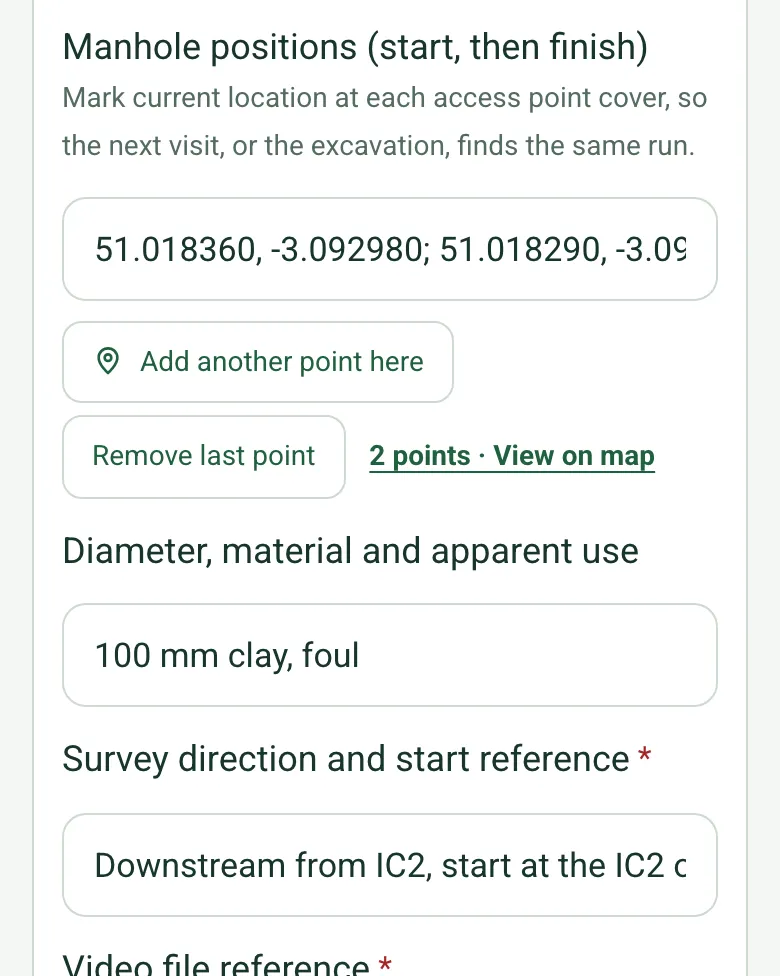
Manhole positions for a run filled in as two GPS points, with Add another point here, Remove last point and 2 points, View on map

Pin each manhole

Mark current location at the start manhole, then at the finish, and the run gets both positions with a View on map link, so the next visit or the excavation finds the same run. Mark current location works on web forms in any phone browser today, and the app version is on its way.

How GPS location works →
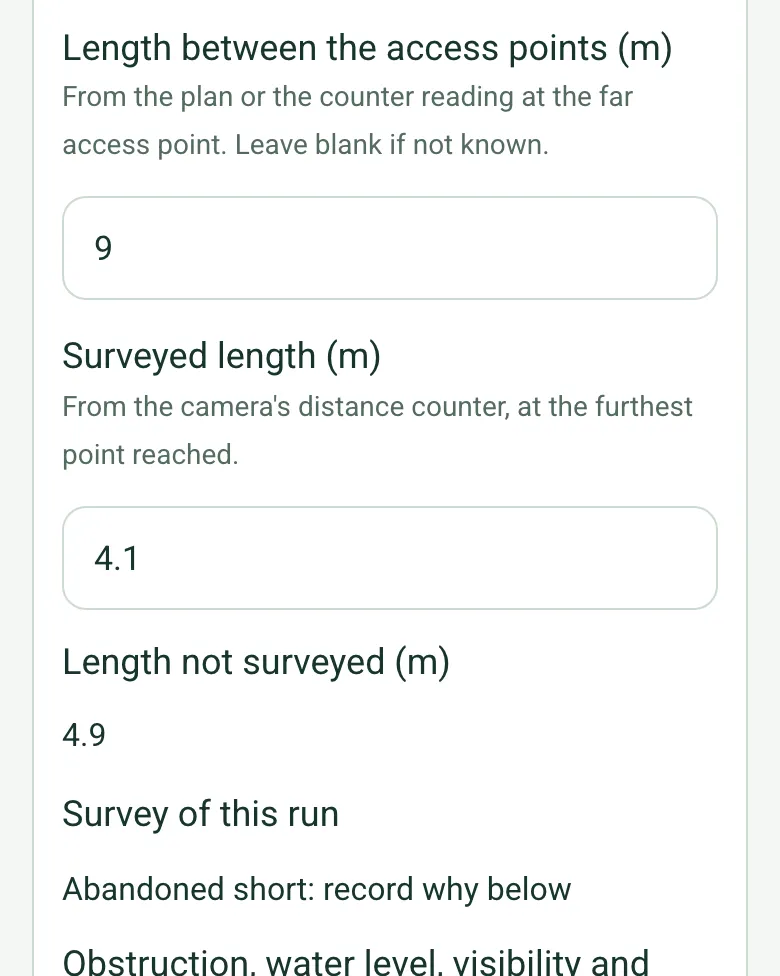
Length between the access points 9 m, surveyed length 4.1 m, length not surveyed worked out as 4.9 m and the run marked Abandoned short: record why below

How much of the run was surveyed

Enter the length between the access points and the camera's counter at the furthest point reached. The form works out the length not surveyed and marks the run as surveyed in full or abandoned short, so a blocked run is never reported as done.

How calculated fields work →
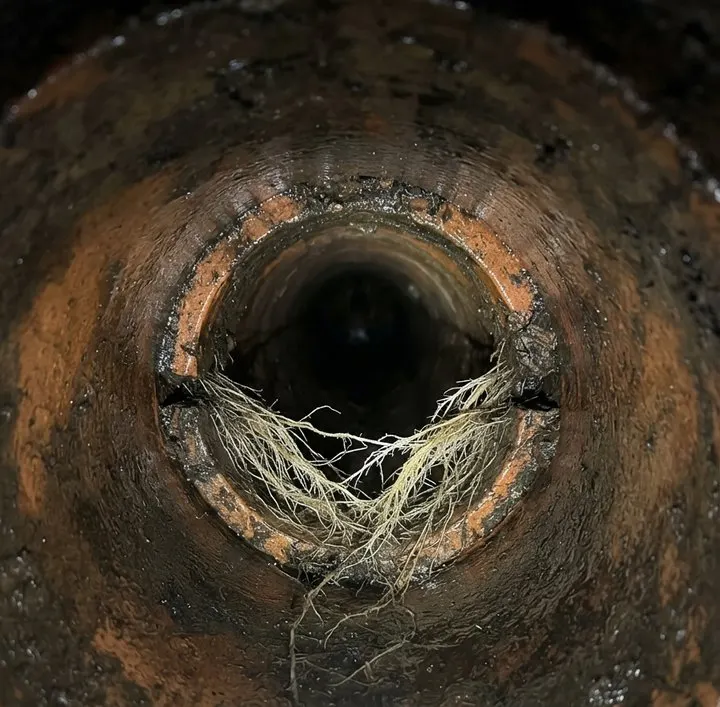
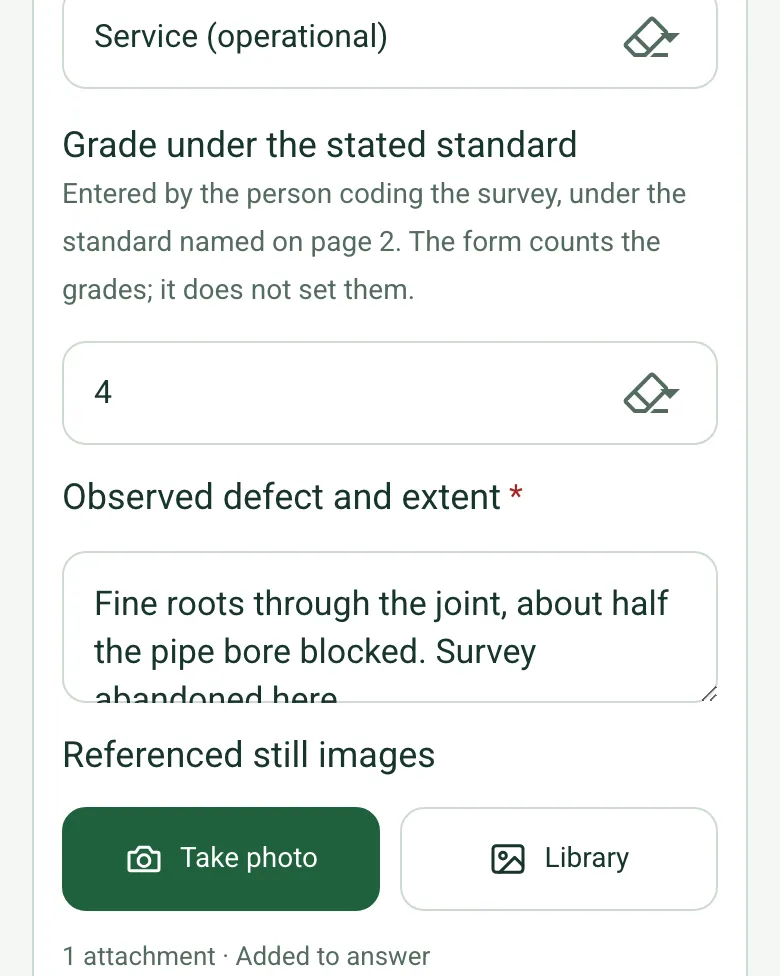
An observation set to Service (operational) with grade 4 under the stated standard, fine roots through the joint, and a still image attached

Code and grade each observation

Record the chainage, the code, whether it is structural or service, and the grade under the standard named in the survey brief, with a still from the footage. The person coding the survey sets the grade; the form only records it.

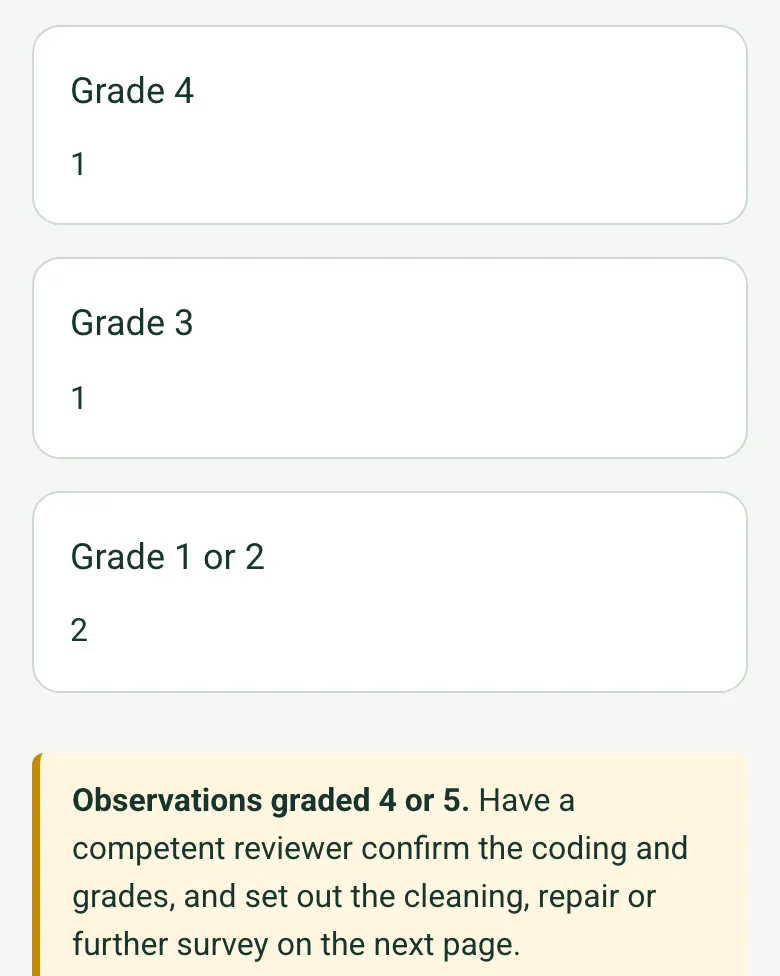
Counts worked out as grade 4: 1, grade 3: 1, grade 1 or 2: 2, with an amber note asking a competent reviewer to confirm the coding and grades

Observations counted by grade

The form totals the runs, the length surveyed and the observations by type and by grade. Any grade 4 or 5 shows a note to have a competent reviewer confirm the coding before the recommendations go out.

How calculated fields work →

A completed CCTV drain survey

A fictional rented house with repeat blockages: two runs between three inspection chambers, one surveyed in full and one abandoned at roots after 4.1 m, with a displaced joint, grease, a crack and the roots coded and graded. Open it as a filled-in form, or switch to a blank copy and try it yourself.

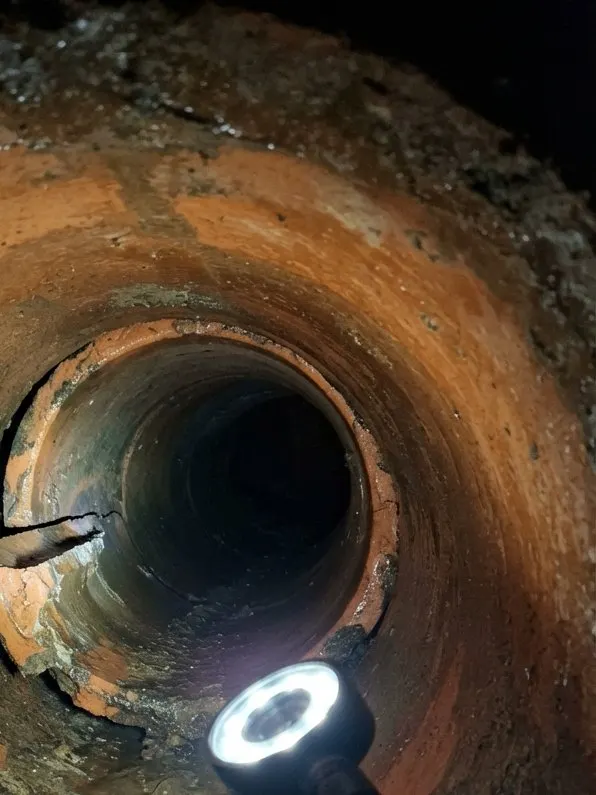
Inside a clay drain pipe lit by the camera, a joint where the next pipe has dropped and sits out of line
R1 at 3.2 m · displaced joint · structural, grade 3
Inside a clay drain pipe, fine tree roots hanging through a joint across about half the bore
R2 at 4.1 m · fine roots · service, grade 4, survey abandoned
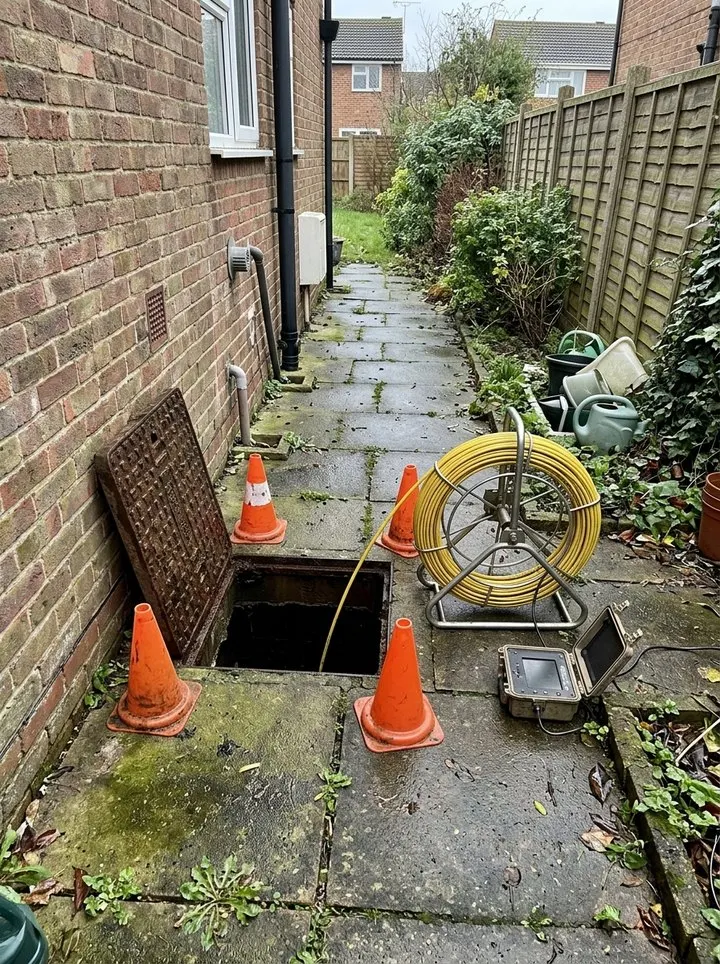
An open manhole on a garden side path with the cover lifted, orange cones round it and a push rod drain camera reel beside it
IC2 on the side path · start of run R2
Down the pipe: a joint passes, then roots hang through the next one

Try the CCTV drain survey record form live

Answer a few questions and watch it adapt. Your answers are not saved, and any photos you add are deleted within the hour.

Live form: CCTV Drain Survey RecordOpen full screen ↗
Fill it in right here

This is the real form as your team would use it: questions appear as you answer, scores work themselves out and you can add photos and signatures. No sign-up needed. Or open a completed example to see every answer, photo and score filled in.

Want to see one filled in? See a completed CCTV drain survey record report (PDF), made by SiteSurvey from a fictional site visit.

Fill it in on a phone or tablet

Your team completes the cctv drain survey record on site in the SiteSurvey app on iPhone, iPad and Android phones and tablets. The project name and address fill in for them, it works without signal, and it syncs when the device is back online with photos kept against the question they answer.

Customers and subcontractors do not need the app: send them a link and they can fill it in from any browser.

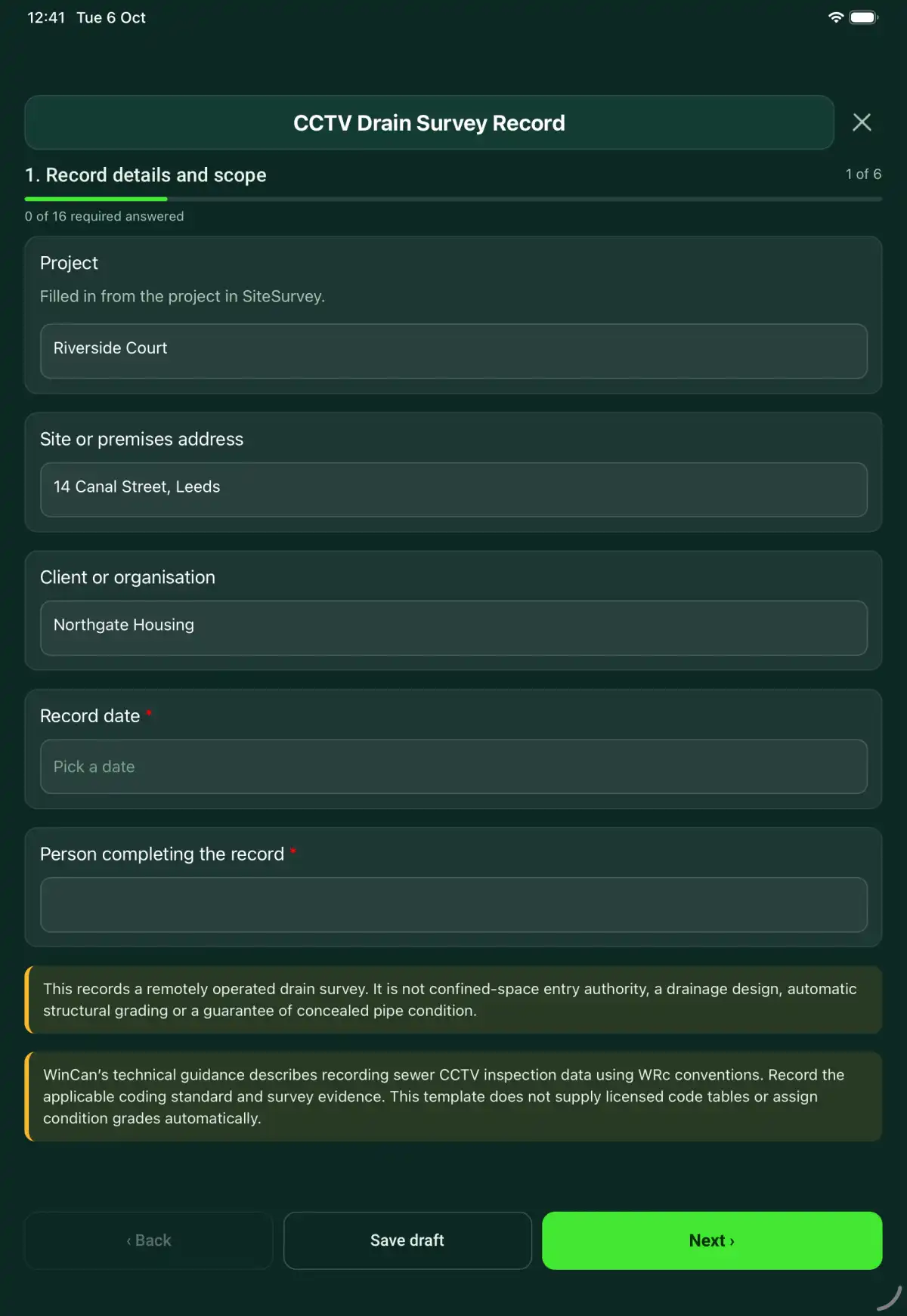
The CCTV Drain Survey Record form in the SiteSurvey app on a tablet
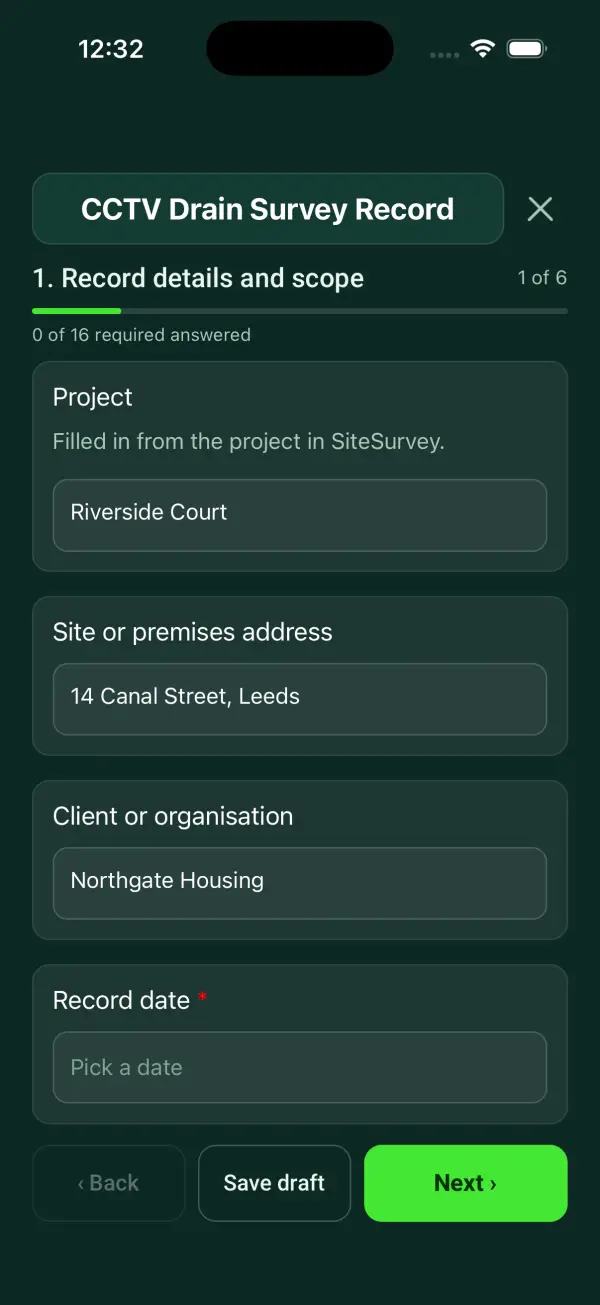
The CCTV Drain Survey Record form in the SiteSurvey app on a phone

Every question in the CCTV drain survey record template

A CCTV drain survey record linking pipe runs, access points, footage, chainage, observed defects, survey limits and recommendations for further review. 6 sections and 54 questions. Follow-up questions and guidance appear only when an answer calls for them, so the person on site never sees the ones that do not apply.

Make it your own: every question is editable

This is a starting point, not a fixed form. Once it is in your SiteSurvey account you can reword any question, add or remove questions, sections and answer options, and add your own logo, so it fits the way your team works and the jobs you do.

Details you only enter once

Add this form to a project in SiteSurvey and it fills in what the project already knows, so nobody on site retypes it and every form on the job uses the same names. Anything filled in can still be changed.

  • Project: the project name
  • Site or premises address: the site address, from the space or the project
  • Client or organisation: the project's customer

Record details and scope

  • ProjectShort answer

    Filled in from the project in SiteSurvey.

    Fills in from the project name
  • Site or premises addressShort answer
    Fills in from the site address, from the space or the project
  • Client or organisationShort answer
    Fills in from the project's customer
  • Record date*Date
  • Person completing the record*Short answer
  • Weather on siteAnswer

    Recent rain raises flows and hides the pipe invert. Note it here.

  • CheckThis records a remotely operated drain survey. It is not confined-space entry authority, a drainage design, automatic structural grading or a guarantee of concealed pipe condition.
  • CheckDrain and sewer CCTV observations are coded to BS EN 13508-2 (Investigation and assessment of drain and sewer systems outside buildings, part 2: visual inspection coding system). In the UK the usual coding and grading scheme is the WRc Manual of Sewer Condition Classification (MSCC), 5th edition, which applies BS EN 13508-2 and gives structural and service grades 1 to 5. Record the standard and edition used on the next page. This template does not supply licensed code tables or assign condition grades automatically.

Survey brief

  • Survey purpose and agreed extent*Short answer
  • Camera operator, if not the author, and training reference*Short answer
  • Camera and distance-measurement check reference*Short answer
  • Applicable coding standard and editionShort answer
  • Access permissions, safe method and restrictions*Notes

Pipe runs

  • Pipe run
    Repeat for each pipe run. Each one asks:
    • Run ID and upstream/downstream access points*Short answer
    • Manhole positions (start, then finish)Short answer

      Mark current location at each access point cover, so the next visit, or the excavation, finds the same run.

    • Diameter, material and apparent useShort answer
    • Survey direction and start reference*Short answer
    • Video file reference*Short answer
    • Length between the access points (m)Number

      From the plan or the counter reading at the far access point. Leave blank if not known.

    • Surveyed length (m)Number

      From the camera's distance counter, at the furthest point reached.

    • Length not surveyed (m)Worked out by the form
      Shown only when the answers above make it relevant
    • Survey of this runWorked out by the form
      Shown only when the answers above make it relevant
    • Obstruction, water level, visibility and unsurveyed extent*Notes

Observations

  • Observation
    Repeat for each observation. Each one asks:
    • Run ID*Short answer
    • Chainage, unit and video time reference*Short answer
    • Code under the stated standard where usedShort answer
    • Observation typeChoose one
      • Structural
      • Service (operational)
      • Construction feature
      • Other
    • Grade under the stated standardChoose one

      Entered by the person coding the survey, under the standard named on page 2. The form counts the grades; it does not set them.

      • 5 (worst)
      • 4
      • 3
      • 2
      • 1 (best)
      • Not graded
    • Observed defect and extent*Notes
    • Referenced still imagesPhotos
  • Runs surveyedWorked out by the form
  • Runs abandoned shortWorked out by the form
  • Total length surveyed (m)Worked out by the form
  • ObservationsWorked out by the form
  • StructuralWorked out by the form
  • ServiceWorked out by the form
  • Grade 5Worked out by the form
  • Grade 4Worked out by the form
  • Grade 3Worked out by the form
  • Grade 1 or 2Worked out by the form
  • CheckObservations graded 4 or 5. Have a competent reviewer confirm the coding and grades, and set out the cleaning, repair or further survey on the next page.
    Shown only when the answers above make it relevant

Interpretation

  • Cleaning, further survey or specialist review recommendationsNotes
  • Separate assessed condition report reference where providedShort answer

    State the coding method and competence behind any grading. Separate the visual observation from the recommendation.

  • Competent reviewer of the coding and gradesShort answer

Actions and review

  • Are further actions required?*Choose one
    • Yes
    • No
  • Further action
    Repeat for each further action. Each one asks:
    Shown when “Are further actions required?” is “Yes”
    • Action and evidence reference*Notes
    • PriorityChoose one
      • Urgent
      • High
      • Medium
      • Low
    • Person responsible*Short answer
    • Target dateDate
    • Action status*Choose one
      • Open
      • In progress
      • Completed
    • Completion evidence*Notes
      Shown when “Action status” is “Completed”
  • Open actionsWorked out by the form

    Worked out from the actions above: open or in progress.

    Shown when “Are further actions required?” is “Yes”
  • Outstanding limitations and information to pass onNotes
  • Record status*Choose one
    • Ready for review
    • Further work needed
    • Work or use stopped
  • Reviewed byShort answer
  • Review dateDate
  • Author signature*Signature
  • CheckSigning records the information entered. It does not itself certify legal compliance, remove a limitation or authorise unsafe work.

Scope and responsibility

This records a remotely operated drain survey. It is not confined-space entry authority, a drainage design, automatic structural grading or a guarantee of concealed pipe condition.

What a useful entry looks like

Separate assessed condition report reference where provided

State the coding method and competence behind any grading. Separate the visual observation from the recommendation.

Observation at the recorded chainage is linked to the survey footage. Any grading references the agreed coding method and named reviewer.

Fictional example of record wording. Use the actual evidence and approved arrangements for your job; this is not a completed report or an instruction to carry out the work.

See it filled in

A completed CCTV drain survey record report, made by SiteSurvey from a fictional site visit: every answer, the photos, the guidance that applied and the sign-off, ready to send as a PDF.

See completed form (PDF) ↗

CCTV Drain Survey Record FAQs

How should I record “Separate assessed condition report reference where provided”?

State the coding method and competence behind any grading. Separate the visual observation from the recommendation.

Does it automatically grade a pipe?

No. The person coding the survey enters each grade under the stated standard. The form counts the observations by grade and flags grades 4 and 5 for a competent reviewer.

Can a blocked run be marked fully surveyed?

No. Record the distance reached, obstruction and remaining unsurveyed extent.

Can someone enter a chamber under this form?

No. This record provides no entry authority or rescue arrangements.

What are the limits of this template?

This records a remotely operated drain survey. It is not confined-space entry authority, a drainage design, automatic structural grading or a guarantee of concealed pipe condition.

Can I complete this form on site and share the record?

In the SiteSurvey app the form works offline, with photos and signatures recorded against the questions. Share the completed record as a PDF or a link. Dates and action owners are recorded fields; this form does not send reminders or update other systems.

Related

Use this CCTV drain survey record form with your team

Add it from the form library in one click, change any question, and every completed form becomes a branded PDF report.

Start your trial →