A thorough examination record for lifting equipment under LOLER, filled in by the competent person. Record the examiner and the employer, then each item: scan its plate or tag, record its type, location, safe working load, the date of its last thorough examination and the basis of the examination. The form works out the days since the last examination and warns if an item on a 6 or 12-month basis was overdue. Record the result as safe to use, a defect to fix by a set date or a dangerous defect, and the latest date for the next examination: on a 6 or 12-month basis the form checks it is no later than the interval allows. It counts the items by result and ends with the examiner's qualifications and signature. It is the record of the examination, not a certificate. Try the form below, see every question or open a completed example.
✎Every question is editable. Add this form to your account, then change the wording, add or remove questions and options, and make it fit your own jobs.
Where lifting equipment is exposed to conditions that cause deterioration, LOLER regulation 9 requires equipment for lifting people, and lifting accessories such as slings and shackles, to be thoroughly examined at least every 6 months, and other lifting equipment at least every 12 months, unless an examination scheme drawn up by a competent person sets different intervals. Equipment also needs examining after installation where its safety depends on how it is installed, and after exceptional circumstances that could affect its safety.
The competent person records each item, the date of its last thorough examination and the basis of the examination. The form works out the days since the last one, warns if an item on a 6 or 12-month basis was overdue, checks the latest date for the next examination against the interval and counts the items by result. It is the record of the examination, not a certificate.
Items counted by result
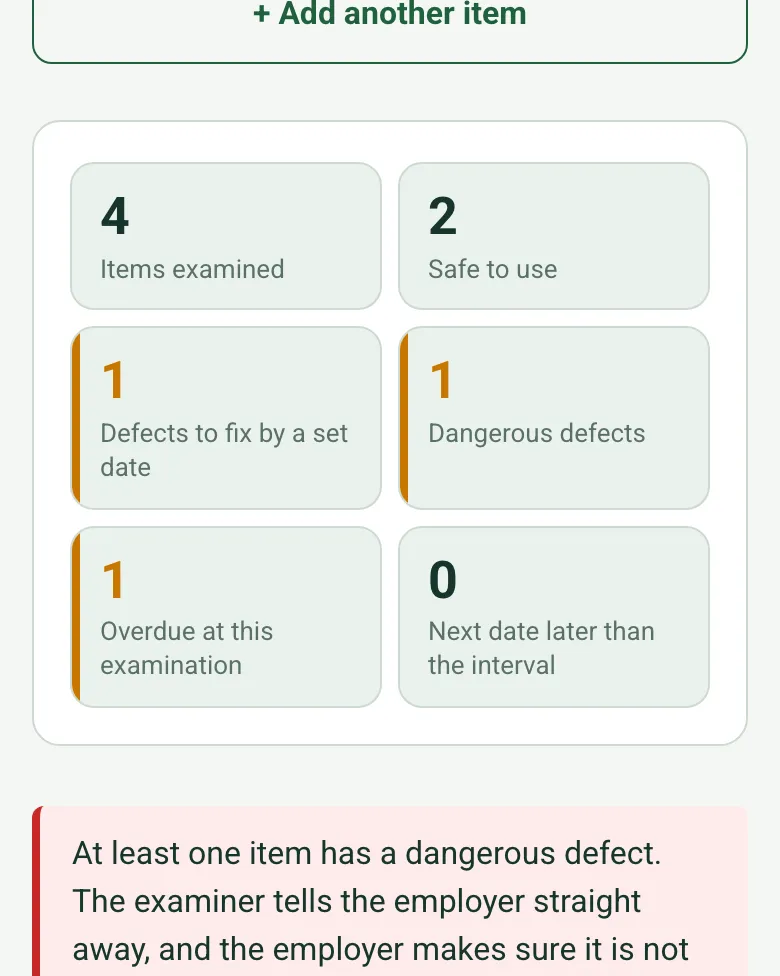
The form counts the items examined, safe to use, with a defect to fix by a set date and with a dangerous defect. A dangerous defect brings up a red note that the employer must make sure it is not used until put right.
From the date of the last thorough examination, the form works out the days since. On a 6-month basis over 6 months, or a 12-month basis over 12, an amber note asks why and whether the item was used while overdue.
Schedule 1 asks for the latest date for the next examination. On a 6 or 12-month basis the form shows the days to it and goes red if the date is later than the interval allows. Under an examination scheme it takes the scheme's date.
Add photos or a short video of each item and any defect, so the employer sees what the examiner found.
A completed LOLER examination record
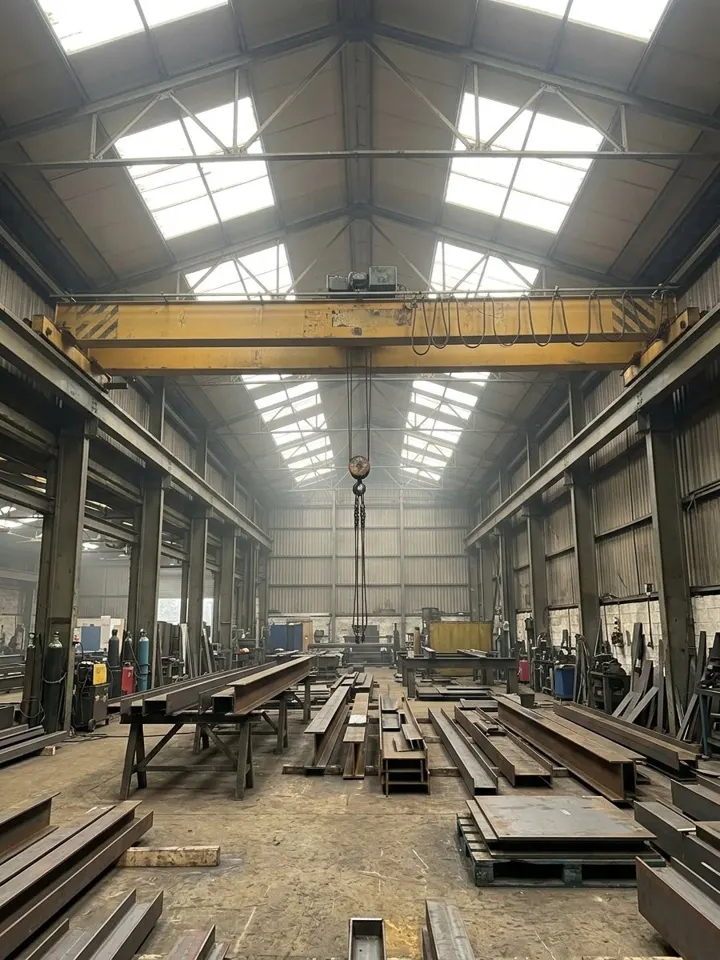
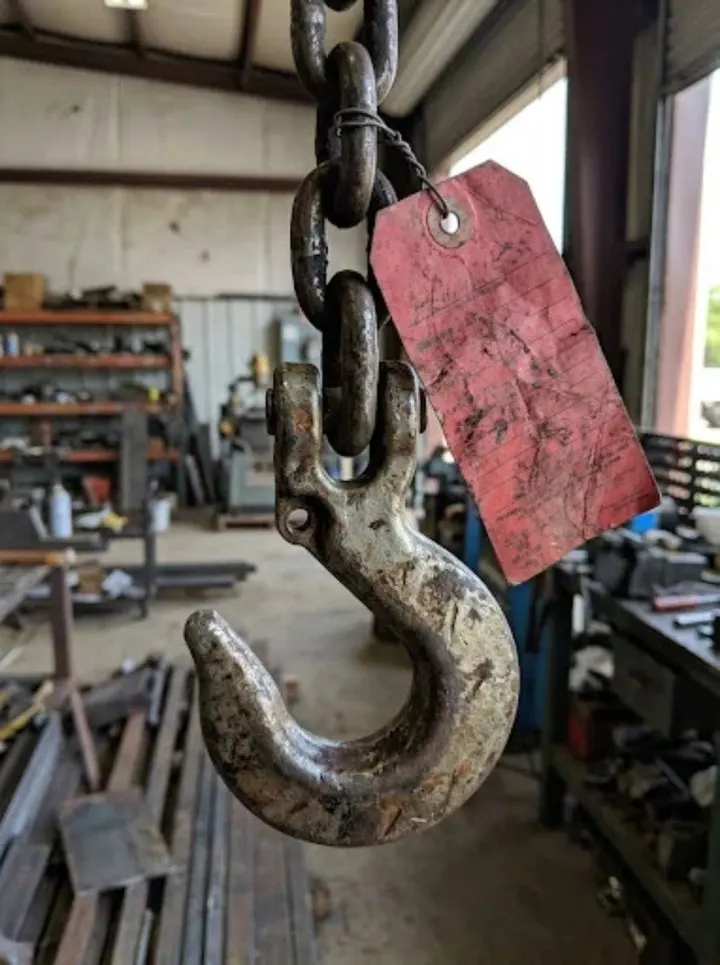
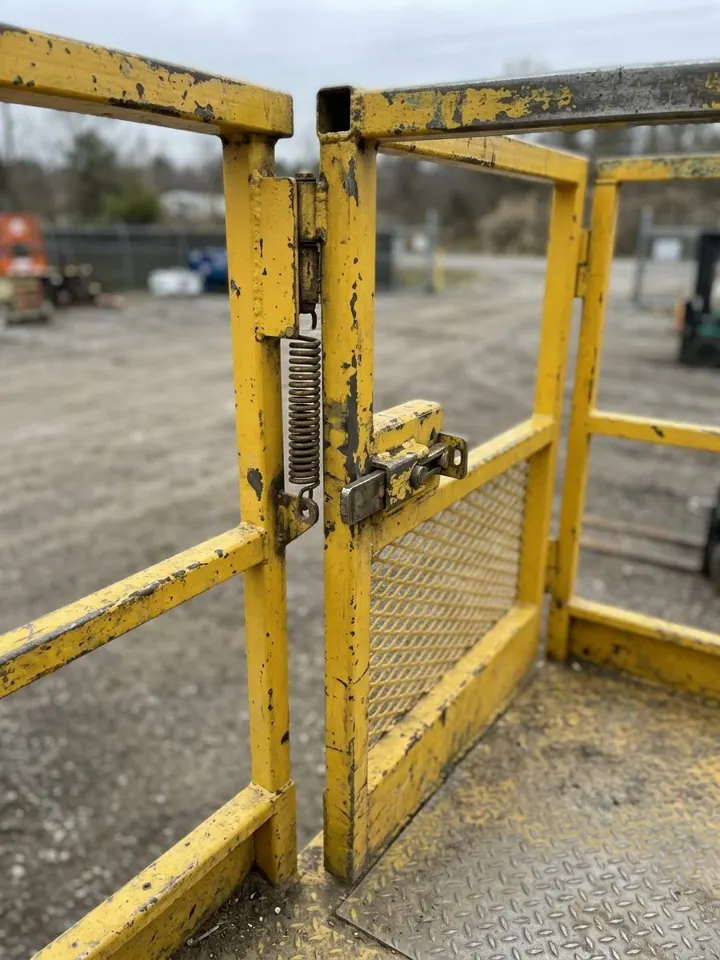
A fictional fabrication works: an overhead crane safe to use, a chain sling hook with a missing safety catch and an opened throat recorded as a dangerous defect, a MEWP gate latch to fix within 14 days, and a chain block last examined 399 days earlier on a 12-month basis, flagged as overdue.
This is the real form as your team would use it: questions appear as you answer, scores work themselves out and you can add photos and signatures. No sign-up needed. Or open a completed example to see every answer, photo and score filled in.
A LOLER thorough examination record: each item of lifting equipment with its identity, SWL, the basis of the examination, defects, whether they are dangerous, the next examination date and the examiner's declaration. 3 sections and 56 questions. Follow-up questions and guidance appear only when an answer calls for them, so the person on site never sees the ones that do not apply.
✎
Make it your own: every question is editable
This is a starting point, not a fixed form. Once it is in your SiteSurvey account you can reword any question, add or remove questions, sections and answer options, and add your own logo, so it fits the way your team works and the jobs you do.
Details you only enter once
Add this form to a project in SiteSurvey and it fills in what the project already knows, so nobody on site retypes it and every form on the job uses the same names. Anything filled in can still be changed.
Project: the project name
Client: the project's customer
Site: the site, when the form is opened for a space or a product
Site address: the site address, from the space or the project
1
Examination
ProjectShort answer
Fills in from the project name
ClientShort answer
Fills in from the project's customer
Site*Short answer
Fills in from the site, when the form is opened for a space or a product
Site addressShort answer
Fills in from the site address, from the space or the project
Examination date*Date
Competent person (examiner)*Short answer
CompanyShort answer
Company addressShort answer
Is the examiner self-employed or employed?Choose one
Self-employed
Employed by the company above
Employer the report is forShort answer
Employer addressShort answer
GuidanceLOLER regulation 9: where lifting equipment is exposed to conditions that cause deterioration liable to result in dangerous situations, it must be thoroughly examined at least every 6 months if it lifts people or is a lifting accessory, at least every 12 months for other lifting equipment, or in line with an examination scheme drawn up by a competent person. It must also be examined each time exceptional circumstances liable to affect its safety have occurred, and, where its safety depends on how it is installed, after installation and before first use.
2
Equipment
Equipment by building or area
Repeat for each entry. Each one asks:
Building or area*Short answer
For example Warehouse bay 3 or Workshop
Equipment examined here
Repeat for each item. Each one asks:
Identification or asset number*Short answer
Scan the plate or tagScan a label: serial number, asset number, swl
Optional. Scan the label or tag to capture its numbers.
Type*Choose one
Hoist
Overhead crane
Mobile crane
Forklift mast and chains
MEWP
Passenger or goods lift
Vehicle tail lift
Patient hoist
Lifting accessory (sling, shackle, eyebolt)
Other
Chain sling
Wire rope sling
Webbing sling
Shackle
Eyebolt
Position in this areaShort answer
Safe working loadShort answer
Date of manufacture (if known)Short answer
Date of the last thorough examinationDate
Days since the last thorough examinationWorked out by the form
Shown when “Date of the last thorough examination” is answered and “Examination date” is answered
Used to lift people?Yes or No
ExaminationChoose one
Every 6 months
Every 12 months
In line with an examination scheme
After exceptional circumstances
After installation, before first use
CheckEquipment for lifting people, and lifting accessories, need examining at least every 6 months unless an examination scheme says otherwise.
Shown only when the answers above make it relevant
CheckThe last thorough examination was more than 6 months before this one. On a 6-month basis (LOLER regulation 9(3)(a)(i)) the equipment was overdue: record why, and whether it was used while overdue.
Shown only when the answers above make it relevant
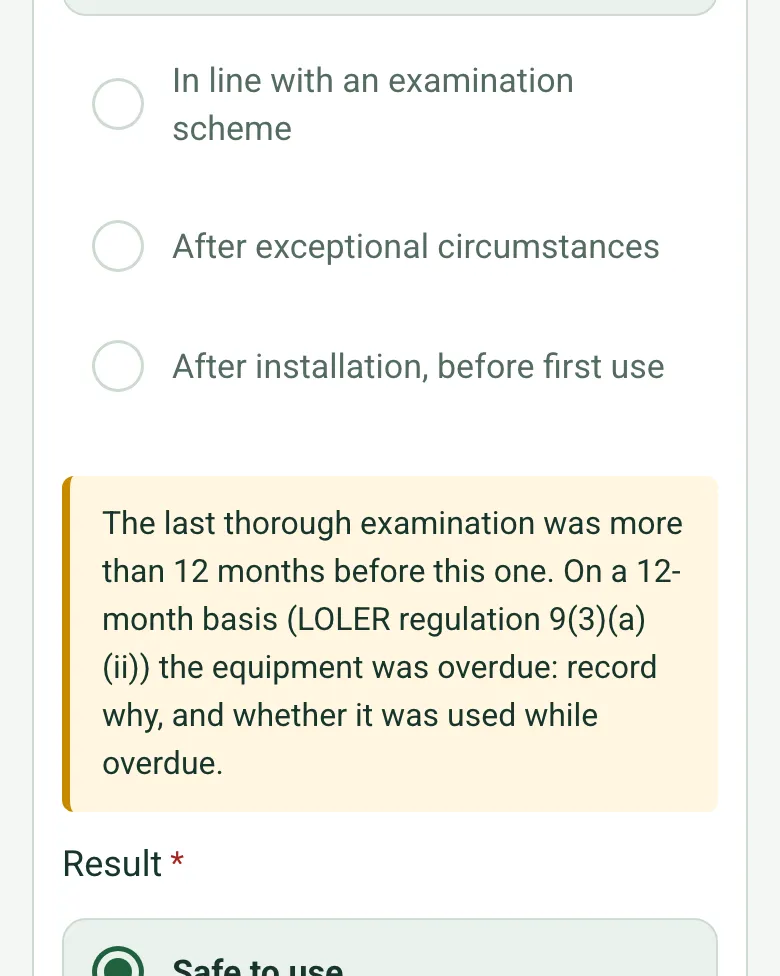
CheckThe last thorough examination was more than 12 months before this one. On a 12-month basis (LOLER regulation 9(3)(a)(ii)) the equipment was overdue: record why, and whether it was used while overdue.
Shown only when the answers above make it relevant
Result*Choose one
Safe to use
Defect to fix by a set date
Dangerous defect: do not use
Defects found and repairs neededNotes
Shown only when the answers above make it relevant
Fix byDate
Shown when “Result” is “Defect to fix by a set date”
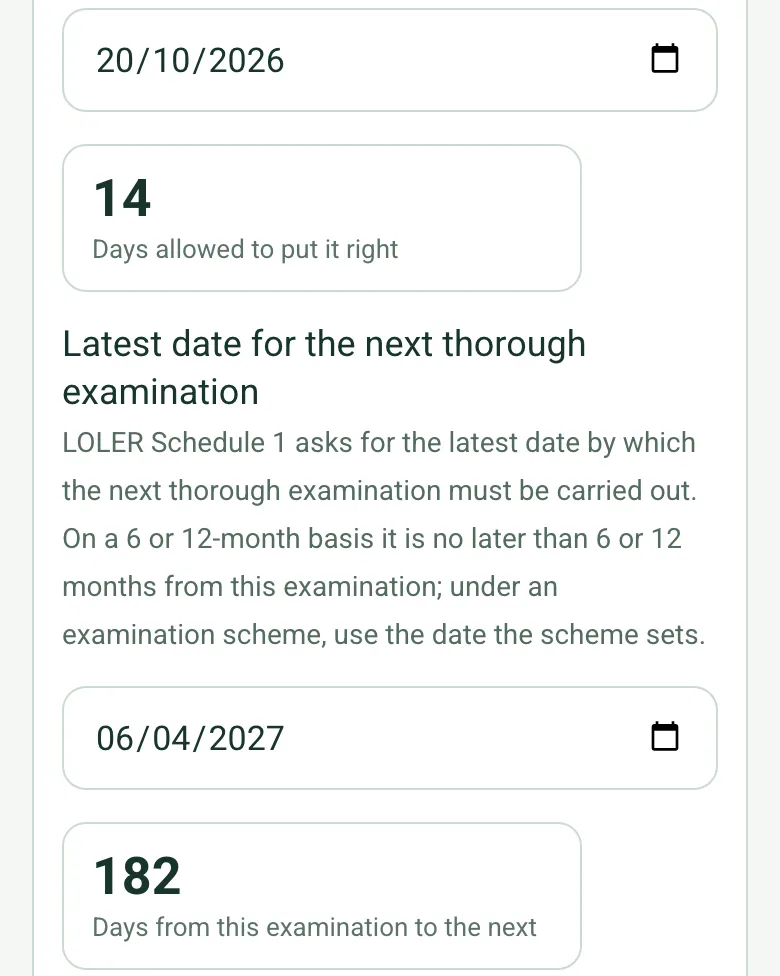
Days allowed to put it rightWorked out by the form
Shown when “Result” is “Defect to fix by a set date” and “Fix by” is answered and “Examination date” is answered
Particulars of any test carried out as part of the examinationNotes
For example a load test, its load and the result. Write None if no test was carried out.
WarningDangerous defect. The examiner must tell the employer straight away, and where there is an existing or imminent risk of serious personal injury, send a copy of the report to the enforcing authority as soon as practicable. The employer must make sure the equipment is not used until the defect is put right.
Shown when “Result” is “Dangerous defect: do not use”
Latest date for the next thorough examinationDate
LOLER Schedule 1 asks for the latest date by which the next thorough examination must be carried out. On a 6 or 12-month basis it is no later than 6 or 12 months from this examination; under an examination scheme, use the date the scheme sets.
Days from this examination to the nextWorked out by the form
Shown when “Latest date for the next thorough examination” is answered and “Examination date” is answered
WarningThe next examination date is more than 6 months after this one. On a 6-month basis the latest date is 6 months from this examination, unless an examination scheme applies.
Shown only when the answers above make it relevant
WarningThe next examination date is more than 12 months after this one. On a 12-month basis the latest date is 12 months from this examination, unless an examination scheme applies.
Shown only when the answers above make it relevant
PhotosPhotos
it_f_safeWorked out by the form
it_f_defectWorked out by the form
it_f_dangerWorked out by the form
it_f_overdueWorked out by the form
it_f_lateWorked out by the form
This building or area: items examinedWorked out by the form
This building or area: safe to useWorked out by the form
This building or area: defects to fix by a set dateWorked out by the form
This building or area: dangerous defectsWorked out by the form
This building or area: overdue at this examinationWorked out by the form
This building or area: next date later than the intervalWorked out by the form
Items examinedWorked out by the form
Safe to useWorked out by the form
Defects to fix by a set dateWorked out by the form
Dangerous defectsWorked out by the form
Overdue at this examinationWorked out by the form
Next date later than the intervalWorked out by the form
WarningAt least one item has a dangerous defect. The examiner tells the employer straight away, and the employer makes sure it is not used until the defect is put right (LOLER regulation 10).
Shown only when the answers above make it relevant
WarningAt least one next examination date is later than the 6 or 12-month interval allows. Check the dates before the report is issued.
Shown only when the answers above make it relevant
3
Declaration
CheckLOLER regulation 10: the examiner makes an authenticated written report containing the information in Schedule 1, as soon as practicable, for the employer and for anyone the equipment is hired or leased from. Schedule 1 includes the date of the report and the name and address of anyone signing or authenticating it for the examiner. This form is a site record of the examination; check every Schedule 1 item is present before it is issued as the report.
Examiner nameWorked out by the form
PositionShort answer
Examiner qualificationsShort answer
Examiner signatureSignature
Name of the person signing or authenticating the report for the examinerShort answer
Only if someone other than the examiner signs the report on their behalf.
Address of that personShort answer
Date of the reportDate
Received for the employer byShort answer
Signature for the employerSignature
See it filled in
A completed LOLER inspection report, made by SiteSurvey from a fictional site visit: every answer, the photos, the guidance that applied and the sign-off, ready to send as a PDF.
Under regulation 10, the examiner must tell the employer straight away about any defect that is or could become a danger. Where there is an existing or imminent risk of serious personal injury, the examiner also sends a copy of the report to the enforcing authority. The employer must make sure the equipment is not used until the defect is put right.
What does the report need to contain?
LOLER Schedule 1 lists 11 items, including the employer's name and address, details to identify the equipment and its date of manufacture where known, the date of the last thorough examination, the safe working load, any defects and the repairs needed, and the examiner's name and qualifications. The form asks for these, and the report goes to the employer as a PDF or a link.
Who can do a thorough examination?
A competent person with the practical and theoretical knowledge and experience of the equipment to find defects and judge how serious they are. HSE says they must be independent and impartial enough to judge without fear or favour, and should not be the person who does the routine maintenance.
Does it cover lifting accessories?
Yes. Slings, shackles and eyebolts are lifting accessories and need examining at least every 6 months unless an examination scheme sets other intervals. The form warns if an accessory, or equipment that lifts people, is on a 12-month cycle, and checks that the next examination date is no more than 6 months away.
Can I scan the equipment tag?
Yes. Scan the plate or tag on the SiteSurvey app to capture the serial or asset number and SWL.
Who uses this?
Engineer surveyors and inspection bodies, lifting equipment companies, plant hire firms, and site and maintenance managers.