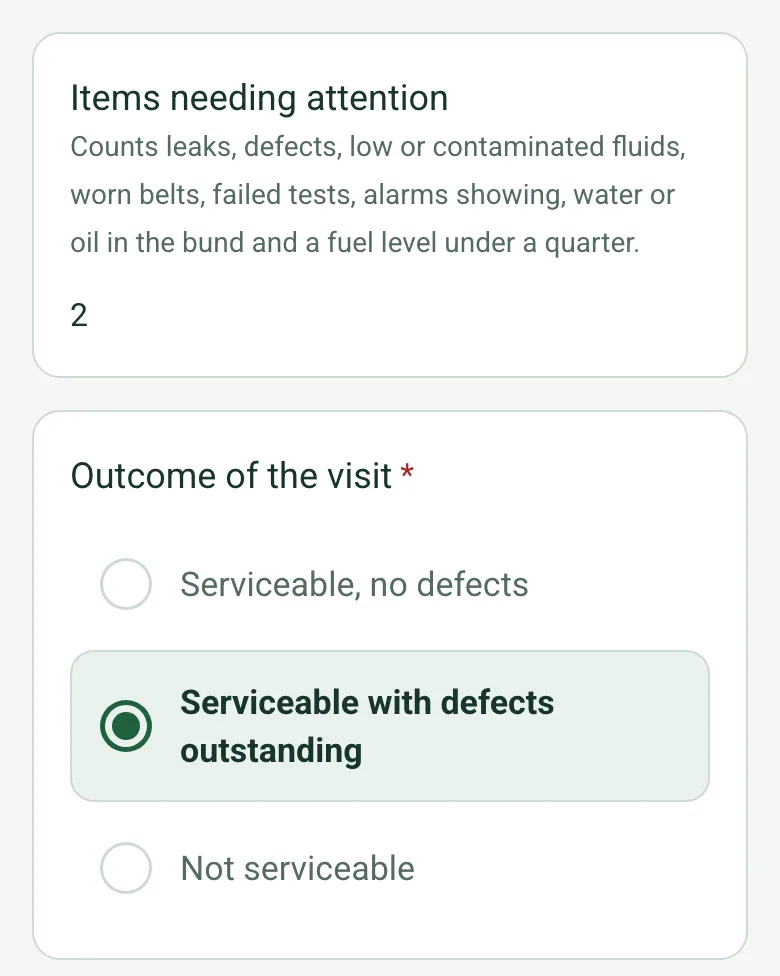
Items needing attention, counted
Leaks, defects, low fluids, worn belts, failed tests, alarms, water or oil in the bund and a low fuel level all add to one count above the outcome, so nothing is missed in the follow-up.
How calculated fields work →Form library · Facilities and maintenance
A service visit form for a standby or prime power generator. It covers making the set safe, engine fluids and filters, the fuel tank and its bund, battery and controls, and a run test with readings, then the outcome, parts and the customer's signature. Every question is listed below, and you can fill the live form in on this page.
Ready to use from the form library, and every question is yours to edit. Try it for a small trial fee, cancel any time.
Try it on your phone
Try it on this phone
Fill in the generator maintenance on your phone now
See how the generator maintenance looks on your phone
Scan the code with your phone camera. It opens the real form, no sign-up needed.
Open the live example and fill it in, just as your team would on site. No sign-up needed.
See it on this phoneEvery question is editable. Add this form to your account, then change the wording, add or remove questions and options, and make it fit your own jobs.
A generator maintenance checklist should cover leaks, the enclosure and exhaust, engine oil and coolant, belts, hoses and filters, the fuel level and condition, the battery and charger, the control panel and emergency stop, and the changeover switch. It should record a run test with voltage, frequency, oil pressure and temperature, and confirm the set was left in auto, ready to start.
Last updated . Facts checked by the SiteSurvey team on 5 October 2026 against GOV.UK: storing oil at a home or business, regulation 5 of the Provision and Use of Work Equipment Regulations 1998 and regulation 4 of the Electricity at Work Regulations 1989.
Take the checklist round the set on a phone: before you start, engine, fuel, battery and controls, then the run test. The form works out the fuel in the tank, the load against the rating and the days since the last service, and counts the items needing attention.
Leaks, defects, low fluids, worn belts, failed tests, alarms, water or oil in the bund and a low fuel level all add to one count above the outcome, so nothing is missed in the follow-up.
How calculated fields work →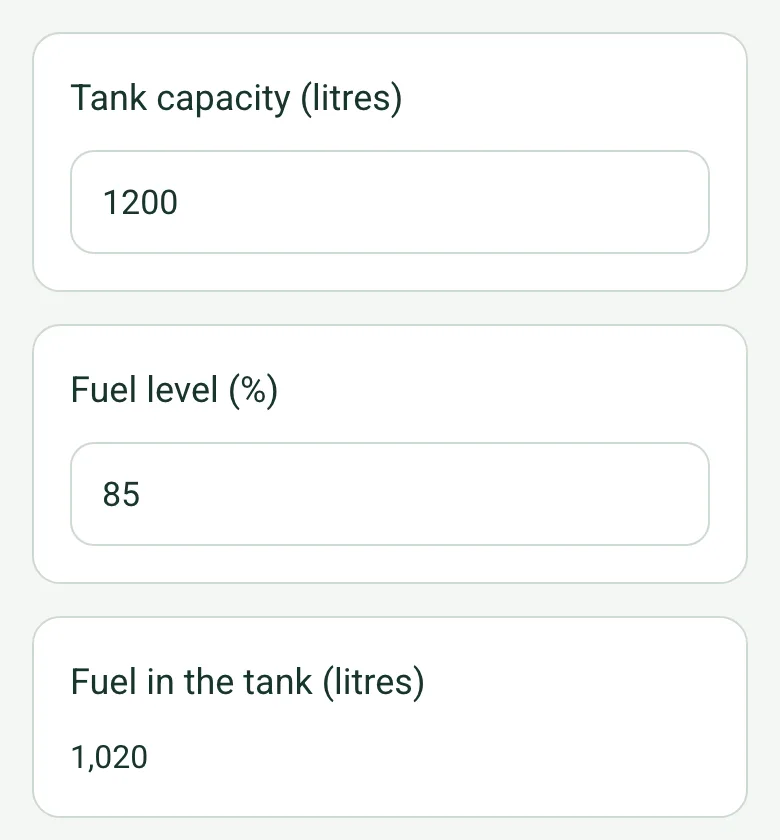
Enter the tank capacity and fuel level and the form gives the litres in the tank. Enter the load during the run test and it shows the load against the set's rating, at a 0.8 power factor.
How calculated fields work →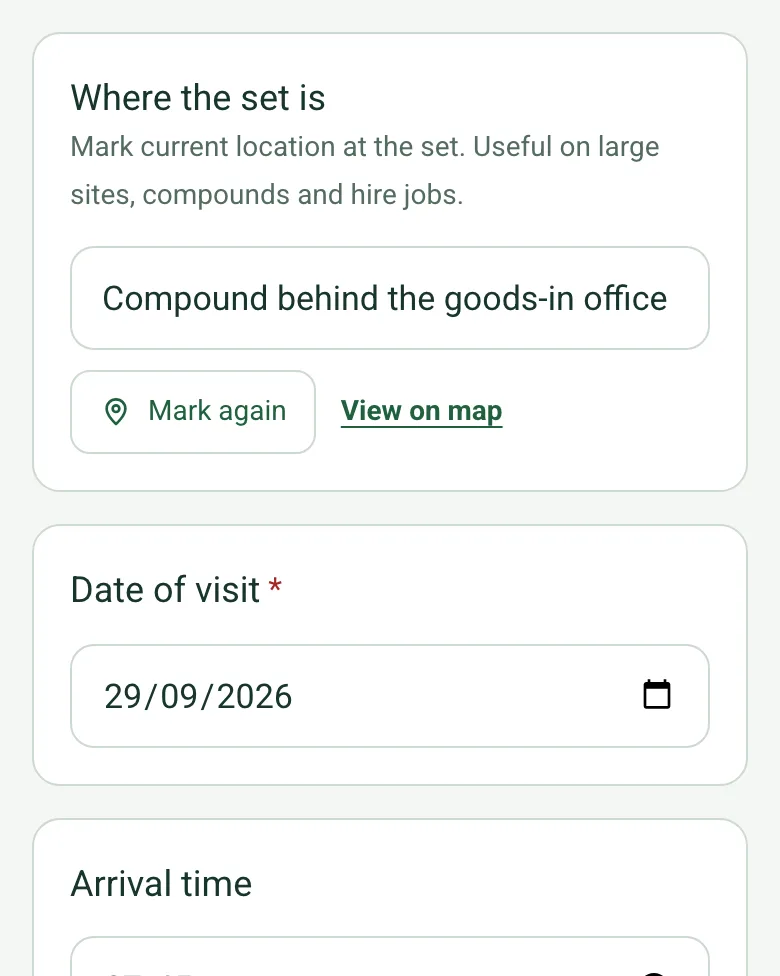
On big sites, compounds and hire jobs, mark where the set is. The next engineer gets your note, GPS coordinates, an OS grid reference and a map link. Mark current location works on web forms in any phone browser today, and the app version is on its way.
How GPS location works →Film the canopy, tank and bund with Walk Cam before you start and say what you see. The clip is kept with the service record.
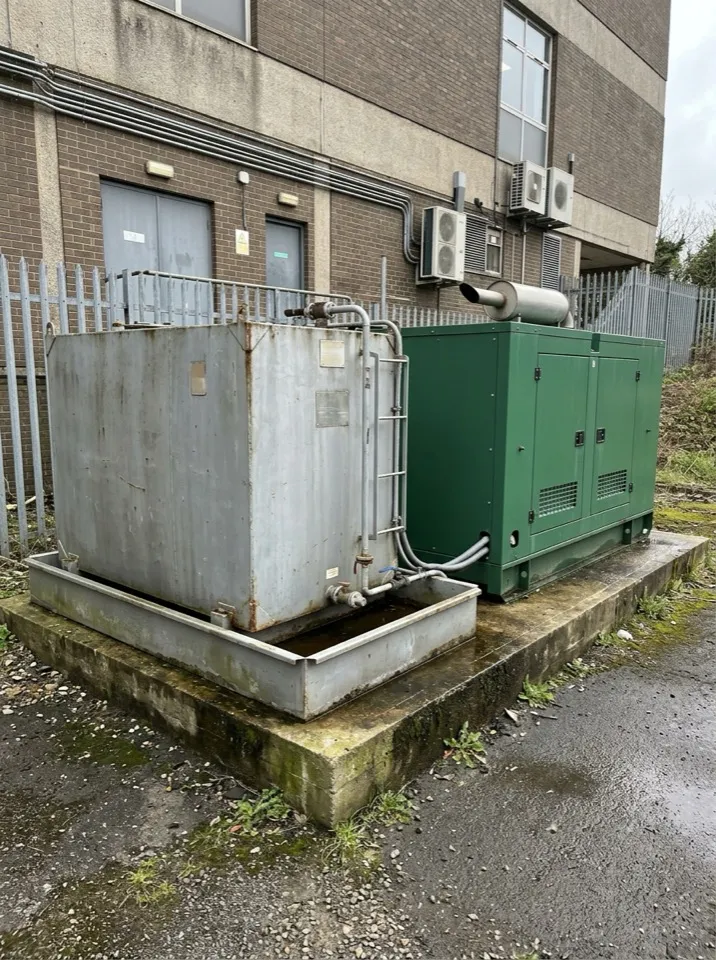
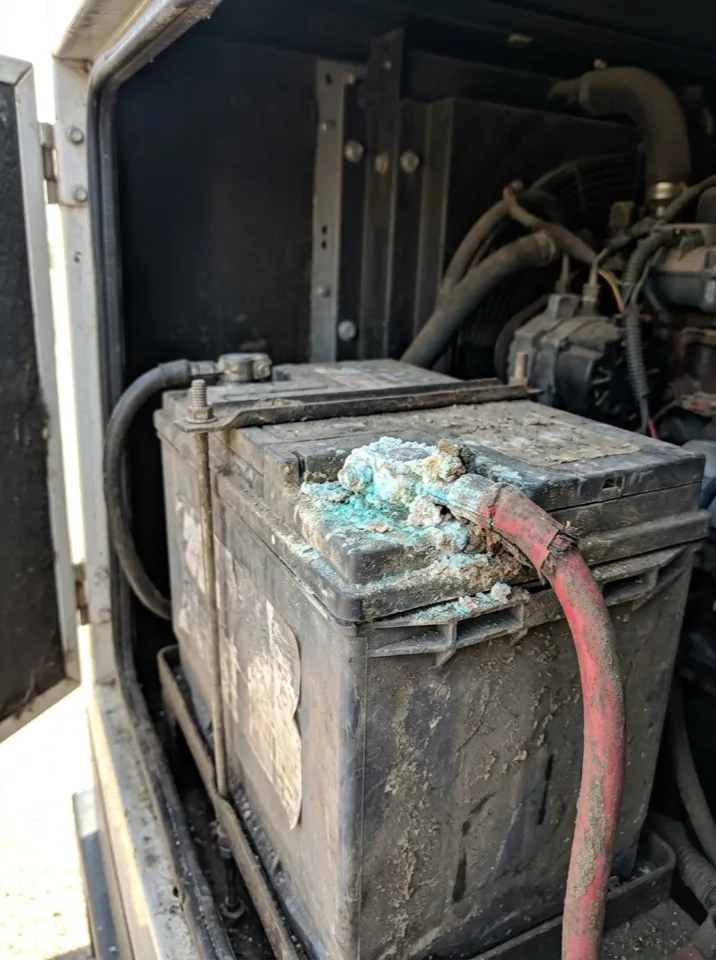
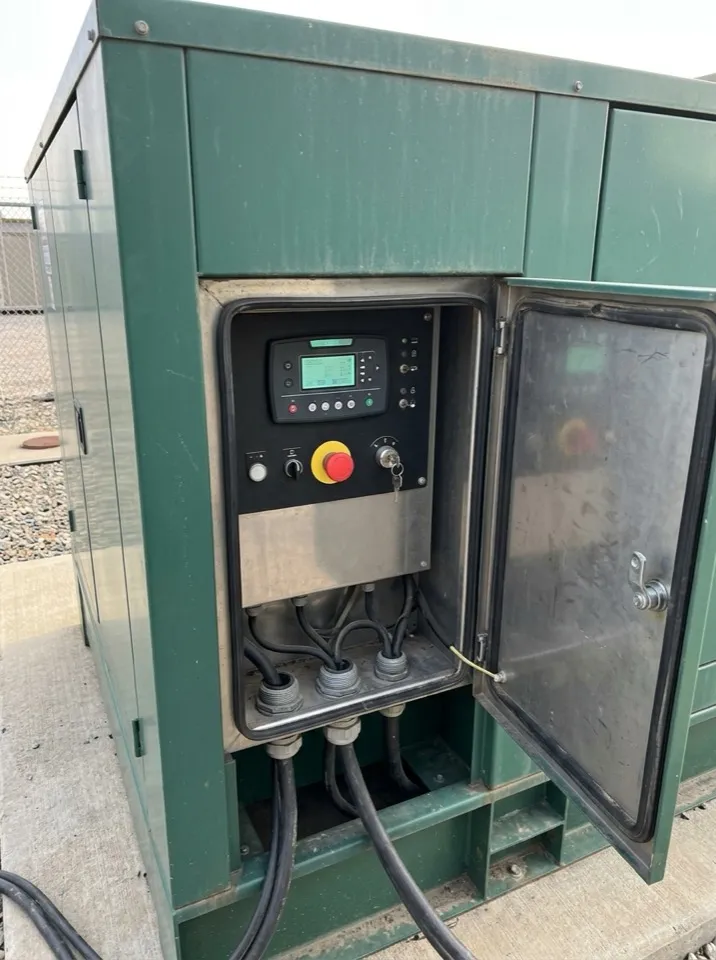
How Walk Cam works →A six-monthly service of a fictional 200 kVA standby set at a distribution centre: oil and filters changed, an hour on the building load at 60% of rating, a worn belt and rainwater in the tank bund for follow-up.
Answer a few questions and watch it adapt. Your answers are not saved, and any photos you add are deleted within the hour.
This is the real form as your team would use it: questions appear as you answer, scores work themselves out and you can add photos and signatures. No sign-up needed. Or open a completed example to see every answer, photo and score filled in.
Want to see one filled in? See a completed generator maintenance report (PDF), made by SiteSurvey from a fictional site visit.
For teams
Paper or a spreadsheet works for the odd job. When your team does this every week, SiteSurvey keeps every visit in one place and turns each one into a report you can send.
Your team completes the generator maintenance on site in the SiteSurvey app on iPhone, iPad and Android phones and tablets. The project name and address fill in for them, it works without signal, and it syncs when the device is back online with photos kept against the question they answer.
Customers and subcontractors do not need the app: send them a link and they can fill it in from any browser.
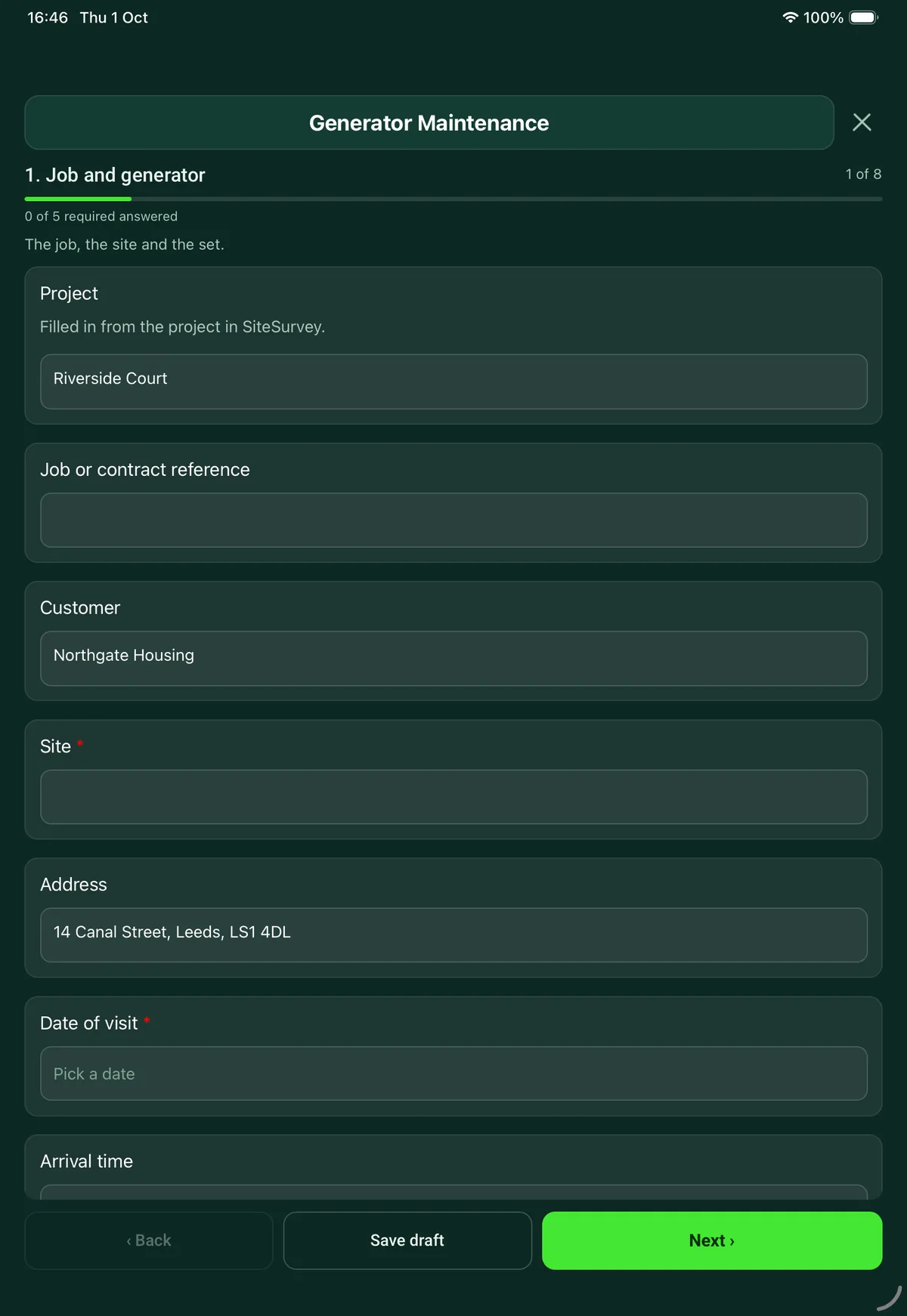
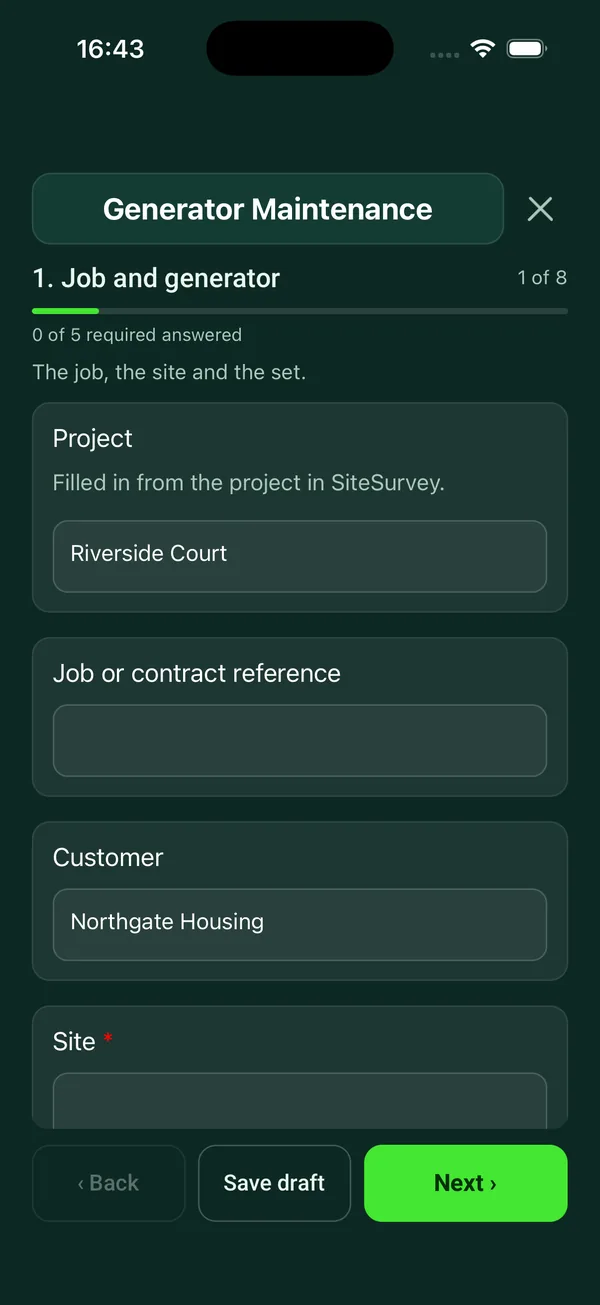
Service visit for a standby or prime power generator: engine, fuel, battery and controls checks, a recorded run test, defects, parts and sign-off. 8 sections and 85 questions. Follow-up questions and guidance appear only when an answer calls for them, so the person on site never sees the ones that do not apply.
This is a starting point, not a fixed form. Once it is in your SiteSurvey account you can reword any question, add or remove questions, sections and answer options, and add your own logo, so it fits the way your team works and the jobs you do.
Add this form to a project in SiteSurvey and it fills in what the project already knows, so nobody on site retypes it and every form on the job uses the same names. Anything filled in can still be changed.
The job, the site and the set.
Filled in from the project in SiteSurvey.
Mark current location at the set. Useful on large sites, compounds and hire jobs.
Make it safe and look it over.
Fluids, filters, belts and hoses.
Tank, level and condition.
Starting, charging, alarms and changeover.
Readings with the set running.
How the set was left and what happens next.
Counts leaks, defects, low or contaminated fluids, worn belts, failed tests, alarms showing, water or oil in the bund and a fuel level under a quarter.
Customer and engineer.
A completed generator maintenance report, made by SiteSurvey from a fictional site visit: every answer, the photos, the guidance that applied and the sign-off, ready to send as a PDF.
Whether the set was run off load, on the building load or on a load bank, for how long, with the load, voltage, frequency, oil pressure and coolant temperature, and any abnormal noise, vibration or smoke. For a standby set it also records whether automatic start on mains failure was tested.
A standby generator switched out of auto for servicing will not start if the mains fails. The form asks the engineer to switch it out of auto before working, and to confirm it is back in auto before leaving. If it is not, the form shows a warning and records who on site was told.
GOV.UK says the oil storage rules for businesses in England and Wales apply to a generator with a connected oil supply tank of 201 litres or more, including stand-by generators, and that a bund must hold 110% of the capacity of the container. The form asks for the tank capacity and, at 201 litres or more, the type of secondary containment. Scotland and Northern Ireland have their own rules.
Oil level and whether the oil and filter were changed, coolant and antifreeze, belts and hoses, the air and fuel filters and the engine heater. Fuel is checked for level, with a warning under a quarter of a tank, and for water or sediment. Battery voltage and age, the charger, terminals, panel alarms, the emergency stop and the changeover switch are recorded too, with test results where a test was done.
No law sets a generator service interval. Regulation 5 of the Provision and Use of Work Equipment Regulations 1998 requires work equipment to be maintained in an efficient state, in efficient working order and in good repair, and regulation 4 of the Electricity at Work Regulations 1989 requires electrical systems to be maintained, as far as necessary, to prevent danger. Follow the manufacturer's schedule and any site or insurer requirement for how often.
The engineer records the outcome as serviceable, serviceable with defects outstanding or not serviceable, with parts used and the next service date. The customer signs on the device, or the form records why nobody could. It works offline in the SiteSurvey app and goes out as a PDF or a share link.
Related templates
Planned maintenance visit: records seen, asset by asset tasks, water temperatures, work done and next visit.
Service visit record for air conditioning, heat pumps, ventilation and air handling units. Unit by unit checks, refrigerant and F gas leak checks, parts used and sign-off.
Job sheet for a reactive or planned job: safety before starting, work done, parts used, tests, outcome and customer sign-off.
Portable appliance inspection and test record: each appliance with its ID, location, class, visual checks, test readings, pass or fail and the action taken.
Add it from the form library in one click, change any question, and every completed form becomes a branded PDF report.
Start your trial →