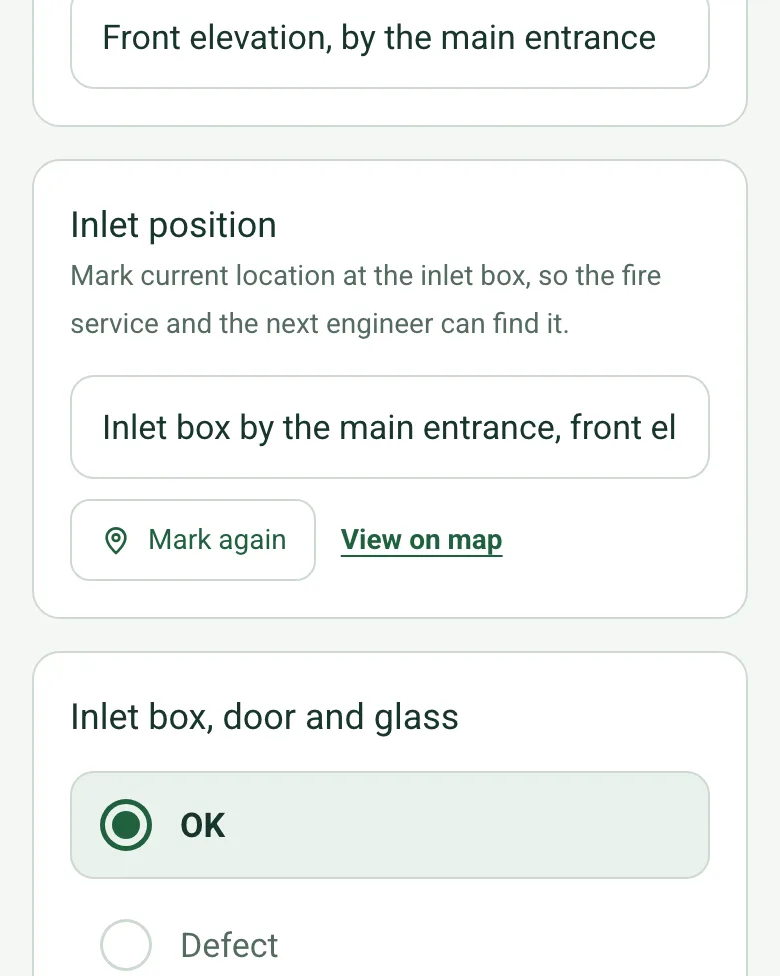
Pin the inlet
Mark current location at the inlet box, so the fire service and the next engineer can find it. Mark current location works on web forms in any phone browser today, and the app version is on its way.
How GPS location works →Form library · Fire safety
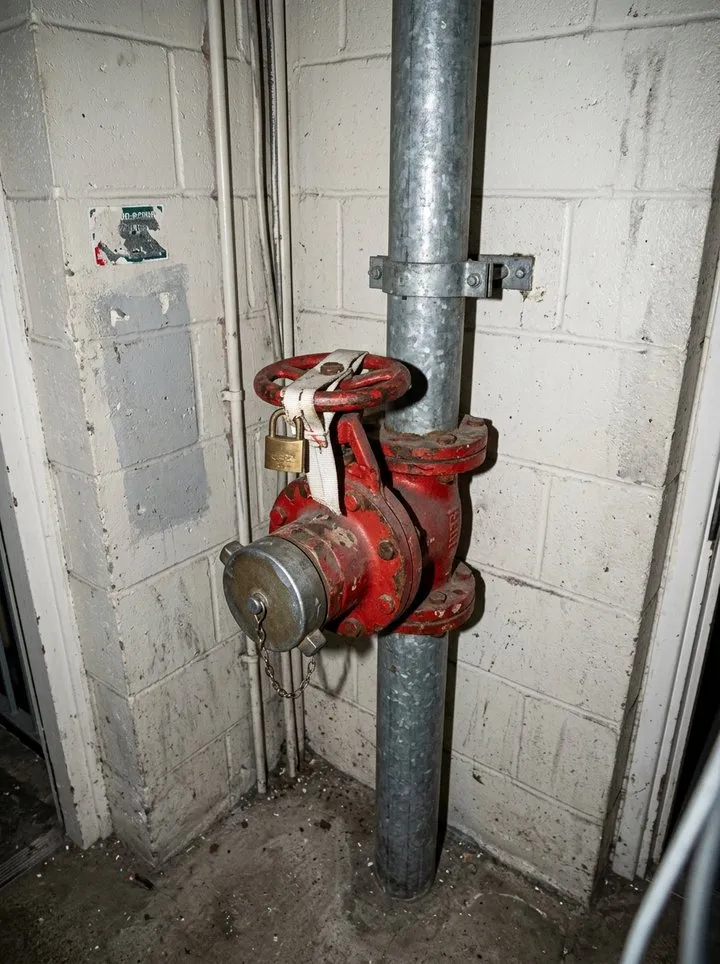
An inspection and test record for a dry rising main. Pin the inlet on the map, check the inlet box, sign, valves, drain and access, then each floor's landing valve, cap and box. The form counts the defects, and for the annual test compares the pressure and hold time with your test procedure and works out the pressure drop. It also asks whether a fault in a high-rise residential building must be reported to the fire and rescue service. Try the form below, see every question or open a completed example.
Ready to use from the form library, and every question is yours to edit. Try it for a small trial fee, cancel any time.
Try it on your phone
Try it on this phone
Fill in the dry riser inspection on your phone now
See how the dry riser inspection looks on your phone
Scan the code with your phone camera. It opens the real form, no sign-up needed.
Open the live example and fill it in, just as your team would on site. No sign-up needed.
See it on this phoneEvery question is editable. Add this form to your account, then change the wording, add or remove questions and options, and make it fit your own jobs.
BAFSA guidance on rising mains designed to BS 9990 says dry risers should be checked every six months and given a wet pressure test every year. Article 38 of the Fire Safety Order requires equipment provided for fire-fighters to be maintained in efficient working order and good repair. In high-rise residential buildings in England (two or more homes, at least 18 m high or at least 7 storeys), the Fire Safety (England) Regulations 2022 also require monthly routine checks of dry riser inlets and outlets.
Last updated . Facts checked by the SiteSurvey team on 17 October 2026 against regulation 7 of the Fire Safety (England) Regulations 2022, regulation 3 of the Fire Safety (England) Regulations 2022 (meaning of high-rise residential building), article 38 of the Regulatory Reform (Fire Safety) Order 2005 (maintenance of measures for fire-fighters) and BAFSA information file 21: wet and dry risers designed to BS 9990.
Pin the inlet, check it and every landing valve, and the form counts the defects. For the annual test, enter the pressure and hold time from your test procedure and the form compares the test with them and works out the pressure drop.
Mark current location at the inlet box, so the fire service and the next engineer can find it. Mark current location works on web forms in any phone browser today, and the app version is on its way.
How GPS location works →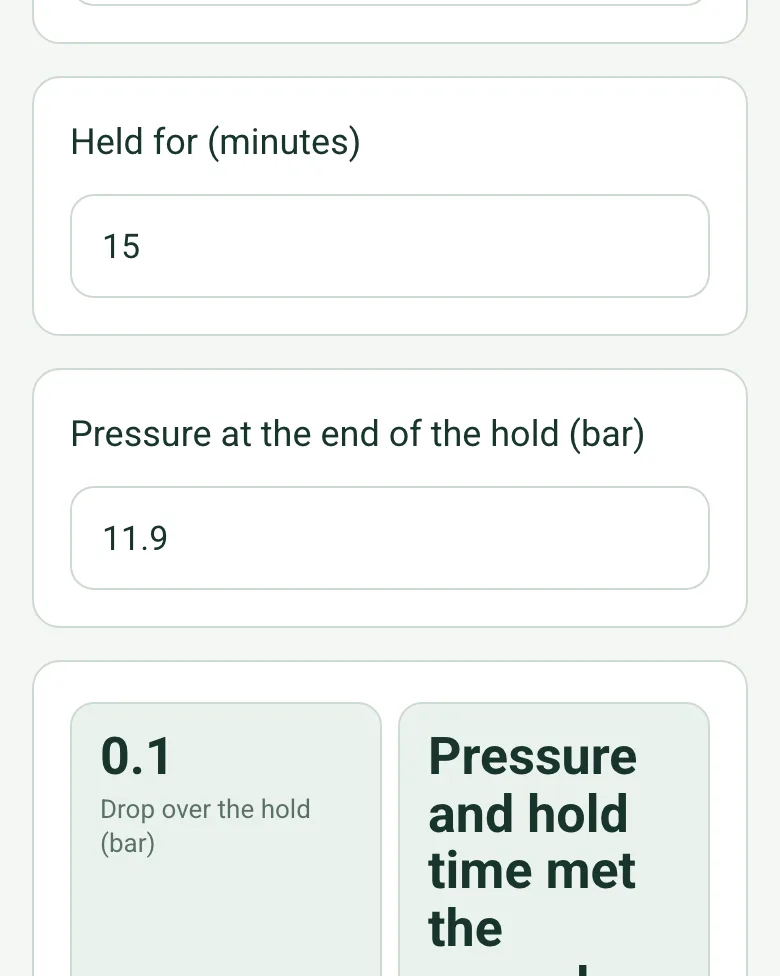
Enter the test pressure and hold time from your maintenance contract or test procedure, then what was applied and the pressure at the end. The form works out the drop and says whether the test met the procedure; it does not set the figures.
How calculated fields work →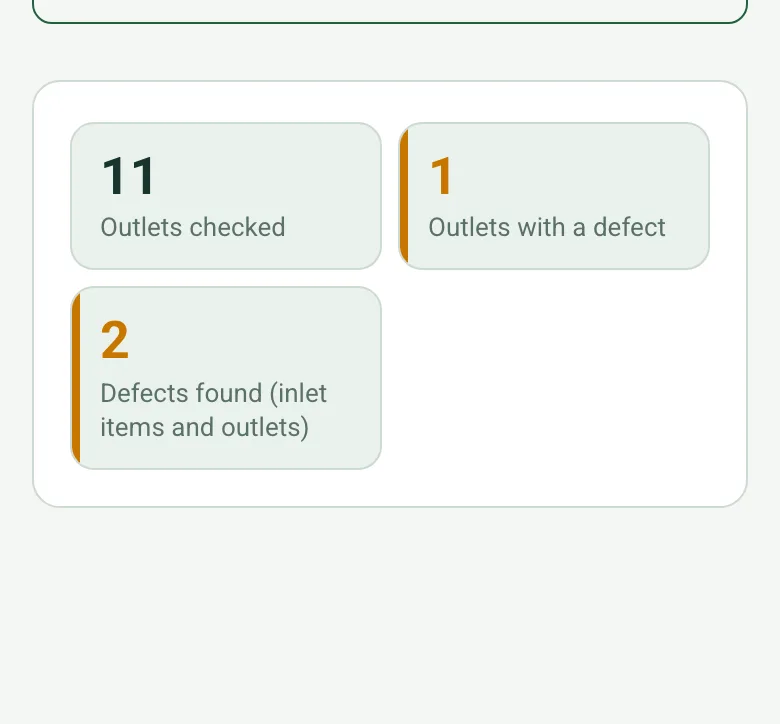
The form counts the outlets checked, the outlets with a defect and the inlet items with a defect, so the total is ready for the 24 hour reporting question in a high-rise residential building.
How calculated fields work →A fictional 12 storey tower block: annual test at 12 bar held for 15 minutes with a 0.1 bar drop, a bike blocking the inlet and a missing cap chain on level 4, both put right on the day. Open it as a filled-in form, or switch to a blank copy and try it yourself.
Answer a few questions and watch it adapt. Your answers are not saved, and any photos you add are deleted within the hour.
This is the real form as your team would use it: questions appear as you answer, scores work themselves out and you can add photos and signatures. No sign-up needed. Or open a completed example to see every answer, photo and score filled in.
Want to see one filled in? See a completed dry riser inspection report (PDF), made by SiteSurvey from a fictional site visit.
A dry riser inspection and test record: building and check type, inlet box, each outlet's valve, cap, strap and signage, the annual pressure test, faults, and the 24-hour reporting rule for high-rise residential buildings. 4 sections and 55 questions. Follow-up questions and guidance appear only when an answer calls for them, so the person on site never sees the ones that do not apply.
This is a starting point, not a fixed form. Once it is in your SiteSurvey account you can reword any question, add or remove questions, sections and answer options, and add your own logo, so it fits the way your team works and the jobs you do.
Add this form to a project in SiteSurvey and it fills in what the project already knows, so nobody on site retypes it and every form on the job uses the same names. Anything filled in can still be changed.
Mark current location at the inlet box, so the fire service and the next engineer can find it.
From the maintenance contract or the written test procedure for this main. The form compares the test with what you enter.
Monthly routine check where regulation 7 applies; six-monthly visual inspection and annual pressure test under BS 9990.
A completed dry riser inspection report, made by SiteSurvey from a fictional site visit: every answer, the photos, the guidance that applied and the sign-off, ready to send as a PDF.
In high-rise residential buildings, the responsible person must check firefighting lifts, evacuation lifts and essential fire-fighting equipment every month and keep a record that residents can access. A fault that cannot be fixed within 24 hours must be reported to the fire and rescue service electronically, and reported again when it is fixed.
That the landing valve is closed, strapped and padlocked, the blank cap and chain are in place, and the outlet box and sign are in good condition.
The test pressure, how long it was held and whether it held with no leaks. Use the pressure and duration in BS 9990 or the manufacturer's instructions.
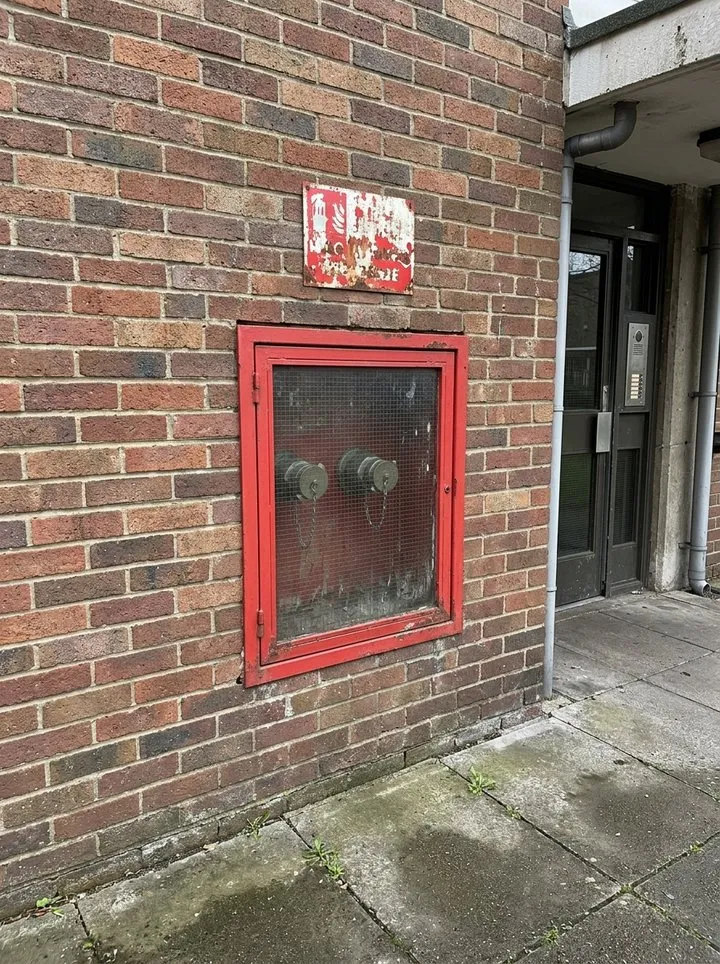
The form checks there is clear access for the fire service and records any obstruction, such as parked bikes or bins, and what was done about it.
It is written for dry risers. Wet risers have pumps and tanks that need their own checks.
Fire protection contractors, facilities managers and housing providers with high-rise blocks.
Related templates
A smoke vent and AOV inspection: control panel and power, detector and switch activation, each vent opening fully and resetting, obstructions, faults and the reporting rules for high-rise residential buildings.
A private fire hydrant record covering identification, access, visible condition, authorised test references, defects and impairment notifications.
A fire alarm test record: the weekly call point test with the call point used, sounders and reset, and the service visit with each device tested, faults, photos and the date of the last service.
Door by door checks (gaps, seals, closers, signage, glazing), 12 month flat entrance door record and remedial work list.
Add it from the form library in one click, change any question, and every completed form becomes a branded PDF report.
Start your trial →