A fire alarm log book for the weekly test, service visits and false alarms. The weekly test records the call point used, warns if it is the same as last week and works out the days since the last weekly test, then checks the panel, sounders, linked systems and reset. Keep a call point rotation: list each call point with the date it was last used, and the form flags any that have waited longer than one full round. A service visit records each device tested, counts passes and failures, and warns when the last service was more than six months ago. Try the form below, see every question or open a completed example.
✎Every question is editable. Add this form to your account, then change the wording, add or remove questions and options, and make it fit your own jobs.
Home Office guidance is that all types of fire warning system should be tested once a week. For an electrical system, operate a manual call point with the test key, using a different call point for each successive test. The same guide says six-monthly servicing and preventive maintenance should be carried out by a competent person, and that it is good practice to record all tests, false alarms and maintenance.
Record today's call point and the days since the last weekly test, then keep the call point rotation: the form works out how long each call point has waited and flags any that have waited longer than one full round, so hard-to-reach call points are not skipped.
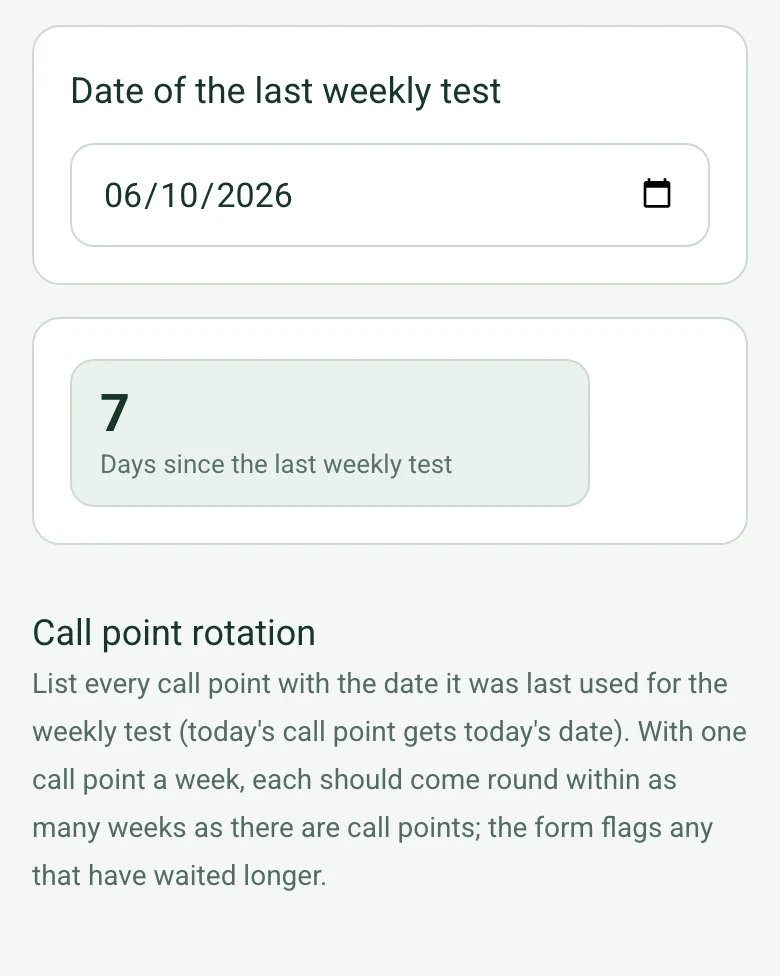
Days since the last weekly test
Enter the date of the last weekly test. The form works out the days since and shows an amber note when it is more than a week, as the Home Office guide says fire warning systems should be tested once a week.
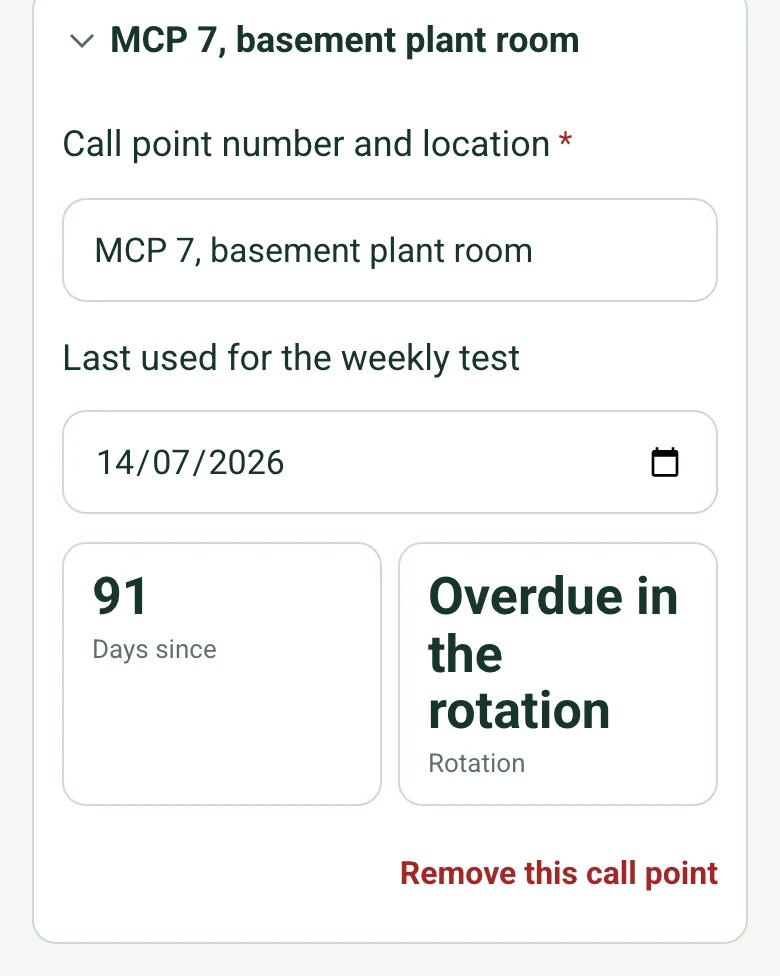
List each call point with the date it was last used. With one a week, each should come round within as many weeks as there are call points; the form marks any that have waited longer.
A fictional business centre: call point 6 used on a monitored system after telling the alarm receiving centre, a sounder not heard in a meeting room with the door shut, and two plant room call points left out of the rotation for 70 and 91 days. Open it as a filled-in form, or switch to a blank copy and try it yourself.
This is the real form as your team would use it: questions appear as you answer, scores work themselves out and you can add photos and signatures. No sign-up needed. Or open a completed example to see every answer, photo and score filled in.
A fire alarm test record: the weekly call point test with the call point used, sounders and reset, and the service visit with each device tested, faults, photos and the date of the last service. 5 sections and 72 questions. Follow-up questions and guidance appear only when an answer calls for them, so the person on site never sees the ones that do not apply.
✎
Make it your own: every question is editable
This is a starting point, not a fixed form. Once it is in your SiteSurvey account you can reword any question, add or remove questions, sections and answer options, and add your own logo, so it fits the way your team works and the jobs you do.
Details you only enter once
Add this form to a project in SiteSurvey and it fills in what the project already knows, so nobody on site retypes it and every form on the job uses the same names. Anything filled in can still be changed.
Project: the project name
Client: the project's customer
Site: the site, when the form is opened for a space or a product
Site address: the site address, from the space or the project
1
Test details
ProjectShort answer
Fills in from the project name
ClientShort answer
Fills in from the project's customer
Site*Short answer
Fills in from the site, when the form is opened for a space or a product
Site addressShort answer
Fills in from the site address, from the space or the project
Date*Date
Responsible person for the premisesShort answer
What is being recorded?*Choose one
Weekly test
Service visit by a competent person
Fault or false alarm
CheckSources. BS 5839-1 (fire detection and alarm systems for non-domestic premises) recommends a weekly test by the user, operating a different manual call point each week, and inspection and servicing by a competent person at intervals of no more than 6 months. BS 5839-6 covers systems in dwellings. The Regulatory Reform (Fire Safety) Order 2005, article 17, requires the responsible person to keep fire detection and warning systems maintained in efficient working order and good repair.
2
Weekly test
GuidanceHome Office guide Fire safety risk assessment: offices and shops. All types of fire warning system should be tested once a week. For electrical systems, activate a manual call point, usually with a test key, using a different call point for each successive test. It is good practice to record all tests, false alarms and any maintenance.
Is the alarm connected to an alarm receiving centre?Yes or No
Was the centre told before the test?Yes or No
Shown when “Is the alarm connected to an alarm receiving centre?” is Yes
CheckWhere a system is connected to a monitoring centre, arrange the test with them first to avoid an unwanted false alarm. Call the centre now and check no call was passed to the fire service.
Shown when “Is the alarm connected to an alarm receiving centre?” is Yes and “Was the centre told before the test?” is No
Call point used today (number and location)*Short answer
Scan the call point labelScan a label: device number
Optional. Scan the label or tag to capture its numbers.
Call point used at the last weekly testShort answer
CheckThis is the same call point as last time. Use a different call point for each test so every one is tested in turn.
Shown only when the answers above make it relevant
Date of the last weekly testDate
Days since the last weekly testWorked out by the form
Shown when “Date of the last weekly test” is answered and “Date” is answered
CheckMore than a week since the last weekly test. The Home Office guide says all fire warning systems should be tested once a week. Record why it was missed.
Shown only when the answers above make it relevant
Call point rotation
Repeat for each entry. Each one asks:
Call point number and location*Short answer
Last used for the weekly testDate
Days sinceWorked out by the form
Shown when “Last used for the weekly test” is answered and “Date” is answered
RotationWorked out by the form
Shown only when the answers above make it relevant
Call points in the rotationWorked out by the form
Shown when “Call point rotation” is answered
Call points overdue in the rotationWorked out by the form
Shown when “Call point rotation” is answered
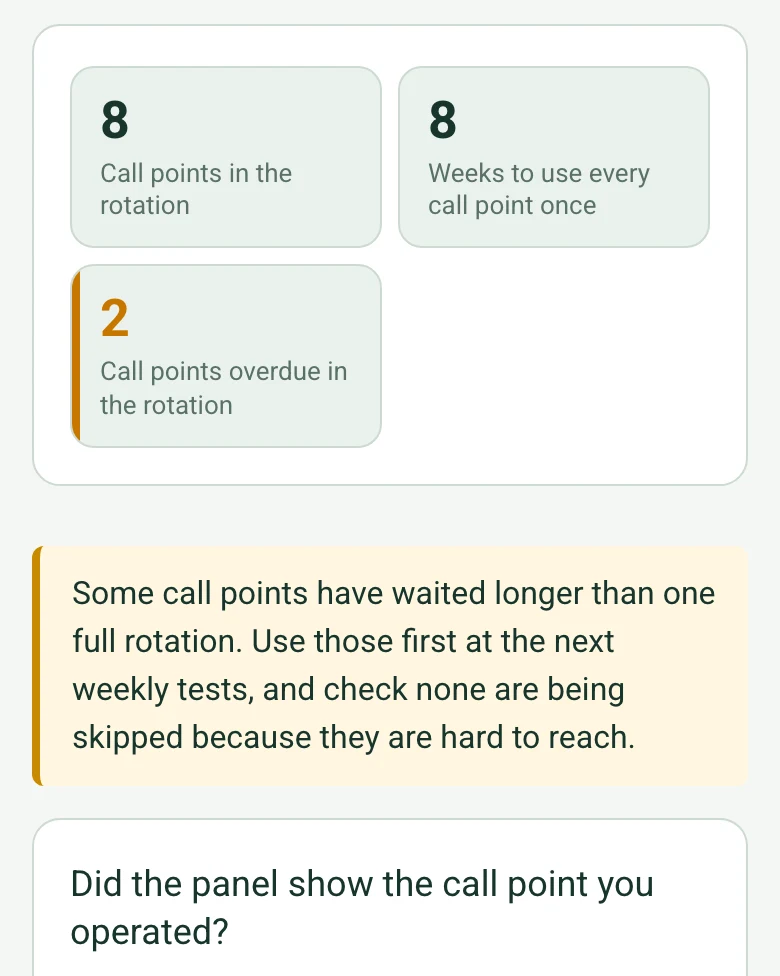
CheckSome call points have waited longer than one full rotation. Use those first at the next weekly tests, and check none are being skipped because they are hard to reach.
Shown only when the answers above make it relevant
Did the panel show the call point you operated?Yes or No
Did the sounders operate?Yes or No
Could the alarm be heard throughout the building?Yes or No
Did linked systems operate, such as door holders releasing?Choose one
Yes
No
None linked
Was the panel back to normal after it was reset?Yes or No
WarningAlarm fault. Record it in the log book, tell the responsible person now and arrange for a competent person to attend.
Shown only when the answers above make it relevant
What was wrong, and where?Notes
Shown only when the answers above make it relevant
Photos of the faultPhotos
Shown only when the answers above make it relevant
Has the responsible person been told about the fault?Yes or No
Shown only when the answers above make it relevant
3
Service visit
Engineer and companyShort answer
Third-party certification, if any (for example BAFE SP203-1)Short answer
Date of the last serviceDate
Days since the last serviceWorked out by the form
Shown when “Date of the last service” is answered and “Date” is answered
CheckMore than six months since the last service. The Home Office guide says six-monthly servicing and preventive maintenance should be carried out by a competent person.
Shown only when the answers above make it relevant
False alarms since the last serviceNumber
Was the log book reviewed for faults and false alarms?Yes or No
Standby batteries and charger tested and within their service life?Yes or No
Is a zone plan displayed next to the panel?Yes or No
Devices by zone or area
Repeat for each entry. Each one asks:
Zone, floor or area*Short answer
For example Zone 3, first floor east
Devices tested here
Repeat for each entry. Each one asks:
Device number or address*Short answer
Scan the device labelScan a label: device number
Optional. Scan the label or tag to capture its numbers.
TypeChoose one
Manual call point
Smoke detector
Heat detector
Multi-sensor
Beam detector
Sounder
Beacon
Interface or relay
Position in this areaShort answer
Result*Choose one
Pass
Fail
Fault found and actionNotes
Shown only when the answers above make it relevant
PhotosPhotos
Shown only when the answers above make it relevant
This zone or area: devices testedWorked out by the form
This zone or area: devices passedWorked out by the form
This zone or area: devices failedWorked out by the form
This zone or area: call points testedWorked out by the form
Devices testedWorked out by the form
Devices passedWorked out by the form
Devices failedWorked out by the form
Devices passed (%)Worked out by the form
Shown only when the answers above make it relevant
Call points testedWorked out by the form
System leftChoose one
Fully working
Working with faults recorded
Not working: responsible person told
WarningThe system is not working. The Home Office guide says that if a system fails, people in the premises must still be warned and able to escape safely: a temporary arrangement with suitable training may be acceptable for a short period while it is repaired.
Shown when “System left” is “Not working: responsible person told”
4
Fault or false alarm
Time of the alarm or faultTime
Device or zone that activatedShort answer
CauseChoose one
Cooking fumes
Steam or dust
Contractor works
Malicious
Equipment fault
Real fire
Not known
Did the fire service attend?Yes or No
What was done to stop it happening again?Notes
5
Actions and sign-off
Are further actions needed?Yes or No
Further actions
Repeat for each action. Each one asks:
Shown when “Are further actions needed?” is Yes
What needs doing?*Notes
PriorityChoose one
Urgent
High
Medium
Low
Who will do it?Short answer
Due dateDate
StatusChoose one
Open
In progress
Completed
Next weekly test dueDate
BS 5839-1: every week.
Days until the weekly testWorked out by the form
Shown when “Date” is answered and “Next weekly test due” is answered
Next service dueDate
BS 5839-1: at intervals of no more than 6 months.
Days until the serviceWorked out by the form
Shown when “Date” is answered and “Next service due” is answered
CheckCheck the dates. A next due date is before the date of this record.
Shown only when the answers above make it relevant
Inspector name*Short answer
Position or companyShort answer
Inspector signatureSignature
CheckSigning records what was found on the day. It is not a guarantee of condition and does not replace any examination, test, design check or repair needed from a competent person.
See it filled in
A completed fire alarm test report, made by SiteSurvey from a fictional site visit: every answer, the photos, the guidance that applied and the sign-off, ready to send as a PDF.
So every call point is tested in turn. The Home Office guide says to use a different call point for each successive test. The form records the call point used today and last week and warns you if they are the same, and its call point rotation list flags any call point that has waited longer than one full round.
What if the alarm goes to a monitoring centre?
Tell the alarm receiving centre before the test, so the test is not passed to the fire service as a real alarm. The form asks whether the system is monitored and whether the centre was told, and if not, prompts you to call them straight away.
What does the weekly test check?
That the panel showed the call point you operated, the sounders worked, the alarm could be heard throughout the building, linked systems such as door holders released, and the panel returned to normal after reset. Any No asks what was wrong and where, and whether the responsible person has been told.
How often does a fire alarm need servicing?
The Home Office guide says six-monthly servicing and preventive maintenance should be carried out by a competent person with specialist knowledge of fire warning and detection systems, usually under a service contract. The service visit section records the engineer, the date of the last service, false alarms since then, batteries, the zone plan and each device tested, and warns when the last service was more than six months ago.
Can I record false alarms?
Yes. Choose fault or false alarm to record the time, the device or zone, the cause, whether the fire service attended and what was done to stop it happening again. The Home Office guide says it is good practice to record all tests, false alarms and any maintenance.
Who is responsible for fire alarm testing?
In England and Wales, the responsible person under the Regulatory Reform (Fire Safety) Order 2005 must keep fire safety equipment, including the fire alarm, maintained in efficient working order. The weekly test is usually done by someone on site; servicing is done by a competent fire alarm engineer.