A record for monitoring cracks in walls over repeat visits. Record the visit and possible causes seen on site, then each crack: its reference, location, pattern, the width at the marked point, the previous width and the first reading with its date. The form works out the change since the last visit, the movement since the first reading and the average rate per month, and counts the cracks that have widened. Measure a crack's length from a photo against the brick courses. An optional Walk Cam route films the wall, the crack with a ruler, the monitor and the matching crack inside. Try the form below, see every question or open a completed example.
✎Every question is editable. Add this form to your account, then change the wording, add or remove questions and options, and make it fit your own jobs.
BRE Digest 251, Assessment of damage in low-rise buildings, sorts cracks into six categories linked to their width and number and the repair needed. BRE says categories 0, 1 and 2, with widths up to 5 mm, can generally be regarded as aesthetic, needing only redecoration. Categories 3 and 4 are serviceability issues affecting weather-tightness and doors and windows, and category 5 is a stability issue likely to need structural intervention. Whether a crack is widening over time can change its category, which is what monitoring shows.
Read each crack at the same marked point on every visit. Keep its first reading, and the form works out the change since the last visit, the movement since the first reading and the average rate per month. The length of a crack can be measured from a photo against the brick courses; widths stay on the gauge or tell-tale. The form records the readings, not a diagnosis.
Movement and rate worked out
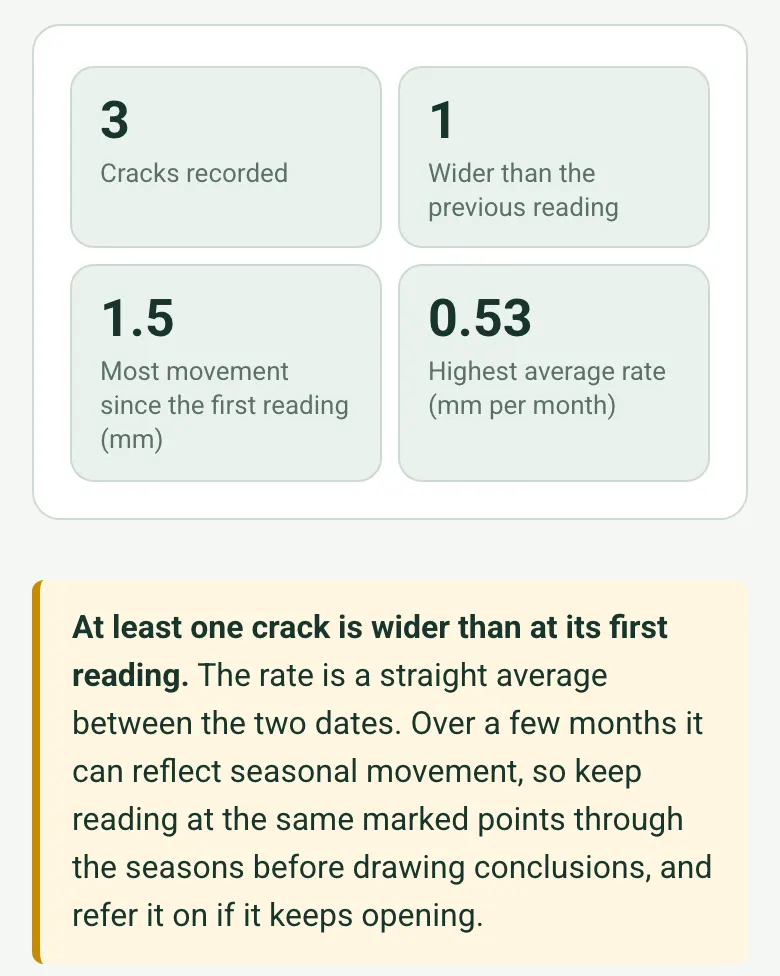
The form counts the cracks that have widened since the last reading and shows the most movement since the first reading and the highest average rate. An amber note says a rate over a few months can be seasonal, so keep reading through the seasons.
Each crack keeps its width now, the previous reading and the first reading with its date, so movement is measured against the baseline, not just the last visit.
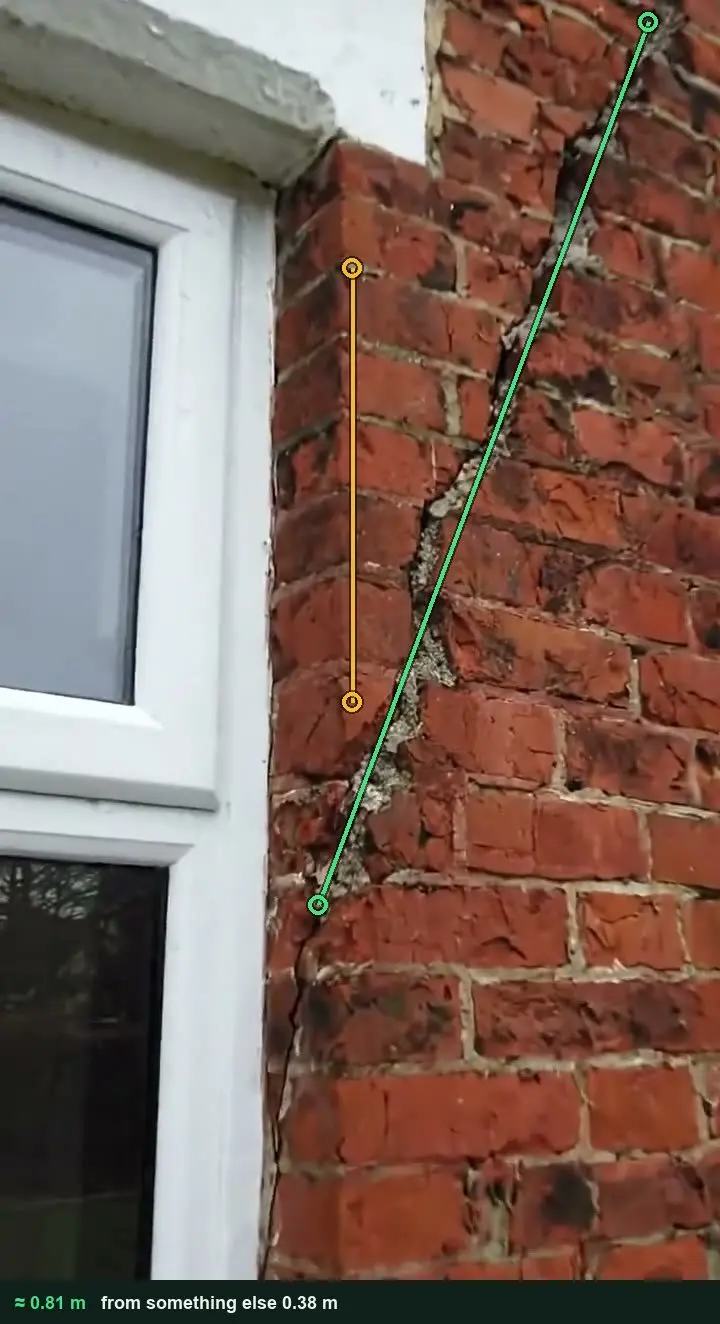
Photograph the crack square on and measure its length against brick courses or an opening. A photo cannot read fractions of a millimetre, so widths stay on the gauge or tell-tale. It works on web forms in any phone browser today, and the app version is on its way.
A fictional semi-detached house on its third reading: the stepped crack by the kitchen window has opened 1 mm since September and 1.5 mm since the first reading in July, about 0.5 mm a month, and is about 0.81 m long; the two other cracks have not moved. Open it as a filled-in form, or switch to a blank copy and try it yourself.
This is the real form as your team would use it: questions appear as you answer, scores work themselves out and you can add photos and signatures. No sign-up needed. Or open a completed example to see every answer, photo and score filled in.
Film the same crack from the same places on every visit, with a scale beside it, so a reviewer can see whether it has changed.
Record the address, wall, date and who filmed. Start wide so the crack can be found again, then hold a ruler or gauge beside it and say the reading. The four AI-generated clips illustrate one route, not a real building.
POINT 01
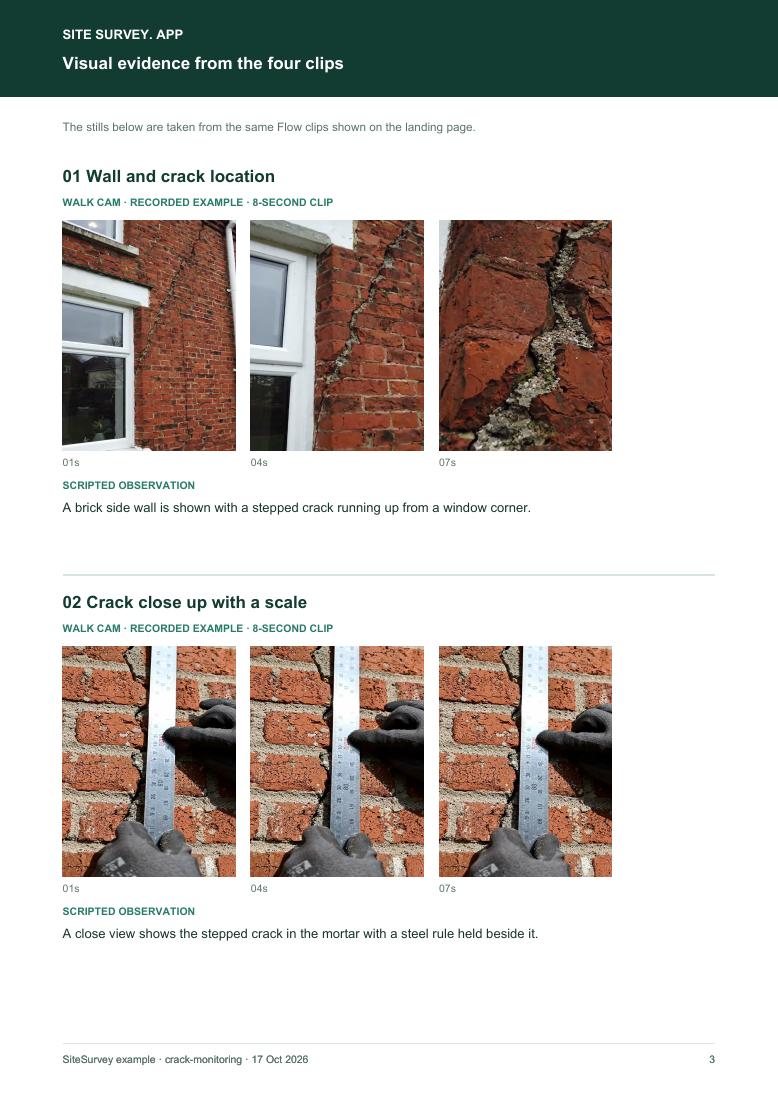
Wall and crack location
Show the whole wall first, with a window, corner or other fixed feature in frame, so the crack can be found again.
A brick side wall is shown with a stepped crack running up from a window corner.
POINT 02
Crack close up with a scale
Move in to the widest point and hold a ruler or crack width gauge beside it. Say the width you read; the video only supports the reading.
A close view shows the stepped crack in the mortar with a steel rule held beside it.
POINT 03
Tell-tale or reference marks
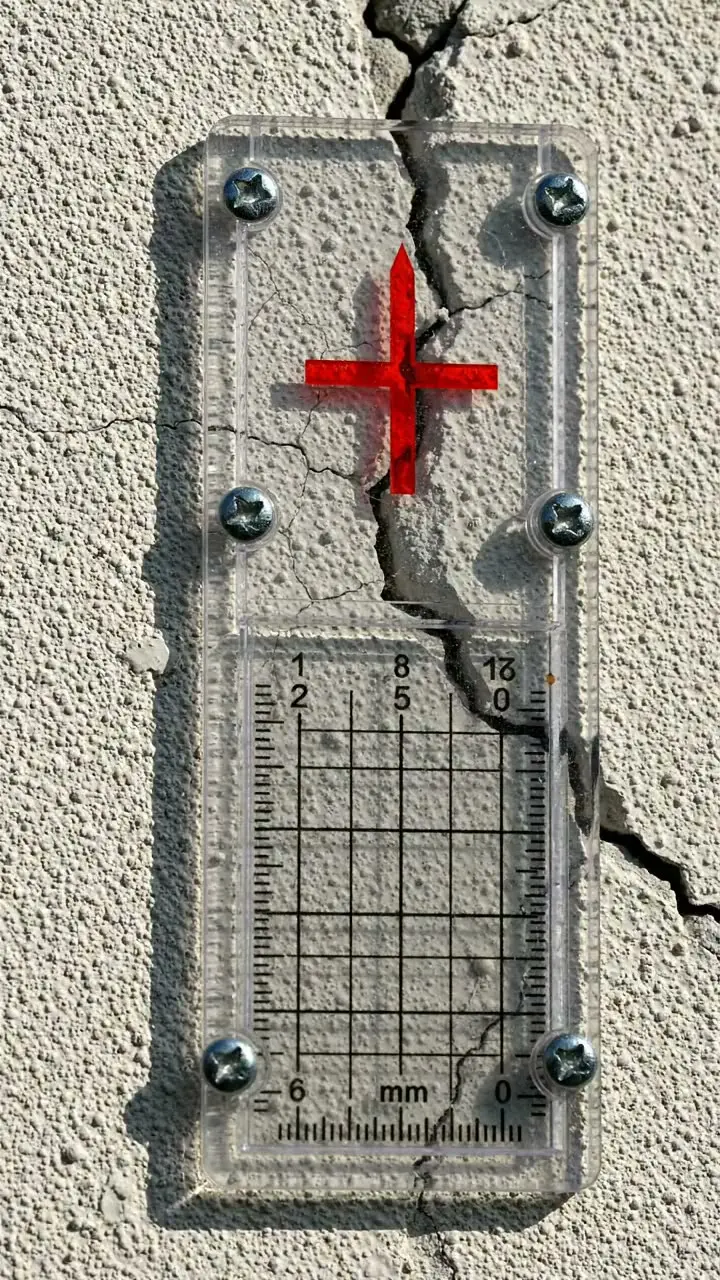
If a tell-tale monitor is fixed across the crack, film its grid square on so the cursor position can be read and compared.
A plastic tell-tale crack monitor fixed across the crack is filmed square on.
POINT 04
Matching crack inside
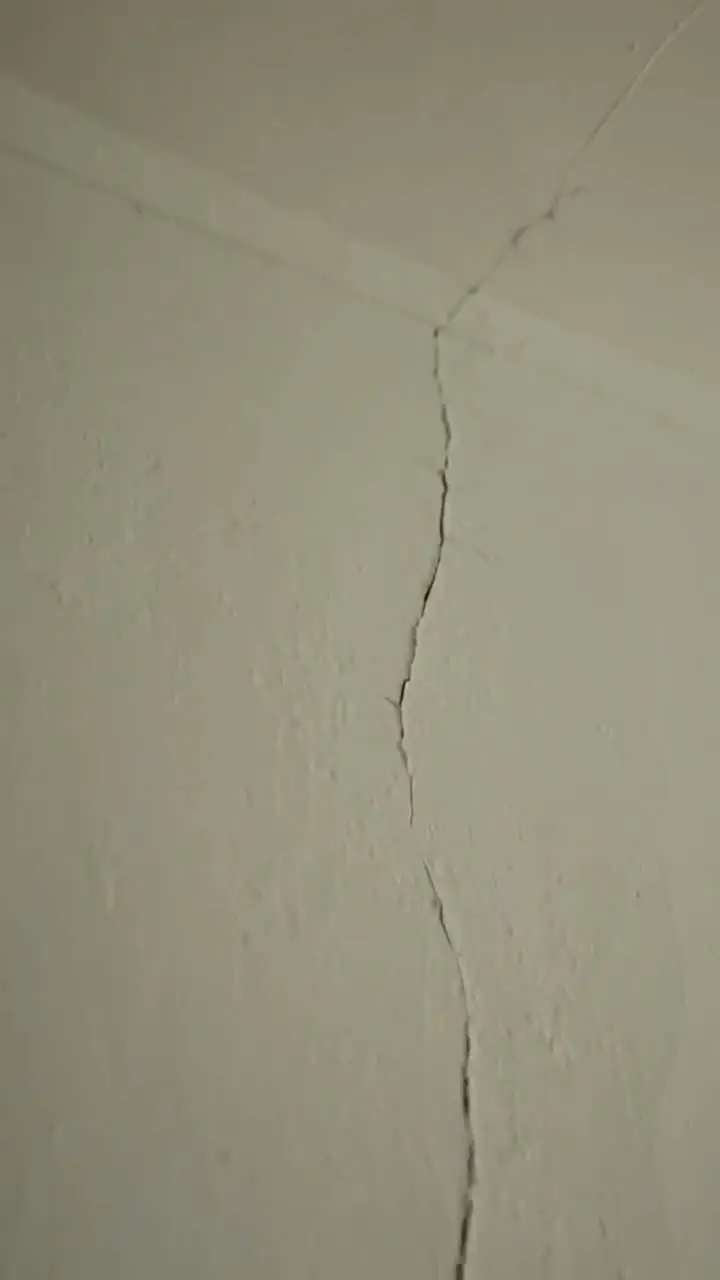
Find the same position inside and film any matching crack, for example above a door or window head.
A diagonal plaster crack runs up from the corner of an internal door frame.
See the footage in a report
A fictional six-page example with the four points, twelve stills from the clips, observations, follow-up actions and the limits of a visual record.
Video records where a crack is and what it looked like. It does not measure movement, find the cause or say whether a building is safe; BRE's guidance is that widening over time changes how damage is classified and significant damage needs a building professional. Example footage was generated in Google Flow and the observations are scripted; no real site is shown. Walk Cam works inside any form in the app. How Walk Cam works · All visual inspections
Every question in the crack monitoring template
A crack monitoring record for walls: each crack with its location, pattern, width at a marked point against the last reading, how it was measured, photos with a scale, BRE Digest 251 category if assessed, and next steps. 3 sections and 51 questions. Follow-up questions and guidance appear only when an answer calls for them, so the person on site never sees the ones that do not apply.
✎
Make it your own: every question is editable
This is a starting point, not a fixed form. Once it is in your SiteSurvey account you can reword any question, add or remove questions, sections and answer options, and add your own logo, so it fits the way your team works and the jobs you do.
Details you only enter once
Add this form to a project in SiteSurvey and it fills in what the project already knows, so nobody on site retypes it and every form on the job uses the same names. Anything filled in can still be changed.
Project: the project name
Client: the project's customer
Site: the site, when the form is opened for a space or a product
Site address: the site address, from the space or the project
1
Visit
ProjectShort answer
Fills in from the project name
ClientShort answer
Fills in from the project's customer
Site*Short answer
Fills in from the site, when the form is opened for a space or a product
Site addressShort answer
Fills in from the site address, from the space or the project
Reading date*Date
Surveyor*Short answer
Weather on siteAnswer
Visit*Choose one
First visit (baseline readings)
Repeat reading
Final reading
Visit numberNumber
Previous reading dateDate
Shown only when the answers above make it relevant
Days since the previous readingWorked out by the form
Shown only when the answers above make it relevant
CheckThe previous reading date is after this reading date. Check both dates.
Shown only when the answers above make it relevant
Property typeChoose one
Detached house
Semi-detached house
Terraced house
Bungalow
Flat or maisonette
Commercial building
Other
Possible causes noted on site (not a diagnosis)Tick all that apply
Trees or large shrubs nearby
Leaking drains or water pipes
Recent building work nearby
Extension or alteration
Not known
GuidanceBRE Digest 251, Assessment of damage in low-rise buildings, sorts cracking into six categories linked to the width and number of cracks and the repair needed. BRE says categories 0, 1 and 2, with crack widths up to 5 mm, can generally be regarded as aesthetic, categories 3 and 4 as serviceability issues affecting weather-tightness and doors and windows, and category 5 as a stability issue likely to need structural intervention. Whether cracks are widening over time can change the category, which is why repeat readings at the same point matter.
2
Cracks
Cracks
Repeat for each crack. Each one asks:
Crack reference (as marked on site)*Short answer
Location*Short answer
FaceChoose one
External
Internal
MaterialChoose one
Brickwork
Blockwork
Stone
Render
Plaster
Concrete
Other
PatternChoose one
Vertical
Horizontal
Diagonal
Stepped through the joints
From the corner of an opening
Width along the crackChoose one
Wider at the top
Wider at the bottom
Even width
Not clear
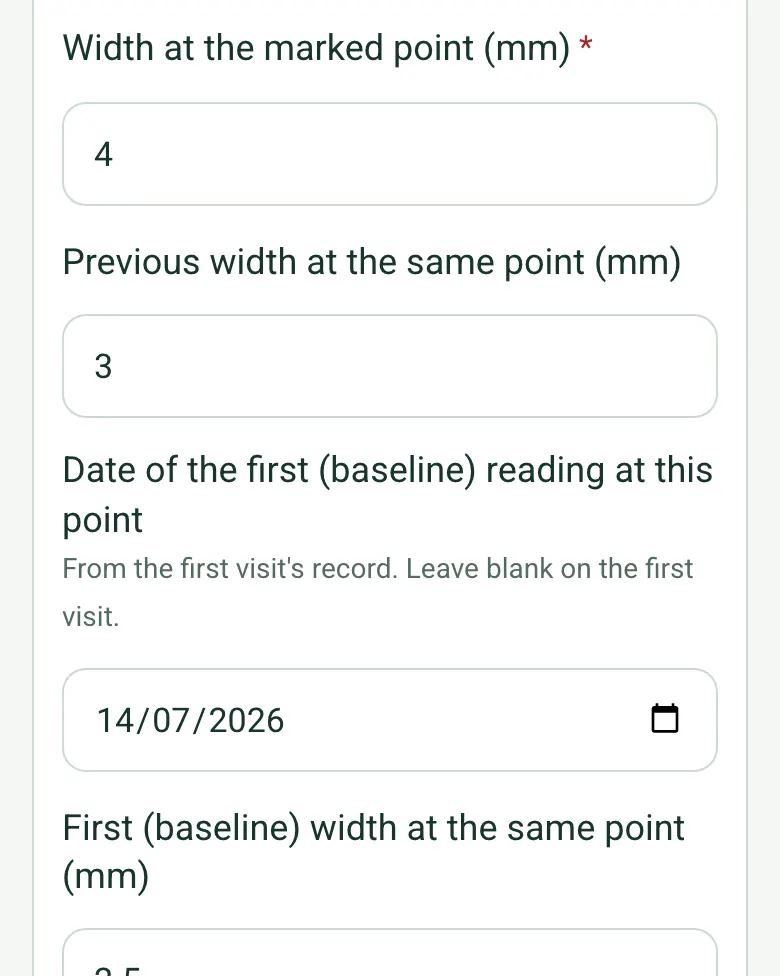
Width at the marked point (mm)*Number
Previous width at the same point (mm)Number
Date of the first (baseline) reading at this pointDate
From the first visit's record. Leave blank on the first visit.
First (baseline) width at the same point (mm)Number
Change since the previous reading (mm)Worked out by the form
Shown when “Width at the marked point (mm)” is answered and “Previous width at the same point (mm)” is answered
CheckWider than the previous reading at the same point. BRE says widening over time can change the damage category.
Shown only when the answers above make it relevant
Movement since the first reading (mm)Worked out by the form
Shown when “Width at the marked point (mm)” is answered and “First (baseline) width at the same point (mm)” is answered
Months since the first readingWorked out by the form
Shown only when the answers above make it relevant
Average rate (mm per month)Worked out by the form
Shown only when the answers above make it relevant
How it was measuredChoose one
Ruler or tape
Crack width gauge
Tell-tale monitor
Between fixed reference marks
Other
Length of the crack (m)Number
Use a tape, or measure from a square-on photo with brick courses or an opening as the reference. Widths stay on the gauge or tell-tale: a photo cannot read fractions of a millimetre. Measuring from a photo gives an estimate.
Monitor or reference mark ID and the reading as recordedShort answer
Shown only when the answers above make it relevant
Doors or windows nearby sticking?Yes or No
Damage category (BRE Digest 251), if assessedChoose one
Category 0, 1 or 2 (aesthetic)
Category 3 or 4 (serviceability)
Category 5 (stability)
Not assessed
WarningBRE says category 5 is a stability issue and is likely to need structural intervention. Get advice from a structural engineer.
Shown when “Damage category (BRE Digest 251), if assessed” is “Category 5 (stability)”
Photos (with a ruler or gauge in view)Photos
Cracks recordedWorked out by the form
Wider than the previous readingWorked out by the form
Most movement since the first reading (mm)Worked out by the form
Highest average rate (mm per month)Worked out by the form
CheckAt least one crack is wider than at its first reading. The rate is a straight average between the two dates. Over a few months it can reflect seasonal movement, so keep reading at the same marked points through the seasons before drawing conclusions, and refer it on if it keeps opening.
Shown only when the answers above make it relevant
Cracks assessed as category 5Worked out by the form
Cracks assessed as category 3 or 4Worked out by the form
Walk Cam: crack monitoringWalk Cam video with voice-to-text
Optional. Film the four guided points on the SiteSurvey app; each clip keeps its spoken note.
3
Actions and sign-off
Monitoring*Choose one
Continue monitoring
Complete: no further movement seen
Refer to a structural engineer
Refer to the insurer
Next reading dueDate
Shown when “Monitoring” is “Continue monitoring”
CheckThe next reading date is before this reading date. Check both dates.
Shown only when the answers above make it relevant
Summary of movement seen so farNotes
Are further actions needed?Yes or No
Further actions
Repeat for each action. Each one asks:
Shown when “Are further actions needed?” is Yes
What needs doing?*Notes
Who will do it?Short answer
Due dateDate
StatusChoose one
Open
In progress
Completed
Inspector nameWorked out by the form
Position or companyShort answer
Inspector signatureSignature
CheckSigning records what was found on the day. It does not replace a specialist survey, test or repair by a competent person.
Scope and responsibility
This is a monitoring record, not a structural survey, a subsidence diagnosis or an insurance decision.
What a useful entry looks like
Width at the marked point against the previous reading
Measure at the same marked point each visit, with the same method, and note the weather. Record what was read; leave the cause and category to the person assessing it.
Crack C1, side elevation from the kitchen window corner: 4 mm at monitor T1, previously 3 mm on 10 September. Kitchen door catching. Next reading 5 November.
Fictional example of record wording. Use the actual evidence and approved arrangements for your job; this is not a completed report or an instruction to carry out the work.
See it filled in
A completed crack monitoring report, made by SiteSurvey from a fictional site visit: every answer, the photos, the guidance that applied and the sign-off, ready to send as a PDF.
One reading shows the width today; repeat readings at the same marked point show whether it is moving. BRE says whether cracks are widening over time is one of the factors that affect how damage is classified.
How long does crack monitoring take?
It depends on the crack and the cause. Mid Suffolk District Council's housing fact sheet says monitoring is likely to be needed for wider cracks, often over several months. The form records each visit with the days since the last reading and the next reading date.
What causes cracks in walls?
Mid Suffolk District Council lists settlement, seasonal thermal and moisture movement, and ground movement, which is most often caused by trees on clay soils, with defective drains or broken water pipes as other common causes. The form records possible causes seen on site, but it is not a diagnosis.
Can I use a tell-tale crack monitor or a crack width gauge?
Yes. Choose how each crack was measured, including a ruler, a crack width gauge, a tell-tale monitor or fixed reference marks, and record the monitor or mark ID with the reading. Read the monitor the way its maker describes; the form only records the reading.
When should I get a structural engineer?
BRE says a building professional should be consulted where damage is significant, and category 5 is likely to need structural intervention. The form shows a red warning on any crack assessed as category 5 and lets you refer the case to an engineer or the insurer.
What does Walk Cam add?
On the SiteSurvey app, the optional Walk Cam route films four points: the whole wall, the crack with a ruler beside it, the tell-tale square on and the matching crack inside. Each clip keeps your spoken note, and the width you read is still typed into the form.