A station by station rodent monitoring and baiting log. Attach the site plan and record the last visit, then add each station: scan its label, pin external stations by GPS, and record the type, the activity found, the bait or block laid in grams, any signs of non-target animals and the station's condition, with photos. The form counts the stations with any activity and the share of stations active, compares it with the last visit, totals the bait laid and counts missing and damaged stations, with a red note for non-target signs and an amber note when rodenticide is down and the last visit was over 14 days ago. Try the form below, see every question or open a completed example.
✎Every question is editable. Add this form to your account, then change the wording, add or remove questions and options, and make it fit your own jobs.
A bait station inspection should record each station's number, location and type, the activity found (bait taken, droppings, gnawing or a rodent caught), whether bait was replaced with the product and amount, signs of non-target animals and the station's condition. The CRRU UK code says to keep a site plan or location list, record every bait point and the amount of bait laid, and note the activity at each point, including missing or disturbed baits.
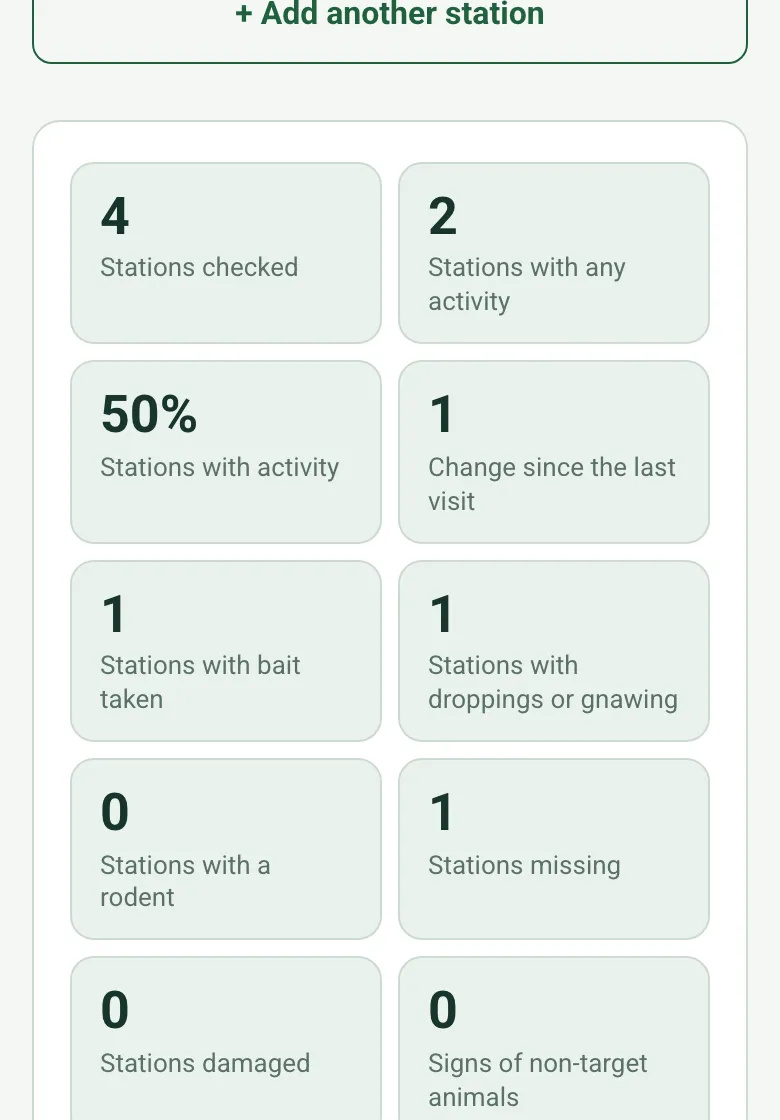
Each station is scanned, pinned if it is outside, and recorded with its activity, bait laid and condition. The form counts the stations with activity and the share active, compares it with the last visit, totals the bait laid, and warns on non-target signs or a rodenticide round over 14 days apart.
Activity against the last visit
The form counts the stations with any activity and works out the share, shows the change since the last visit and totals the bait laid. More activity than last time brings up an amber note.
Pin the stations along fences, yards and bin stores, so the next technician finds them. Indoors the station number and site plan are enough. It works on web forms in any phone browser today, and the app version is on its way.
Photograph activity, damaged or missing stations and proofing gaps with each record.
A completed bait station log
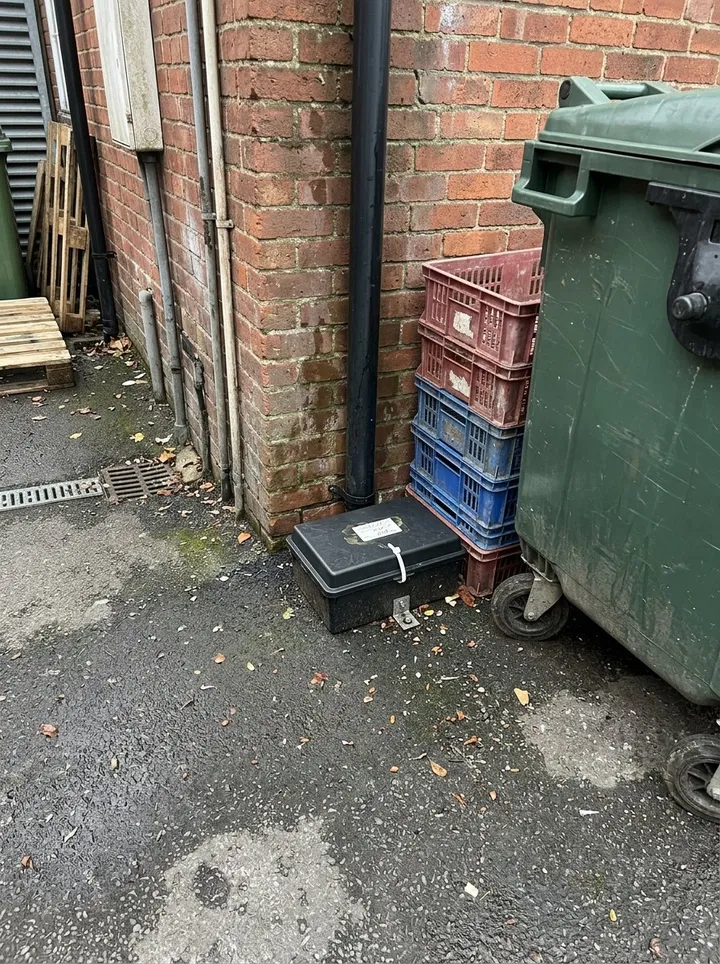
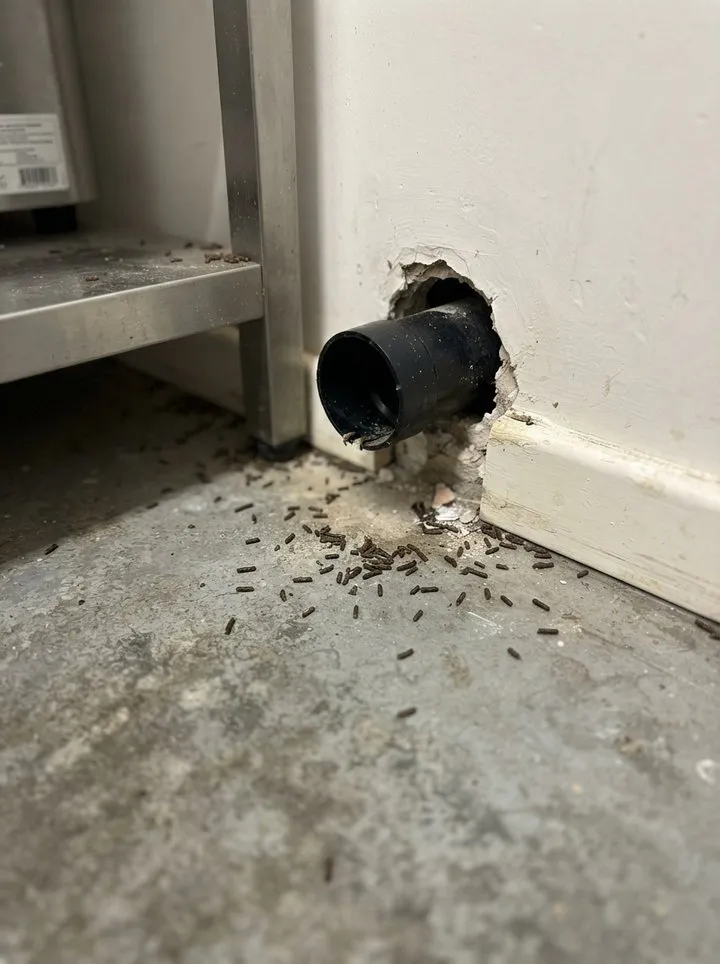
A fictional bakery's monitoring round: four stations, the monitoring block at the yard bins taken, droppings behind the dry store racking, a snap trap missing by the despatch door, 2 of 4 stations active against 1 last time, and a rodenticide treatment recommended.
This is the real form as your team would use it: questions appear as you answer, scores work themselves out and you can add photos and signatures. No sign-up needed. Or open a completed example to see every answer, photo and score filled in.
A rodent bait station inspection log: each station scanned by its number, with location, type, activity, bait taken and replaced, condition and photos, activity counts, recommendations and sign-off. 3 sections and 59 questions. Follow-up questions and guidance appear only when an answer calls for them, so the person on site never sees the ones that do not apply.
✎
Make it your own: every question is editable
This is a starting point, not a fixed form. Once it is in your SiteSurvey account you can reword any question, add or remove questions, sections and answer options, and add your own logo, so it fits the way your team works and the jobs you do.
Details you only enter once
Add this form to a project in SiteSurvey and it fills in what the project already knows, so nobody on site retypes it and every form on the job uses the same names. Anything filled in can still be changed.
Project: the project name
Client: the project's customer
Site: the site, when the form is opened for a space or a product
Site address: the site address, from the space or the project
1
Visit
ProjectShort answer
Fills in from the project name
ClientShort answer
Fills in from the project's customer
Site*Short answer
Fills in from the site, when the form is opened for a space or a product
Site addressShort answer
Fills in from the site address, from the space or the project
Visit date*Date
Technician*Short answer
VisitChoose one
Routine
Follow-up
Call-out
Date of the last visitDate
Days since the last visitWorked out by the form
Shown when “Date of the last visit” is answered and “Visit date” is answered
Stations with activity at the last visitNumber
From the last report, so the form can show the trend.
Site plan with station numbersPhotos
GuidanceThe CRRU UK Code of Best Practice (July 2024) says that, as a general guide, baits should be inspected no later than seven days after they are first laid and at least fortnightly after that, with dead rodents removed, bait points kept secure from non-target animals, and baits removed at the end of the treatment. Permanent baiting should never be routine: the preferred approach is traps or non-toxic baits to show whether rodents are present.
2
Stations
Stations by area or zone
Repeat for each entry. Each one asks:
Area or zone*Short answer
For example Loading bay, Kitchen or External perimeter
Stations in this area
Repeat for each station. Each one asks:
Station number*Short answer
Scan the station labelScan a label: station number
Optional. Scan the label or tag to capture its numbers.
Position in this areaShort answer
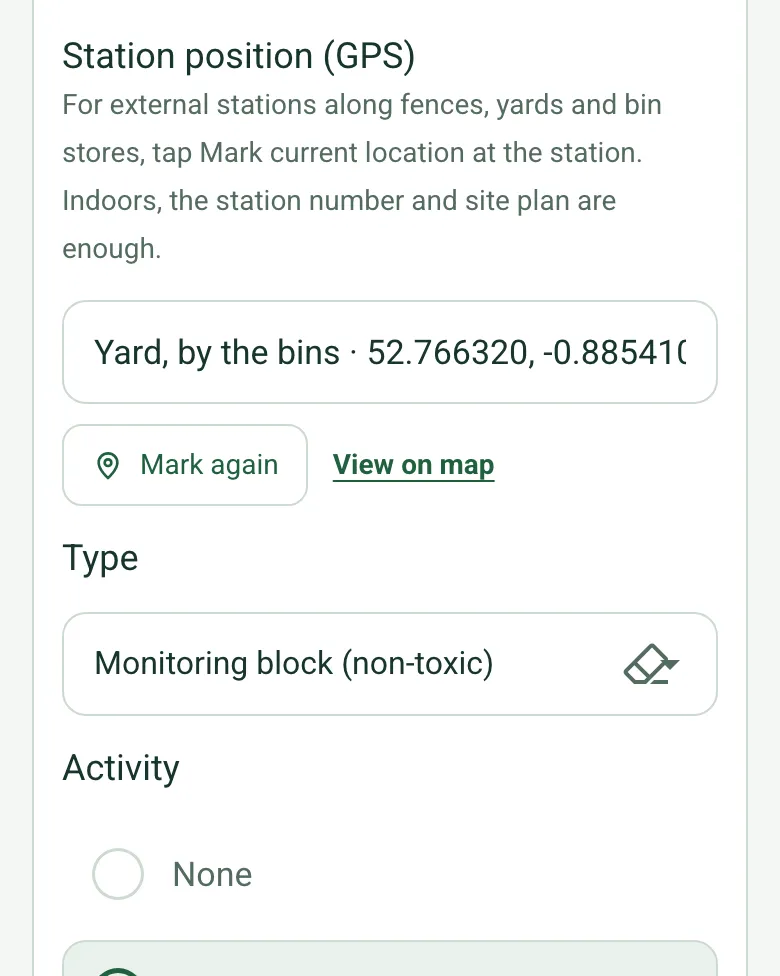
Station position (GPS)Short answer
For external stations along fences, yards and bin stores, tap Mark current location at the station. Indoors, the station number and site plan are enough.
TypeChoose one
Bait station (rodenticide)
Monitoring block (non-toxic)
Snap trap
Electronic trap
Glue board
ActivityChoose one
None
Bait taken
Droppings or gnawing
Rodent caught or found
Bait or block replaced?Yes or No
Shown only when the answers above make it relevant
Product and amountShort answer
Shown when “Bait or block replaced?” is Yes
Bait or block laid (g)Number
Shown when “Bait or block replaced?” is Yes
Signs of non-target animals at the bait (for example small mammals or birds)?Yes or No
Shown only when the answers above make it relevant
Body removed and disposed of safely?Yes or No
Shown when “Activity” is “Rodent caught or found”
Station conditionChoose one
OK
Damaged
Missing
PhotosPhotos
Shown only when the answers above make it relevant
f_rowWorked out by the form
f_activeWorked out by the form
f_nontargetWorked out by the form
f_toxicWorked out by the form
f_damagedWorked out by the form
This area or zone: stations checkedWorked out by the form
This area or zone: stations with any activityWorked out by the form
This area or zone: stations with bait takenWorked out by the form
This area or zone: stations with droppings or gnawingWorked out by the form
This area or zone: stations with a rodentWorked out by the form
This area or zone: stations missingWorked out by the form
This area or zone: stations damagedWorked out by the form
This area or zone: signs of non-target animalsWorked out by the form
This area or zone: bait and blocks laid (g)Worked out by the form
This area or zone: f_toxicWorked out by the form
Stations checkedWorked out by the form
Stations with any activityWorked out by the form
Stations with activity (%)Worked out by the form
Change since the last visitWorked out by the form
Shown when “Stations with activity at the last visit” is answered
Stations with bait takenWorked out by the form
Stations with droppings or gnawingWorked out by the form
Stations with a rodentWorked out by the form
Stations missingWorked out by the form
Stations damagedWorked out by the form
Signs of non-target animalsWorked out by the form
Bait and blocks laid (g)Worked out by the form
WarningSigns of non-target animals at a bait point. The CRRU UK code says bait points must be kept secure from non-target animals: review the station type and position, and record what was changed.
Shown only when the answers above make it relevant
CheckRodenticide bait is down and the last visit was more than 14 days ago. As a general guide, the CRRU UK code says baits should be inspected at least fortnightly after the first week. Follow the product label too.
Shown only when the answers above make it relevant
CheckMore stations show activity than at the last visit. Say in the recommendations what will change, such as proofing, hygiene or a shorter interval.
Shown only when the answers above make it relevant
3
Findings and sign-off
Proofing and hygiene issuesTick all that apply
Gaps around pipes or doors
Door seals
Food left out
Waste storage
Harbourage (clutter, vegetation)
None found
RecommendationsNotes
Next visitDate
Days to the next visitWorked out by the form
Shown when “Visit date” is answered and “Next visit” is answered
CheckThe next visit date is before the date of this record. Check the date.
Shown only when the answers above make it relevant
Client nameShort answer
Client signatureSignature
Completed byWorked out by the form
Technician signatureSignature
See it filled in
A completed bait station log report, made by SiteSurvey from a fictional site visit: every answer, the photos, the guidance that applied and the sign-off, ready to send as a PDF.
The CRRU UK Code of Best Practice says that, as a general guide, baits should be inspected no later than seven days after they are first laid and at least fortnightly after that, with dead rodents removed and bait taken away at the end of the treatment. Follow the product label too.
Should bait be left down permanently?
The CRRU code says permanent baiting should never be routine. The preferred approach is traps or non-toxic monitoring baits to show whether rodents are present, which may then trigger a rodenticide treatment.
Can I scan each station?
Yes. Put a label on each station and scan it on the SiteSurvey app, so the right station number goes on each record.
Does it count activity?
Yes. The form counts stations with bait taken, with droppings or gnawing, with a rodent, and missing or damaged stations. It works out the share of stations with activity, shows the change since the last visit and totals the bait laid, so trends show up visit to visit.
What about proofing?
Record gaps around pipes and doors, door seals, food left out, waste storage and harbourage. Food hygiene law requires adequate procedures to control pests in food premises, and the FSA says food waste should be removed quickly so it does not attract pests.
Who uses this?
Pest control companies, food manufacturers, warehouses, restaurants and facilities teams. The client and technician sign, and the report goes as a PDF or a link.