Form library · Facilities and maintenance

Sprinkler inspection checklist

For people carrying out authorised routine sprinkler observations. Record the system and approved schedule and pin the valve set on a large site. Record the routine observations, with the clearance between stored goods and the sprinkler deflectors measured against the design minimum, and the gauge readings against the minimums in the approved schedule. Then record tests, any impairment and actions. Try the form below, see every question or open a completed example.

Ready to use from the form library, and every question is yours to edit. Try it for a small trial fee, cancel any time.

Try it on your phone

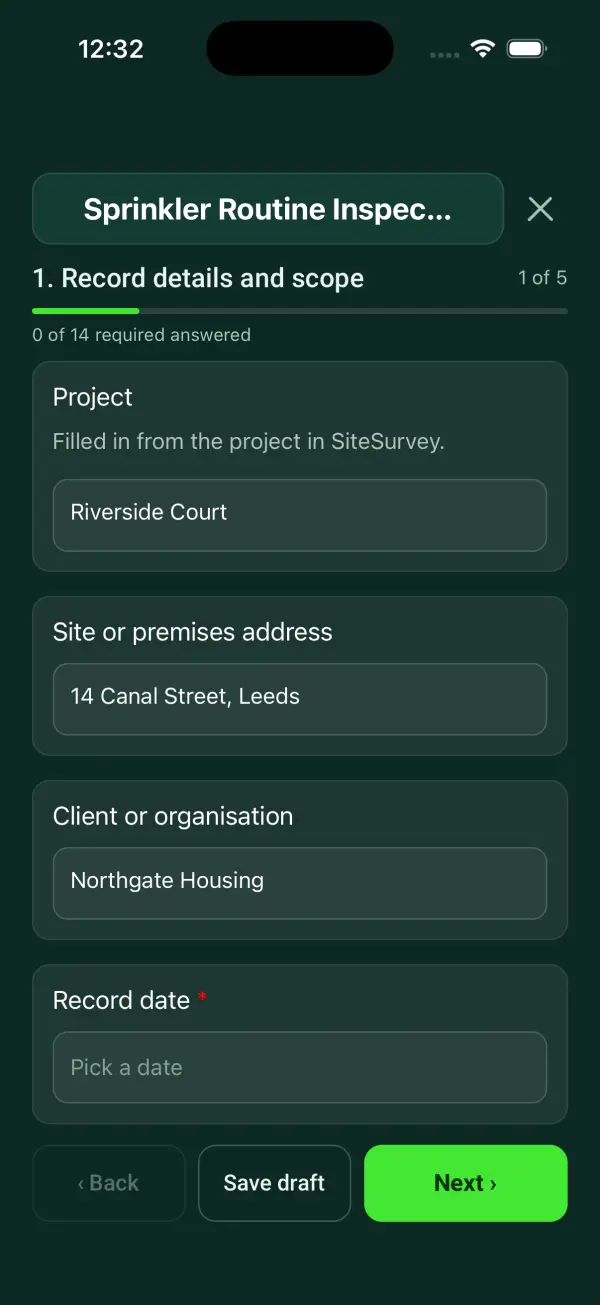
Try it on this phone

Fill in the sprinkler routine inspection on your phone now

See how the sprinkler routine inspection looks on your phone

Scan the code with your phone camera. It opens the real form, no sign-up needed.

Open the live example and fill it in, just as your team would on site. No sign-up needed.

See it on this phone

Every question is editable. Add this form to your account, then change the wording, add or remove questions and options, and make it fit your own jobs.

Or start your trial with this form ready →

One email, and we won't add you to a mailing list.

How are sprinkler checks determined?

BAFSA describes routine checks and specialist maintenance for sprinkler-protected buildings. Use the system’s applicable standard, approved schedule and competent contractor advice; routine observations do not replace specialist servicing.

Last updated . Facts checked by the SiteSurvey team on 6 October 2026 against BAFSA sprinkler protected buildings guidance and Government fire safety guidance for offices and shops.

Built for the routine sprinkler check

Pin the valve set on a large site, record the gauge readings against the minimums in your approved schedule, and measure the clearance between stored goods and the sprinkler deflectors. The form counts the observations needing action and flags anything below a minimum.

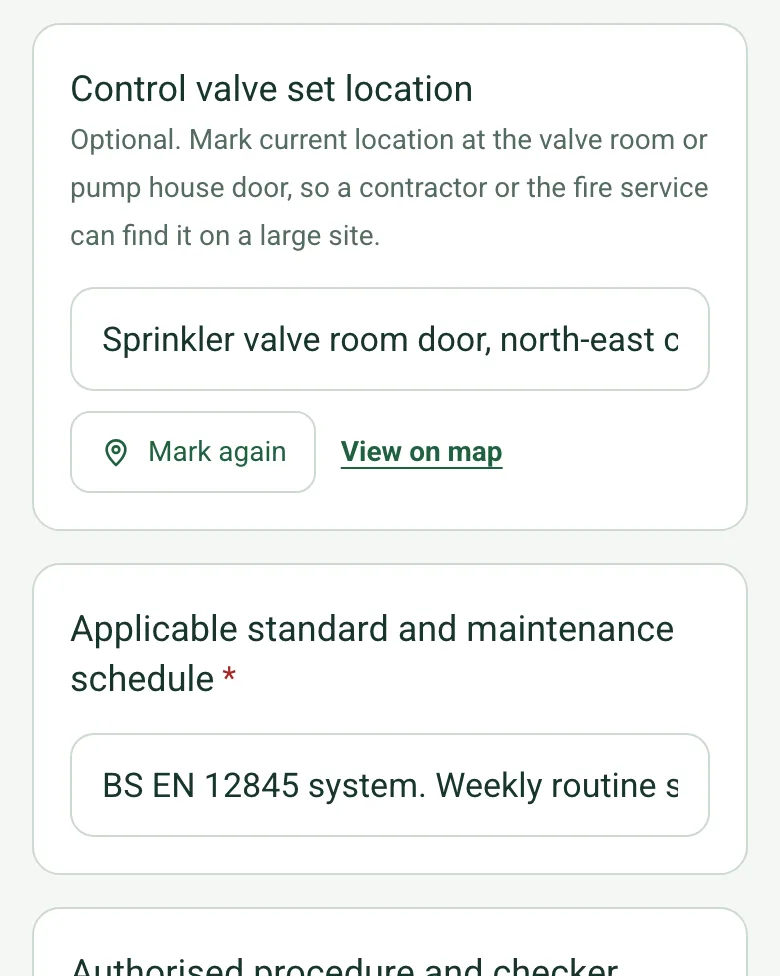
Control valve set location filled in with a note, a GPS point and a View on map link

Pin the valve set

Mark current location at the valve room or pump house door, so a contractor or the fire service can find it on a large site. Mark current location works on web forms in any phone browser today, and the app version is on its way.

How GPS location works →
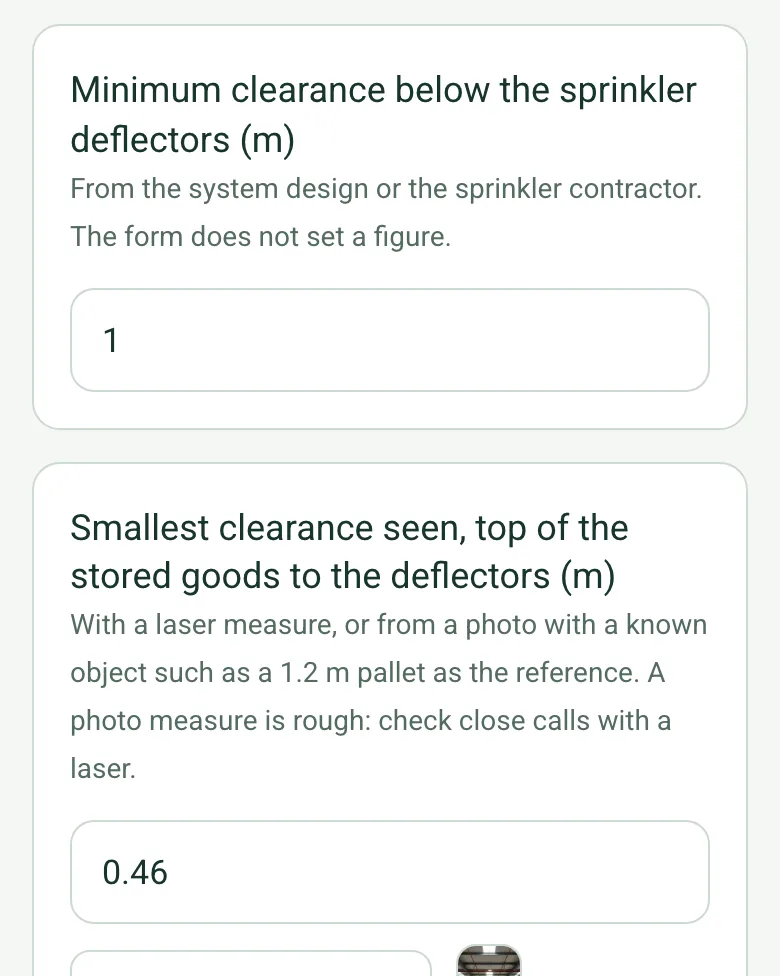
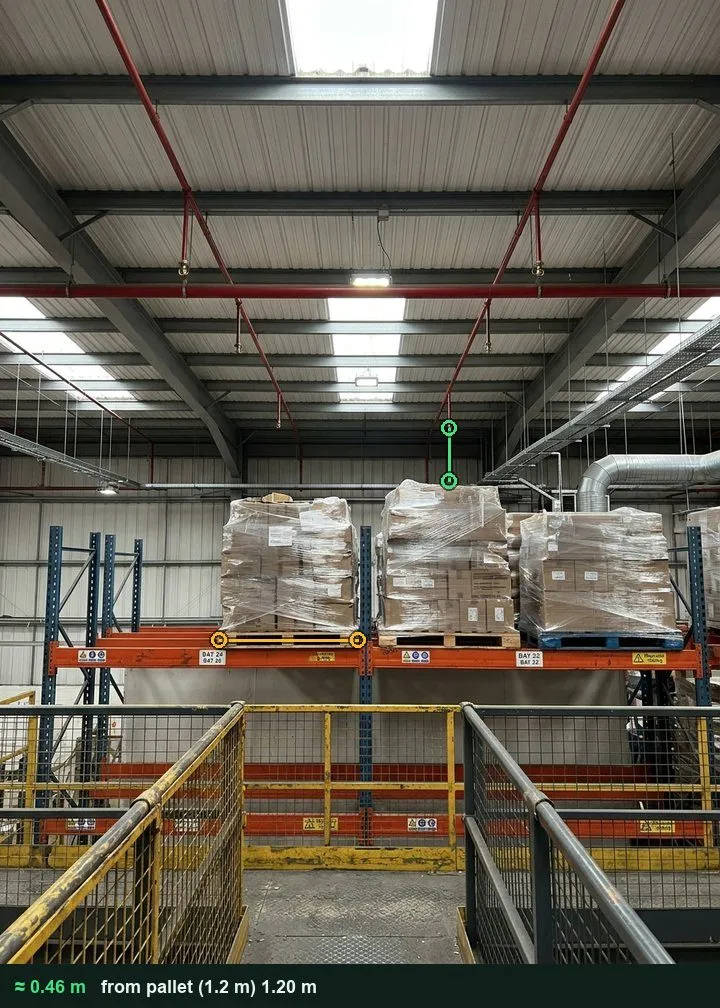
Minimum clearance of 1 m from the system design and the smallest clearance seen, 0.46 m, filled in from a measured photo

Clearance below the sprinklers

Enter the minimum clearance from the design or your contractor, then the smallest clearance seen, with a laser or from a photo with a 1.2 m pallet as the reference. Goods closer than the minimum show a note to lower them. It works on web forms in any phone browser today, and the app version is on its way.

How measuring from a photo works →
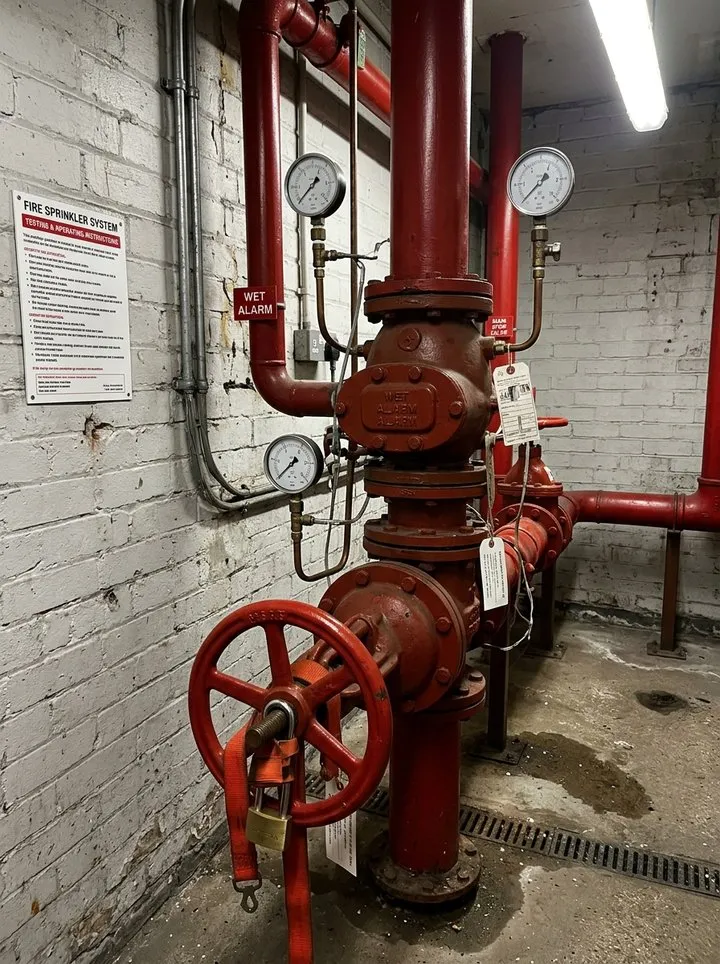
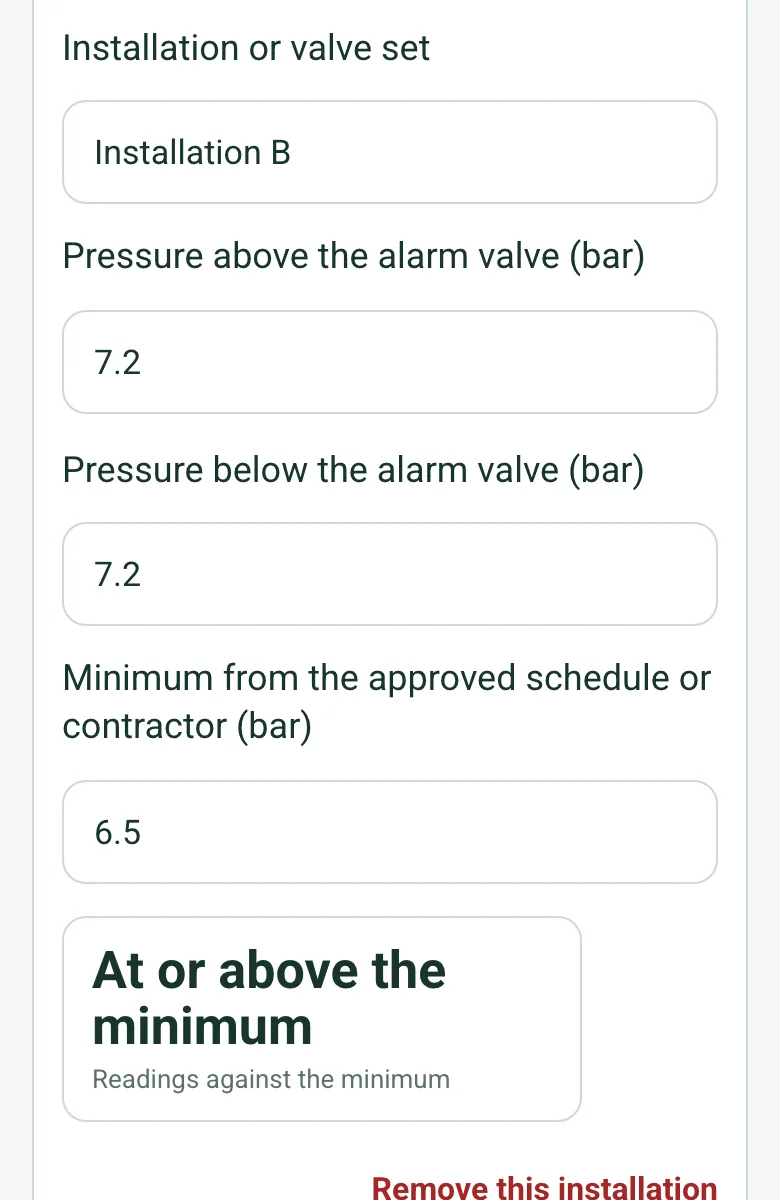
Installation B with 7.2 bar above and below the alarm valve, a minimum of 6.5 bar from the approved schedule and the check At or above the minimum

Gauges against the schedule

Read the gauges as they stand and enter the minimum from the approved schedule or contractor. A reading below it shows a red note to treat it as a possible impairment and follow the site procedure. The form sets no figure of its own.

How calculated fields work →

A completed sprinkler check

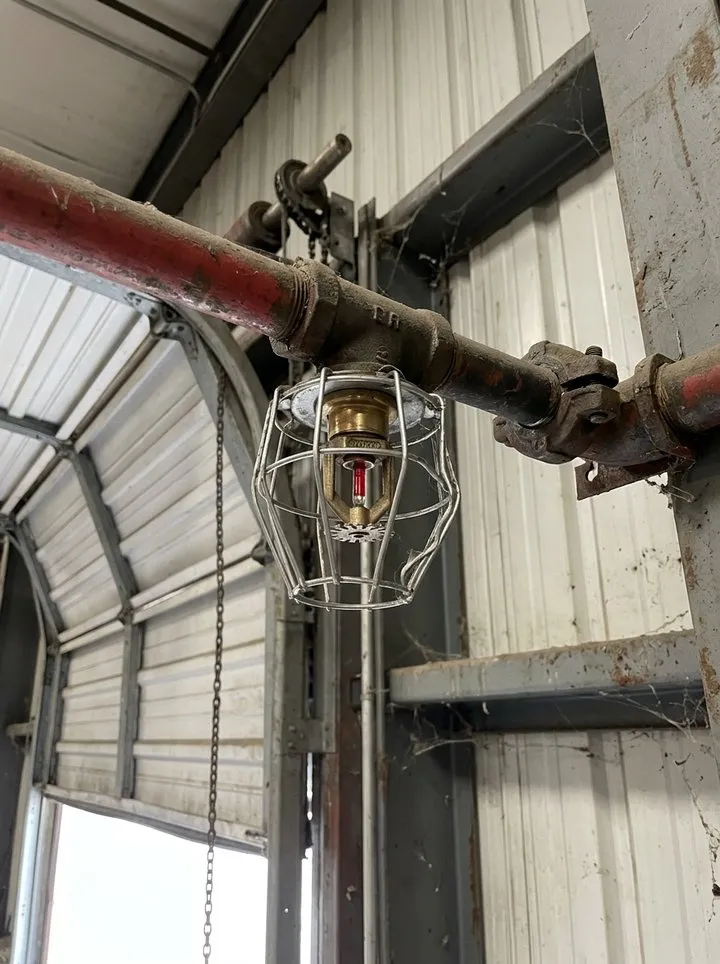
A fictional high-bay warehouse: both installations' gauges above the schedule minimum, the valve room pinned, a bent head guard above a dock door, and top-level pallets about 0.46 m below the deflectors against a 1.0 m design minimum, broken down the same day. Open it as a filled-in form, or switch to a blank copy and try it yourself.

Top-level pallets on warehouse racking with sprinkler pipes above, marked up against a 1.2 m pallet to give about 0.46 m clearance to a sprinkler head
Aisle 4 · about 0.46 m to the deflectors
A red wet pipe sprinkler alarm valve set with its main valve strapped open and two pressure gauges
Installation A valve set · 7.1 bar
A sprinkler head guard bent out of shape above a loading dock door
Bent guard above dock door 4
Up the racking to the sprinkler heads

Try the sprinkler routine inspection form live

Answer a few questions and watch it adapt. Your answers are not saved, and any photos you add are deleted within the hour.

Live form: Sprinkler Routine InspectionOpen full screen ↗
Fill it in right here

This is the real form as your team would use it: questions appear as you answer, scores work themselves out and you can add photos and signatures. No sign-up needed. Or open a completed example to see every answer, photo and score filled in.

Want to see one filled in? See a completed sprinkler routine inspection report (PDF), made by SiteSurvey from a fictional site visit.

Fill it in on a phone or tablet

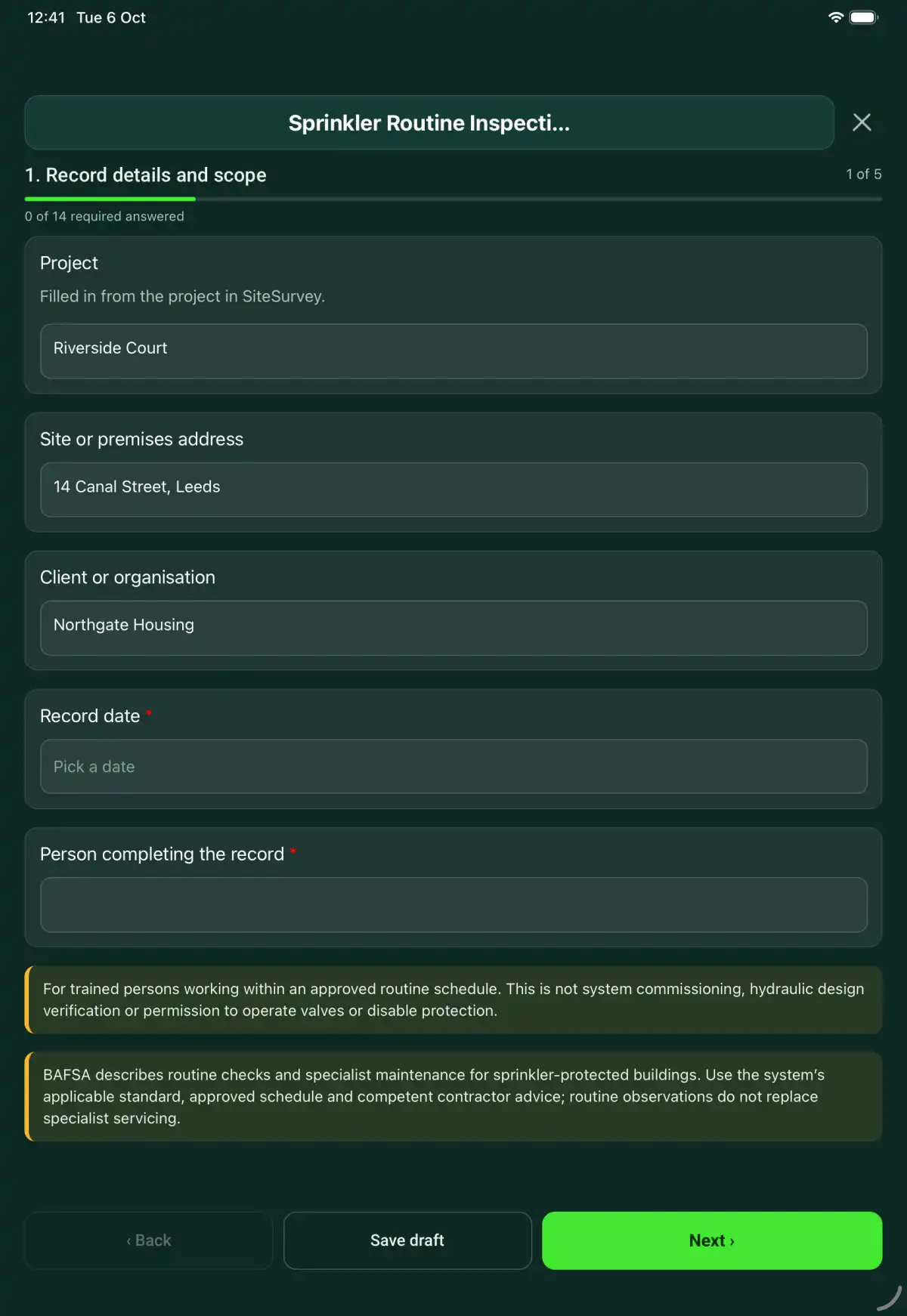
Your team completes the sprinkler routine inspection on site in the SiteSurvey app on iPhone, iPad and Android phones and tablets. The project name and address fill in for them, it works without signal, and it syncs when the device is back online with photos kept against the question they answer.

Customers and subcontractors do not need the app: send them a link and they can fill it in from any browser.

The Sprinkler Routine Inspection form in the SiteSurvey app on a tablet
The Sprinkler Routine Inspection form in the SiteSurvey app on a phone

Every question in the sprinkler routine inspection template

A sprinkler routine-check record with system identity, approved schedule, visual observations, authorised test references and impairment notifications. 6 sections and 59 questions. Follow-up questions and guidance appear only when an answer calls for them, so the person on site never sees the ones that do not apply.

Make it your own: every question is editable

This is a starting point, not a fixed form. Once it is in your SiteSurvey account you can reword any question, add or remove questions, sections and answer options, and add your own logo, so it fits the way your team works and the jobs you do.

Details you only enter once

Add this form to a project in SiteSurvey and it fills in what the project already knows, so nobody on site retypes it and every form on the job uses the same names. Anything filled in can still be changed.

  • Project: the project name
  • Site or premises address: the site address, from the space or the project
  • Client or organisation: the project's customer

Record details and scope

  • ProjectShort answer

    Filled in from the project in SiteSurvey.

    Fills in from the project name
  • Site or premises addressShort answer
    Fills in from the site address, from the space or the project
  • Client or organisationShort answer
    Fills in from the project's customer
  • Record date*Date
  • Person completing the record*Short answer
  • CheckFor trained persons working within an approved routine schedule. This is not system commissioning, hydraulic design verification or permission to operate valves or disable protection.
  • CheckCommercial sprinkler systems are inspected and maintained to BS EN 12845:2015+A1:2019, clause 20: the user carries out a weekly routine (gauges, water levels, main valve positions, water motor alarm test and automatic pump start test) and a competent contractor services the system quarterly, half-yearly and annually, with longer interval checks on top. Residential and domestic systems follow BS 9251:2021 instead. Article 17 of the Regulatory Reform (Fire Safety) Order 2005 requires fire safety equipment to be kept in efficient working order and good repair. BAFSA guidance supports both. Routine observations do not replace specialist servicing.

System and schedule

  • System, protected area and responsible person*Short answer
  • Control valve set locationShort answer

    Optional. Mark current location at the valve room or pump house door, so a contractor or the fire service can find it on a large site.

  • Applicable standard and maintenance schedule*Short answer
  • Authorised procedure and checker training reference*Short answer
  • Last specialist service and open defectsShort answer

Routine observations

  • Visible heads and guards checked for damage or obstruction*Choose one
    • Acceptable
    • Action needed
    • Not checked
    • Not applicable
  • Action, limitation or reason not applicable*Notes
    Shown only when the answers above make it relevant
  • Control valves observed in their documented normal state*Choose one
    • Acceptable
    • Action needed
    • Not checked
    • Not applicable
  • Action, limitation or reason not applicable*Notes
    Shown only when the answers above make it relevant
  • Alarm panel and supply status observed*Choose one
    • Acceptable
    • Action needed
    • Not checked
    • Not applicable
  • Action, limitation or reason not applicable*Notes
    Shown only when the answers above make it relevant
  • Protected areas checked for relevant storage or layout changes*Choose one
    • Acceptable
    • Action needed
    • Not checked
    • Not applicable
  • Action, limitation or reason not applicable*Notes
    Shown only when the answers above make it relevant
  • Plant-room access and visible leaks checked*Choose one
    • Acceptable
    • Action needed
    • Not checked
    • Not applicable
  • Action, limitation or reason not applicable*Notes
    Shown only when the answers above make it relevant
  • Minimum clearance below the sprinkler deflectors (m)Number

    From the system design or the sprinkler contractor. The form does not set a figure.

  • Smallest clearance seen, top of the stored goods to the deflectors (m)Number

    With a laser measure, or from a photo with a known object such as a 1.2 m pallet as the reference. A photo measure is rough: check close calls with a laser.

  • Clearance checkWorked out by the form
    Shown only when the answers above make it relevant
  • CheckStored goods are closer to the sprinkler deflectors than the design minimum. Lower the stock and tell the responsible person and the sprinkler contractor.
    Shown only when the answers above make it relevant
  • Observations needing actionWorked out by the form
  • Not checkedWorked out by the form

Gauges and weekly tests

  • Gauge readings
    Repeat for each entry. Each one asks:
    • Installation or valve setShort answer
    • Pressure above the alarm valve (bar)Number
    • Pressure below the alarm valve (bar)Number
    • Minimum from the approved schedule or contractor (bar)Number
    • Readings against the minimumWorked out by the form
      Shown only when the answers above make it relevant
  • Installations with a reading below the minimumWorked out by the form
  • WarningA gauge reading is below the minimum in the approved schedule. Treat it as a possible impairment: follow the site procedure, tell the responsible person and call the sprinkler contractor.
    Shown only when the answers above make it relevant
  • CheckWeekly routine (BS EN 12845 clause 20). Record each test as it was done today.
  • Water motor alarm gong test (each alarm valve)Choose one
    • OK
    • Defect
    • Not tested
  • Automatic pump start testChoose one
    • OK
    • Defect
    • Not tested
    • No pumps
  • Main stop valves locked open in the correct positionChoose one
    • OK
    • Defect
    • Not tested
  • Water tank levels correctChoose one
    • OK
    • Defect
    • Not tested
    • No tanks
  • Pump start pressure (bar)Number
    Shown only when the answers above make it relevant
  • Pump run time (minutes)Number
    Shown only when the answers above make it relevant
  • Weekly tests with a defectWorked out by the form
  • WarningA weekly test failed. Treat it as a possible impairment: tell the responsible person and call the sprinkler contractor.
    Shown only when the answers above make it relevant
  • Other authorised tests, results and report referencesNotes

Impairment and next checks

  • Impairment identified*Choose one
    • No impairment identified within scope
    • Impairment or uncertainty
  • Affected areas, responsible person notified and interim measures*Notes

    Identify who was notified of an impairment, when and under which site procedure. Record restoration separately.

    Shown when “Impairment identified” is “Impairment or uncertainty”
  • Specialist restoration and verification referenceShort answer
  • Observed condition evidencePhotos
  • Next weekly check dueDate

    BS EN 12845 clause 20: every week.

  • Days to the next weekly checkWorked out by the form
    Shown when “Record date” is answered and “Next weekly check due” is answered
  • CheckThe next due date is before the date of this visit. Check the date.
    Shown only when the answers above make it relevant
  • Next contractor service dueDate

    Set by the approved schedule: quarterly, half-yearly or annual service.

  • Days to the next serviceWorked out by the form
    Shown when “Record date” is answered and “Next contractor service due” is answered
  • CheckThe next due date is before the date of this visit. Check the date.
    Shown only when the answers above make it relevant

Actions and review

  • Are further actions required?*Choose one
    • Yes
    • No
  • Further action
    Repeat for each further action. Each one asks:
    Shown when “Are further actions required?” is “Yes”
    • Action and evidence reference*Notes
    • PriorityChoose one
      • Urgent
      • High
      • Medium
      • Low
    • Person responsible*Short answer
    • Target dateDate
    • Action status*Choose one
      • Open
      • In progress
      • Completed
    • Completion evidence*Notes
      Shown when “Action status” is “Completed”
  • Outstanding limitations and information to pass onNotes
  • Record status*Choose one
    • Ready for review
    • Further work needed
    • Work or use stopped
  • Reviewed byShort answer
  • Review dateDate
  • Author signature*Signature
  • CheckSigning records the information entered. It does not itself certify legal compliance, remove a limitation or authorise unsafe work.

Scope and responsibility

For trained persons working within an approved routine schedule. This is not system commissioning, hydraulic design verification or permission to operate valves or disable protection.

What a useful entry looks like

Affected areas, responsible person notified and interim measures

Identify who was notified of an impairment, when and under which site procedure. Record restoration separately.

System impairment reported to the designated contact at the recorded time under procedure FS-11. Restoration evidence remains to be confirmed.

Fictional example of record wording. Use the actual evidence and approved arrangements for your job; this is not a completed report or an instruction to carry out the work.

See it filled in

A completed sprinkler routine inspection report, made by SiteSurvey from a fictional site visit: every answer, the photos, the guidance that applied and the sign-off, ready to send as a PDF.

See completed form (PDF) ↗

Sprinkler Routine Inspection FAQs

How should I record “Affected areas, responsible person notified and interim measures”?

Identify who was notified of an impairment, when and under which site procedure. Record restoration separately.

Does this prescribe weekly test steps?

No. Use the approved schedule for the particular system and record the work actually authorised.

Can a closed valve be opened without authorisation?

No. Follow the system procedure and escalation arrangements; the checklist does not grant operational authority.

What if a system is impaired?

Record affected areas, notification and interim measures, then link the restoration evidence.

What are the limits of this template?

For trained persons working within an approved routine schedule. This is not system commissioning, hydraulic design verification or permission to operate valves or disable protection.

Can I complete this form on site and share the record?

In the SiteSurvey app the form works offline, with photos and signatures recorded against the questions. Share the completed record as a PDF or a link. Dates and action owners are recorded fields; this form does not send reminders or update other systems.

Related

Use this sprinkler routine inspection form with your team

Add it from the form library in one click, change any question, and every completed form becomes a branded PDF report.

Start your trial →