Form library · Health and safety
Noise risk assessment template
For people assessing workplace noise exposure and controls. Record people and work, exposure evidence and control decisions. Try the form below, see every question or open a completed example.
Ready to use from the form library, and every question is yours to edit. Try it for a small trial fee, cancel any time.
Try it on your phone
Try it on this phone
Fill in the workplace noise risk assessment on your phone now
See how the workplace noise risk assessment looks on your phone
Scan the code with your phone camera. It opens the real form, no sign-up needed.
Open the live example and fill it in, just as your team would on site. No sign-up needed.
See it on this phoneEvery question is editable. Add this form to your account, then change the wording, add or remove questions and options, and make it fit your own jobs.
Is a noise assessment just a sound reading?
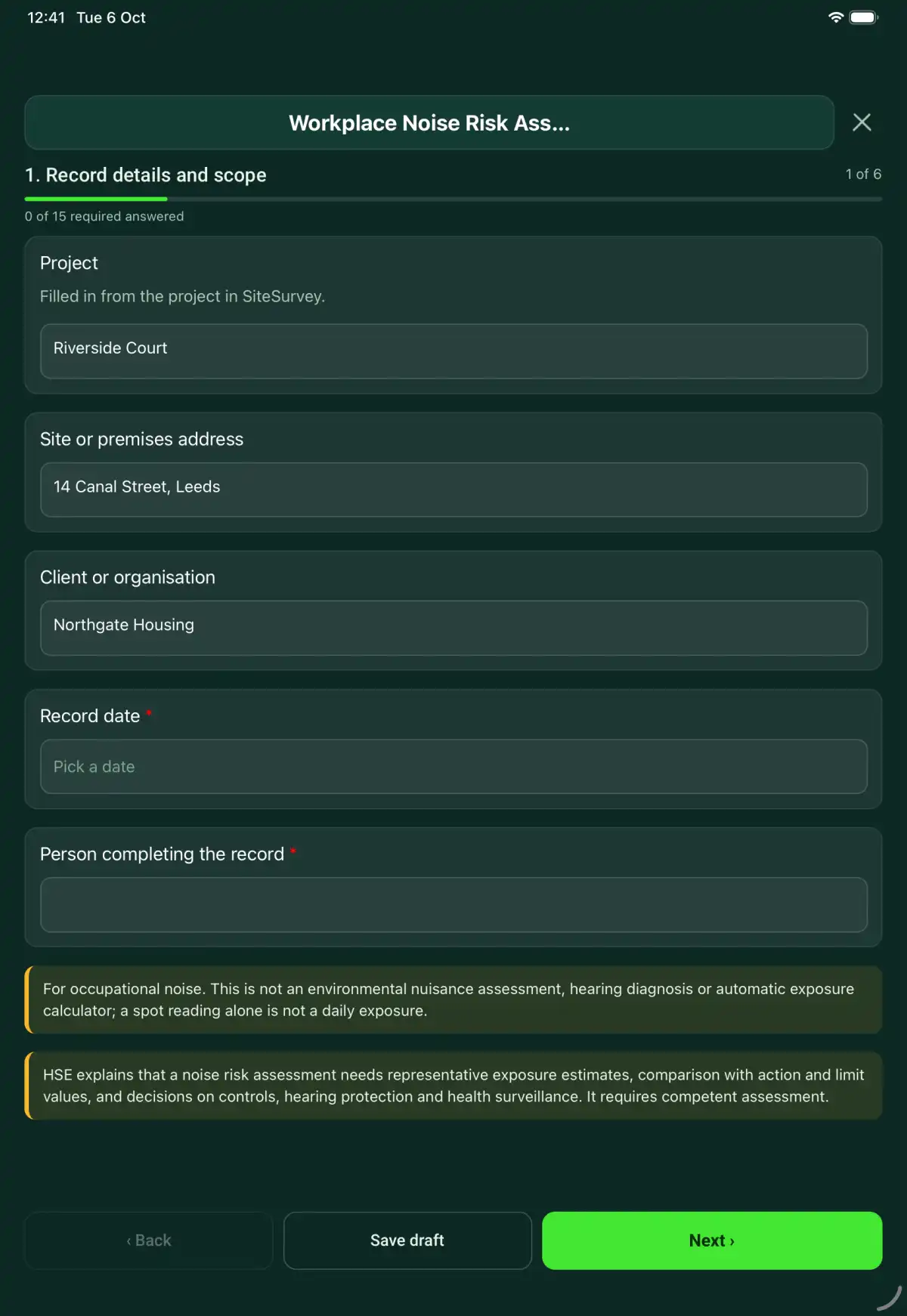
HSE explains that a noise risk assessment needs representative exposure estimates, comparison with action and limit values, and decisions on controls, hearing protection and health surveillance. It requires competent assessment.
Last updated . Facts checked by the SiteSurvey team on 6 October 2026 against HSE noise risk assessment and HSE controlling noise at work.
Try the workplace noise risk assessment form live
Answer a few questions and watch it adapt. Your answers are not saved, and any photos you add are deleted within the hour.
This is the real form as your team would use it: questions appear as you answer, scores work themselves out and you can add photos and signatures. No sign-up needed. Or open a completed example to see every answer, photo and score filled in.
Want to see one filled in? See a completed workplace noise risk assessment report (PDF), made by SiteSurvey from a fictional site visit.
Fill it in on a phone or tablet
Your team completes the workplace noise risk assessment on site in the SiteSurvey app on iPhone, iPad and Android phones and tablets. The project name and address fill in for them, it works without signal, and it syncs when the device is back online with photos kept against the question they answer.
Customers and subcontractors do not need the app: send them a link and they can fill it in from any browser.
Every question in the workplace noise risk assessment template
A workplace noise assessment recording affected tasks, exposure evidence, comparison with applicable values, control decisions and review arrangements. 6 sections and 42 questions. Follow-up questions and guidance appear only when an answer calls for them, so the person on site never sees the ones that do not apply.
Make it your own: every question is editable
This is a starting point, not a fixed form. Once it is in your SiteSurvey account you can reword any question, add or remove questions, sections and answer options, and add your own logo, so it fits the way your team works and the jobs you do.
Details you only enter once
Add this form to a project in SiteSurvey and it fills in what the project already knows, so nobody on site retypes it and every form on the job uses the same names. Anything filled in can still be changed.
- Project: the project name
- Site or premises address: the site address, from the space or the project
- Client or organisation: the project's customer
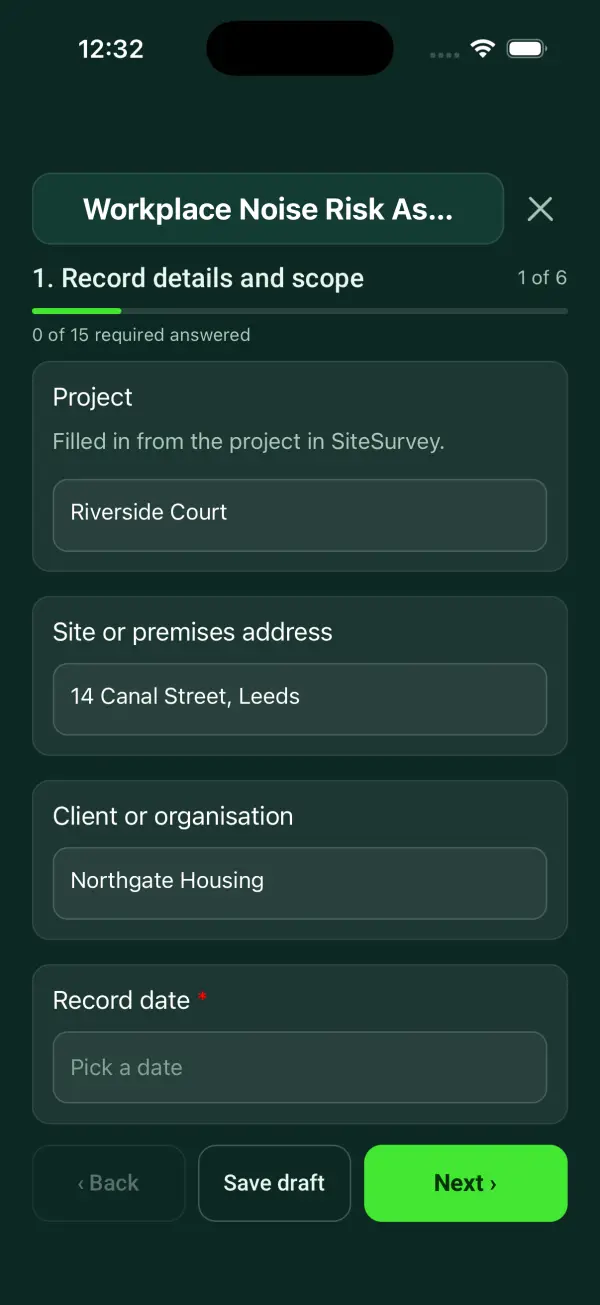
Record details and scope
- ProjectShort answer
Filled in from the project in SiteSurvey.
Fills in from the project name - Site or premises addressShort answerFills in from the site address, from the space or the project
- Client or organisationShort answerFills in from the project's customer
- Record date*Date
- Person completing the record*Short answer
- CheckFor occupational noise. This is not an environmental nuisance assessment, hearing diagnosis or automatic exposure calculator; a spot reading alone is not a daily exposure.
- CheckThe Control of Noise at Work Regulations 2005 apply, with HSE guidance L108 Controlling noise at work. Regulation 4 sets the values: lower exposure action values 80 dB(A) daily or weekly personal exposure (LEP,d) and 135 dB(C) peak; upper exposure action values 85 dB(A) and 137 dB(C) peak; exposure limit values 87 dB(A) and 140 dB(C) peak, which take account of hearing protection. Regulation 5 requires a suitable and sufficient risk assessment by a competent person, recorded and reviewed. Regulation 6 requires exposure to be eliminated or reduced, with a programme of controls above the upper action values. Regulation 7 covers hearing protection and hearing protection zones, regulation 8 the maintenance and use of equipment, and regulation 9 health surveillance where there is a risk to health. Regulation 10 requires information, instruction and training.
People and work
- Work area and activities*Short answer
- Assessor and competence reference*Short answer
- Exposed roles, work patterns and vulnerable groups without medical details*Notes
- Assessment method and applicable guidanceShort answer
Identify the evidence, tasks and exposure periods used. A single unrepresentative reading should not stand in for a full assessment.
Exposure evidence
- Task exposureRepeat for each task exposure. Each one asks:
- Task and equipment*Short answer
- Duration and pattern*Short answer
- Representative data source or monitoring report*Short answer
- Other exposure data (for example dosimeter LEP,d), with unitsShort answer
- Comparison with the action and limit values (notes)Short answer
- Variability and uncertaintyNotes
- Average level for the task, LAeq (dB(A))Number
- Time exposed per day (hours)Number
- Highest peak, LCpeak (dB(C))Number
- This task: % of the upper action value (85 dB(A))Worked out by the formShown only when the answers above make it relevant
- GuidanceEach task's share of the daily exposure is worked out from LAeq and time as LEP,d = LAeq + 10 log(T/8), shown here as a percentage of the upper action value. 100% is the same as 85 dB(A) LEP,d, about 32% is 80 dB(A) and about 158% is 87 dB(A). Adding the tasks together gives the daily total. These figures ignore hearing protection.
- Daily exposure, % of the upper action valueWorked out by the form
- Band against the action valuesWorked out by the formShown only when the answers above make it relevant
- Tasks with a peak at or above 137 dB(C)Worked out by the form
- WarningAt or above the upper action value. Regulation 6 requires a programme of organisational and technical measures, hearing protection zones and compulsory hearing protection, and regulation 9 health surveillance for those at risk.Shown only when the answers above make it relevant
Control decisions
- Elimination, substitution and engineering controls*Notes
- Work organisation and information needsNotes
- Hearing protection selection and zone decisionsNotes
- Health surveillance referral decision and basis, without clinical recordsNotes
Review triggers
- Changes requiring reassessment*Notes
- Planned review and responsible personShort answer
- Next review dueDate
Review when the work, equipment or exposure changes, or the health surveillance results suggest it.
- Days to the next reviewWorked out by the formShown when “Record date” is answered and “Next review due” is answered
- CheckThe next due date is before the date of this visit. Check the date.Shown only when the answers above make it relevant
Actions and review
- Are further actions required?*Choose one
- Yes
- No
- Further actionRepeat for each further action. Each one asks:Shown when “Are further actions required?” is “Yes”
- Action and evidence reference*Notes
- PriorityChoose one
- Urgent
- High
- Medium
- Low
- Person responsible*Short answer
- Target dateDate
- Action status*Choose one
- Open
- In progress
- Completed
- Completion evidence*NotesShown when “Action status” is “Completed”
- Outstanding limitations and information to pass onNotes
- Record status*Choose one
- Ready for review
- Further work needed
- Work or use stopped
- Reviewed byShort answer
- Review dateDate
- Author signature*Signature
- CheckSigning records the information entered. It does not itself certify legal compliance, remove a limitation or authorise unsafe work.
Scope and responsibility
For occupational noise. This is not an environmental nuisance assessment, hearing diagnosis or automatic exposure calculator; a spot reading alone is not a daily exposure.
What a useful entry looks like
Assessment method and applicable guidance
Identify the evidence, tasks and exposure periods used. A single unrepresentative reading should not stand in for a full assessment.
Assessment references monitoring report NM-06 and the current task-duration record. The changed cutting process requires additional evidence.
Fictional example of record wording. Use the actual evidence and approved arrangements for your job; this is not a completed report or an instruction to carry out the work.
See it filled in
A completed workplace noise risk assessment report, made by SiteSurvey from a fictional site visit: every answer, the photos, the guidance that applied and the sign-off, ready to send as a PDF.
Workplace Noise Risk Assessment FAQs
How should I record “Assessment method and applicable guidance”?
Identify the evidence, tasks and exposure periods used. A single unrepresentative reading should not stand in for a full assessment.
Can a phone sound reading establish exposure?
Do not assume it does. Record suitable evidence, measurement limitations and competent interpretation.
Where are action values entered?
Record the applicable values and their source in each exposure comparison; the form performs no calculation.
Should medical results be entered?
No. Record the referral decision and controlled reference, keeping clinical records separately.
What are the limits of this template?
For occupational noise. This is not an environmental nuisance assessment, hearing diagnosis or automatic exposure calculator; a spot reading alone is not a daily exposure.
Can I complete this form on site and share the record?
In the SiteSurvey app the form works offline, with signatures recorded against the questions. Share the completed record as a PDF or a link. Dates and action owners are recorded fields; this form does not send reminders or update other systems.
Related
Hazards this form covers
Who each hazard harms, what the law expects and the control measures to look for, in our hazard library.
Related templates
Templates that go with the workplace noise risk assessment form
An occupational noise measurement record linking instruments, calibration checks, task conditions, timed measurements, uncertainty and assessment references.
A US hearing conservation program record under OSHA 29 CFR 1910.95: noise monitoring by area and job against the 85 dBA action level and the 90 dBA Table G-16 limit, results given to employees, hearing protectors with an Appendix B estimate of the level under them, each employee in the program with baseline and most recent audiogram dates and days since, standard threshold shift follow-up, protectors offered, training sessions, records and actions.
Use this workplace noise risk assessment form with your team
Add it from the form library in one click, change any question, and every completed form becomes a branded PDF report.
Start your trial →