Form library · Quality and compliance

Noise monitoring report template

For competent people measuring noise at work. Record each run with its LAeq and peak: the form compares each peak with the action values and estimates each worker group's daily exposure in HSE exposure points, against the 80 and 85 dB(A) action values. Try the form below, see every question or open a completed example.

Ready to use from the form library, and every question is yours to edit. Try it for a small trial fee, cancel any time.

Try it on your phone

Try it on this phone

Fill in the occupational noise monitoring record on your phone now

See how the occupational noise monitoring record looks on your phone

Scan the code with your phone camera. It opens the real form, no sign-up needed.

Open the live example and fill it in, just as your team would on site. No sign-up needed.

See it on this phone

Every question is editable. Add this form to your account, then change the wording, add or remove questions and options, and make it fit your own jobs.

Or start your trial with this form ready →

One email, and we won't add you to a mailing list.

How should measurements be interpreted?

HSE guidance requires representative evidence for occupational noise exposure assessment. Record the measurement method, task duration and uncertainty so a competent assessor can interpret the readings.

Last updated . Facts checked by the SiteSurvey team on 6 October 2026 against HSE controlling noise at work and HSE noise risk assessment.

Built for measuring noise at work

Record each measurement run with its LAeq, its peak and the time a day spent on that task. The form shows how each peak compares with the action values and adds up each worker group's day in exposure points, as in HSE's ready-reckoner. It is an estimate from the figures you enter, not the noise risk assessment.

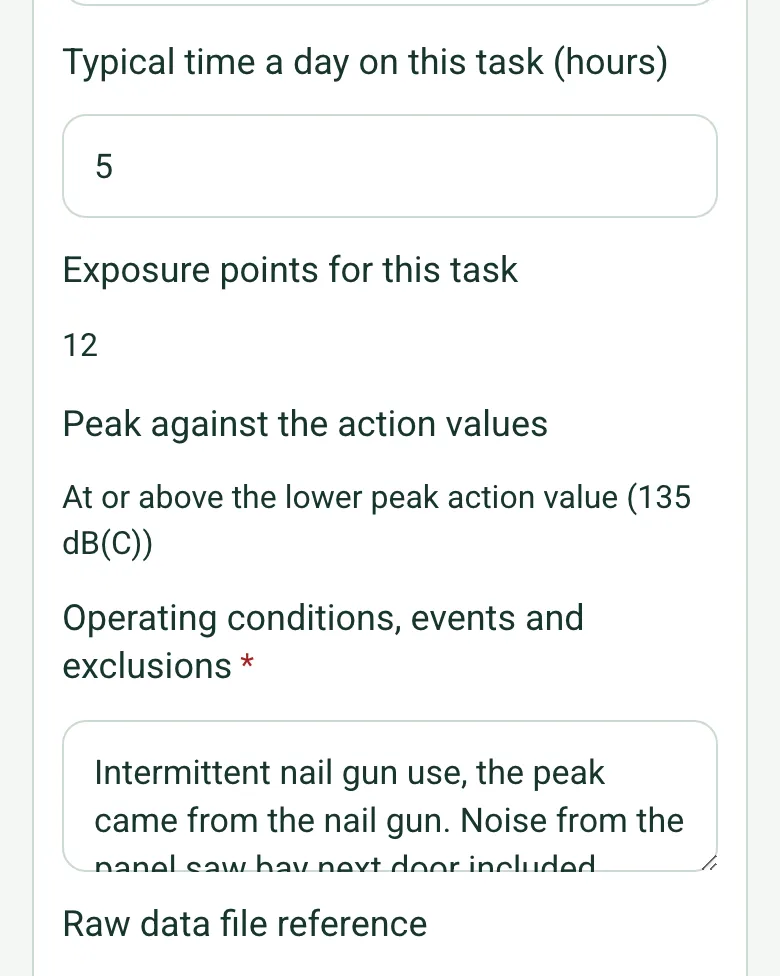
A measurement run at 5 hours a day giving 12 exposure points, with the peak worked out as at or above the lower peak action value of 135 dB(C)

Points and peak for each task

Enter the LAeq, the LCpeak and the hours a day on the task. The form works out the task's exposure points and shows whether the peak is below, at or above the 135 and 137 dB(C) action values or the 140 dB(C) limit value.

How calculated fields work →
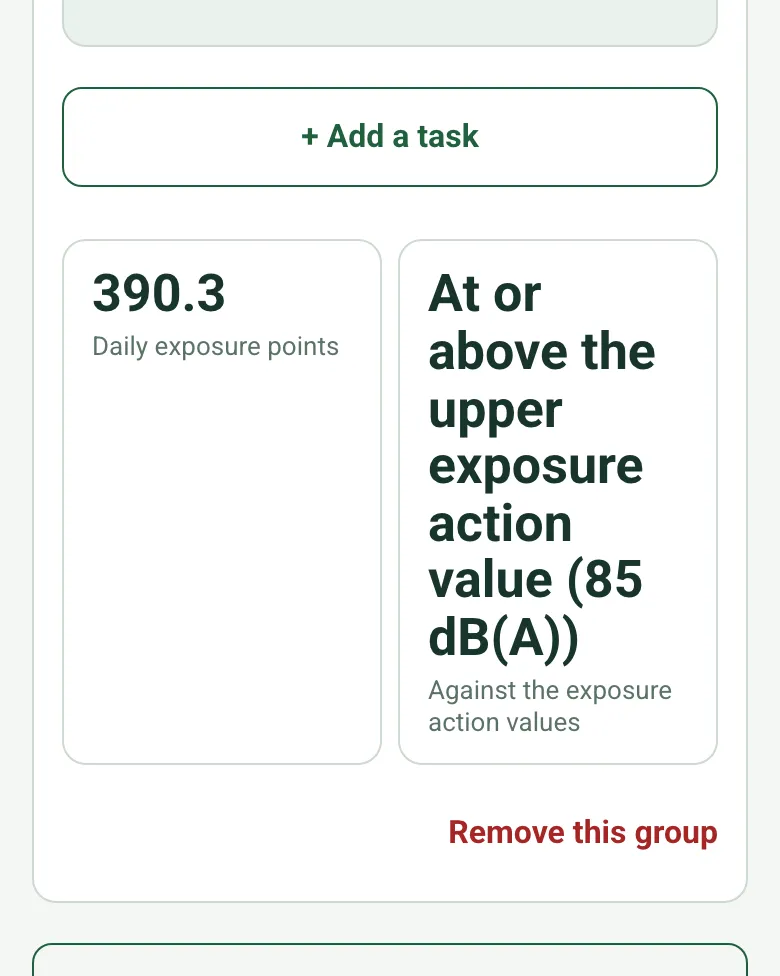
A machinist's tasks in a typical day adding up to 390 exposure points, worked out as at or above the upper exposure action value of 85 dB(A)

A day's exposure for each group

List the tasks in a typical day for each anonymised role. The points add up: 32 is about 80 dB(A) and 100 is about 85 dB(A), so the group shows against the lower and upper exposure action values. Hearing protection is not taken into account.

How calculated fields work →
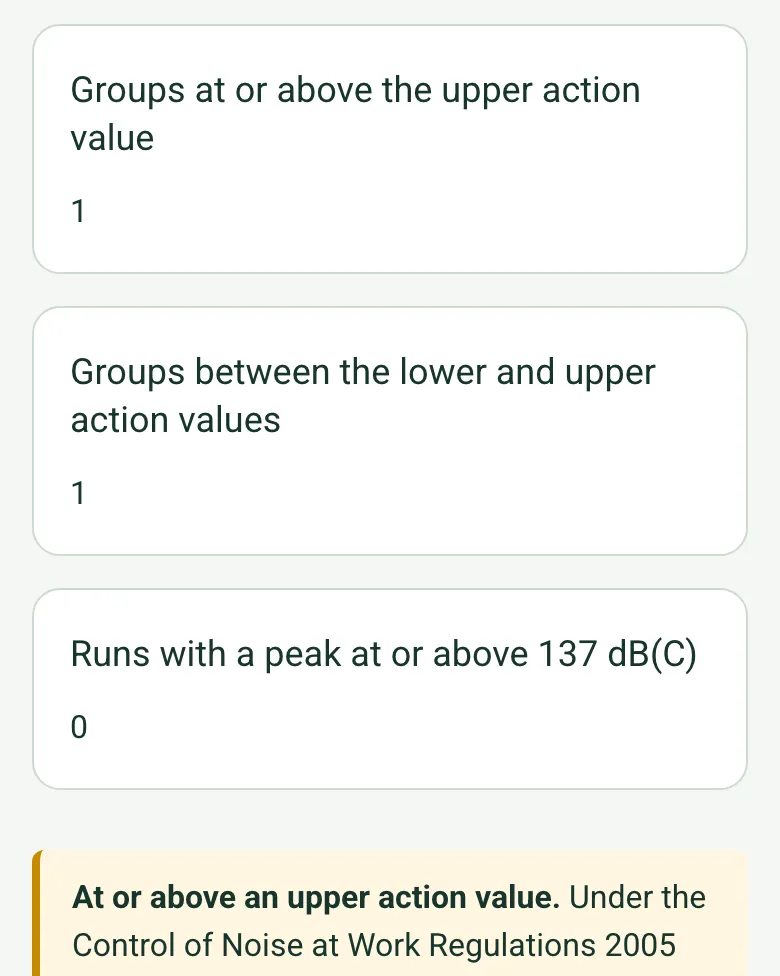
Counts worked out as 1 group at or above the upper action value, 1 between the lower and upper, 0 runs with a peak at or above 137 dB(C), and an amber note on the duties

Groups over the action values, counted

The form counts the groups above each action value and the runs with high peaks, and an amber note lists the duties that come with the upper action values under the Control of Noise at Work Regulations 2005, to pass to whoever owns the noise risk assessment.

How calculated fields work →

A completed noise monitoring record

A fictional joinery workshop: three task measurements at the panel saw, the planer and the assembly bench, with calibration checks, and three worker groups from about 2 to 390 exposure points. Open it as a filled-in form, or switch to a blank copy and try it yourself.

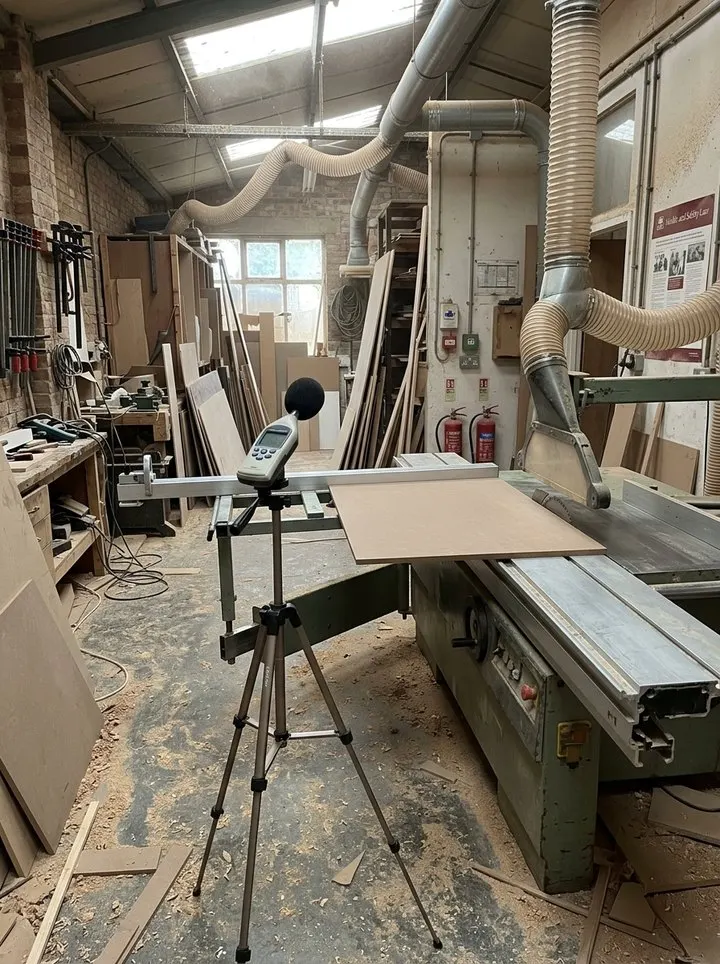
A sound level meter with a foam windshield on a tripod at head height beside a sliding table panel saw in a joinery workshop
Panel saw · LAeq 91 dB · 3 hours a day
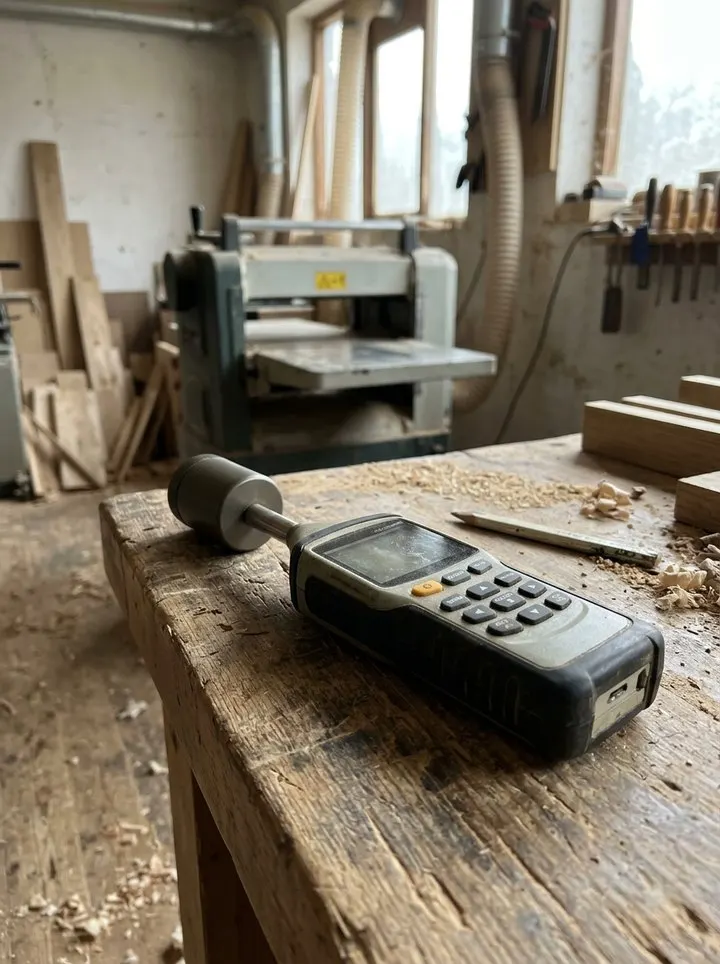
A sound level meter resting on a workbench with a planer-thicknesser behind it
Planer-thicknesser · LAeq 96 dB · 1.5 hours a day
The meter on its tripod beside a running saw

Try the occupational noise monitoring record form live

Answer a few questions and watch it adapt. Your answers are not saved, and any photos you add are deleted within the hour.

Live form: Occupational Noise Monitoring RecordOpen full screen ↗
Fill it in right here

This is the real form as your team would use it: questions appear as you answer, scores work themselves out and you can add photos and signatures. No sign-up needed. Or open a completed example to see every answer, photo and score filled in.

Want to see one filled in? See a completed occupational noise monitoring record report (PDF), made by SiteSurvey from a fictional site visit.

Fill it in on a phone or tablet

Your team completes the occupational noise monitoring record on site in the SiteSurvey app on iPhone, iPad and Android phones and tablets. The project name and address fill in for them, it works without signal, and it syncs when the device is back online with photos kept against the question they answer.

Customers and subcontractors do not need the app: send them a link and they can fill it in from any browser.

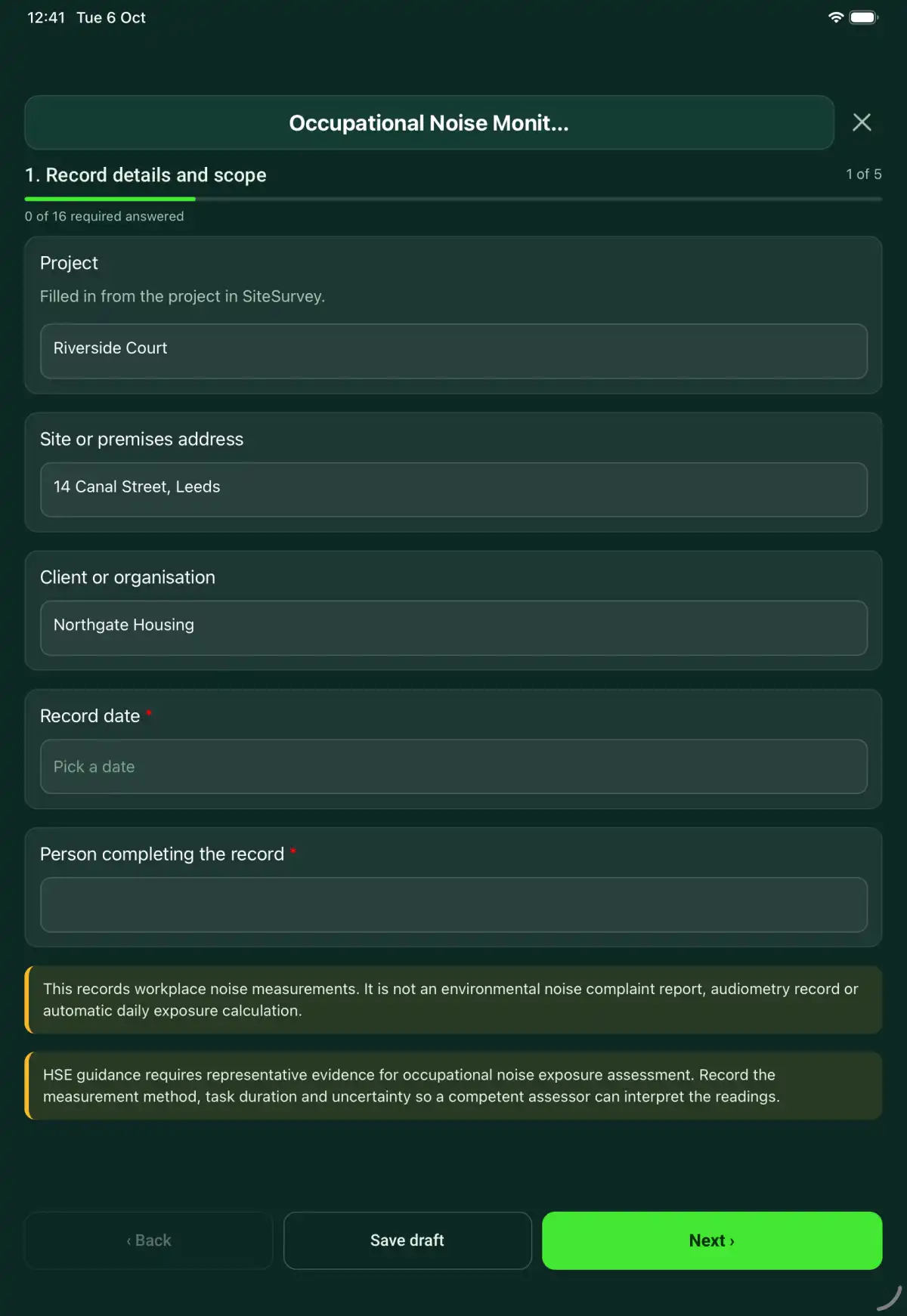
The Occupational Noise Monitoring Record form in the SiteSurvey app on a tablet
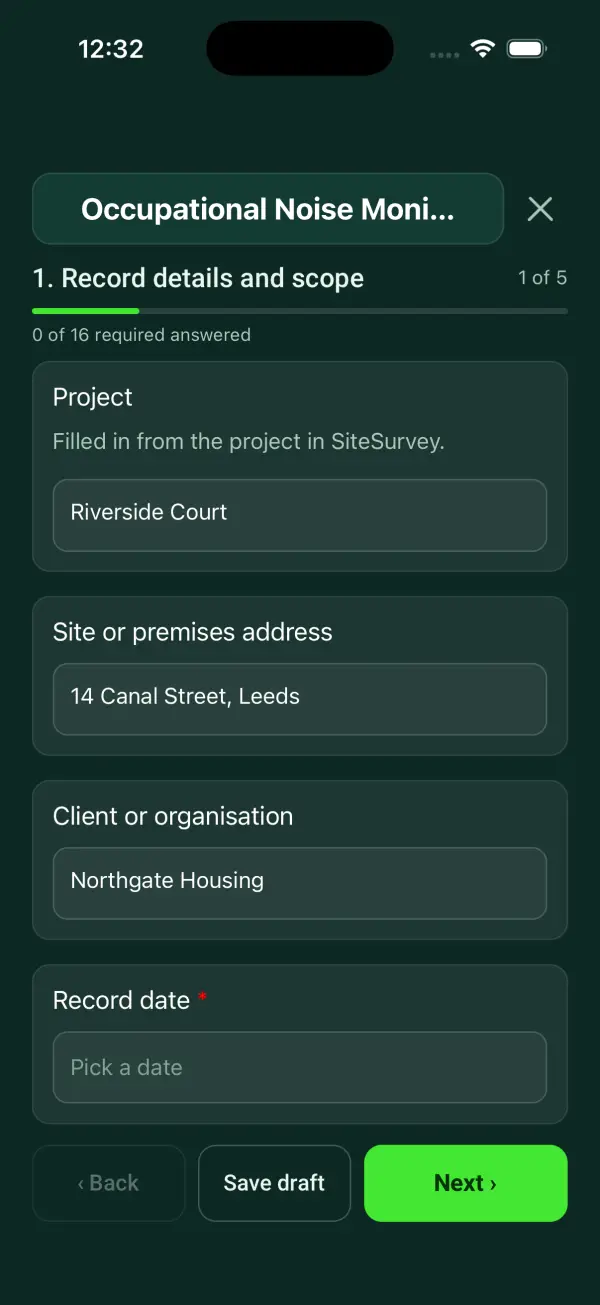
The Occupational Noise Monitoring Record form in the SiteSurvey app on a phone

Every question in the occupational noise monitoring record template

An occupational noise measurement record linking instruments, calibration checks, task conditions, timed measurements, uncertainty and assessment references. 6 sections and 49 questions. Follow-up questions and guidance appear only when an answer calls for them, so the person on site never sees the ones that do not apply.

Make it your own: every question is editable

This is a starting point, not a fixed form. Once it is in your SiteSurvey account you can reword any question, add or remove questions, sections and answer options, and add your own logo, so it fits the way your team works and the jobs you do.

Details you only enter once

Add this form to a project in SiteSurvey and it fills in what the project already knows, so nobody on site retypes it and every form on the job uses the same names. Anything filled in can still be changed.

  • Project: the project name
  • Client or organisation: the project's customer
  • Site or premises address: the site address, from the space or the project

Record details and scope

  • ProjectShort answer

    Filled in from the project in SiteSurvey.

    Fills in from the project name
  • Client or organisationShort answer
    Fills in from the project's customer
  • Site or premises addressShort answer
    Fills in from the site address, from the space or the project
  • Record date*Date
  • Person completing the record*Short answer
  • CheckThis records workplace noise measurements. It is not an environmental noise complaint report or an audiometry record. The exposure points are an estimate from the levels and durations entered, not the noise risk assessment.
  • CheckHSE guidance requires representative evidence for occupational noise exposure assessment. Record the measurement method, task duration and uncertainty so a competent assessor can interpret the readings. Sources: The Control of Noise at Work Regulations 2005 and HSE guidance L108, Controlling noise at work.

Measurement plan

  • Survey purpose and covered tasks*Short answer
  • Competent surveyor*Short answer
  • Method and applicable guidance reference*Short answer
  • Meter, microphone and calibrator IDs*Short answer
  • Calibration records and pre/post field checks*Short answer

Measurement runs

  • Measurement run
    Repeat for each measurement run. Each one asks:
    • Location, task and anonymised role*Short answer
    • Start, finish and representative task duration*Short answer
    • Measurement metric, weighting and settings*Short answer
    • Other readings and units, if anyShort answer
    • LAeq (dB(A))Number
    • Peak sound pressure, LCpeak (dB(C))Number
    • Typical time a day on this task (hours)Number
    • Exposure points for this taskWorked out by the form
      Shown only when the answers above make it relevant
    • Peak against the action valuesWorked out by the form
      Shown only when the answers above make it relevant
    • Operating conditions, events and exclusions*Notes
    • Raw data file referenceShort answer
    • Photos of the measurement positionPhotos

      The microphone position, the source and anything unusual during the run.

Daily exposure estimate

  • GuidanceExposure points add up across a working day, as in HSE's ready-reckoner: 32 points is about 80 dB(A) daily exposure (the lower exposure action value) and 100 points is 85 dB(A) (the upper exposure action value). The estimate depends on the levels and times entered, ignores hearing protection and does not replace the noise risk assessment.
  • Worker group
    Repeat for each group. Each one asks:
    • Anonymised role or worker group*Short answer
    • Tasks in a typical day
      Repeat for each task. Each one asks:
      • Task*Short answer
      • LAeq for this task (dB(A))Number
      • Hours a day on this taskNumber
      • Exposure pointsWorked out by the form
    • Daily exposure pointsWorked out by the form
    • Against the exposure action valuesWorked out by the form
      Shown only when the answers above make it relevant
  • Groups at or above the upper action valueWorked out by the form
  • Groups between the lower and upper action valuesWorked out by the form
  • Runs with a peak at or above 137 dB(C)Worked out by the form
  • CheckAt or above an upper action value. Under the Control of Noise at Work Regulations 2005 this brings duties such as a programme of control measures, hearing protection zones and the use of hearing protection. Pass these results to the person responsible for the noise risk assessment.
    Shown only when the answers above make it relevant

Interpretation and handover

  • Uncertainty and representativeness limitations*Notes

    Record factors affecting representativeness and uncertainty. Keep measured values separate from subsequent exposure calculations.

  • Separate exposure calculation and risk assessment referenceShort answer
  • Immediate concerns and person informedNotes
  • Technical reviewerShort answer

Actions and review

  • Are further actions required?Choose one
    • Yes
    • No
  • Further action
    Repeat for each further action. Each one asks:
    Shown when “Are further actions required?” is “Yes”
    • Action and evidence reference*Notes
    • PriorityChoose one
      • Urgent
      • High
      • Medium
      • Low
    • Person responsibleShort answer
    • Target dateDate
    • Action statusChoose one
      • Open
      • In progress
      • Completed
    • Completion evidence*Notes
      Shown when “Action status” is “Completed”
  • Open actionsWorked out by the form

    Worked out from the actions above: open or in progress.

    Shown when “Are further actions required?” is “Yes”
  • Outstanding limitations and information to pass onNotes
  • Record status*Choose one
    • Ready for review
    • Further work needed
    • Work or use stopped
  • Reviewed byShort answer
  • Review dateDate
  • Author signature*Signature
  • CheckSigning records the information entered. It does not itself certify legal compliance, remove a limitation or authorise unsafe work.

Scope and responsibility

This records workplace noise measurements. It is not an environmental noise complaint report or an audiometry record. The exposure points are an estimate from the levels and durations entered, not the noise risk assessment.

What a useful entry looks like

Uncertainty and representativeness limitations

Record factors affecting representativeness and uncertainty. Keep measured values separate from subsequent exposure calculations.

Monitoring covered the recorded production period. Intermittent activity outside that period is identified for assessment in the interpretation report.

Fictional example of record wording. Use the actual evidence and approved arrangements for your job; this is not a completed report or an instruction to carry out the work.

See it filled in

A completed occupational noise monitoring record report, made by SiteSurvey from a fictional site visit: every answer, the photos, the guidance that applied and the sign-off, ready to send as a PDF.

See completed form (PDF) ↗

Occupational Noise Monitoring Record FAQs

How should I record “Uncertainty and representativeness limitations”?

Record factors affecting representativeness and uncertainty. Keep measured values separate from subsequent exposure calculations.

How is this different from the noise risk assessment?

This holds measurement evidence; the assessment records exposure comparisons and control decisions.

Does it calculate daily exposure?

It gives an estimate. Each task's exposure points come from the LAeq and the hours a day you enter, and they add up for each worker group, as in HSE's ready-reckoner. The estimate ignores hearing protection, and the noise risk assessment still decides the exposure and the controls.

Should worker medical information be included?

No. Use role references and keep health records in the appropriate controlled system.

What are the limits of this template?

This records workplace noise measurements. It is not an environmental noise complaint report or an audiometry record. The exposure points are an estimate from the levels and durations entered, not the noise risk assessment.

Can I complete this form on site and share the record?

In the SiteSurvey app the form works offline, with signatures recorded against the questions. Share the completed record as a PDF or a link. Dates and action owners are recorded fields; this form does not send reminders or update other systems.

Related

Hazards this form covers

Who each hazard harms, what the law expects and the control measures to look for, in our hazard library.

Use this occupational noise monitoring record form with your team

Add it from the form library in one click, change any question, and every completed form becomes a branded PDF report.

Start your trial →