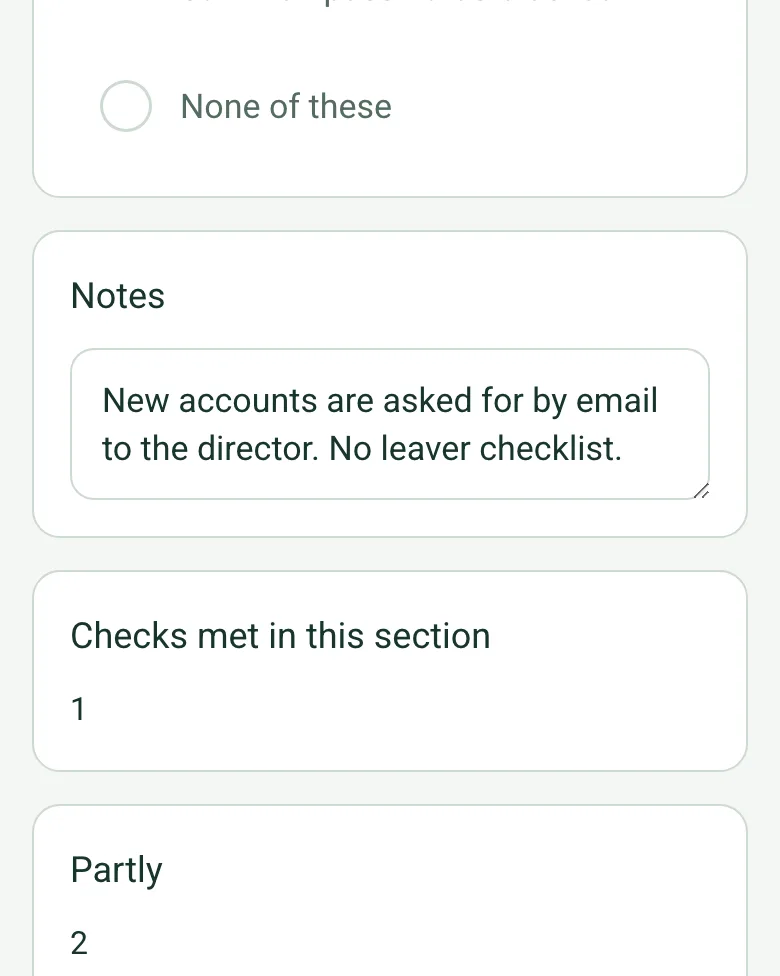
Each section scored as you go
At the end of every section the form counts the checks met, partly met, not met and not known. Partly is kept apart from Met, because Cyber Essentials expects every requirement to be met.
How calculated fields work →Form library · AV and IT
A cyber security audit form built around the five technical controls of Cyber Essentials: firewalls, secure configuration, security update management, user access control and malware protection. It adds backups, physical security and incident readiness, then lists findings by risk. Every question is listed below, and you can fill the live form in on this page.
Ready to use from the form library, and every question is yours to edit. Try it for a small trial fee, cancel any time.
Try it on your phone
Try it on this phone
Fill in the IT security audit on your phone now
See how the IT security audit looks on your phone
Scan the code with your phone camera. It opens the real form, no sign-up needed.
Open the live example and fill it in, just as your team would on site. No sign-up needed.
See it on this phoneEvery question is editable. Add this form to your account, then change the wording, add or remove questions and options, and make it fit your own jobs.
An IT security audit checklist should cover the five technical controls of Cyber Essentials, the minimum standard of cyber security the UK government recommends for organisations of all sizes: firewalls, secure configuration, security update management, user access control and malware protection. A wider audit also checks backups and restore tests, physical security, and whether staff know how to report an incident.
Last updated . Facts checked by the SiteSurvey team on 5 October 2026 against NCSC Cyber Essentials: Requirements for IT Infrastructure v3.3, NCSC Cyber Essentials overview and ICO guide to personal data breaches.
Work through the five Cyber Essentials controls and the wider checks on a phone or laptop. Each section counts the checks met, partly met, not met and not known, the summary adds them up, and the findings are counted by risk.
At the end of every section the form counts the checks met, partly met, not met and not known. Partly is kept apart from Met, because Cyber Essentials expects every requirement to be met.
How calculated fields work →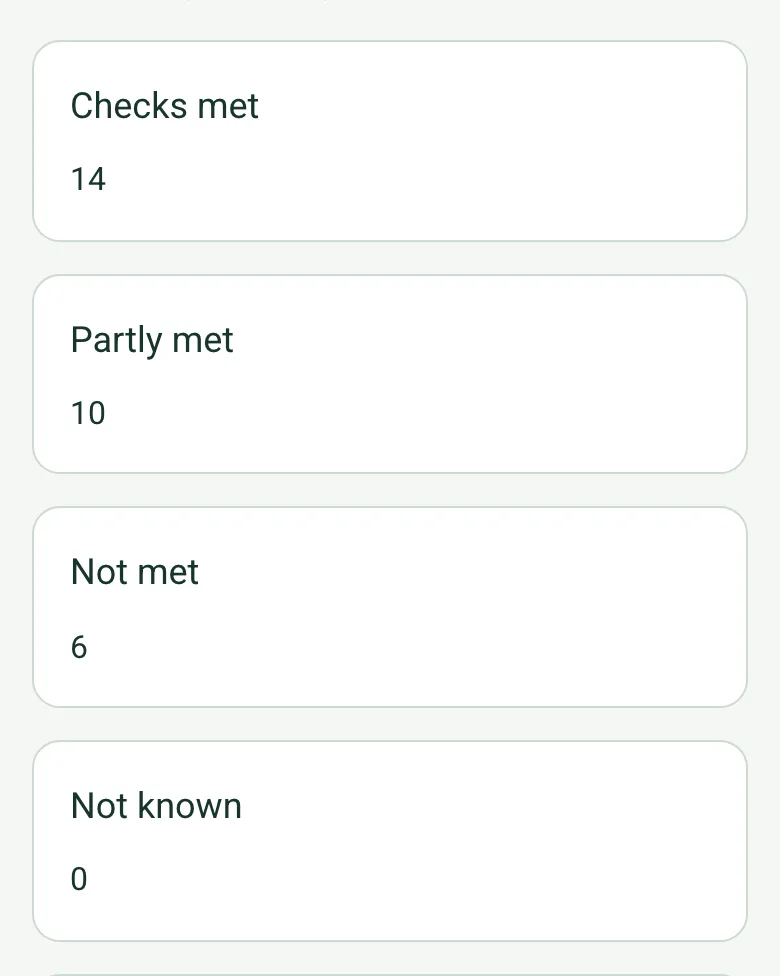
The summary adds every section up: checks met, partly met, not met and not known, the share fully met, and how many of the five Cyber Essentials sections have every check met. It helps you pick the overall result; it is not a Cyber Essentials assessment.
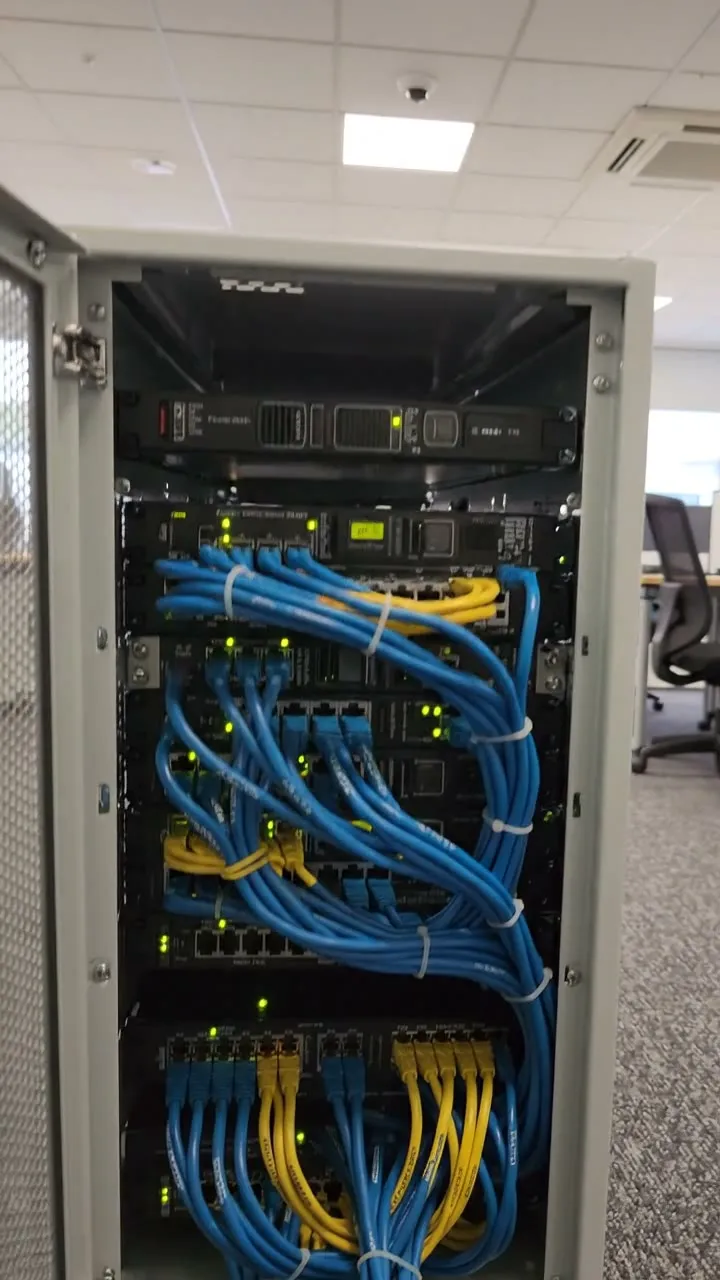
How calculated fields work →Walk Cam records the cabinet and the room with your spoken note typed in: whether it locks, the free space, power and cooling.
How Walk Cam works →A fictional 14-person design studio: 14 checks met, 10 partly met and 6 not met, no Cyber Essentials section fully clear yet, seven findings (one high risk: a leaver's account still enabled) and the three things to do first.
Answer a few questions and watch it adapt. Your answers are not saved, and any photos you add are deleted within the hour.
This is the real form as your team would use it: questions appear as you answer, scores work themselves out and you can add photos and signatures. No sign-up needed. Or open a completed example to see every answer, photo and score filled in.
Want to see one filled in? See a completed IT security audit report (PDF), made by SiteSurvey from a fictional site visit.
For teams
Paper or a spreadsheet works for the odd job. When your team does this every week, SiteSurvey keeps every visit in one place and turns each one into a report you can send.
Your team completes the it security audit checklist on site in the SiteSurvey app on iPhone, iPad and Android phones and tablets. The project name and address fill in for them, it works without signal, and it syncs when the device is back online with photos kept against the question they answer.
Customers and subcontractors do not need the app: send them a link and they can fill it in from any browser.
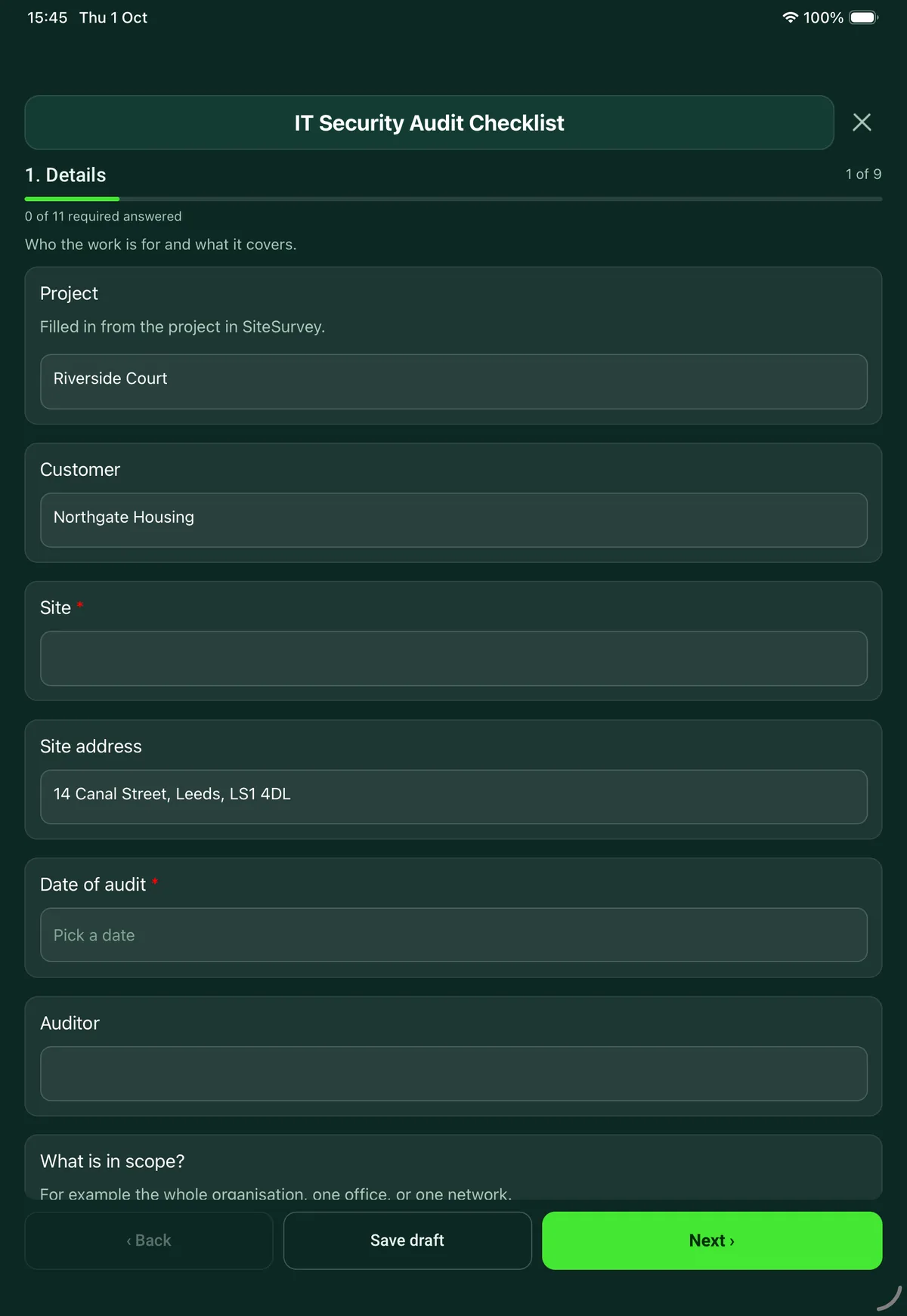
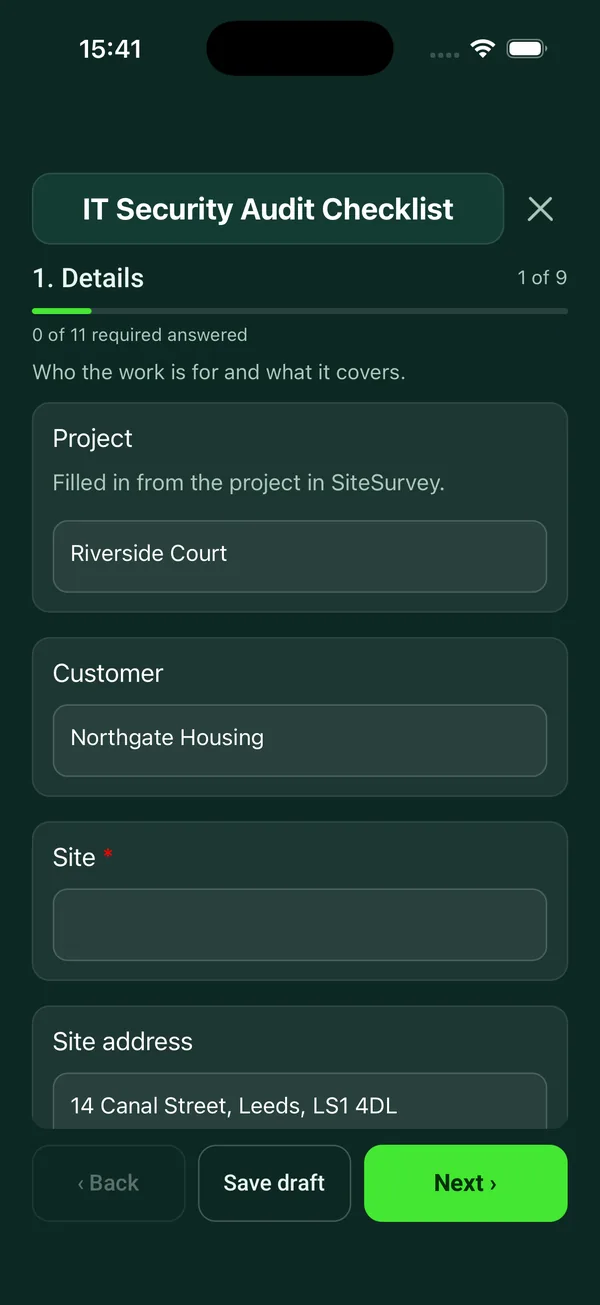
Security audit built around the five Cyber Essentials controls, plus backups, physical security and incident readiness, with rated findings. 9 sections and 105 questions. Follow-up questions and guidance appear only when an answer calls for them, so the person on site never sees the ones that do not apply.
This is a starting point, not a fixed form. Once it is in your SiteSurvey account you can reword any question, add or remove questions, sections and answer options, and add your own logo, so it fits the way your team works and the jobs you do.
Add this form to a project in SiteSurvey and it fills in what the project already knows, so nobody on site retypes it and every form on the job uses the same names. Anything filled in can still be changed.
Who the work is for and what it covers.
Filled in from the project in SiteSurvey.
For example the whole organisation, one office, or one network.
Every device in scope should sit behind a firewall.
Devices and software set up to give attackers less to work with.
Supported software, updated quickly.
For example the update report from the management tool.
Accounts for the right people, with no more access than they need.
Stopping malicious software from running.
Outside the five controls, but part of any security audit.
One entry for each thing the customer should act on.
The overall picture, in plain words for the customer.
Cyber Essentials certification is renewed every 12 months. Set the date to suit the renewal or your own review cycle.
A completed IT security audit report, made by SiteSurvey from a fictional site visit: every answer, the photos, the guidance that applied and the sign-off, ready to send as a PDF.
It follows the five Cyber Essentials controls and quotes requirements from the NCSC's Requirements for IT Infrastructure v3.3, published in April 2026. It is a readiness check for your own use or for a customer, not a Cyber Essentials assessment or certificate.
Cyber Essentials requires updates that fix critical or high risk vulnerabilities, meaning a CVSS v3 base score of 7 or above, to be installed within 14 days of release. Software must also be licensed and supported, and removed from devices when it becomes unsupported. The form asks for both and for the evidence seen.
Cyber Essentials says sign-in to cloud services must always use multi-factor authentication, and that it should always be used for administrative accounts and accounts that can be reached from the internet. Where a password is used, one of three protections is needed: multi-factor authentication, a minimum length of at least 12 characters, or at least 8 characters with a deny list that blocks common passwords. The form records which is in place.
That every device is behind a firewall, default administrator passwords have been changed, inbound rules are approved and documented, and laptops used on other networks have a software firewall switched on. If the firewall admin page can be reached from the internet with only a password, the form flags it: Cyber Essentials only allows that access with a documented business need and multi-factor authentication or an IP allow list.
It asks whether staff know how to report a security incident and to whom. The ICO says a notifiable personal data breach must be reported to it without undue delay, and not later than 72 hours after becoming aware of it, so staff need to know who to tell straight away.
Each check is answered Yes, Partly, No or Not known, with notes for each control. Gaps go on the findings page with a High, Medium or Low risk, a recommendation, an owner and a date. The auditor and the customer sign on the device, and the report goes out as a PDF or a share link.
Related templates
On-site IT audit for a small or mid-sized organisation: network and speeds against the contract, servers, devices, backup, accounts and security, a key controls score and rated findings.
Walk round audit of IT equipment by room: tag, make, model, serial, user, condition and support status for every device, checked against the register, with counts of what is missing, unsupported or due for replacement.
Internal audit of a quality, health and safety or environmental management system, a 5S area or a procedure, with findings, corrective actions and sign-off.
Record of IT equipment leaving service: each item and serial number, how its data was erased or destroyed, verification, waste transfer and signed certificate.
Add it from the form library in one click, change any question, and every completed form becomes a branded PDF report.
Start your trial →