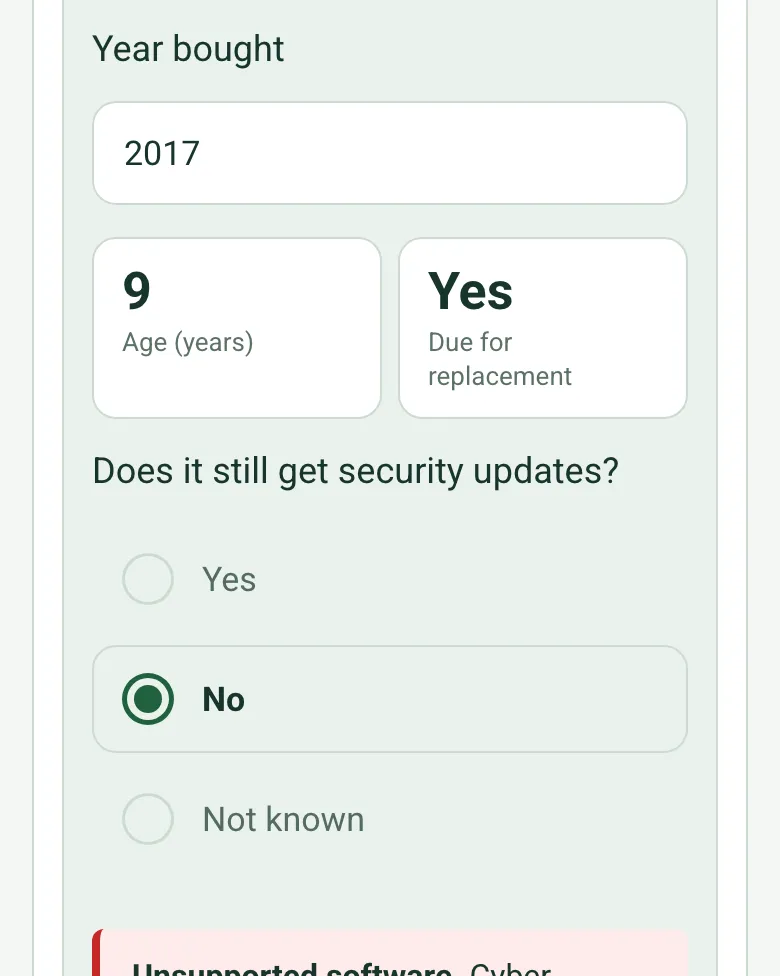
Age and replacement, per device
Enter the year bought and the form shows the age, and whether the device is due for replacement under your refresh policy, such as 5 years.
How calculated fields work →Form library · AV and IT
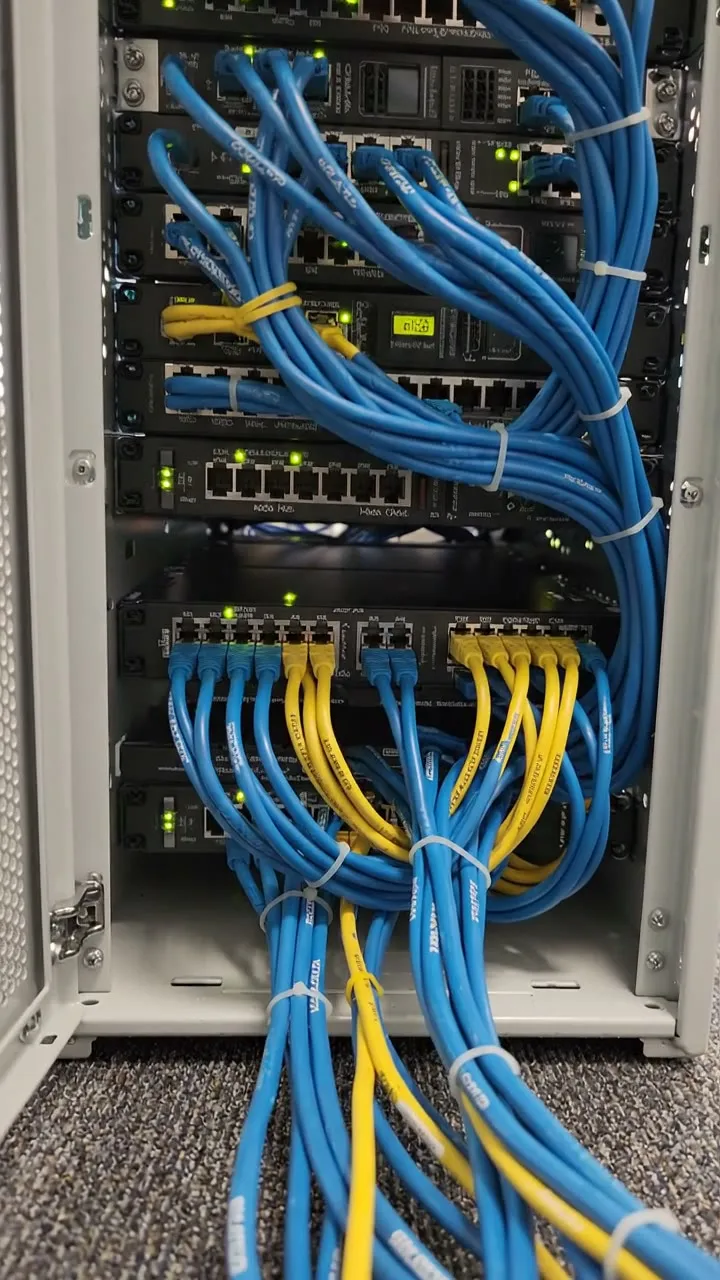
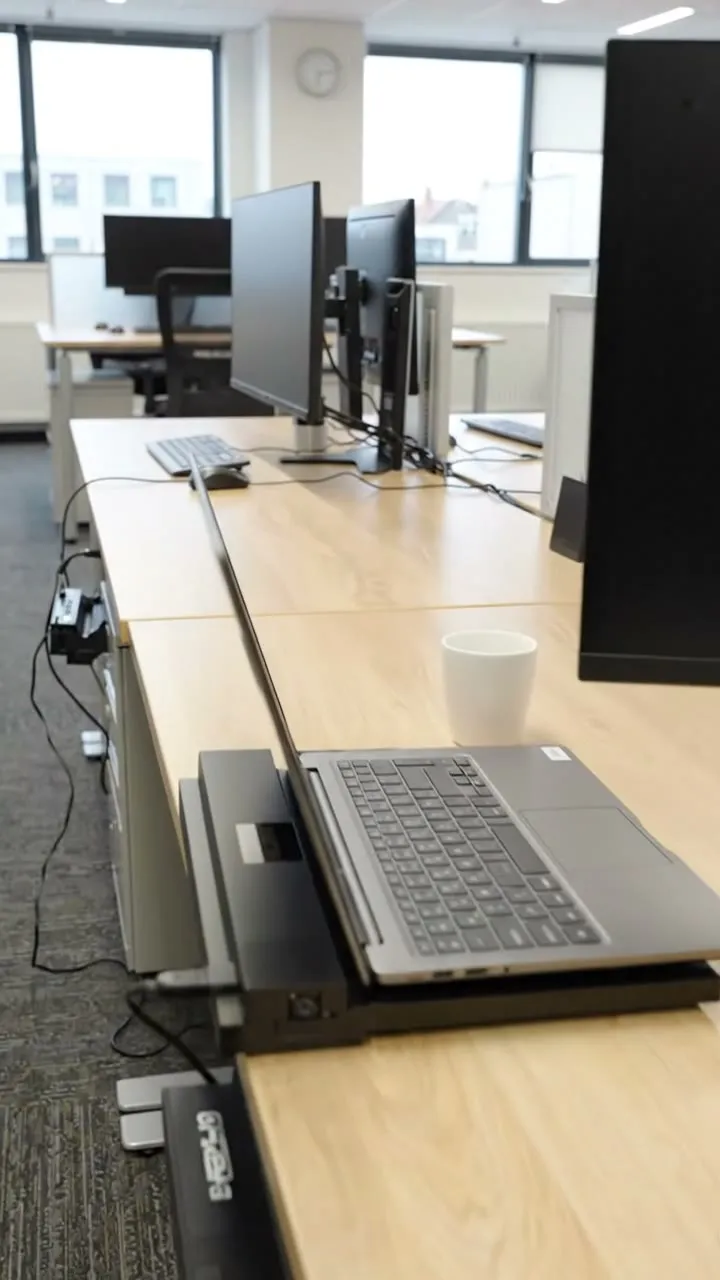
A walk round audit form for IT equipment, room by room. Record every laptop, desktop, monitor, switch and access point with its tag, serial number, user, year bought and condition, check it against the existing register, and list anything that cannot be found. Enter the register count and your refresh policy, and the form works out the share of the register found and counts devices that are unsupported, not on the register or due for replacement. Try the form below, see every question or open a completed example.
Ready to use from the form library, and every question is yours to edit. Try it for a small trial fee, cancel any time.
Try it on your phone
Try it on this phone
Fill in the IT asset inventory on your phone now
See how the IT asset inventory looks on your phone
Scan the code with your phone camera. It opens the real form, no sign-up needed.
Open the live example and fill it in, just as your team would on site. No sign-up needed.
See it on this phoneEvery question is editable. Add this form to your account, then change the wording, add or remove questions and options, and make it fit your own jobs.
An IT asset inventory should record, for each device, its type, asset tag, make and model, serial number, location, the person it is assigned to, the year it was bought and its condition. For computers, phones and network equipment it should also record whether the device still gets security updates. An audit should list items on the register that could not be found.
Last updated . Facts checked by the SiteSurvey team on 5 October 2026 against NCSC Cyber Essentials: Requirements for IT Infrastructure v3.3 and ICO guide to personal data breaches.
Worked example · IT equipment inventory
Use Label Capture for product identifiers and the inventory template for the wider hardware audit. This illustrative example uses fictional asset details. Scanning happens in the mobile app; the web form preview does not scan labels or automatically copy product data into audit answers.
Step 1
Open the switch product in First floor / Comms room. Scan its manufacturer label, using a still photo and OCR if the printed serial is difficult to capture live.
Example label: S/N DEMO-SW-0042 · MAC 02:00:00:00:00:42
Step 2
Confirm DEMO-SW-0042 into the serial-number data point. The MAC address saves automatically. Compare both values with the printed label before using them.
Serial number ≠ part number. Check the label’s field names.
Step 3
In the IT asset inventory form, record asset tag IT-0042, the serial, room, make and model, condition and register status. Add a label photo so someone can check the evidence later.
Example audit entry: Switch · IT-0042 · Comms room · Good
Step 4
Review the product identifiers and the completed inventory audit before sharing the report. Record any missing equipment or register corrections for follow-up.
A labelled product, a located asset and an auditable inventory entry.
Go room by room and add each device with its tag, serial, user, year bought and condition, against the existing register. Enter how many items the register lists and your refresh policy, and the form counts what was found, what is missing, what no longer gets security updates and what is due for replacement.
Enter the year bought and the form shows the age, and whether the device is due for replacement under your refresh policy, such as 5 years.
How calculated fields work →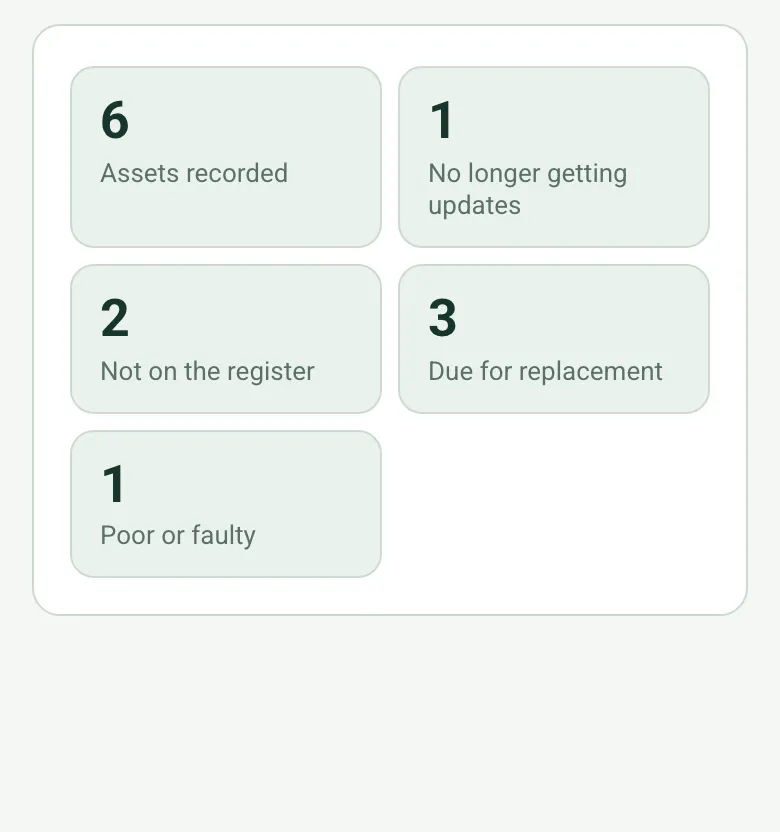
Each room counts its own devices and the totals add them up: assets recorded, unsupported, not on the register, due for replacement and poor or faulty.
How calculated fields work →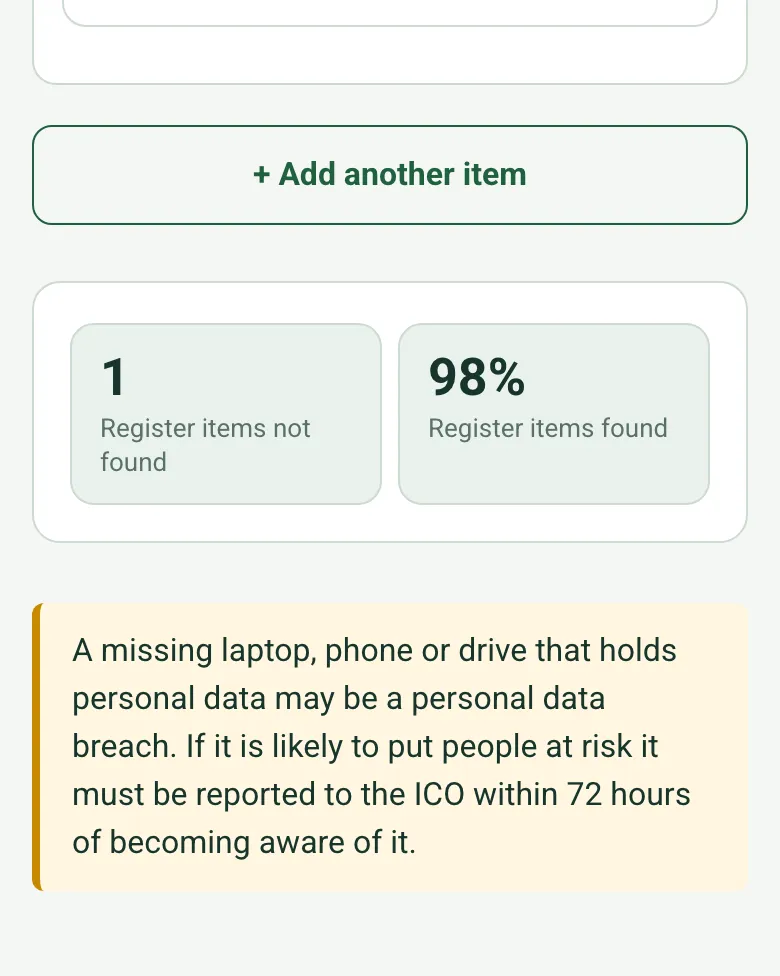
List anything on the register you could not find. The form works out the share of the register found, and a missing device that could hold personal data brings up a note about reporting it.
How calculated fields work →Film each floor with a spoken note in the SiteSurvey app, as a record of what was where on the day.
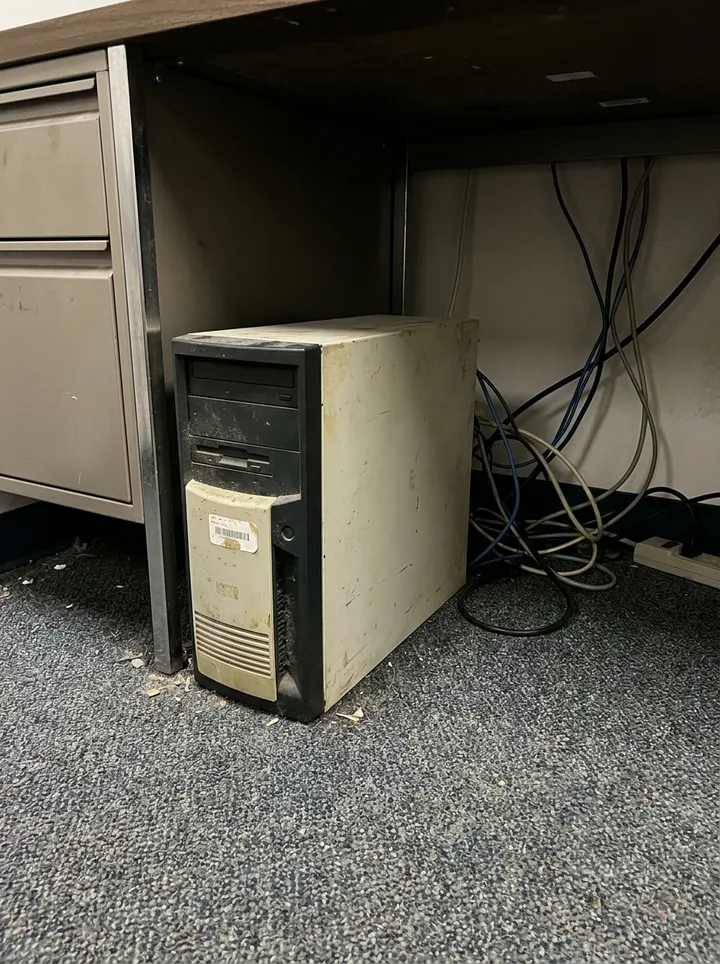
A fictional lettings office: 41 of the 42 items on the register found, two network items added and tagged, three devices due for replacement on a five year policy, and a leaver's laptop missing. Open it as a filled-in form, or switch to a blank copy and try it yourself.
Answer a few questions and watch it adapt. Your answers are not saved, and any photos you add are deleted within the hour.
This is the real form as your team would use it: questions appear as you answer, scores work themselves out and you can add photos and signatures. No sign-up needed. Or open a completed example to see every answer, photo and score filled in.
Want to see one filled in? See a completed IT asset inventory report (PDF), made by SiteSurvey from a fictional site visit.
Your team completes the it asset inventory audit on site in the SiteSurvey app on iPhone, iPad and Android phones and tablets. The project name and address fill in for them, it works without signal, and it syncs when the device is back online with photos kept against the question they answer.
Customers and subcontractors do not need the app: send them a link and they can fill it in from any browser.
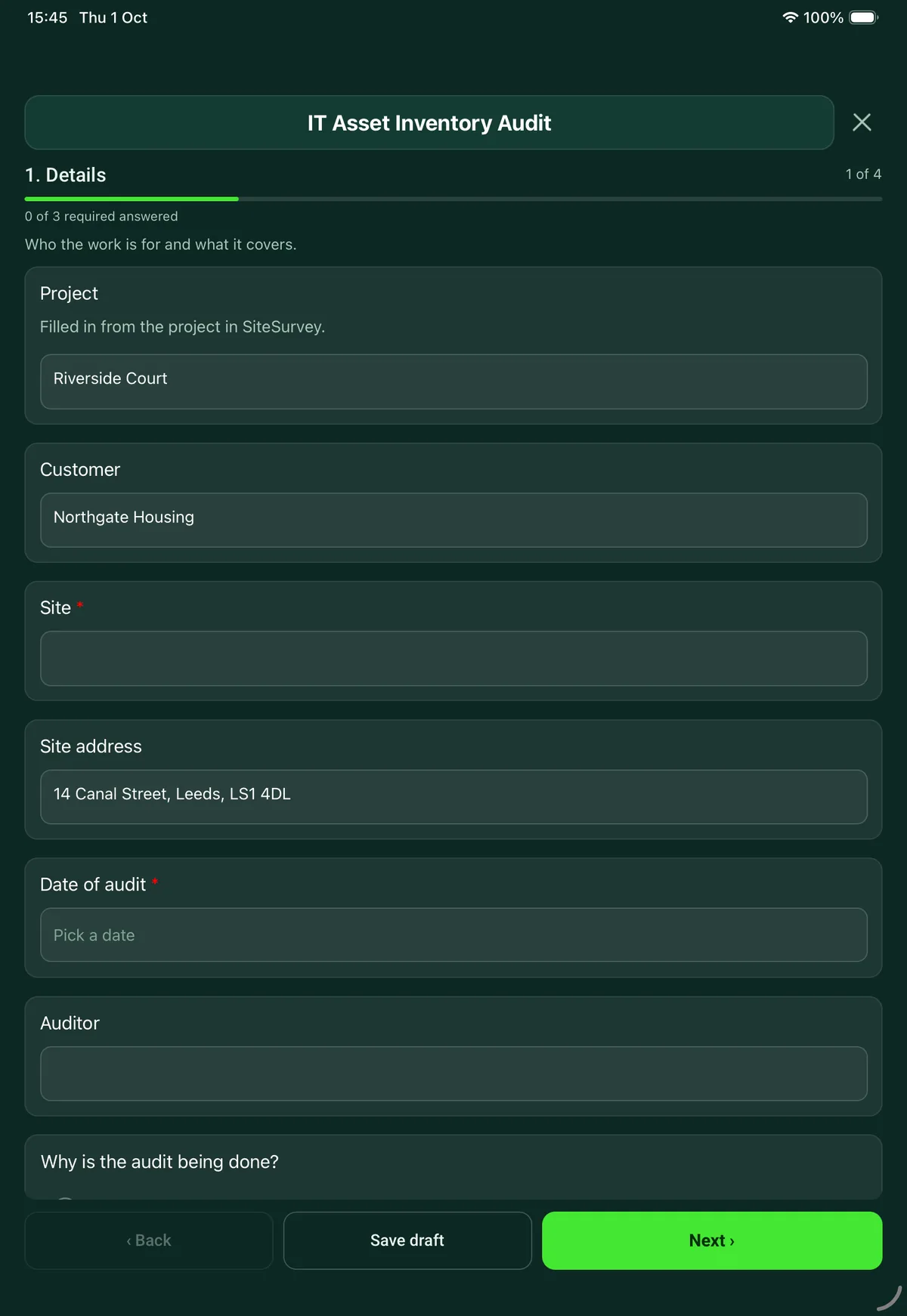
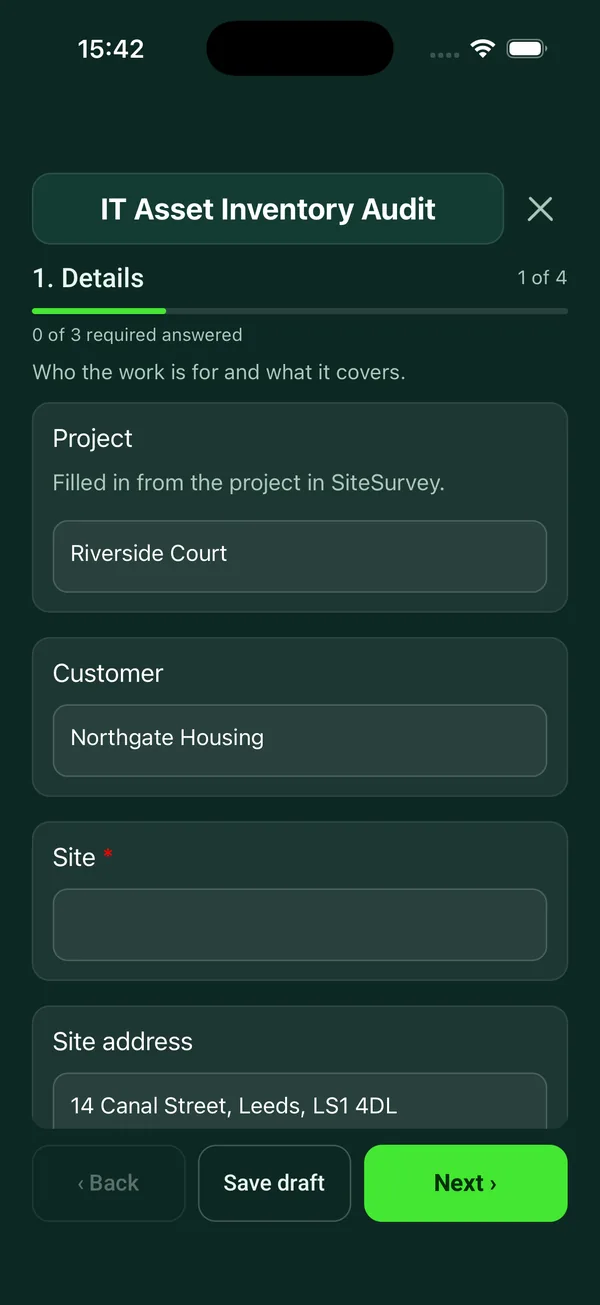
Walk round audit of IT equipment by room: tag, make, model, serial, user, condition and support status for every device, checked against the register, with counts of what is missing, unsupported or due for replacement. 4 sections and 51 questions. Follow-up questions and guidance appear only when an answer calls for them, so the person on site never sees the ones that do not apply.
This is a starting point, not a fixed form. Once it is in your SiteSurvey account you can reword any question, add or remove questions, sections and answer options, and add your own logo, so it fits the way your team works and the jobs you do.
Add this form to a project in SiteSurvey and it fills in what the project already knows, so nobody on site retypes it and every form on the job uses the same names. Anything filled in can still be changed.
Who the work is for and what it covers.
Filled in from the project in SiteSurvey.
The number of items the register lists for the areas covered.
Rooms, floors or departments. Note any you could not get into.
Your refresh policy, for example 5 years for laptops and desktops. Leave blank to skip the replacement count.
One entry for each device. Photograph the label so serial numbers can be checked later.
Items on the register that you could not find.
What changed and what the customer should do.
For example replace unsupported devices, trace missing items, update the register.
A completed IT asset inventory report, made by SiteSurvey from a fictional site visit: every answer, the photos, the guidance that applied and the sign-off, ready to send as a PDF.
Yes. In the mobile app, Label Capture records identifiers against a product in its site and space. Confirm serial numbers into the chosen product data point, then use this audit form to record the asset tag, serial, location, condition and register checks. The worked example explains both steps; the web form preview is not a label scanner.
Yes. Choose building a register for the first time and add an entry for each device as you walk round, from laptops and monitors to docking stations, switches, printers, UPS units and AV equipment, with a photo of the label so serial numbers can be checked later. You can fit asset tags on the same visit and record each tag number. Up to 250 assets fit on one form.
Each asset is marked as on the register with correct details, on the register with wrong details, or not on the register, and you note what needs correcting. A separate page lists items on the register that could not be found, with the last known user or location. Enter how many items the register lists and the form counts the assets recorded, those not on the register, those not found, and the share of the register found.
Cyber Essentials requires software to be licensed and supported, and removed from devices when it becomes unsupported. The form asks the question for laptops, desktops, servers, phones, tablets and routers or firewalls, flags a No, and counts how many devices no longer get updates so they can be planned for replacement.
Record it on the not found page and say whether it could hold personal or confidential data. If it could, the form asks whether it was encrypted and who was told, and notes that it may be a personal data breach. The ICO says a breach likely to put people at risk must be reported to it within 72 hours of becoming aware of it.
Yes. Enter the year an item was bought and the form shows its age in years. Add your refresh policy, such as 5 years, and it marks each device due for replacement or not and counts them, with poor or faulty devices counted too.
Yes. In the SiteSurvey app the audit works without signal, which helps in comms rooms and basements, and syncs when the device is back online. Photos stay with the asset they belong to, and the report goes out as a PDF or a share link.
Related templates
Signed record of IT equipment issued to or returned by a member of staff: each item, serial number, condition, setup or leaver checks and both signatures.
Record of IT equipment leaving service: each item and serial number, how its data was erased or destroyed, verification, waste transfer and signed certificate.
Build or update an asset register: each asset with its tag, make, model, serial, position (GPS outside), condition, life and photos, totals by condition and life, and changes to the register.
On-site IT audit for a small or mid-sized organisation: network and speeds against the contract, servers, devices, backup, accounts and security, a key controls score and rated findings.
Add it from the form library in one click, change any question, and every completed form becomes a branded PDF report.
Start your trial →