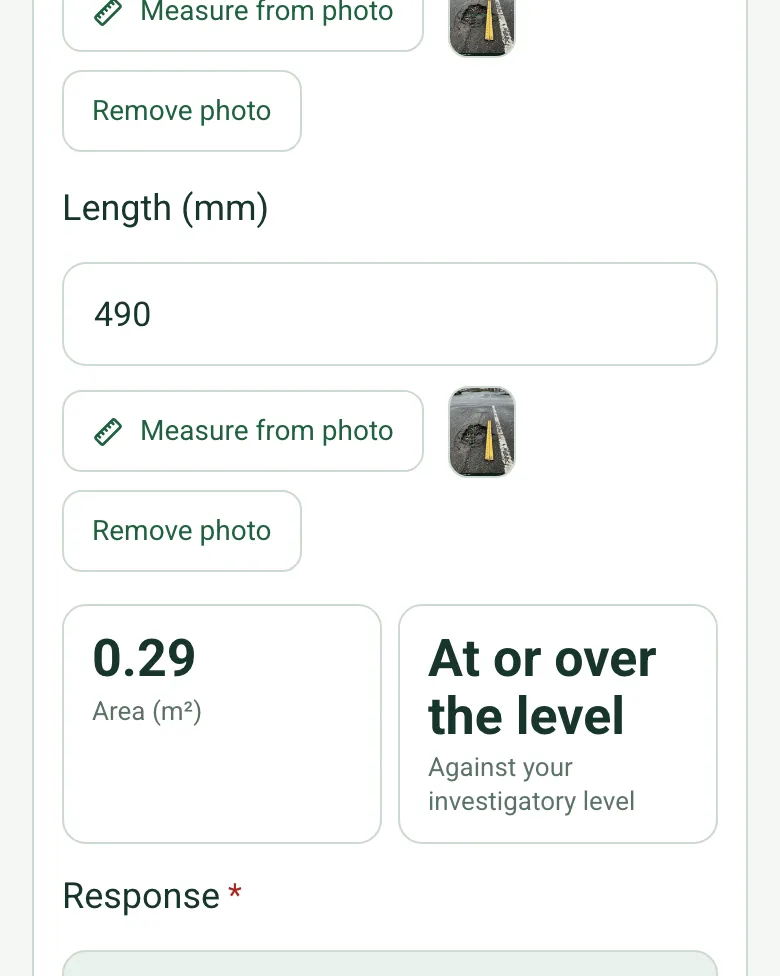
Each defect against your level
The depth by rule or gauge is compared with the investigatory level from your own inspection policy, and the width and length give the area for the patching order.
How calculated fields work →Form library · Facilities and maintenance
A safety inspection of roads, footways and car parks. Record the route or car park, its hierarchy category, the inspection type and your own investigatory levels. Add each defect (potholes, trip hazards, kerbs, ironwork, signs, markings, lighting, drainage, vegetation and barriers) with its position by GPS, depth by rule or gauge, width and length by tape or measured from a photo, the response category, whether it was made safe and photos. The form shows each pothole or footway trip against your investigatory level, works out the area to repair, counts the defects by response and flags any 24-hour defect not made safe. Try the form below, see every question or open a completed example.
Ready to use from the form library, and every question is yours to edit. Try it for a small trial fee, cancel any time.
Try it on your phone
Try it on this phone
Fill in the highway inspection on your phone now
See how the highway inspection looks on your phone
Scan the code with your phone camera. It opens the real form, no sign-up needed.
Open the live example and fill it in, just as your team would on site. No sign-up needed.
See it on this phoneEvery question is editable. Add this form to your account, then change the wording, add or remove questions and options, and make it fit your own jobs.
A highway safety inspection records the route inspected, the date, the inspector and the method, then each defect found with its location, type and size, the response category (for example make safe within 24 hours or repair within 28 days), whether it was made safe on site, and photos. The UK Roads Liaison Group code of practice, Well-managed Highway Infrastructure, promotes a risk-based approach in which each authority sets its own levels of service. Its 2016 edition says records should be kept of all inspections, including the time and nature of any response.
Last updated . Facts checked by the SiteSurvey team on 17 October 2026 against section 58 of the Highways Act 1980, UK Roads Liaison Group: Well-managed Highway Infrastructure code of practice and Well-managed Highway Infrastructure, 2016 edition, sections A.5.6 to A.5.8 (inspections, records and defects).
Enter your own investigatory levels once, then pin each defect with GPS and record its depth by rule and its size by tape or from a photo. The form shows each pothole or footway trip against your level, works out the area to repair, counts the defects by response and flags any 24-hour defect not made safe.
The depth by rule or gauge is compared with the investigatory level from your own inspection policy, and the width and length give the area for the patching order.
How calculated fields work →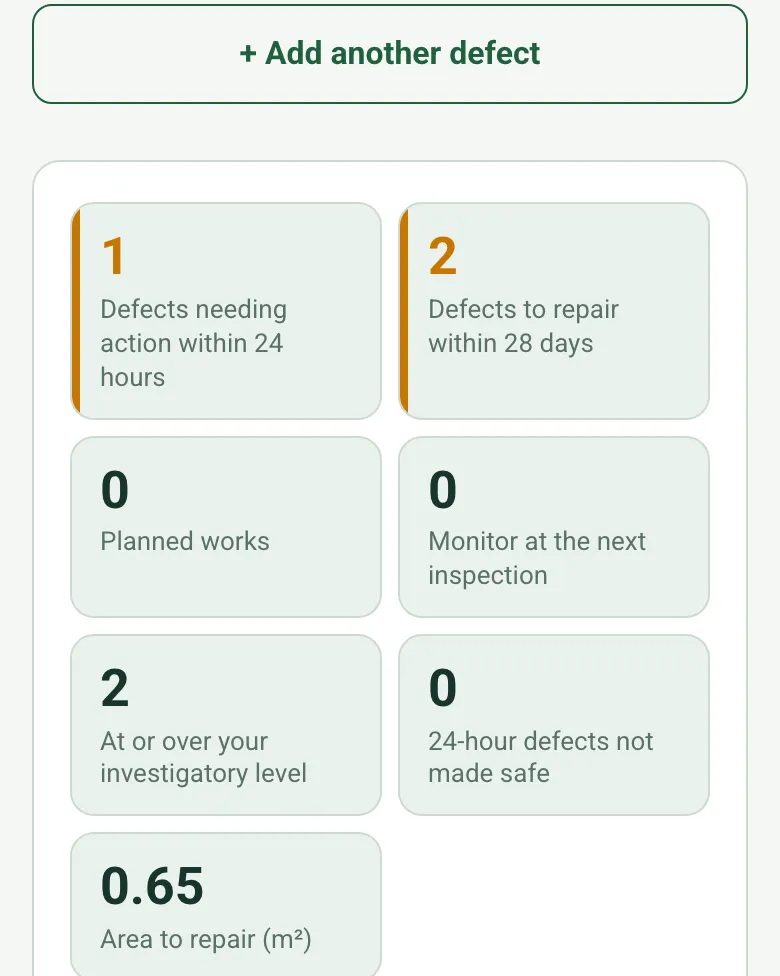
The form counts the defects by response category and those at or over your level, totals the area to repair and flags a 24-hour defect that was not made safe on site.
How calculated fields work →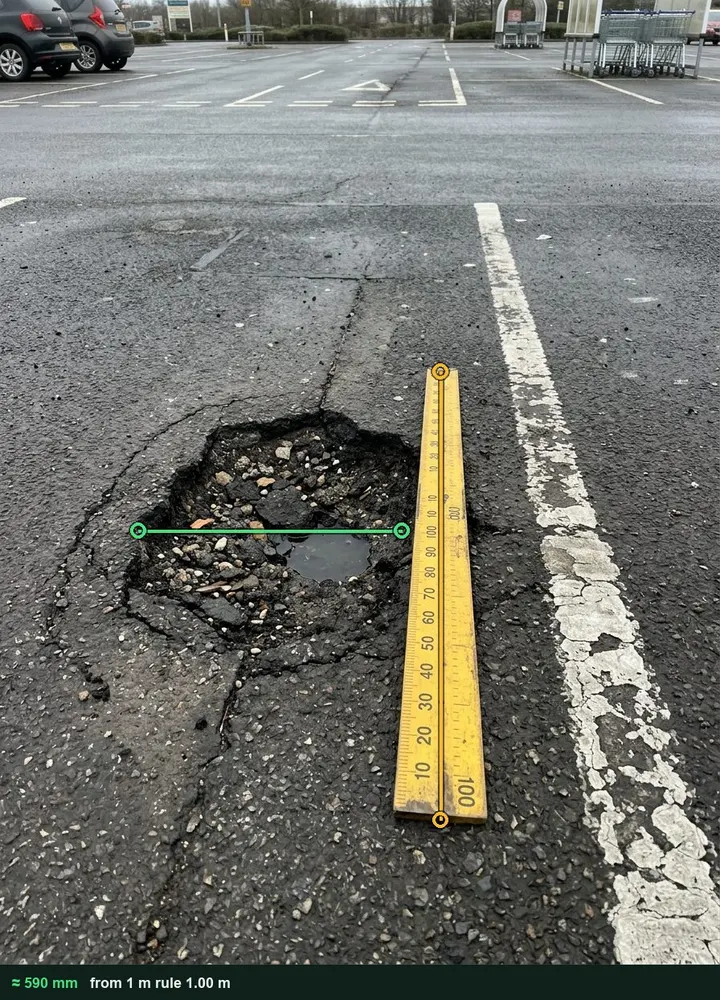
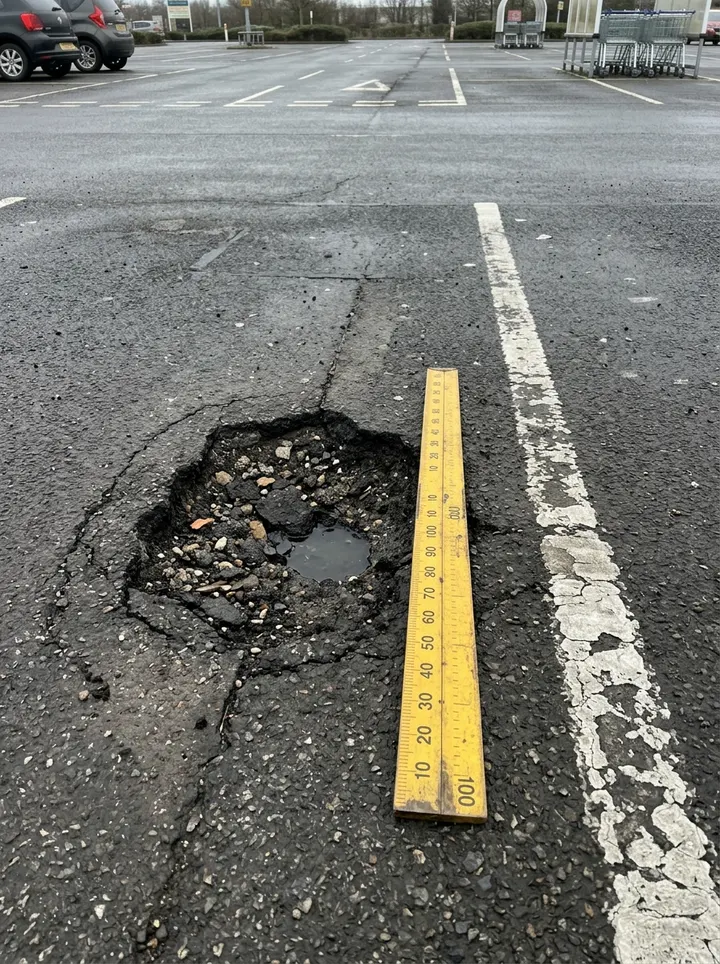
Lay a rule beside the defect and take the photo looking down. Depth still needs a rule or gauge in the deepest point. It works on web forms in any phone browser today, and the app version is on its way.
How measuring from a photo works →Add a short clip or photos with a scale to each defect, as evidence of what was found and how it was made safe.
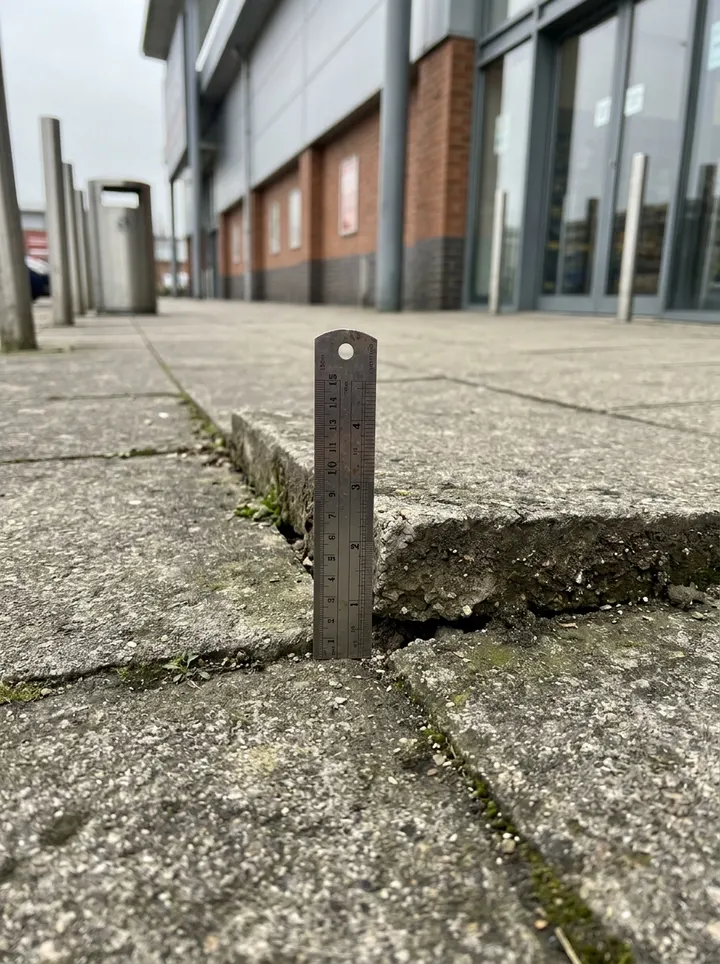
A fictional retail park in Darlington with investigatory levels of 40 mm in the car park and 20 mm on footways (the site's own policy): a 55 mm pothole in aisle C, about 590 by 490 mm from a photo against a 1 m rule, coned on the day; a 25 mm slab trip outside unit 4; and a lamp out on column 12.
Answer a few questions and watch it adapt. Your answers are not saved, and any photos you add are deleted within the hour.
This is the real form as your team would use it: questions appear as you answer, scores work themselves out and you can add photos and signatures. No sign-up needed. Or open a completed example to see every answer, photo and score filled in.
Want to see one filled in? See a completed highway inspection report (PDF), made by SiteSurvey from a fictional site visit.
A highway, footway and car park safety inspection: route, hierarchy and inspection type, each defect with its type, size, response category and photos, made safe, and actions. 3 sections and 49 questions. Follow-up questions and guidance appear only when an answer calls for them, so the person on site never sees the ones that do not apply.
This is a starting point, not a fixed form. Once it is in your SiteSurvey account you can reword any question, add or remove questions, sections and answer options, and add your own logo, so it fits the way your team works and the jobs you do.
Add this form to a project in SiteSurvey and it fills in what the project already knows, so nobody on site retypes it and every form on the job uses the same names. Anything filled in can still be changed.
Optional. From your own inspection policy. The code of practice leaves these levels to each authority or owner.
Optional. From your own inspection policy.
Optional. Mark the defect so the repair gang finds it.
By a ruler or gauge at the deepest point or the highest edge.
Use a tape, or measure from a photo looking straight down, with a rule or a known bay line in the same plane.
Optional. Film a guided walk-through on the SiteSurvey app; each clip keeps its spoken note.
Set by the inspection frequency the authority or owner has set for this hierarchy category.
A completed highway inspection report, made by SiteSurvey from a fictional site visit: every answer, the photos, the guidance that applied and the sign-off, ready to send as a PDF.
Section 58 of the Highways Act 1980 gives a highway authority a defence to a claim if it took the care reasonably required, and the court considers whether it knew, or could reasonably have known, of the danger. The code of practice says records are crucial to the defence of claims, including nil returns.
There is no fixed national frequency. The 2016 edition of the code says each authority should set inspection frequencies through a risk-based approach, taking account of the network hierarchy. Record the hierarchy category and inspection type on each inspection.
No. The form's categories are examples. The code says the response to each defect should be based on risk, so use the response times in your own inspection policy.
No. The UK Roads Liaison Group says the code is not statutory and adopting it is a matter for each highway authority. An updated edition was published in October 2026.
Yes, if you enter them. Add your own carriageway depth and footway trip height from your inspection policy, and each pothole or footway trip shows whether it is at or over the level, with a count. Each defect also gets a GPS point, photos with a scale, and a width and length for the area to repair.
Highway inspectors, councils, highway maintenance contractors, and car park and estate managers on retail parks, hospitals and business parks.
Related templates
Planned maintenance visit: records seen, asset by asset tasks, water temperatures, work done and next visit.
Build or update an asset register: each asset with its tag, make, model, serial, position (GPS outside), condition, life and photos, totals by condition and life, and changes to the register.
Inspection round for plant: asset condition, refrigerant and leak checks, pressure vessels, next due dates.
Job sheet for a reactive or planned job: safety before starting, work done, parts used, tests, outcome and customer sign-off.
Add it from the form library in one click, change any question, and every completed form becomes a branded PDF report.
Start your trial →