Form library · Facilities and maintenance

Fuel tank inspection checklist

For people recording visible fuel-tank and containment conditions. Record tank and regime, visible checks and containment and response. Try the form below, see every question or open a completed example.

Ready to use from the form library, and every question is yours to edit. Try it for a small trial fee, cancel any time.

Try it on your phone

Try it on this phone

Fill in the fuel tank visual inspection on your phone now

See how the fuel tank visual inspection looks on your phone

Scan the code with your phone camera. It opens the real form, no sign-up needed.

Open the live example and fill it in, just as your team would on site. No sign-up needed.

See it on this phone

Every question is editable. Add this form to your account, then change the wording, add or remove questions and options, and make it fit your own jobs.

Or start your trial with this form ready →

One email, and we won't add you to a mailing list.

Are oil storage requirements the same everywhere?

GOV.UK oil-storage guidance explains requirements for business storage in England and Wales and links to other jurisdictions. Applicability depends on location, storage and use. Confirm the applicable requirements rather than assuming a single UK rule.

Last updated . Facts checked by the SiteSurvey team on 6 October 2026 against GOV.UK oil storage regulations for businesses and GOV.UK pollution prevention for businesses.

Built for checking a fuel tank on site

Pin the tank by GPS, measure the bund wall from a photo and let the form work out the bund volume as a share of the tank, with a note when it is under 110%. The five visible checks are tallied as you go.

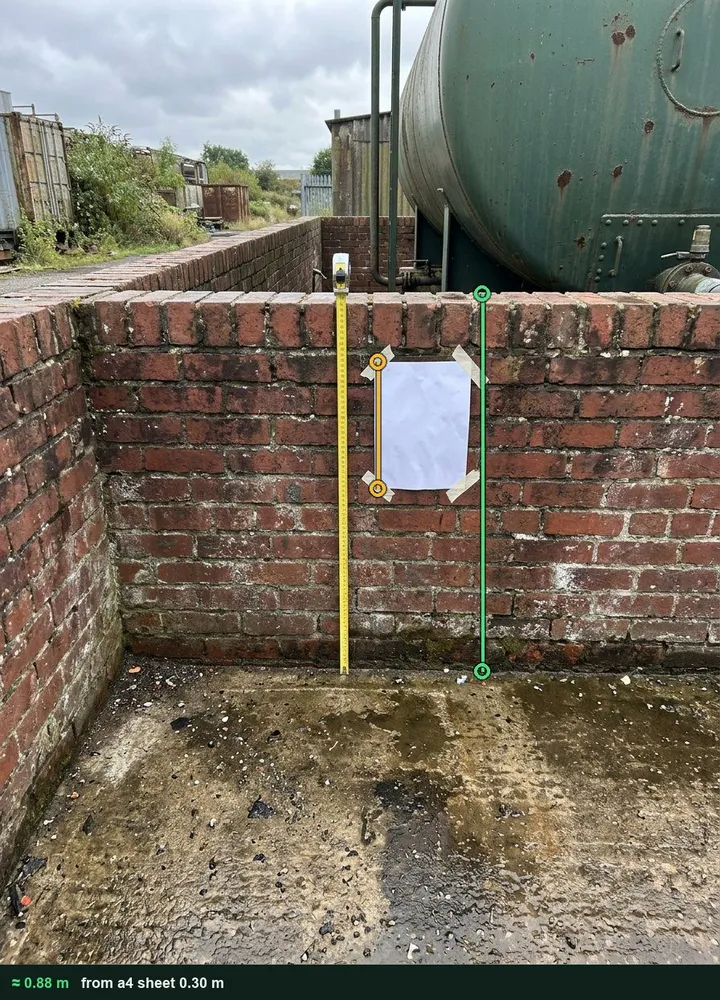
The inside of a brick bund wall marked up with an amber line on an A4 sheet and a green line from the bund floor to the top of the wall, about 0.88 m

Bund height from a photo

Tape an A4 sheet to the bund wall, photograph it square on, tap the sheet and then the wall from floor to top. The height goes into the answer with the marked-up photo. A tape is still best, so the photo is a quick estimate. It works on web forms in any phone browser today, and the app version is on its way.

How measuring from a photo works →
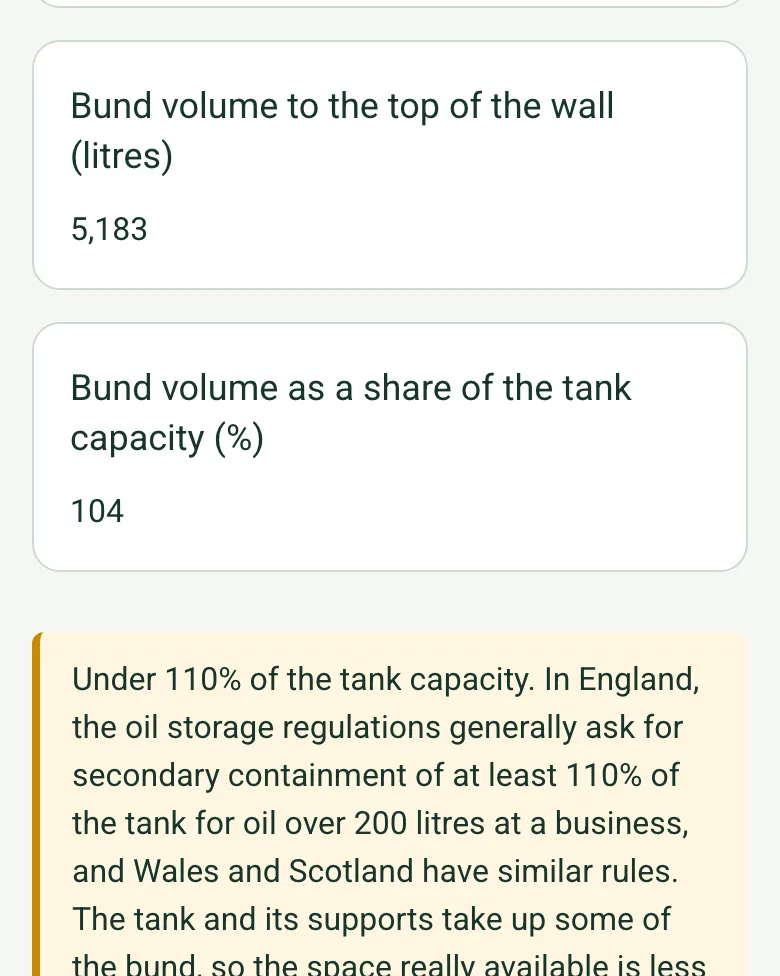
The completed fuel tank check on a phone: bund volume 5,183 litres, 104% of the tank capacity, with an amber note that it is under 110%

Bund volume against the tank

Enter the bund's length and width and the tank capacity. The form works out the volume to the top of the wall and its share of the tank, and flags anything under 110%, the figure the oil storage rules in England generally ask for.

How calculated fields work →
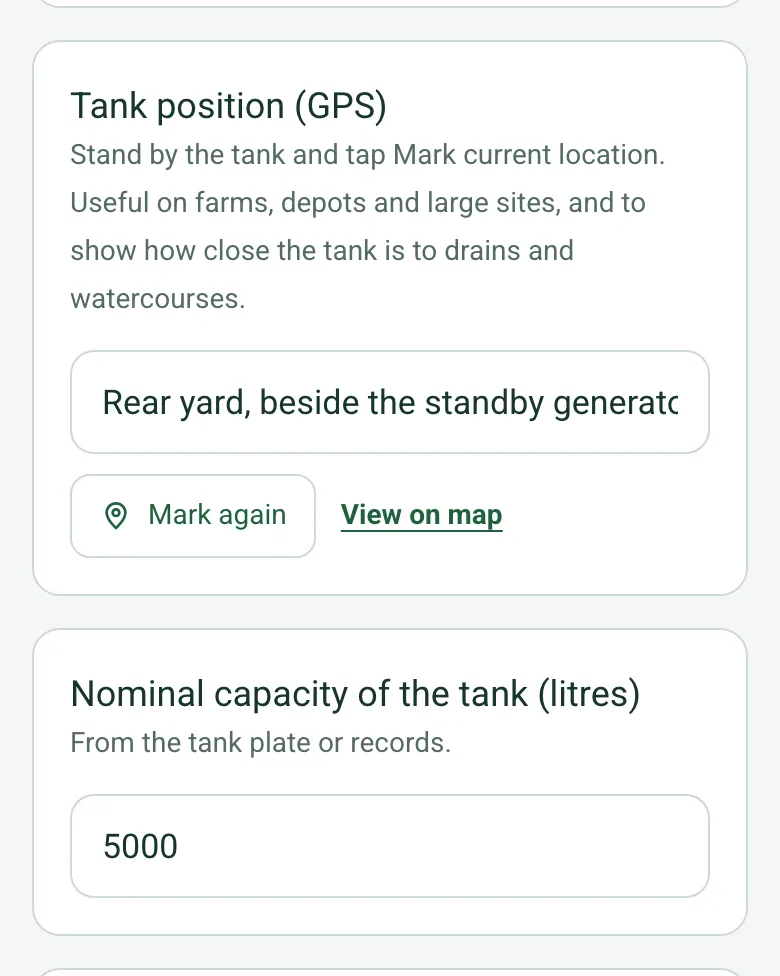
The completed fuel tank check on a phone: Tank position (GPS) filled with Rear yard, beside the standby generator and coordinates, with View on map

Pin the tank

Tap Mark current location beside the tank, so it is easy to find on a farm, a depot or a large site, and to show how close it is to drains. Mark current location works on web forms in any phone browser today, and the app version is on its way.

How GPS location works →

Film the tank and bund

Walk Cam records the tank, the bund and anything in it with your spoken note typed in as you talk.

How Walk Cam works →

A completed fuel tank inspection

A fictional cold store's 5,000 litre generator diesel tank: pinned by GPS, the bund wall measured at 0.88 m from a photo, the bund volume worked out at 104% of the tank and flagged, rainwater in the bund and a faded fill point label to put right.

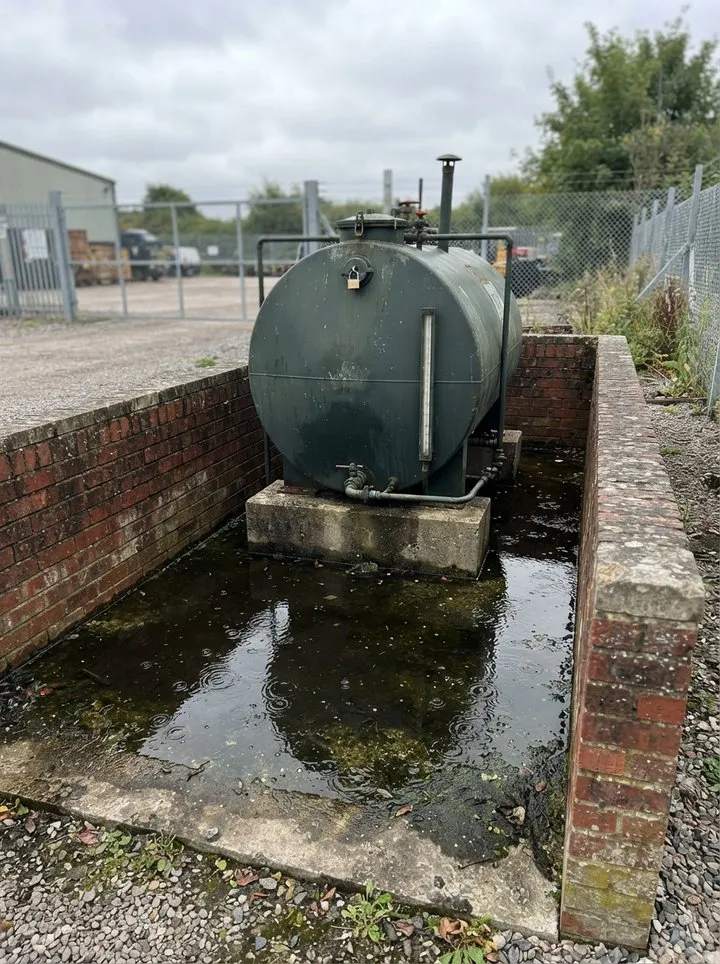
A green steel diesel tank on a plinth inside a brick bund with rainwater on the floor
FT-01 · about 40 mm of rainwater in the bund · no sheen
The bund wall with an A4 sheet and a tape, marked up to about 0.88 m
Bund wall · 0.88 m from a photo · volume 104% of the tank
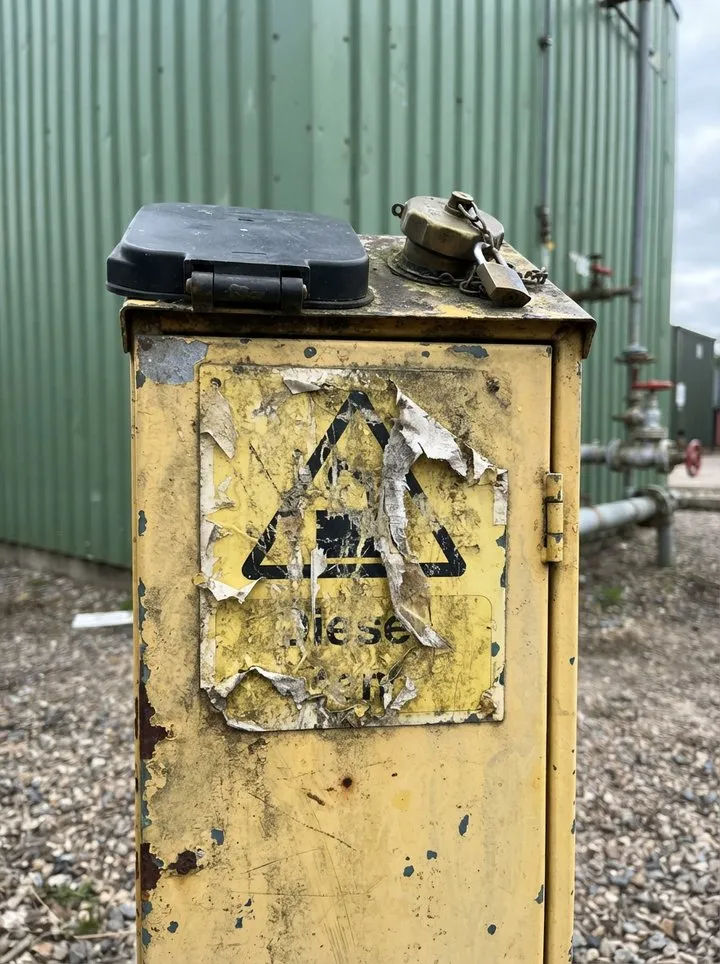
A yellow fill point cabinet with a faded, peeling diesel label
Fill point · label faded · new label booked

Try the fuel tank visual inspection form live

Answer a few questions and watch it adapt. Your answers are not saved, and any photos you add are deleted within the hour.

Live form: Fuel Tank Visual InspectionOpen full screen ↗
Fill it in right here

This is the real form as your team would use it: questions appear as you answer, scores work themselves out and you can add photos and signatures. No sign-up needed. Or open a completed example to see every answer, photo and score filled in.

Want to see one filled in? See a completed fuel tank visual inspection report (PDF), made by SiteSurvey from a fictional site visit.

For teams

Using the fuel tank visual inspection template across several sites?

Paper or a spreadsheet works for one site. When several sites or managers do the same check, SiteSurvey keeps every result in one place.

  • Each site uses the same form on a phone or tablet, with photos attached to the answer they belong to.
  • Results from every site sit together, so you can compare sites and spot the same problem coming back.
  • Each completed check becomes a branded PDF report you can share or file.

Fill it in on a phone or tablet

Your team completes the fuel tank visual inspection on site in the SiteSurvey app on iPhone, iPad and Android phones and tablets. The project name and address fill in for them, it works without signal, and it syncs when the device is back online with photos kept against the question they answer.

Customers and subcontractors do not need the app: send them a link and they can fill it in from any browser.

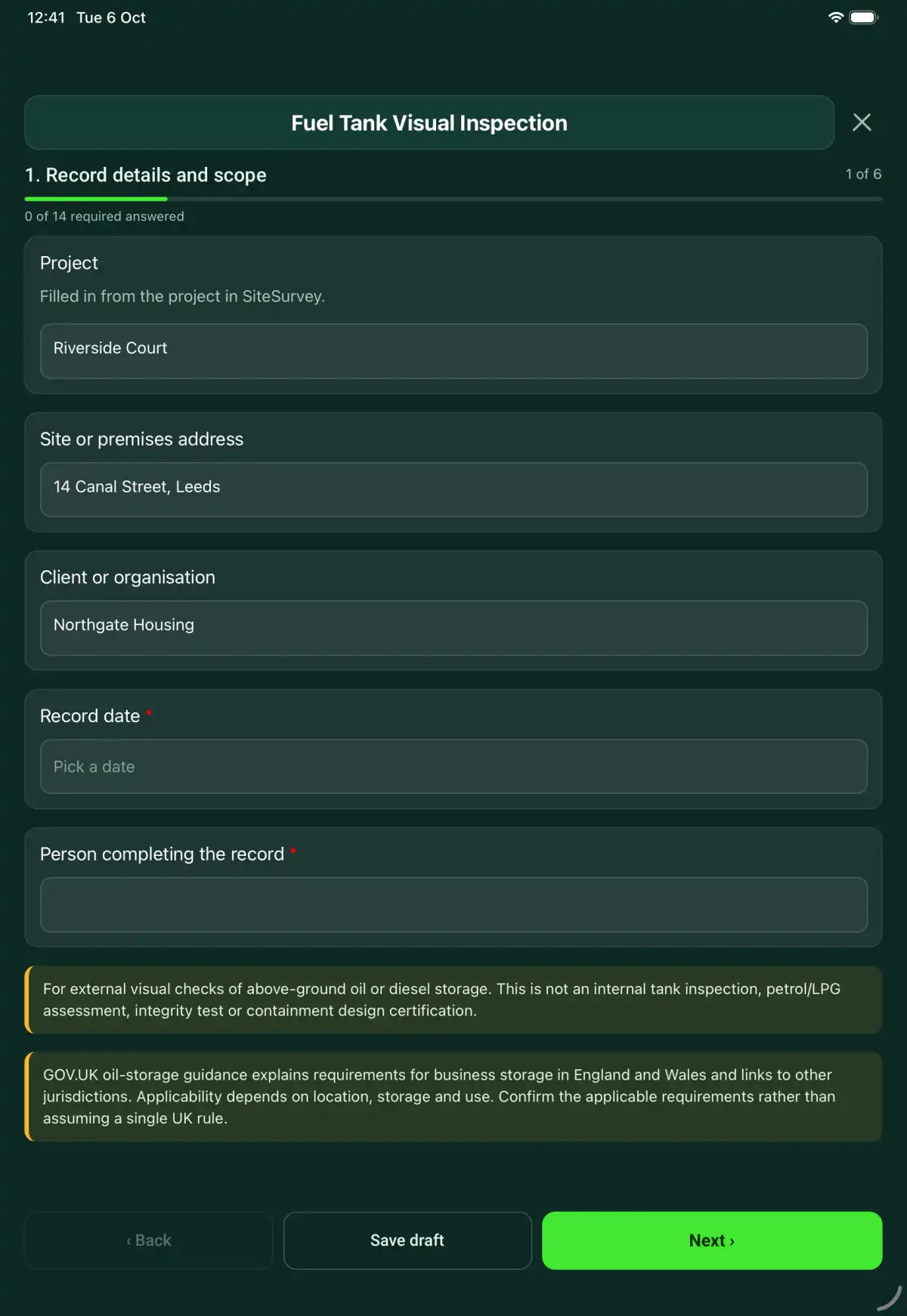
The Fuel Tank Visual Inspection form in the SiteSurvey app on a tablet
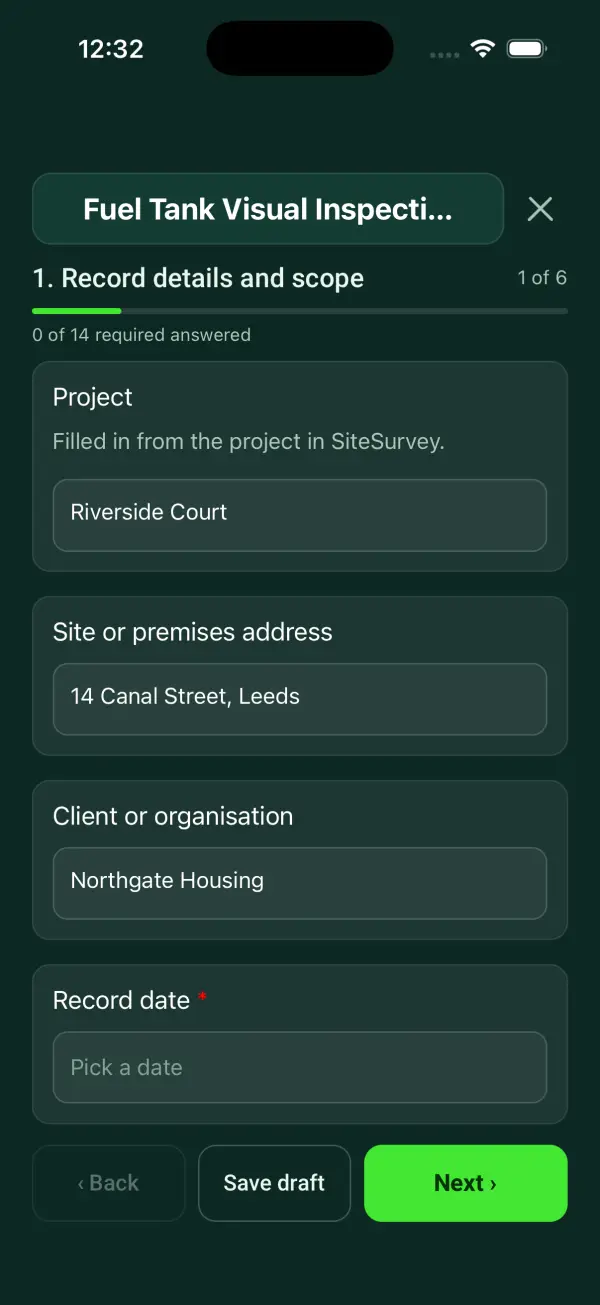
The Fuel Tank Visual Inspection form in the SiteSurvey app on a phone

Every question in the fuel tank visual inspection template

A fuel tank visual record covering tank identity, visible condition, containment, pipework, spill indicators, local requirements and defect response. 6 sections and 52 questions. Follow-up questions and guidance appear only when an answer calls for them, so the person on site never sees the ones that do not apply.

Make it your own: every question is editable

This is a starting point, not a fixed form. Once it is in your SiteSurvey account you can reword any question, add or remove questions, sections and answer options, and add your own logo, so it fits the way your team works and the jobs you do.

Details you only enter once

Add this form to a project in SiteSurvey and it fills in what the project already knows, so nobody on site retypes it and every form on the job uses the same names. Anything filled in can still be changed.

  • Project: the project name
  • Site or premises address: the site address, from the space or the project
  • Client or organisation: the project's customer

Record details and scope

  • ProjectShort answer

    Filled in from the project in SiteSurvey.

    Fills in from the project name
  • Site or premises addressShort answer
    Fills in from the site address, from the space or the project
  • Client or organisationShort answer
    Fills in from the project's customer
  • Record date*Date
  • Person completing the record*Short answer
  • Weather on siteAnswer

    Rain can fill a bund and hide staining. Note it here.

  • CheckFor external visual checks of above-ground oil or diesel storage. This is not an internal tank inspection, petrol/LPG assessment, integrity test or containment design certification.
  • CheckThe governing rules are the Control of Pollution (Oil Storage) (England) Regulations 2001, the Water Resources (Control of Pollution) (Oil Storage) (Wales) Regulations 2016 and the Water Environment (Oil Storage) (Scotland) Regulations 2006. In England they apply to oil stored in containers of more than 200 litres (201 litres and over) at businesses and other non-domestic premises, and require secondary containment (a bund or drip tray) that can hold at least 110% of the tank capacity. Applicability depends on location, storage and use. Confirm the applicable requirements rather than assuming a single UK rule.

Tank and regime

  • Tank ID, location and owner*Short answer
  • Stored product (for example heating oil or diesel)*Short answer
  • Tank position (GPS)Short answer

    Stand by the tank and tap Mark current location. Useful on farms, depots and large sites, and to show how close the tank is to drains and watercourses.

  • Nominal capacity of the tank (litres)Number

    From the tank plate or records.

  • Secondary containmentChoose one
    • Integrally bunded tank (bund built into the tank)
    • Separate bund (masonry, concrete or steel)
    • Drip tray only
    • None seen
  • Bund internal length (m)Number

    Measuring from a photo gives an estimate. Use a tape for the final figure.

    Shown when “Secondary containment” is “Separate bund (masonry, concrete or steel)”
  • Bund internal width (m)Number

    Measuring from a photo gives an estimate. Use a tape for the final figure.

    Shown when “Secondary containment” is “Separate bund (masonry, concrete or steel)”
  • Bund wall height, inside (m)Number

    A tape is best. Measure from photo gives an estimate from a photo square on to the wall, with an A4 sheet or a known object against it.

    Shown when “Secondary containment” is “Separate bund (masonry, concrete or steel)”
  • Bund volume to the top of the wall (litres)Worked out by the form
    Shown only when the answers above make it relevant
  • Bund volume as a share of the tank capacity (%)Worked out by the form
    Shown only when the answers above make it relevant
  • CheckUnder 110% of the tank capacity. In England, the Control of Pollution (Oil Storage) (England) Regulations 2001 ask for secondary containment of at least 110% of the tank for oil over 200 litres at a business, and Wales and Scotland have similar rules. The tank and its supports take up some of the bund, so the space really available is less than this figure. Check the requirement recorded above.
    Shown only when the answers above make it relevant
  • Nation, use and applicable requirement reference*Short answer
  • Tank and containment design recordsShort answer
  • Access restrictions and inaccessible areasNotes

Visible checks

  • Tank shell, supports and visible damage checked*Choose one
    • Acceptable
    • Action needed
    • Not checked
    • Not applicable
  • Action, limitation or reason not applicable*Notes
    Shown only when the answers above make it relevant
  • Bund or secondary containment visibly checked*Choose one
    • Acceptable
    • Action needed
    • Not checked
    • Not applicable
  • Action, limitation or reason not applicable*Notes
    Shown only when the answers above make it relevant
  • Visible pipes, valves and connections checked*Choose one
    • Acceptable
    • Action needed
    • Not checked
    • Not applicable
  • Action, limitation or reason not applicable*Notes
    Shown only when the answers above make it relevant
  • Fill point, labels and overfill equipment checked within scope*Choose one
    • Acceptable
    • Action needed
    • Not checked
    • Not applicable
  • Action, limitation or reason not applicable*Notes
    Shown only when the answers above make it relevant
  • Staining, leakage and nearby drainage risks checked*Choose one
    • Acceptable
    • Action needed
    • Not checked
    • Not applicable
  • Action, limitation or reason not applicable*Notes
    Shown only when the answers above make it relevant
  • Checks acceptableWorked out by the form
  • Checks needing actionWorked out by the form
  • Checks not doneWorked out by the form
  • CheckOne or more checks need action or were not done: record why, and carry them into the use decision and the actions.
    Shown only when the answers above make it relevant

Containment and response

  • Water, oil or debris in containment and authorised disposal actionNotes

    Describe observed contents or contamination and the viewing limitation. Do not infer containment integrity from a visual observation alone.

  • Spill equipment and incident-plan referenceShort answer
  • Tank and findings photosPhotos

Handover

  • Use decision*Choose one
    • Available within recorded limits
    • Restricted use
    • Out of service
  • Restrictions, isolation and person informed*Notes
    Shown only when the answers above make it relevant
  • Repair or follow-up job referenceShort answer

Actions and review

  • Are further actions required?*Choose one
    • Yes
    • No
  • Further action
    Repeat for each further action. Each one asks:
    Shown when “Are further actions required?” is “Yes”
    • Action and evidence reference*Notes
    • PriorityChoose one
      • Urgent
      • High
      • Medium
      • Low
    • Person responsible*Short answer
    • Target dateDate
    • Action status*Choose one
      • Open
      • In progress
      • Completed
    • Completion evidence*Notes
      Shown when “Action status” is “Completed”
  • Outstanding limitations and information to pass onNotes
  • Record status*Choose one
    • Ready for review
    • Further work needed
    • Work or use stopped
  • Reviewed byShort answer
  • Review dateDate
  • Next inspection dueDate

    Set by the duty holder or the tank maker.

  • Days to next dueWorked out by the form
    Shown when “Record date” is answered and “Next inspection due” is answered
  • CheckThe next inspection due date is before the inspection date. Check the date.
    Shown only when the answers above make it relevant
  • Author signature*Signature
  • CheckSigning records the information entered. It does not itself certify legal compliance, remove a limitation or authorise unsafe work.

Scope and responsibility

For external visual checks of above-ground oil or diesel storage. This is not an internal tank inspection, petrol/LPG assessment, integrity test or containment design certification.

What a useful entry looks like

Water, oil or debris in containment and authorised disposal action

Describe observed contents or contamination and the viewing limitation. Do not infer containment integrity from a visual observation alone.

Liquid observed in the containment area; source not established during the visit. Photograph FT-08 and the referral are recorded for follow-up.

Fictional example of record wording. Use the actual evidence and approved arrangements for your job; this is not a completed report or an instruction to carry out the work.

See it filled in

A completed fuel tank visual inspection report, made by SiteSurvey from a fictional site visit: every answer, the photos, the guidance that applied and the sign-off, ready to send as a PDF.

See completed form (PDF) ↗

Fuel Tank Visual Inspection FAQs

How should I record “Water, oil or debris in containment and authorised disposal action”?

Describe observed contents or contamination and the viewing limitation. Do not infer containment integrity from a visual observation alone.

Does this prove a bund has sufficient capacity?

No. Reference the design or competent assessment; a visual check cannot establish capacity or integrity.

Can I drain bund water to a surface drain?

Do not assume it is clean or permitted. Follow the assessed disposal arrangements and record the action.

Can the inspector enter the tank?

No. This record excludes entry and internal inspection.

What are the limits of this template?

For external visual checks of above-ground oil or diesel storage. This is not an internal tank inspection, petrol/LPG assessment, integrity test or containment design certification.

Can I complete this form on site and share the record?

In the SiteSurvey app the form works offline, with photos and signatures recorded against the questions. Share the completed record as a PDF or a link. Dates and action owners are recorded fields; this form does not send reminders or update other systems.

Related

Use this fuel tank visual inspection form with your team

Add it from the form library in one click, change any question, and every completed form becomes a branded PDF report.

Start your trial →