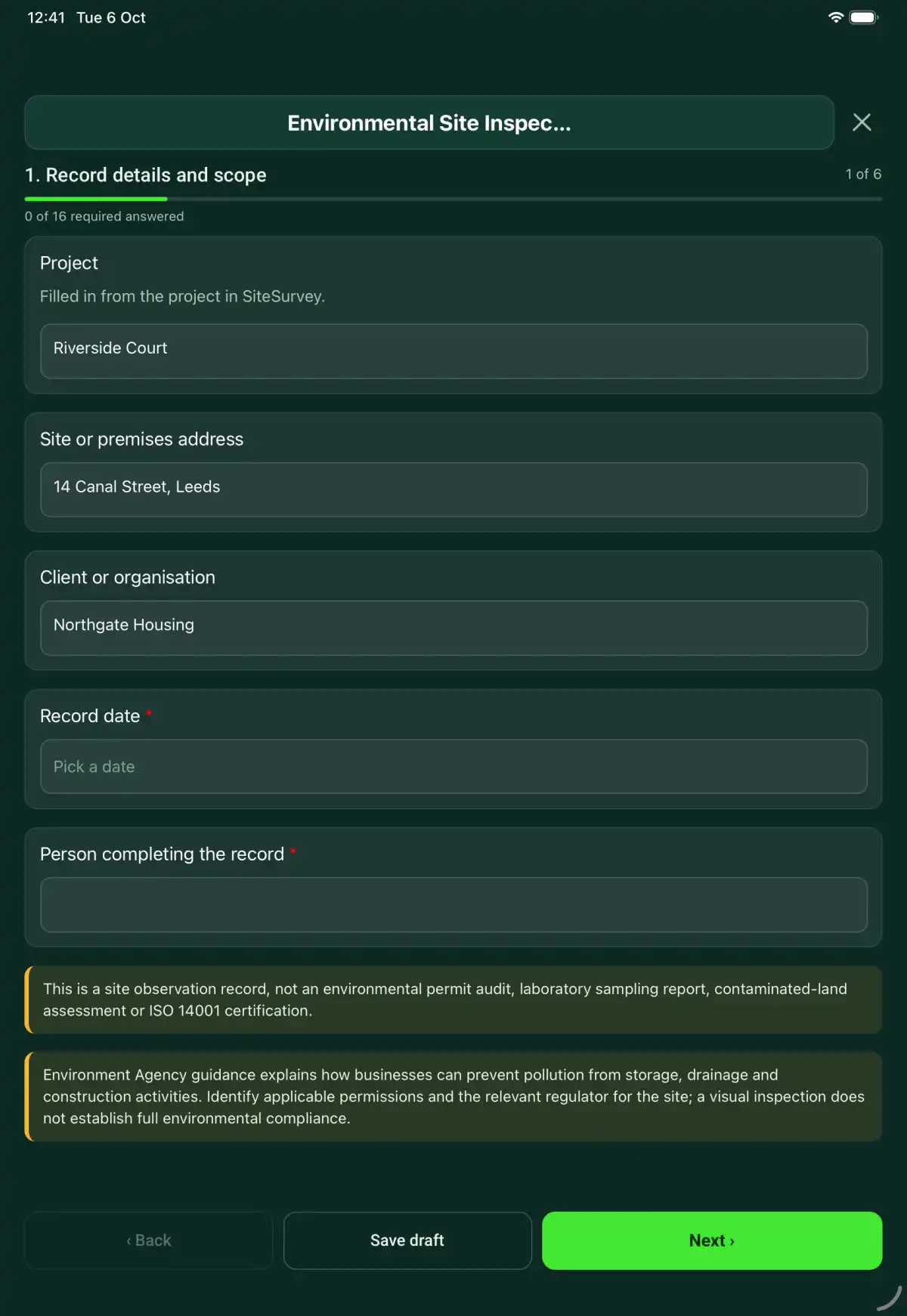
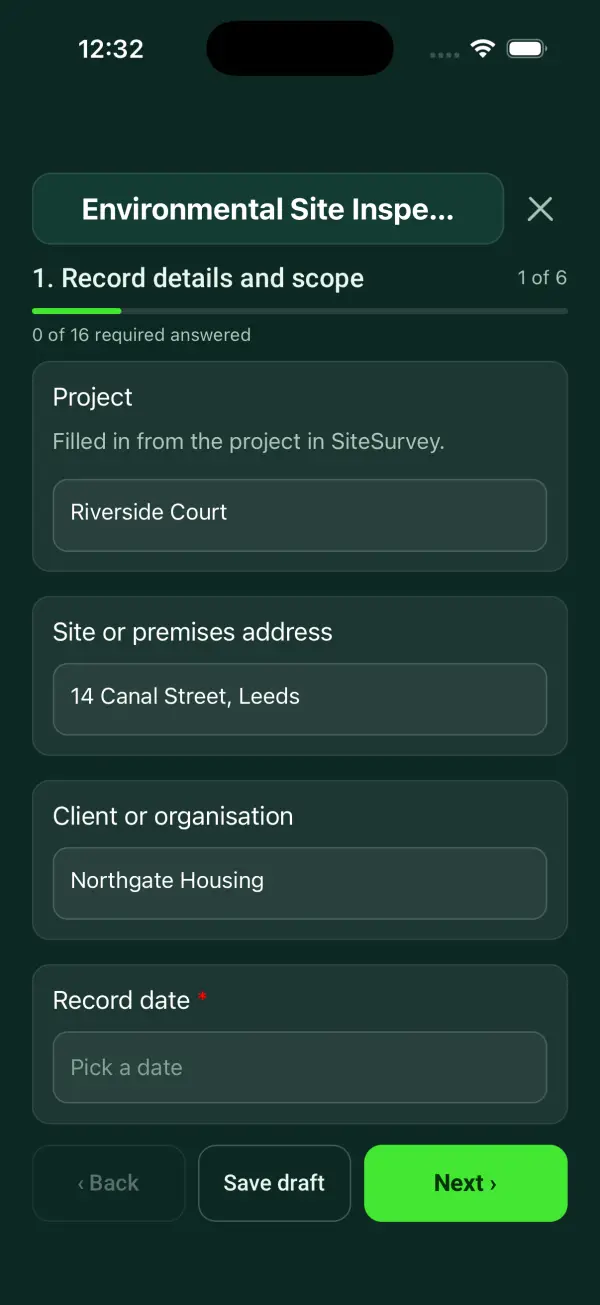
For people inspecting site environmental controls. Work through the drainage, storage, waste, dust and spill checks, which the form counts. For each observation mark where it was with GPS, record what it could reach and whether pollution has reached a drain, watercourse or land, and measure the affected area with a tape or from a photo. The form totals the observations that could reach water and the area affected, and shows a red note when pollution has reached a receptor. Try the form below, see every question or open a completed example.
✎Every question is editable. Add this form to your account, then change the wording, add or remove questions and options, and make it fit your own jobs.
Environment Agency guidance explains how businesses can prevent pollution from storage, drainage and construction activities. Identify applicable permissions and the relevant regulator for the site; a visual inspection does not establish full environmental compliance.
Work through the drainage, storage, waste, dust and spill checks, then record each observation with where it was, what it could reach and the area affected. The form counts the checks needing action and the observations that could reach water, and shows a red note when pollution has reached a drain, watercourse or land.
Observations that could reach water
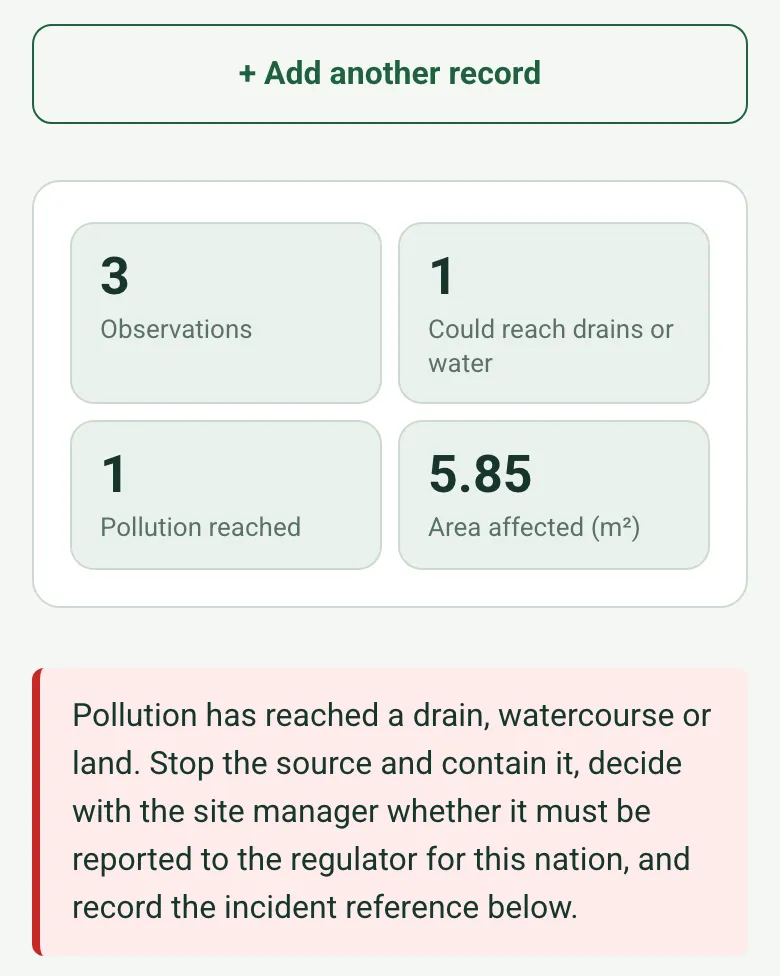
Record what each observation could reach and whether pollution has reached it. The form counts them, totals the area affected and shows a red note to stop the source, contain it and decide whether to report it.
Film where the site drainage meets the watercourse, so the record shows the receptor as well as the source.
A completed environmental site inspection
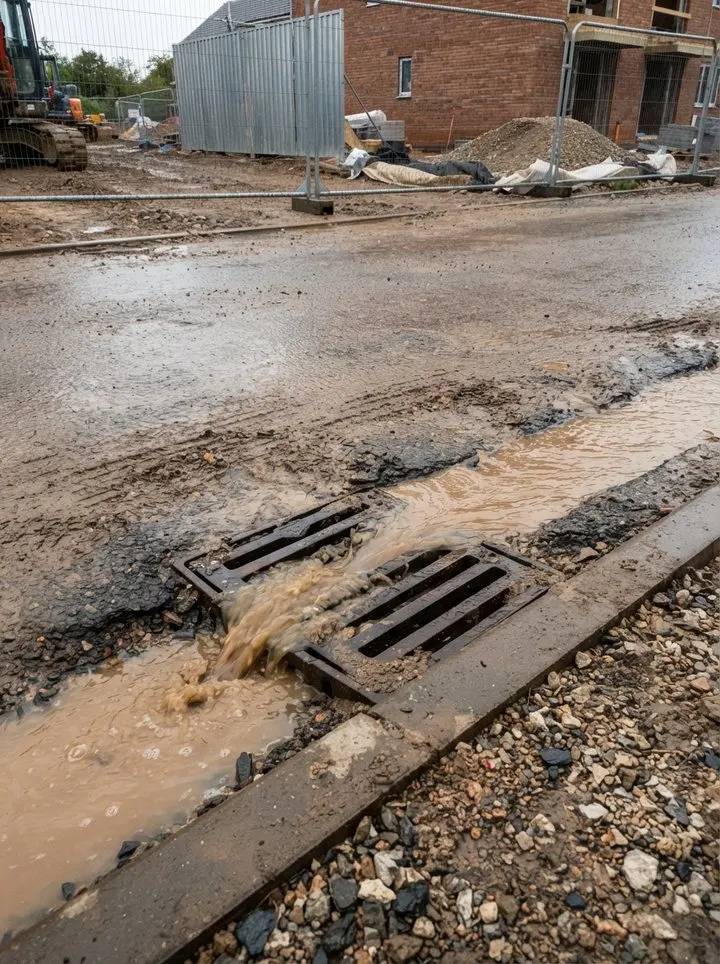
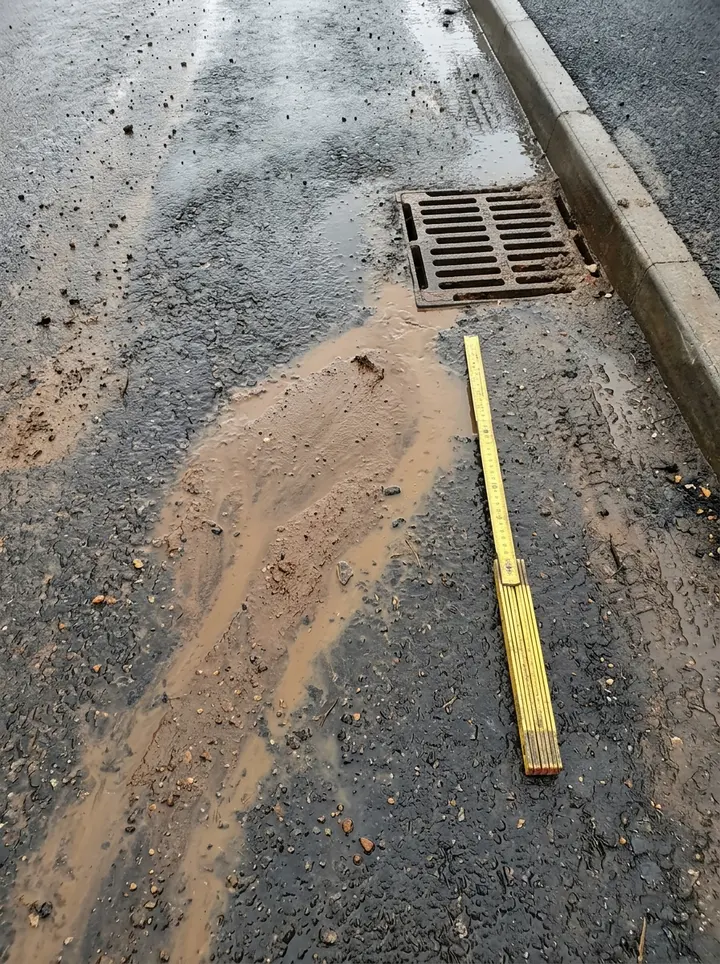
A fictional housing site in Carlisle: silty water pumped from an excavation was running into a road gully that drains to the nearest beck, a trail about 0.9 by 6.5 m by tape. The pump was stopped and rerouted through the settlement tank, and plasterboard was pulled out of a mixed skip.
This is the real form as your team would use it: questions appear as you answer, scores work themselves out and you can add photos and signatures. No sign-up needed. Or open a completed example to see every answer, photo and score filled in.
Your team completes the environmental site inspection on site in the SiteSurvey app on iPhone, iPad and Android phones and tablets. The project name and address fill in for them, it works without signal, and it syncs when the device is back online with photos kept against the question they answer.
Customers and subcontractors do not need the app: send them a link and they can fill it in from any browser.
Every question in the environmental site inspection template
An environmental site inspection covering drainage, material storage, waste, dust, spill readiness, consent references, observations and corrective actions. 6 sections and 60 questions. Follow-up questions and guidance appear only when an answer calls for them, so the person on site never sees the ones that do not apply.
✎
Make it your own: every question is editable
This is a starting point, not a fixed form. Once it is in your SiteSurvey account you can reword any question, add or remove questions, sections and answer options, and add your own logo, so it fits the way your team works and the jobs you do.
Details you only enter once
Add this form to a project in SiteSurvey and it fills in what the project already knows, so nobody on site retypes it and every form on the job uses the same names. Anything filled in can still be changed.
Project: the project name
Client or organisation: the project's customer
Site or premises address: the site address, from the space or the project
1
Record details and scope
ProjectShort answer
Filled in from the project in SiteSurvey.
Fills in from the project name
Client or organisationShort answer
Fills in from the project's customer
Site or premises addressShort answer
Fills in from the site address, from the space or the project
Record date*Date
Person completing the record*Short answer
Weather on siteAnswer
CheckThis is a site observation record, not an environmental permit audit, laboratory sampling report, contaminated-land assessment or ISO 14001 certification.
CheckSources (England). The Environmental Permitting (England and Wales) Regulations 2016 control permitted activities and water discharges. The Environmental Protection Act 1990, section 34 (waste duty of care): waste must be stored securely, passed only to an authorised person such as a registered waste carrier, and every transfer must have a written description (waste transfer note) kept for at least 2 years. The Control of Pollution (Oil Storage) (England) Regulations 2001: oil containers holding more than 200 litres at business premises need secondary containment holding at least 110% of the container's capacity. The Water Resources Act 1991 makes it an offence to cause or knowingly permit polluting matter to enter controlled waters. Other nations have their own rules and regulator.
2
Site and controls
Activities and work areas*Short answer
Nation and relevant regulator*Short answer
Environmental plan and drainage drawing references*Short answer
Applicable consent, permit and discharge referencesShort answer
3
Inspection checks
Drains and receiving waters protected from contamination*Choose one
Acceptable
Action needed
Not checked
Not applicable
Action, limitation or reason not applicable*Notes
Shown only when the answers above make it relevant
Oil and chemical storage visibly controlled*Choose one
Acceptable
Action needed
Not checked
Not applicable
Action, limitation or reason not applicable*Notes
Shown only when the answers above make it relevant
Waste segregated and storage condition checked*Choose one
Acceptable
Action needed
Not checked
Not applicable
Action, limitation or reason not applicable*Notes
Shown only when the answers above make it relevant
Dust, mud and visible emissions controls observed*Choose one
Acceptable
Action needed
Not checked
Not applicable
Action, limitation or reason not applicable*Notes
Shown only when the answers above make it relevant
Spill equipment and incident reporting routes available*Choose one
Acceptable
Action needed
Not checked
Not applicable
Action, limitation or reason not applicable*Notes
Shown only when the answers above make it relevant
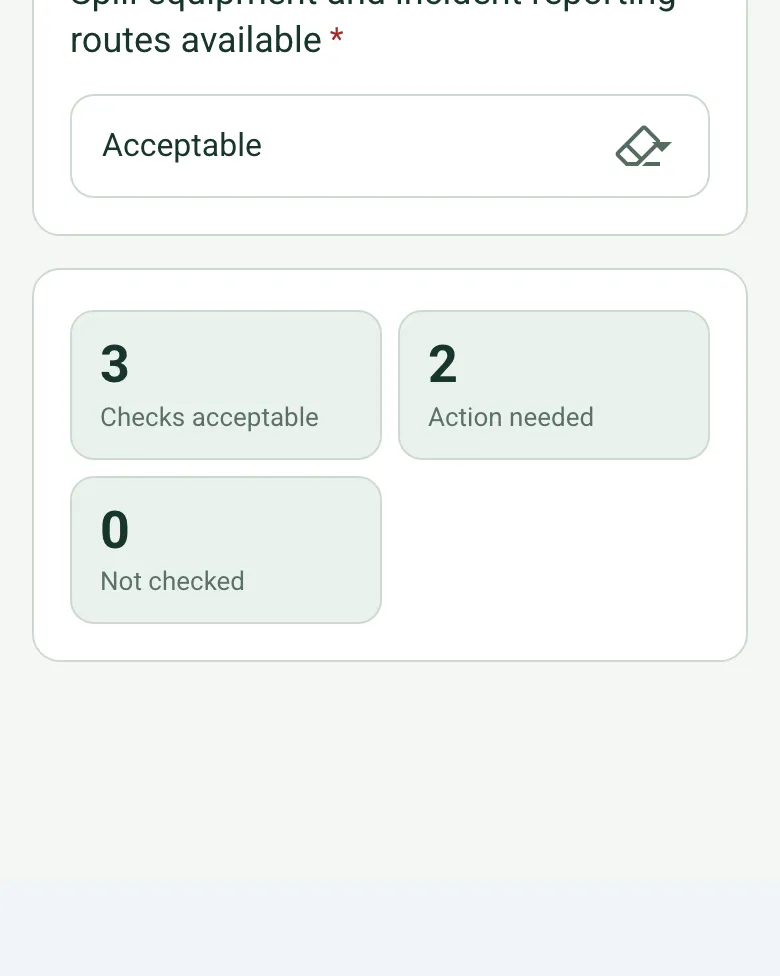
Checks acceptableWorked out by the form
Action neededWorked out by the form
Not checkedWorked out by the form
Waste transfer notes held for waste removed from siteChoose one
Yes
No
Not applicable
Waste carriers checked as registered with the regulatorChoose one
Yes
No
Not applicable
WarningDuty of care gap. Environmental Protection Act 1990, section 34: waste must only go to an authorised person and each transfer needs a waste transfer note. Put this right and record it in the actions.
Shown only when the answers above make it relevant
Oil containers holding more than 200 litres have a bund or drip tray holding at least 110% of the containerChoose one
Yes
No
Not applicable
WarningOil storage not contained. The Control of Pollution (Oil Storage) (England) Regulations 2001 require secondary containment of at least 110% of the container's capacity. Record the action.
Shown when “Oil containers holding more than 200 litres have a bund or drip tray holding at least 110% of the container” is “No”
4
Observations
Environmental observation
Repeat for each observation. Each one asks:
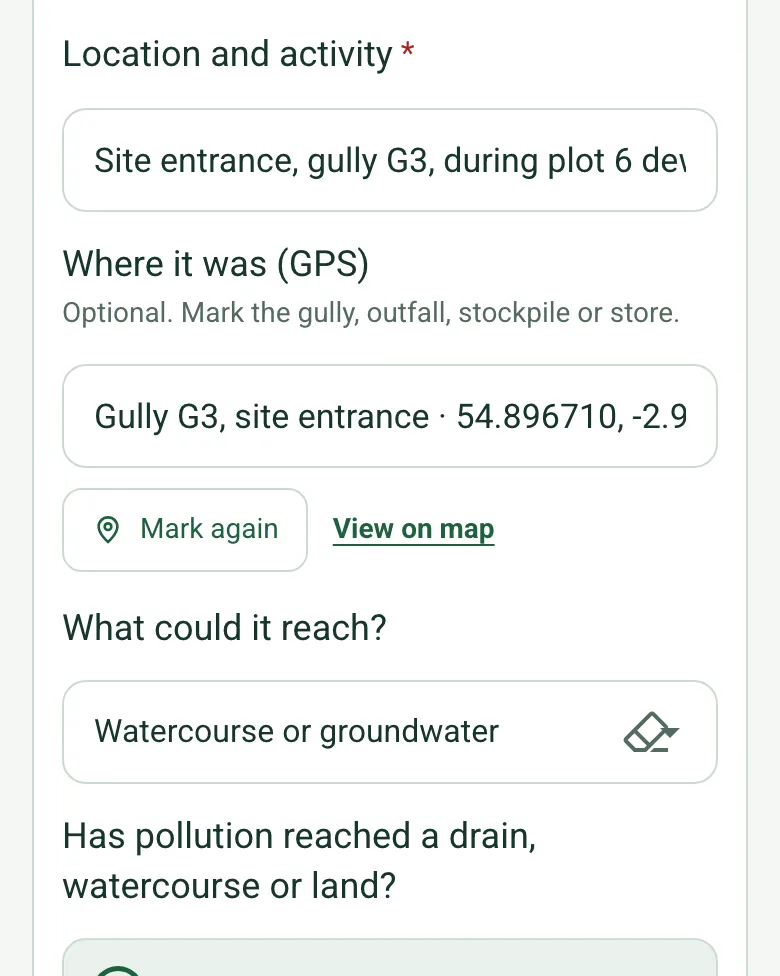
Location and activity*Short answer
Where it was (GPS)Short answer
Optional. Mark the gully, outfall, stockpile or store.
What could it reach?Choose one
Drain or sewer
Watercourse or groundwater
Land
Air or neighbours
Nothing identified
Has pollution reached a drain, watercourse or land?Choose one
Yes
No
Not known
Observation and potential receptor*Notes
Immediate control and responsible person*Notes
Affected area: width (m)Number
Optional. Such as a spill, silt on the road or a stained patch. Use a tape, or measure from a photo with a known size in the same plane, such as a gully grate or a door.
Length (m)Number
Area (m²)Worked out by the form
Shown only when the answers above make it relevant
Observation photosPhotos
Walk Cam: this areaWalk Cam video with voice-to-text
Optional. Film a guided walk-through on the SiteSurvey app.
is_waterWorked out by the form
is_reachedWorked out by the form
ObservationsWorked out by the form
Could reach drains or waterWorked out by the form
Pollution reachedWorked out by the form
Area affected (m²)Worked out by the form
Shown only when the answers above make it relevant
WarningPollution has reached a drain, watercourse or land. Stop the source and contain it, decide with the site manager whether it must be reported to the regulator for this nation, and record the incident reference below.
Shown only when the answers above make it relevant
5
Incident and follow-up
Separate incident and regulator-notification references if applicableShort answer
Areas not inspected and monitoring evidence requiredNotes
State the activities, locations and evidence not covered. Distinguish a visual observation from monitoring or consent verification.
Follow-up inspection referenceShort answer
Next inspection dueDate
Set by the site environmental plan or permit.
Days until the next inspectionWorked out by the form
Shown when “Record date” is answered and “Next inspection due” is answered
CheckCheck the date. The next date is before the date of this visit.
Shown only when the answers above make it relevant
6
Actions and review
Are further actions required?Choose one
Yes
No
Further action
Repeat for each further action. Each one asks:
Shown when “Are further actions required?” is “Yes”
Action and evidence reference*Notes
PriorityChoose one
Urgent
High
Medium
Low
Person responsibleShort answer
Target dateDate
Action statusChoose one
Open
In progress
Completed
Completion evidence*Notes
Shown when “Action status” is “Completed”
Outstanding limitations and information to pass onNotes
Record status*Choose one
Ready for review
Further work needed
Work or use stopped
Reviewed byShort answer
Review dateDate
Author signature*Signature
CheckSigning records the information entered. It does not itself certify legal compliance, remove a limitation or authorise unsafe work.
Scope and responsibility
This is a site observation record, not an environmental permit audit, laboratory sampling report, contaminated-land assessment or ISO 14001 certification.
What a useful entry looks like
Areas not inspected and monitoring evidence required
State the activities, locations and evidence not covered. Distinguish a visual observation from monitoring or consent verification.
Visit covered the active work area and visible drainage controls. Discharge sampling and off-site storage were outside the inspection scope.
Fictional example of record wording. Use the actual evidence and approved arrangements for your job; this is not a completed report or an instruction to carry out the work.
See it filled in
A completed environmental site inspection report, made by SiteSurvey from a fictional site visit: every answer, the photos, the guidance that applied and the sign-off, ready to send as a PDF.
How should I record “Areas not inspected and monitoring evidence required”?
State the activities, locations and evidence not covered. Distinguish a visual observation from monitoring or consent verification.
Does this authorise discharge to a drain?
No. Confirm the drainage destination and necessary permissions through the relevant process.
Can visual inspection establish water quality?
No. Where measurements or sampling are required, link the appropriate monitoring and laboratory evidence.
What if pollution has reached a drain or watercourse?
The form shows a red note: stop the source, contain it and decide whether the incident must be reported to the regulator for the nation the site is in, then record the incident reference. The form does not decide whether an incident is reportable, and the rules differ between England, Wales, Scotland and Northern Ireland.
What are the limits of this template?
This is a site observation record, not an environmental permit audit, laboratory sampling report, contaminated-land assessment or ISO 14001 certification.
Can I complete this form on site and share the record?
In the SiteSurvey app the form works offline, with photos and signatures recorded against the questions. Share the completed record as a PDF or a link. Dates and action owners are recorded fields; this form does not send reminders or update other systems.