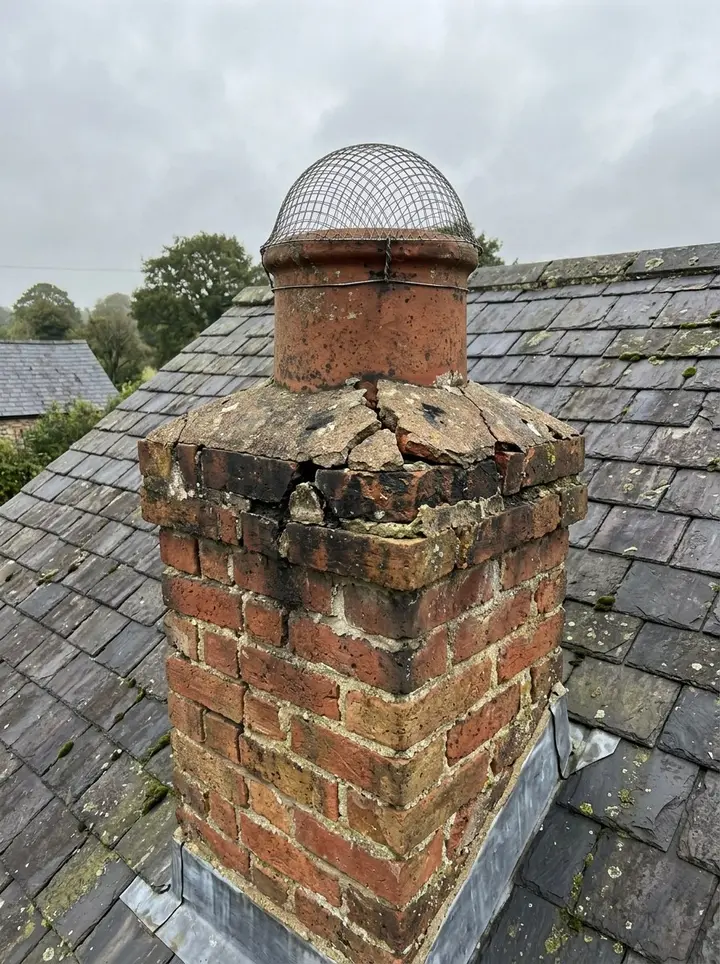
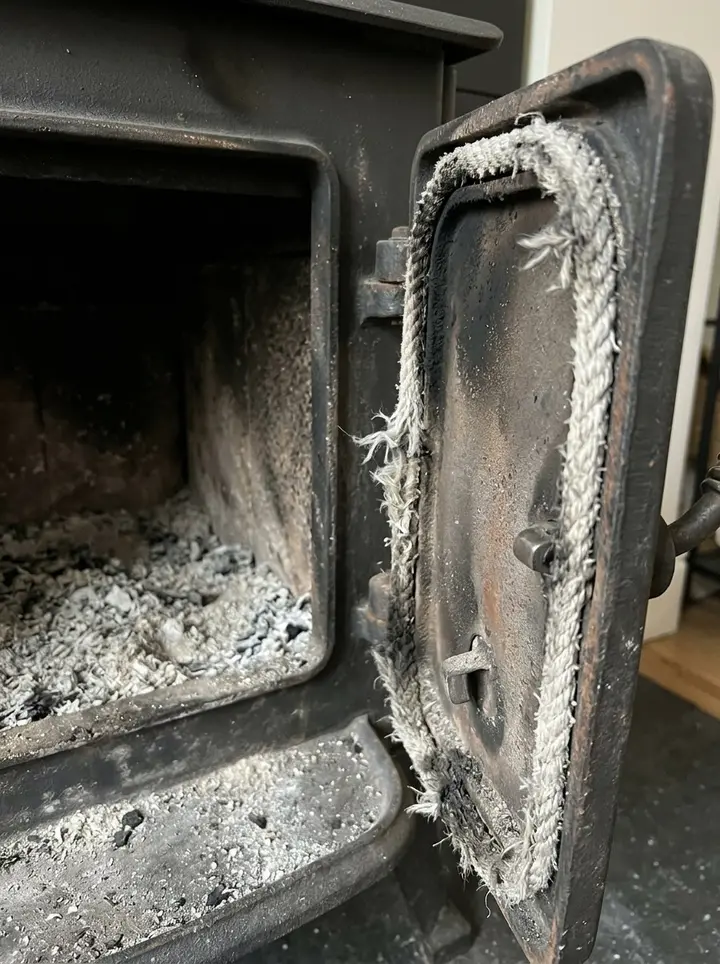
A record of a chimney sweep and inspection. Record the appliance, fuel and flue, the sweeping method, debris and the smoke draw test, then the pot, stack, flue, register plate, door seals, hearth and ventilation, with a detail box for each defect. Measure the clearance from the stove to the nearest combustible, from a photo or with a tape, and the form compares it with the figure in the appliance instructions. It counts the checks and defects, pins the visit and shows the months to the next sweep. Try the form below, see every question or open a completed example.
✎Every question is editable. Add this form to your account, then change the wording, add or remove questions and options, and make it fit your own jobs.
What is checked when a chimney is swept and inspected?
This record covers the appliance, fuel and flue, the sweeping method and debris removed, and a smoke draw test. The inspection covers the pot or cowl, stack and flaunching, the flue or liner, register plate, appliance door seals, hearth and clearances, ventilation and whether there is a working carbon monoxide alarm. The sweep records the outcome and when to sweep again. HETAS encourages sweeping at least twice a year when burning wood and at least once a year when burning smokeless fuels.
Record the sweep and the checks on a phone at the hearth. Measure the clearance from the stove to the nearest combustible and compare it with the appliance instructions, count the checks that passed and the defects found, pin the visit and see how long until the next sweep. It is a record of the sweep and the checks, not a certificate of the installation.
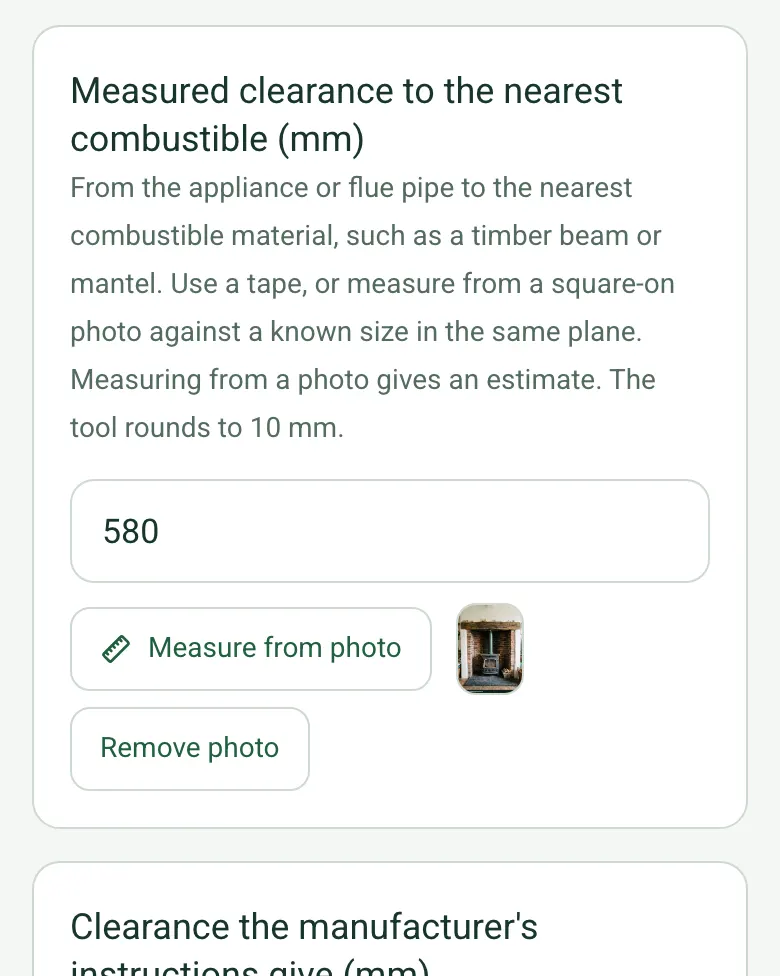
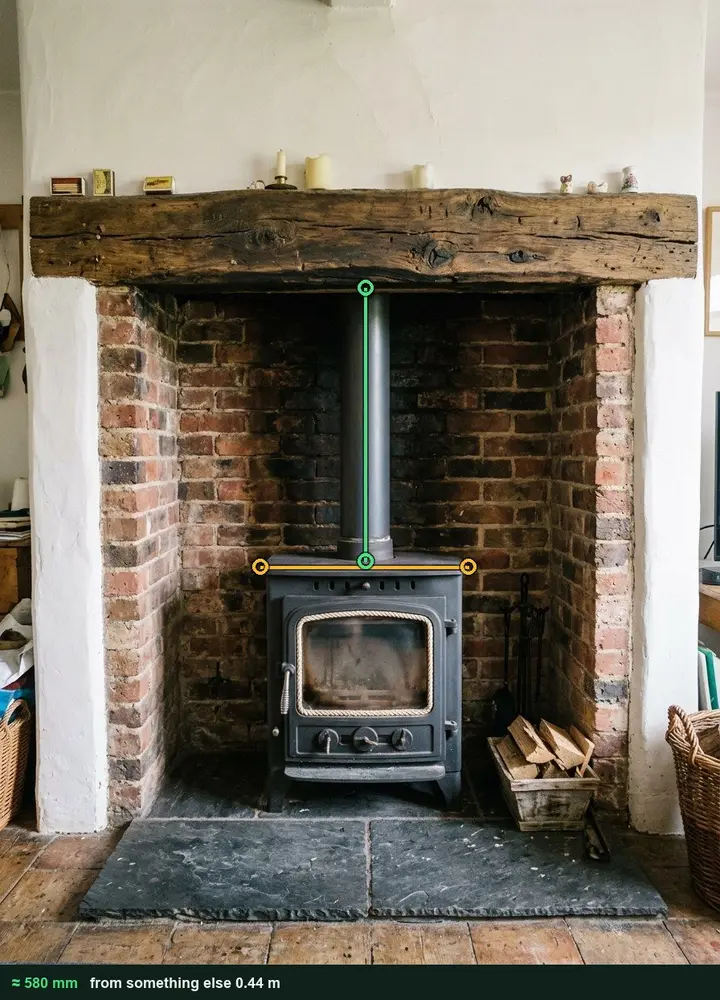
Measure the clearance to a beam
Photograph the fireplace square on and measure the gap from the stove to the beam, using the stove's width from its data plate as the reference, or use a tape. The marked-up photo stays with the answer. It works on web forms in any phone browser today, and the app version is on its way.
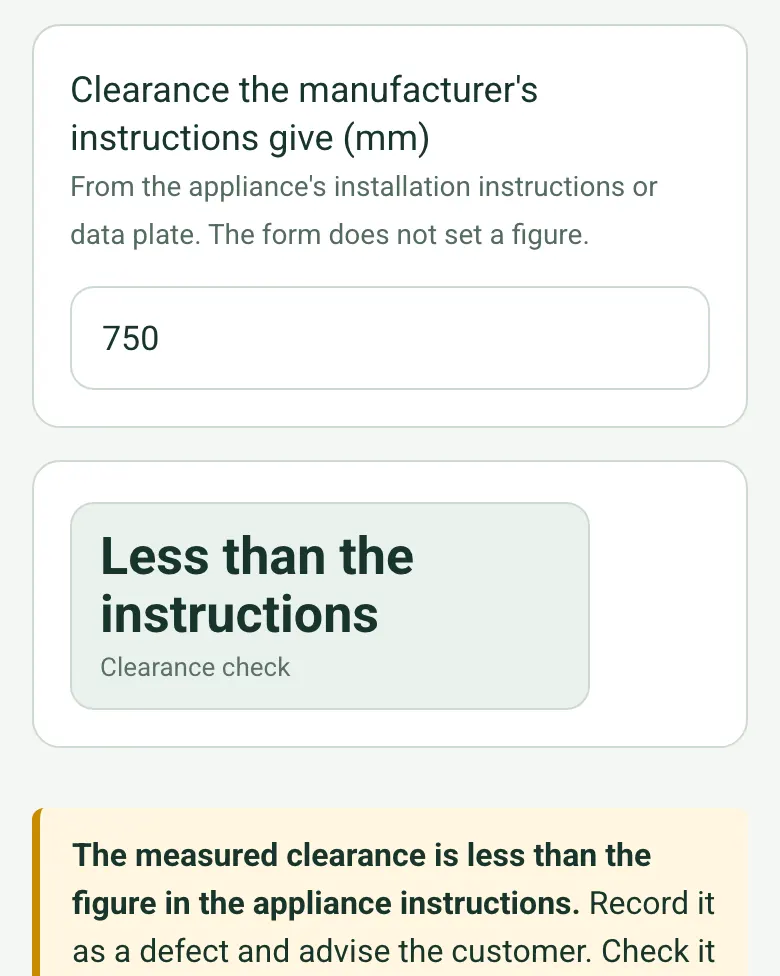
Enter the clearance from the appliance's installation instructions and the form says whether the measured gap is less. It sets no figure of its own, so the comparison always follows the stove in front of you.
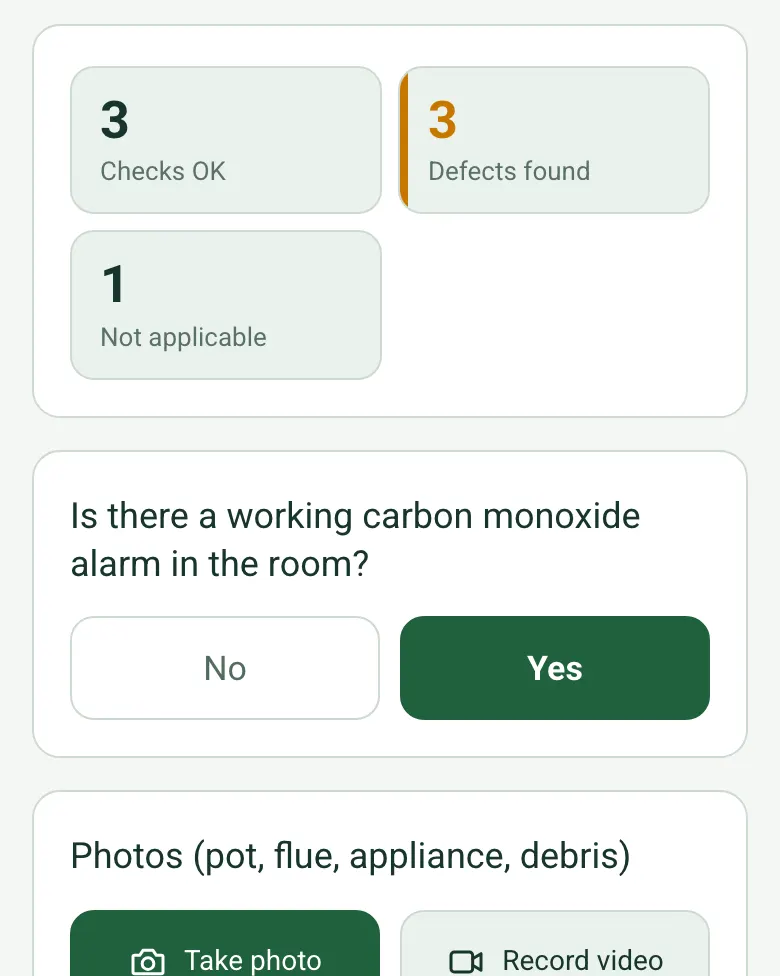
The form counts the pot, stack, flue, register plate, door seals, hearth and ventilation checks that were OK, had a defect or did not apply, so the outcome and the advice are easy to explain to the customer.
Mark current location at the front door as a record of the visit, useful for rural cottages with no clear house number. Mark current location works on web forms in any phone browser today, and the app version is on its way.
A fictional cottage with a wood burning stove: swept with rods and a vacuum, smoke draw test passed, cracked flaunching referred to a roofer, the door rope replaced, and the stove top measured at about 580 mm from the oak beam against 750 mm in the instructions. Open it as a filled-in form, or switch to a blank copy and try it yourself.
This is the real form as your team would use it: questions appear as you answer, scores work themselves out and you can add photos and signatures. No sign-up needed. Or open a completed example to see every answer, photo and score filled in.
A chimney sweep and inspection record: appliance, fuel and flue, sweeping method, smoke test, condition checks, CO alarm, debris found, the next sweep date and the customer's signature. 3 sections and 51 questions. Follow-up questions and guidance appear only when an answer calls for them, so the person on site never sees the ones that do not apply.
✎
Make it your own: every question is editable
This is a starting point, not a fixed form. Once it is in your SiteSurvey account you can reword any question, add or remove questions, sections and answer options, and add your own logo, so it fits the way your team works and the jobs you do.
Details you only enter once
Add this form to a project in SiteSurvey and it fills in what the project already knows, so nobody on site retypes it and every form on the job uses the same names. Anything filled in can still be changed.
Project: the project name
Client: the project's customer
Site: the site, when the form is opened for a space or a product
Site address: the site address, from the space or the project
1
Appliance and flue
ProjectShort answer
Fills in from the project name
ClientShort answer
Fills in from the project's customer
Site*Short answer
Fills in from the site, when the form is opened for a space or a product
Site addressShort answer
Fills in from the site address, from the space or the project
Property locationShort answer
Mark it at the front door, as a record of the visit. Tap Mark current location on site. It saves the coordinates, a grid reference and the accuracy.
Date swept*Date
Sweep name and HETAS or guild number*Short answer
Appliance*Choose one
Open fire
Wood burning stove
Multi-fuel stove
Range cooker
Oil appliance
Gas fire
Other
Fuel burntChoose one
Wood
Smokeless fuel
House coal
Oil
Gas
Mixed
FlueChoose one
Masonry, unlined
Masonry with liner
Twin wall system
Not known
RoomShort answer
GuidanceHETAS recommends sweeping at least twice a year when burning wood and at least once a year for smokeless fuel. How often depends on how much the appliance is used.
2
Sweep and checks
Method*Tick all that apply
Brush rods
Power sweep
Vacuum
Debris removedChoose one
Light
Moderate
Heavy
Tar or glazed deposits
CheckTar or glazed deposits are signs of creosote, which HETAS says acts as a highly flammable fuel in a chimney fire. Advise the customer on fuel and burning habits, such as burning wood with a moisture content of 20% or less, and consider specialist removal.
Shown when “Debris removed” is “Tar or glazed deposits”
Smoke draw test*Choose one
Pass
Fail
WarningSmoke draw test failed. Do not use the appliance until the flue has been investigated and put right.
Shown only when the answers above make it relevant
Pot, cowl or bird guardChoose one
OK
Defect
Not applicable
What is wrong?Short answer
Shown when “Pot, cowl or bird guard” is “Defect”
Chimney stack and flaunchingChoose one
OK
Defect
Not applicable
What is wrong?Short answer
Shown when “Chimney stack and flaunching” is “Defect”
Flue or liner conditionChoose one
OK
Defect
Not applicable
What is wrong?Short answer
Shown when “Flue or liner condition” is “Defect”
Register plate or closure plateChoose one
OK
Defect
Not applicable
What is wrong?Short answer
Shown when “Register plate or closure plate” is “Defect”
Appliance door seals and ropeChoose one
OK
Defect
Not applicable
What is wrong?Short answer
Shown when “Appliance door seals and rope” is “Defect”
Hearth and clearances to combustiblesChoose one
OK
Defect
Not applicable
What is wrong?Short answer
Shown when “Hearth and clearances to combustibles” is “Defect”
Measured clearance to the nearest combustible (mm)Number
From the appliance or flue pipe to the nearest combustible material, such as a timber beam or mantel. Use a tape, or measure from a square-on photo against a known size in the same plane. Measuring from a photo gives an estimate. The tool rounds to 10 mm.
Shown only when the answers above make it relevant
Clearance the manufacturer's instructions give (mm)Number
From the appliance's installation instructions or data plate. The form does not set a figure.
Shown only when the answers above make it relevant
Clearance checkWorked out by the form
Shown only when the answers above make it relevant
CheckThe measured clearance is less than the figure in the appliance instructions. Record it as a defect and advise the customer. Check it with a tape before deciding the outcome.
Shown only when the answers above make it relevant
Permanent air supply (ventilation)Choose one
OK
Defect
Not applicable
What is wrong?Short answer
Shown when “Permanent air supply (ventilation)” is “Defect”
Checks OKWorked out by the form
Defects foundWorked out by the form
Not applicableWorked out by the form
Is there a working carbon monoxide alarm in the room?Yes or No
WarningAdvise the customer to fit a carbon monoxide alarm. Approved Document J says one should be fitted in the room when a new or replacement fixed solid fuel appliance is installed in a dwelling, and landlords must have one in any room used as living accommodation that has a fixed combustion appliance, other than a gas cooker.
Shown when “Is there a working carbon monoxide alarm in the room?” is No
Photos (pot, flue, appliance, debris)Photos
3
Certificate and sign-off
Outcome*Choose one
Safe to use
Safe to use, work advised
Do not use until put right
Sweeping certificate issued?Yes or No
CheckThis is a site record of the sweep and checks. It supports the sweeping certificate issued under the sweep's scheme (HETAS, NACS, the Guild of Master Chimney Sweeps or APICS) and does not replace it.
Recommended next sweepDate
Months to the next sweep (about)Worked out by the form
Shown only when the answers above make it relevant
GuidanceThe next sweep is more than about 6 months away. HETAS encourages sweeping at least twice a year when burning wood.
Shown only when the answers above make it relevant
Advice givenNotes
Defects and actions
Repeat for each action. Each one asks:
Shown only when the answers above make it relevant
Action needed*Notes
PriorityChoose one
Urgent
High
Medium
Low
OwnerShort answer
Due dateDate
StatusChoose one
Open
In progress
Completed
PhotosPhotos
Customer nameShort answer
Customer signatureSignature
Completed byWorked out by the form
Sweep signatureSignature
See it filled in
A completed chimney inspection report, made by SiteSurvey from a fictional site visit: every answer, the photos, the guidance that applied and the sign-off, ready to send as a PDF.
HETAS encourages sweeping at least twice a year when burning wood and at least once a year when burning smokeless fuels, and says it can also depend on how much the appliance is used. If you sweep twice a year, the second sweep should be after the peak of the heating season.
What if the smoke draw test fails?
The form warns not to use the appliance until the flue has been investigated and put right, and the outcome can be recorded as do not use. HETAS advises stopping use and calling a sweep if smoke comes back into the room.
Is a carbon monoxide alarm needed?
Approved Document J says a CO alarm should be fitted in the room when a new or replacement fixed solid fuel appliance is installed in a dwelling. Landlords must have one in any room used as living accommodation with a fixed combustion appliance, other than a gas cooker. The form warns if there is no working alarm.
What about tar deposits?
HETAS says creosote acts as a highly flammable fuel in a chimney fire and builds up faster when wet wood is burnt, so it advises wood with a moisture content of 20% or less. The form flags tar or glazed deposits so you can advise the customer.
Can I issue a sweeping certificate?
The form records whether a sweeping certificate was issued. The completed record, with photos and the customer's signature, goes as a PDF or a link.
Who uses this?
Chimney sweeps, stove installers, landlords and housing teams with solid fuel appliances.