Form library · AV and IT

Rack audit checklist

A cabinet by cabinet audit for IT support teams and MSPs. Record each item by U position and height, and the form works out the U used and free. Enter the PDU and UPS readings, and it compares the load with the rating and the UPS runtime with what the site needs, works out the temperature rise front to back and counts the checks needing action. Try the form below, see every question or open a completed example.

Ready to use from the form library, and every question is yours to edit. Try it for a small trial fee, cancel any time.

Try it on your phone

Try it on this phone

Fill in the rack audit on your phone now

See how the rack audit looks on your phone

Scan the code with your phone camera. It opens the real form, no sign-up needed.

Open the live example and fill it in, just as your team would on site. No sign-up needed.

See it on this phone

Every question is editable. Add this form to your account, then change the wording, add or remove questions and options, and make it fit your own jobs.

Or start your trial with this form ready →

One email, and we won't add you to a mailing list.

What should a rack audit checklist include?

A rack audit checklist should identify the cabinet, its size and whether it is locked, with photos of the front and back. It should list every item by U position with its make, model, label and power state, then check the PDUs, the UPS, the temperature at the front of the cabinet, fans, blanking plates, patching, labelling and cable management.

Last updated . Facts checked by the SiteSurvey team on 5 October 2026 against ICO guide to data security and regulation 4 of the Electricity at Work Regulations 1989.

Built for auditing a comms cabinet in one visit

Work down the cabinet with the form on a phone. Record each item by U position and height and the form works out the space used and free. Enter the PDU and UPS readings and it compares them with the rating and the runtime the site needs, works out the temperature rise front to back and counts the checks needing action.

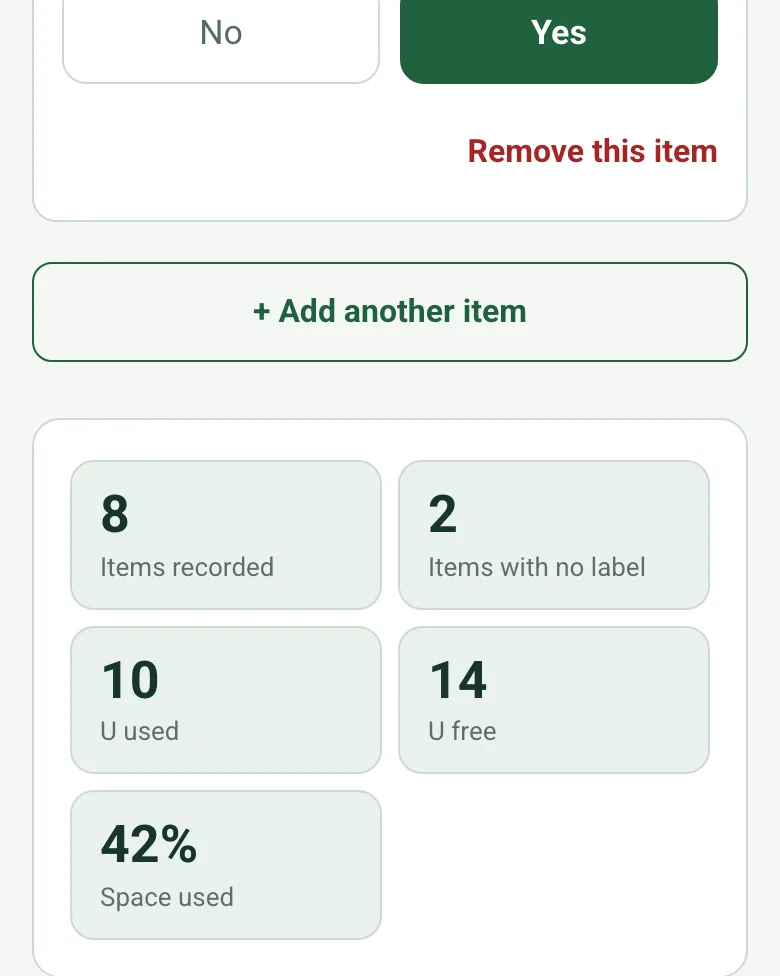
Counts worked out as 8 items recorded, 2 with no label, 10 U used, 14 U free and 42% of the cabinet used

U used and free

Give each item its height in U as you record it. The form adds them up against the rack size, so you can tell the customer how much room is left before the next switch arrives, and it warns when the cabinet is over 90% full.

How calculated fields work →
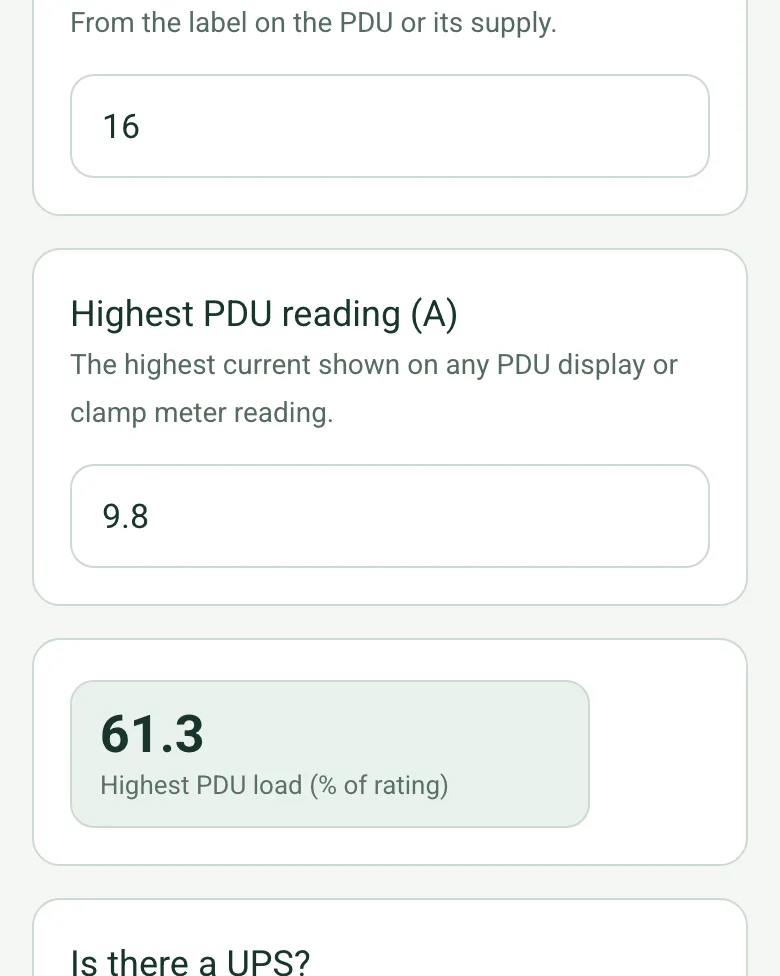
PDU rating 16 A and highest PDU reading 9.8 A, worked out as 61.3% of the rating

PDU load against its rating

Enter the PDU rating from its label and the highest reading on its display or a clamp meter. The form works out the load as a share of the rating and flags anything above 80%, before someone plugs in one more server.

How calculated fields work →
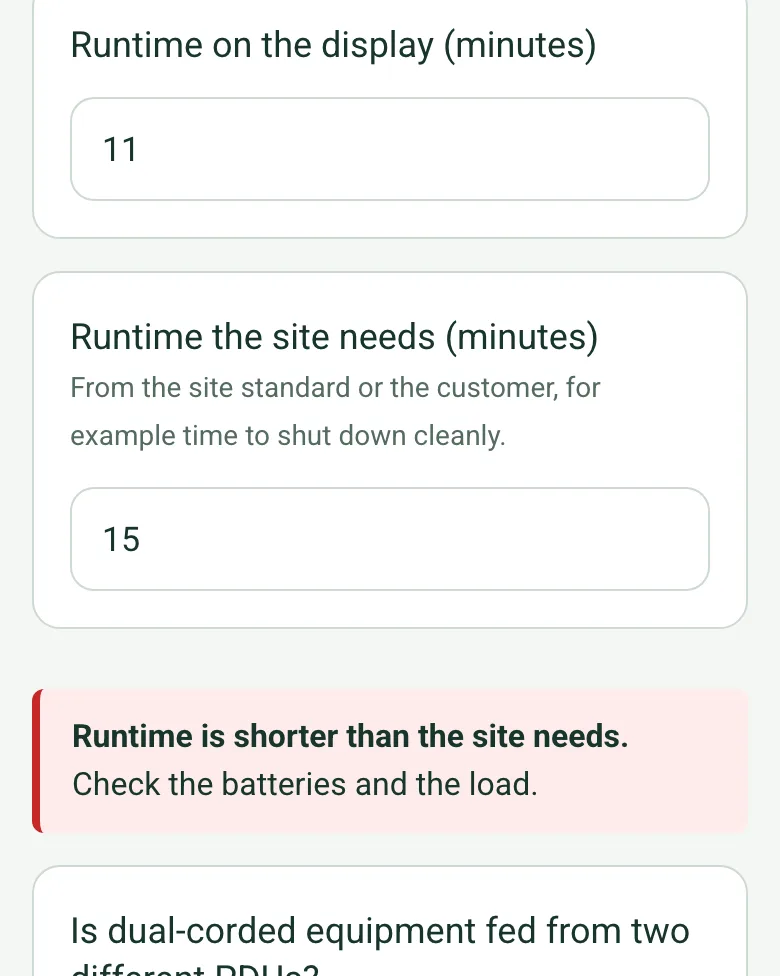
UPS runtime on the display 11 minutes against 15 minutes the site needs, with a red note: Runtime is shorter than the site needs. Check the batteries and the load

UPS runtime against what the site needs

Read the load and runtime off the UPS display and enter the runtime the site needs to shut down cleanly. A short runtime shows a red note, so ageing batteries are found on the audit, not in the next power cut.

How calculated fields work →
5 checks needing action, counted from cabinet not locked, dual-corded kit on one PDU, no blanking plates, untidy patching and labelling not to the site standard

Checks needing action counted

The form counts the checks that need action across the audit: lock, UPS status, dual feeds, temperature, fans, blanking plates, patching and labelling. The number heads the report, with the issues, photos and owner underneath.

How calculated fields work →

Film the cabinet as you go

Walk Cam records the front and back of the cabinet with your spoken notes typed in, so the next engineer sees the patching before opening the door.

How Walk Cam works →

A completed rack audit

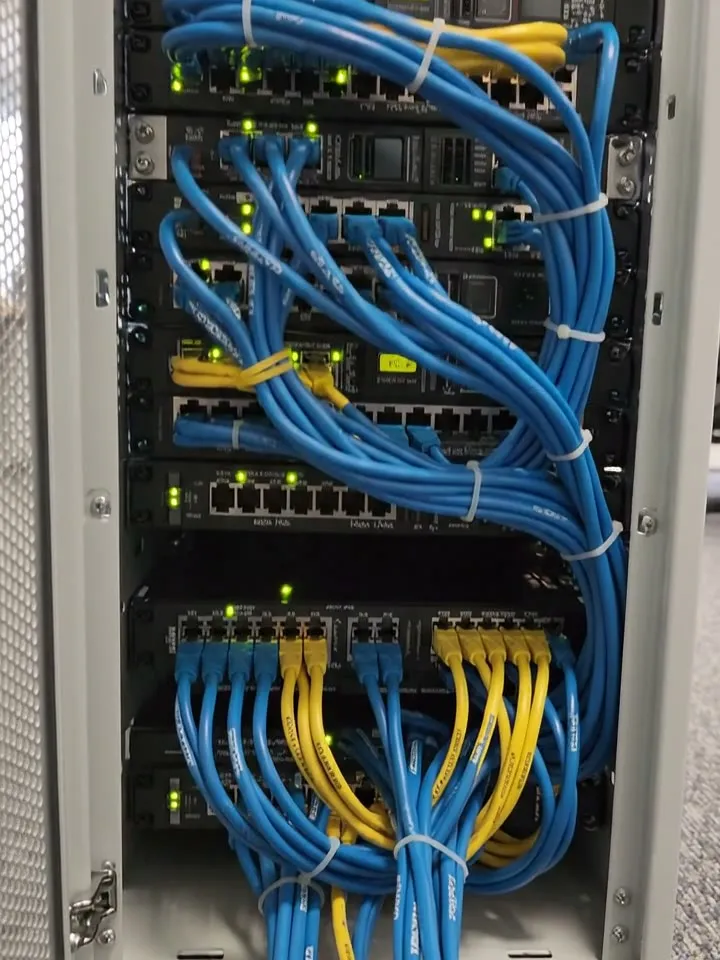
A fictional business centre's 24U cabinet: 10 U used and 14 free, PDU 1 at 61% of its rating, a UPS showing 11 minutes against the 15 the centre needs, 8.5 °C rise front to back and five checks needing action. Open it as a filled-in form, or switch to a blank copy and try it yourself.

The front of an open data cabinet with blue patch leads from patch panels down to network switches
CAB-G01 front · 10 U used of 24
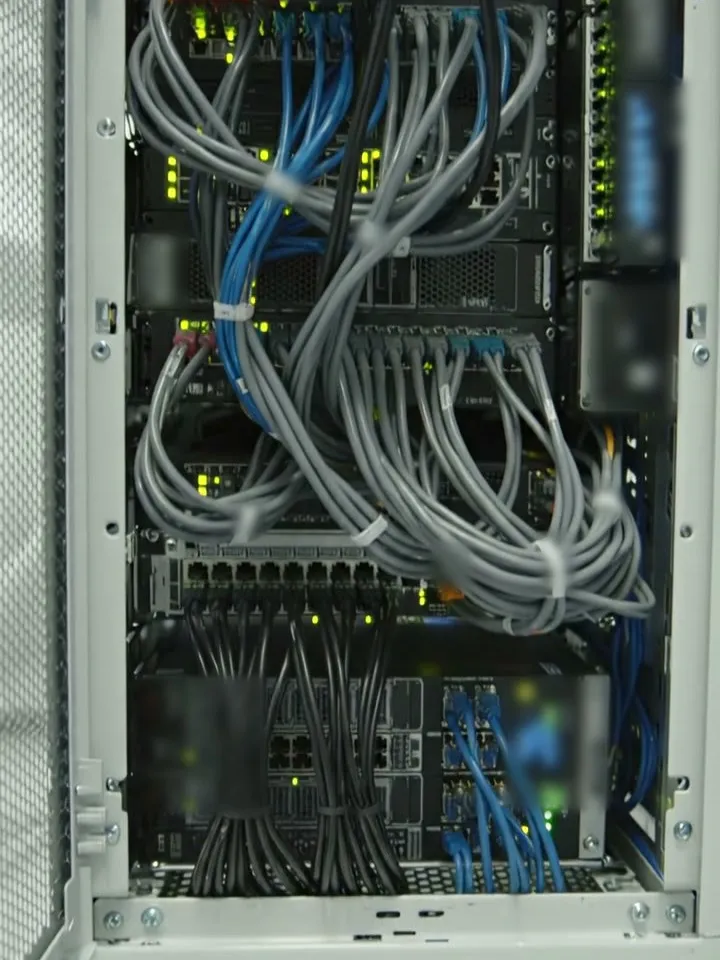
The back of the cabinet with grey power leads hanging loose next to the data cables
Back · power and data not separated
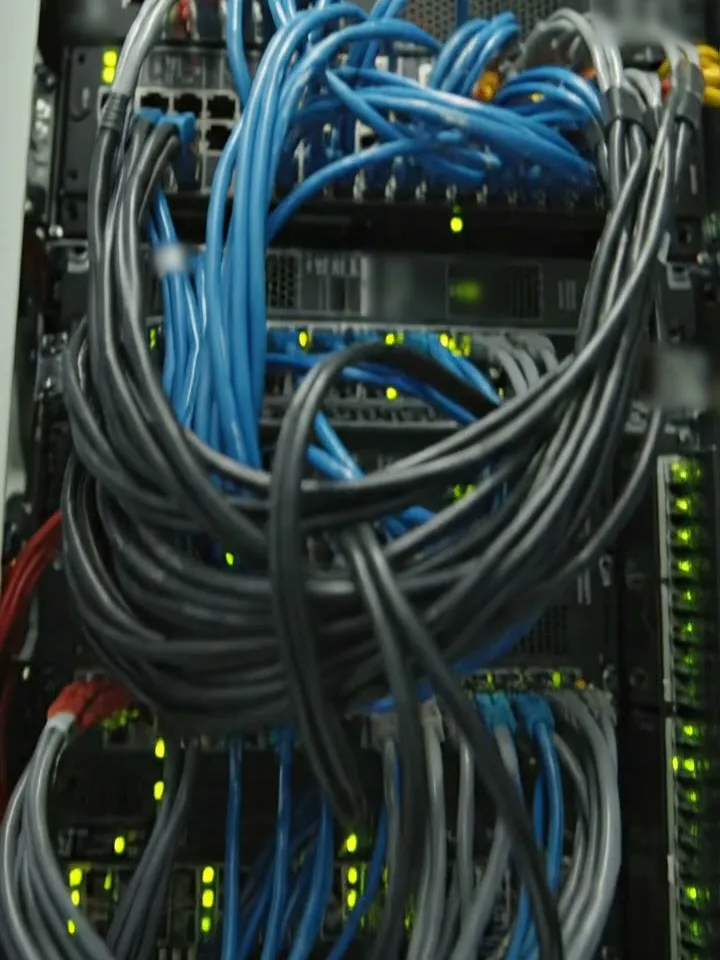
A tangle of blue and grey leads at the back of the cabinet blocking the airflow
Loose leads blocking the airflow

Try the rack audit form live

Answer a few questions and watch it adapt. Your answers are not saved, and any photos you add are deleted within the hour.

Live form: Rack AuditOpen full screen ↗
Fill it in right here

This is the real form as your team would use it: questions appear as you answer, scores work themselves out and you can add photos and signatures. No sign-up needed. Or open a completed example to see every answer, photo and score filled in.

Want to see one filled in? See a completed rack audit report (PDF), made by SiteSurvey from a fictional site visit.

Fill it in on a phone or tablet

Your team completes the rack audit on site in the SiteSurvey app on iPhone, iPad and Android phones and tablets. The project name and address fill in for them, it works without signal, and it syncs when the device is back online with photos kept against the question they answer.

Customers and subcontractors do not need the app: send them a link and they can fill it in from any browser.

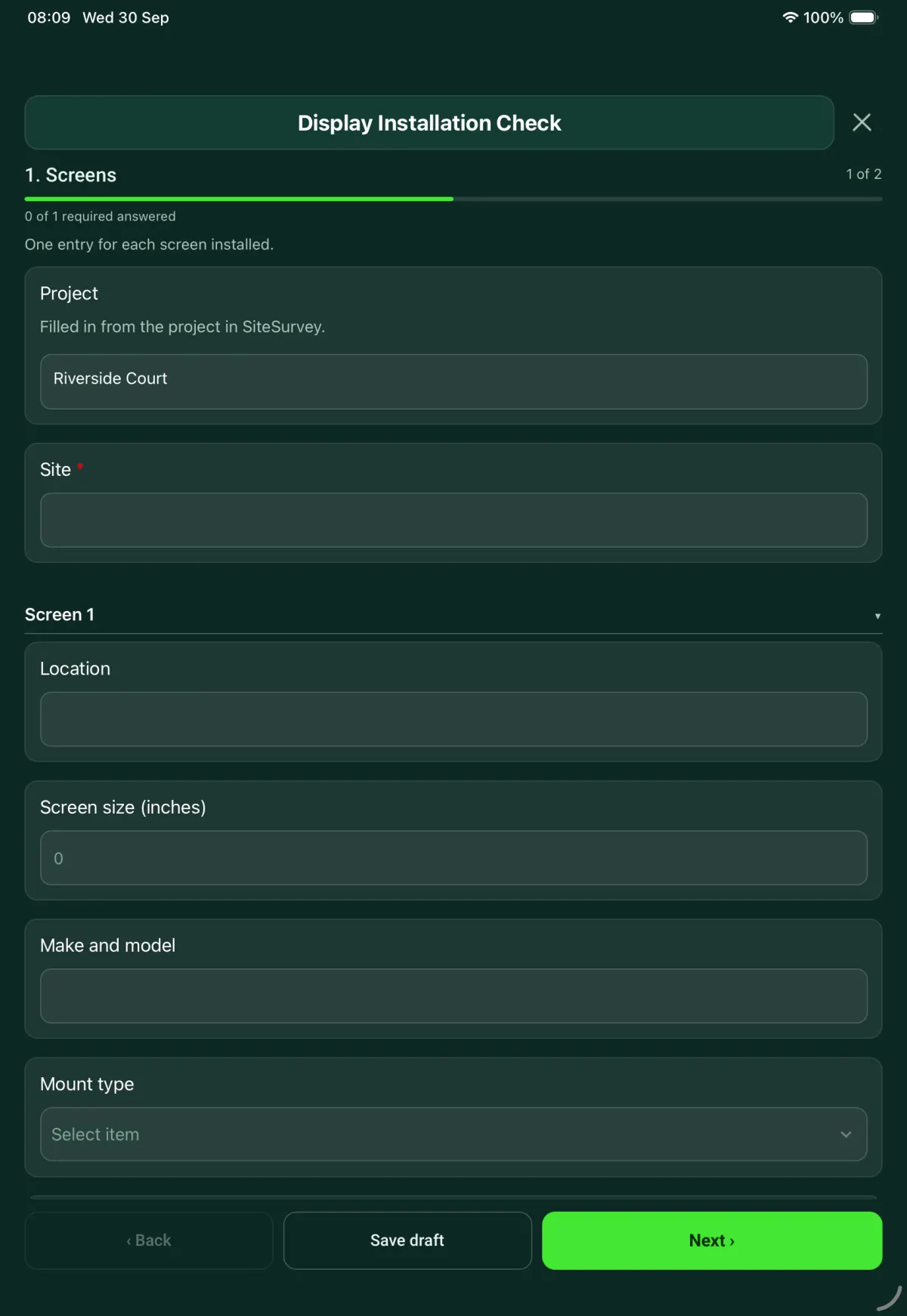
The Rack Audit form in the SiteSurvey app on a tablet
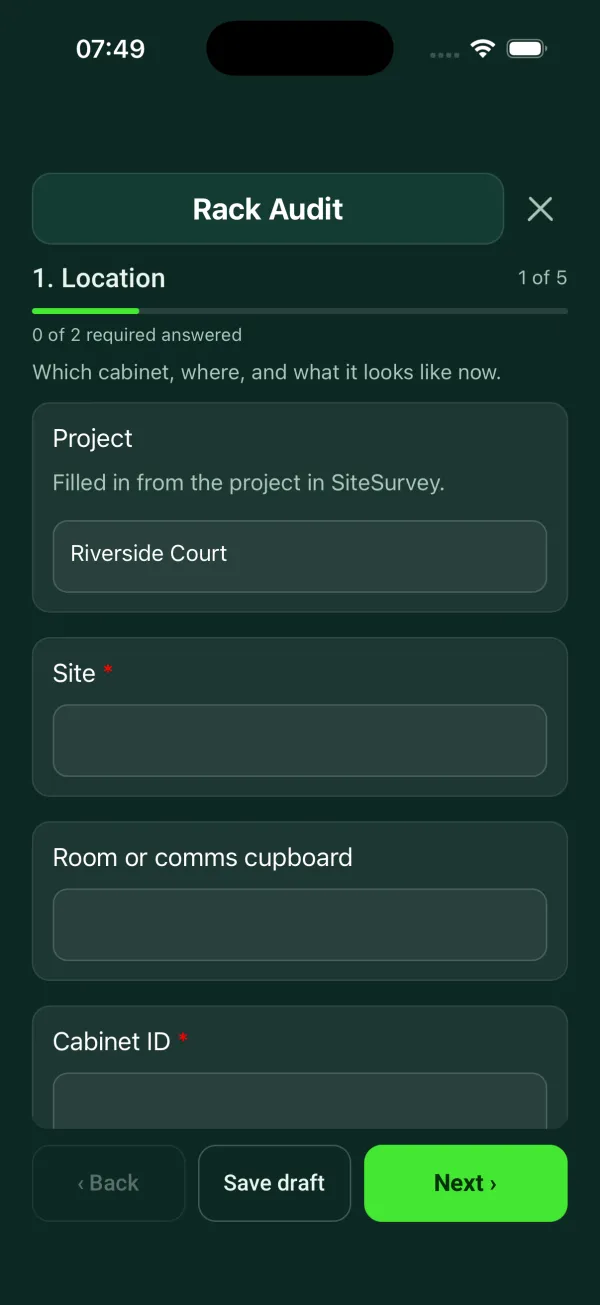
The Rack Audit form in the SiteSurvey app on a phone

Every question in the rack audit template

Cabinet by cabinet audit: equipment by U position, power, cooling, labelling, cable management. 5 sections and 50 questions. Follow-up questions and guidance appear only when an answer calls for them, so the person on site never sees the ones that do not apply.

Make it your own: every question is editable

This is a starting point, not a fixed form. Once it is in your SiteSurvey account you can reword any question, add or remove questions, sections and answer options, and add your own logo, so it fits the way your team works and the jobs you do.

Details you only enter once

Add this form to a project in SiteSurvey and it fills in what the project already knows, so nobody on site retypes it and every form on the job uses the same names. Anything filled in can still be changed.

  • Project: the project name
  • Client: the project's customer
  • Site address: the site address, from the space or the project
  • Site: the site, when the form is opened for a space or a product

Location

Which cabinet, where, and what it looks like now.

  • ProjectShort answer

    Filled in from the project in SiteSurvey.

    Fills in from the project name
  • ClientShort answer
    Fills in from the project's customer
  • Site addressShort answer
    Fills in from the site address, from the space or the project
  • Site*Short answer
    Fills in from the site, when the form is opened for a space or a product
  • Room or comms cupboardShort answer
  • Cabinet ID*Short answer
  • Rack size (U)Number
  • Cabinet lockChoose one
    • Locked
    • Lockable, found unlocked
    • No lock
  • Photos of the front, doors openPhotos
  • Photos of the backPhotos

Equipment

One entry for each item, working from the top of the cabinet down.

  • GuidanceMost cabinets number U1 at the bottom. Check the numbers on the rails before you start and record the lowest and highest U an item takes, for example 38 to 39.
  • Equipment
    Repeat for each item. Each one asks:
    • U positionShort answer
    • Height (U)Number

      How many U it takes, for example 2 for 38 to 39.

    • DeviceChoose one
      • Patch panel
      • Fibre patch panel
      • Network switch
      • Router or firewall
      • Server
      • Storage or NAS
      • NVR or DVR
      • UPS
      • PDU
      • Shelf
      • Cable manager or brush panel
      • Blanking plate
      • AV matrix or processor
      • Amplifier
      • Other (describe)
    • Make and modelShort answer
    • Labelled?Yes or No
    • Powered on?Yes or No
  • Items recordedWorked out by the form
  • Items with no labelWorked out by the form
  • U usedWorked out by the form
  • U freeWorked out by the form
    Shown only when the answers above make it relevant
  • Space used (%)Worked out by the form
    Shown only when the answers above make it relevant
  • WarningMore U recorded than the cabinet has. Check the rack size and each item’s height.
    Shown only when the answers above make it relevant
  • CheckOver 90% of the cabinet is used. Plan where new equipment will go before it arrives.
    Shown only when the answers above make it relevant

Power and cooling

How the cabinet is fed, and whether it is running cool.

  • Number of PDUsNumber
  • PDU rating (A)Number

    From the label on the PDU or its supply.

    Shown only when the answers above make it relevant
  • Highest PDU reading (A)Number

    The highest current shown on any PDU display or clamp meter reading.

    Shown only when the answers above make it relevant
  • Highest PDU load (% of rating)Worked out by the form
    Shown only when the answers above make it relevant
  • CheckAbove 80% of the PDU rating. Balance the load or add a feed before adding equipment.
    Shown only when the answers above make it relevant
  • Is there a UPS?Yes or No
  • UPS status on the displayChoose one
    • Normal
    • On battery
    • Alarm or fault showing
    Shown when “Is there a UPS?” is Yes
  • WarningThe UPS was on battery or showing a fault at the visit. The site contact was told, because the cabinet could lose power without warning.
    Shown only when the answers above make it relevant
  • UPS load on the display (%)Number
    Shown when “Is there a UPS?” is Yes
  • Runtime on the display (minutes)Number
    Shown when “Is there a UPS?” is Yes
  • Runtime the site needs (minutes)Number

    From the site standard or the customer, for example time to shut down cleanly.

    Shown when “Is there a UPS?” is Yes
  • CheckUPS load above 80%. There is little headroom, and the runtime will be short.
    Shown only when the answers above make it relevant
  • WarningRuntime is shorter than the site needs. Check the batteries and the load.
    Shown only when the answers above make it relevant
  • Is dual-corded equipment fed from two different PDUs?Yes or No
  • Load notesNotes

    PDU readings, overloaded strips, daisy-chained extensions.

  • Temperature at the front of the cabinet (°C)Number
  • Temperature at the back of the cabinet (°C)Number
  • Rise front to back (°C)Worked out by the form
    Shown when “Temperature at the front of the cabinet (°C)” is answered and “Temperature at the back of the cabinet (°C)” is answered
  • CheckThis is above 27 °C, the top of the recommended range for air going into IT equipment in ASHRAE TC 9.9, Thermal Guidelines for Data Processing Environments (5th edition, 2021), which recommends 18 to 27 °C at the equipment inlet. Check the room cooling and anything blocking the airflow.
    Shown only when the answers above make it relevant
  • Cabinet fansChoose one
    • Working
    • Not working
    • No fans fitted
  • Are empty U spaces fitted with blanking plates?Yes or No

Cabling

Patching, labels and cable management.

  • Is the patching tidy?Yes or No
  • Does the labelling meet the site standard?Yes or No
  • Cable managementRating 1 to 5 (Poor to Very good)
  • Checks needing actionWorked out by the form
    Shown only when the answers above make it relevant
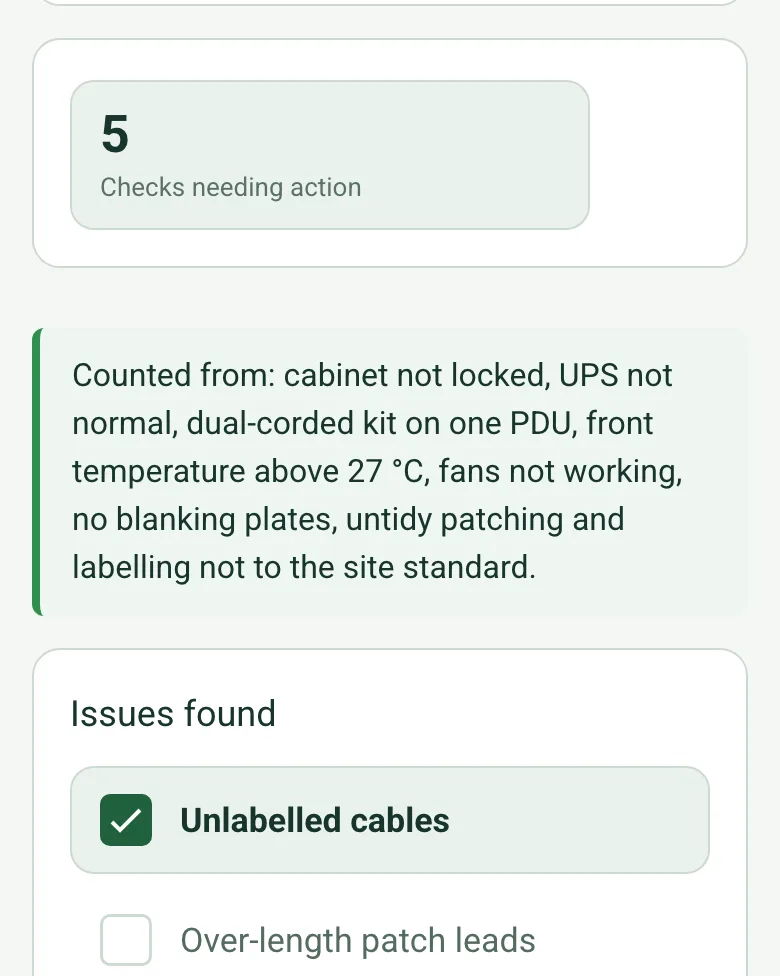
  • GuidanceCounted from: cabinet not locked, UPS not normal, dual-corded kit on one PDU, front temperature above 27 °C, fans not working, no blanking plates, untidy patching and labelling not to the site standard.
    Shown only when the answers above make it relevant
  • Issues foundTick all that apply
    • Unlabelled cables
    • Over-length patch leads
    • Cables blocking airflow
    • Tight bends or crushed cables
    • Loose or unsupported cables
    • Redundant cables left in place
    • Doors cannot close
    • Power and data not separated
    • Other (describe)
  • Photos of the issuesPhotos
    Shown when “Issues found” is answered
  • Action neededNotes
    Shown when “Issues found” is answered
  • Who will do this?Short answer
    Shown when “Issues found” is answered
  • By when?Date
    Shown when “Issues found” is answered

Auditor sign-off

  • NameShort answer
  • DateDate
  • Auditor signatureSignature
  • Site contact told of the findingsShort answer

See it filled in

A completed rack audit report, made by SiteSurvey from a fictional site visit: every answer, the photos, the guidance that applied and the sign-off, ready to send as a PDF.

See completed form (PDF) ↗

Rack audit FAQs

Which way are rack units numbered?

Most cabinets number U1 at the bottom, but check the numbers on the rails before you start. Record the lowest and highest U an item takes, for example 38 to 39, and its height in U. The form counts the items recorded, how many have no label, and the U used and free in the cabinet.

What temperature should a server rack be?

The form warns when the temperature at the front of the cabinet is above 27 °C, the top of the ASHRAE recommended range for air going into IT equipment. If it is, check the room cooling and anything blocking the airflow. The form also records whether the fans work and whether empty U spaces have blanking plates.

What does the audit check on power?

It records the number of PDUs, the PDU rating and the highest reading, whether there is a UPS, what its display shows, its load and runtime, and whether dual-corded equipment is fed from two different PDUs. The form flags a PDU above 80% of its rating and a UPS runtime shorter than the site needs. If the UPS is on battery or showing a fault, the report notes that the site contact was told, because the cabinet could lose power without warning. Load notes cover PDU readings, overloaded strips and daisy-chained extensions. The Electricity at Work Regulations 1989 require electrical systems to be maintained so as to prevent danger, so far as reasonably practicable.

What cabling issues does it look for?

Unlabelled cables, over-length patch leads, cables blocking airflow, tight bends or crushed cables, loose or unsupported cables, redundant cables left in place, doors that cannot close, and power and data not separated. Ticking any issue opens photos, the action needed, who will do it and by when. Cable management is also given an overall rating out of 5.

Why does the audit record whether the cabinet is locked?

Servers and network equipment can give access to the data an organisation holds. The ICO's guidance on data security includes physical measures such as the quality of doors and locks and how access to premises is controlled. The form records locked, lockable but found unlocked, or no lock, with photos of the front and back.

Does it work in a comms room with no signal?

In the SiteSurvey app, yes. The form works offline and syncs when the device is back online. Each record covers one cabinet, identified by site, room and cabinet ID, and ends with the auditor's signature and the site contact told of the findings.

Related

Use this rack audit form with your team

Add it from the form library in one click, change any question, and every completed form becomes a branded PDF report.

Start your trial →